


Nassau is compact enough that you can cross New Providence Island by car in under an hour, but where you stay still shapes your entire trip. Beach quality, taxi costs, restaurant options and how long it takes to get back to your room after a day of sightseeing or cruising all depend on your base. This guide walks through Nassau’s main areas on New Providence, compares signature resorts with smaller hotels and apartments, and highlights how location influences your budget just as much as the nightly room rate.
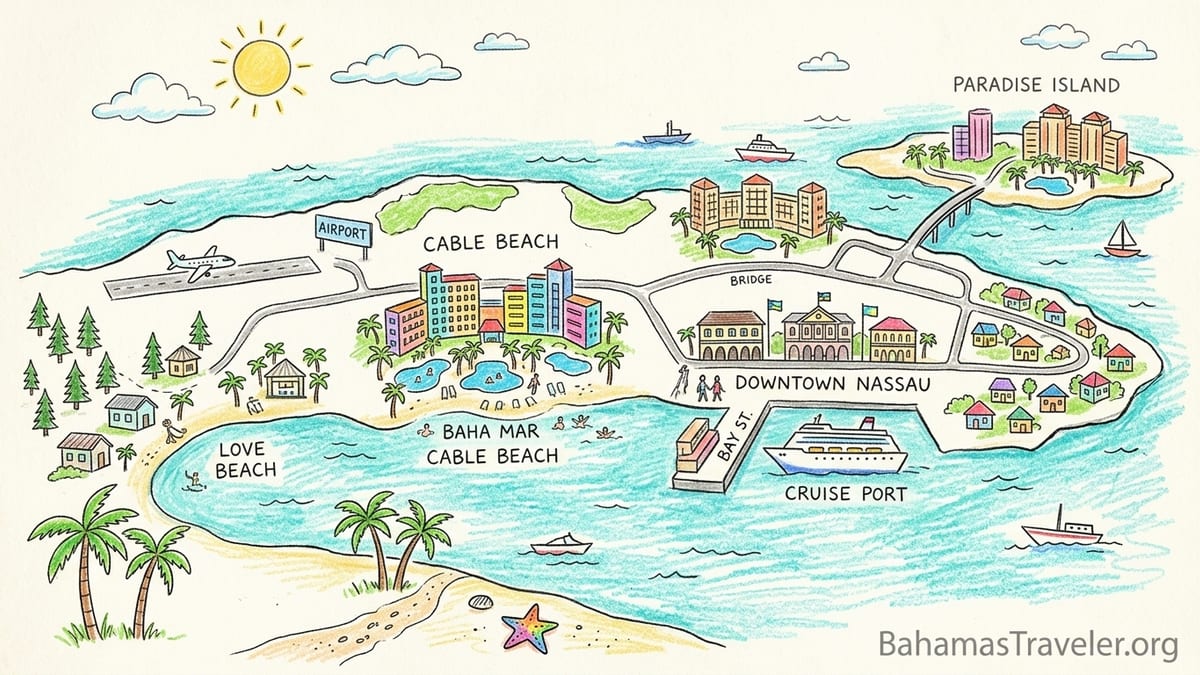
Understanding Nassau’s Neighborhoods on New Providence
New Providence is the island that holds Nassau, Lynden Pindling International Airport and most of the hotels visitors use for a Bahamas vacation. Paradise Island, where Atlantis and several other large resorts sit, is a separate smaller island across the bridge from Downtown Nassau, so it is not covered in detail here. When you search for accommodation, pay attention to whether a hotel is on New Providence or Paradise Island, since taxi times, restaurant options and beach access differ quite a bit between the two.
The core visitor areas on New Providence run west to east along the island’s north shore. Closest to the airport is the western coastline, including Love Beach and Gambier, which is quieter and mostly low rise. Moving east you reach Cable Beach, a long strip of sand and the island’s classic resort district. Farther east is Downtown Nassau, centered around the cruise port, Bay Street and Rawson Square. Beyond the city center, central and eastern New Providence become primarily residential, where you will mostly find independent apartments, guesthouses and locally focused neighborhoods.
Choosing between these areas comes down to your priorities. If you want a self-contained luxury resort with multiple pools, restaurants and a big beach, Cable Beach is usually the first place to look. If you care about walking to the cruise port, museums, rum shops and local eateries, Downtown makes more sense. Travelers who want a quiet base near the airport often favor the western shore, while those planning longer stays sometimes prefer an apartment in a local neighborhood, accepting that they will rely more on taxis or rental cars.
Taxi pricing is an important part of that calculation. As of late 2026, the airport’s published standard fares are about 29 US dollars to Cable Beach and 36 US dollars to Downtown Nassau for the first two passengers, with supplements for additional riders and late-night service. Those fixed costs can make an inexpensive apartment on the far eastern side of New Providence less of a bargain once you factor in transport to beaches, restaurants and tours.
Downtown Nassau: Best for Cruise Port Access and Sightseeing
Downtown Nassau works best for first-time visitors focused on history, shopping and day trips, or for cruise passengers who want a hotel before or after sailing. You can walk from many hotels to the cruise terminal, the Queen’s Staircase, the John Watling’s Distillery area, the Straw Market and government buildings in minutes. Bay Street and the adjacent lanes hold jewelry shops, duty-free boutiques and a growing handful of cafes and bars that stay open after the ships depart.
The flagship property in this area is the British Colonial Nassau, which reopened after a complete renovation and remains the only sizable beachfront hotel directly in Downtown. The hotel stands on its own sheltered stretch of sand just off Bay Street, giving you private-beach access within a short walk of the cruise docks and city attractions. Recent booking channels list a nightly hotel fee of about 49 to 68 US dollars per room, subject to local value-added tax and service charges, which covers amenities such as enhanced Wi-Fi, non-motorized water sports, fitness center access and beach facilities. Room-only rates for a standard city-view room often start in the low to mid 300s in US dollars outside peak holiday periods, and climb higher for harbor or ocean views.
Next door, Margaritaville Beach Resort Nassau blends a modern high-rise tower with a marina, small on-site water park and multiple casual dining outlets. The property operates on an a la carte basis rather than an all-inclusive plan, so you pay separately for meals and drinks. The resort charges a daily resort fee of about 68 to 75 US dollars per room before tax, which includes access to its Fins Up water park, non-motorized water sports, beach amenities, fitness center and Wi-Fi. Promotional offers have advertised room rates from roughly 200 US dollars per night for certain categories during low-demand periods, but realistic high-season pricing for an ocean-view room is often closer to the mid 400s or higher once taxes and the resort fee are added.
For travelers comparing Downtown to other parts of New Providence, two costs stand out. First, restaurant pricing in central Nassau reflects a mix of tourist-oriented menus and local spots. You can find simple plates of peas and rice, conch fritters or grilled chicken in the 15 to 25 US dollar range at local cafes, but waterfront venues or international restaurants often charge 30 to 50 US dollars per main course. Second, the absence of an all-inclusive option in the immediate Downtown area means your final bill will depend heavily on how often you eat in hotel restaurants versus nearby casual spots. That makes Downtown ideal for travelers who enjoy trying different places on foot and want quick taxi or bus access to other parts of the island.
Cable Beach: Luxury Resorts, Swimming and All Inclusive Ease
Cable Beach has been Nassau’s main resort strip for decades, and it remains the easiest base on New Providence for travelers who want a classic beach hotel experience with a good balance of comfort, swimming and dining options. The shoreline is a long, gently curving stretch of pale sand with typically calm, shallow water that suits casual swimmers and children on normal weather days. The area is roughly 15 minutes by taxi from Lynden Pindling International Airport under light traffic and about the same distance from Downtown.
The largest single complex on New Providence is Baha Mar on Cable Beach, which combines three distinct hotels around a shared casino, water park, golf course and more than 40 dining outlets. Grand Hyatt Baha Mar forms the central and largest section, with over 1,800 rooms and suites positioned around multiple pools and direct access to the Baha Bay water park. To the west sits SLS Baha Mar, with a more adults-focused, nightlife-oriented feel, and to the east is Rosewood Baha Mar, the smallest and most upscale of the three. Guests of any of the Baha Mar hotels have access to Baha Bay water park and the complex’s pools and restaurants, although certain cabanas and clubs carry extra fees.
Current information from resort and booking sources indicates that Baha Mar properties apply a daily resort fee to each room in addition to the base nightly rate, with amounts varying by brand and room type but often landing around 60 to 80 US dollars per night before tax. That fee typically includes Wi-Fi, local calls, certain resort activities and access to shared facilities like the water park. Guest reviews in 2026 consistently praise the variety of pools and the quality of the beach, along with kid-friendly scheduling such as crafts, face painting and outdoor movie nights. Criticisms focus mainly on the overall cost of food and drink, where casual poolside meals and cocktails can easily push a family’s daily spending into the hundreds of dollars if they remain on property for every meal.
On the eastern edge of Cable Beach, Breezes Bahamas offers a simpler, older-style resort that is fully all inclusive. Breezes advertises that its rates cover all meals at several restaurants, unlimited drinks at multiple bars, pool and beach access, land sports, entertainment, Wi-Fi and all taxes and gratuities, with no separate resort fee. That flat pricing makes Breezes popular with travelers who want predictable costs and do not need the brand-new feel or extensive amenities of Baha Mar. Recent promotional packages for Breezes have shown nightly rates that, when averaged over common three to five night stays, often come out significantly lower than booking a room-only property and paying separately for food and drinks along Cable Beach.
Goldwynn Resort & Residences, situated on a quieter stretch near the eastern end of Cable Beach, positions itself as a luxury boutique alternative. With a smaller key count than the major resorts, it emphasizes apartment-style suites, refined decor and a relaxed pool scene right on the sand. Public rate calendars in 2026 often show entry-level studio or one-bedroom units starting in the high 400s to 600s in US dollars per night outside peak holidays, plus taxes and a nightly resort fee, which may run in the 50 to 70 US dollar range according to contemporary booking summaries. Goldwynn tends to appeal to couples and longer-stay guests who want a self-contained unit with kitchen facilities, but who still value on-site service, housekeeping and a restaurant level that feels more intimate than a mega resort.
The Western Shore and Love Beach: Quiet Stays and Airport Convenience
West of Cable Beach, New Providence’s north coast becomes much less developed, with small clusters of homes, beach bars and a handful of modest hotels and apartment-style properties. The highlight for many repeat visitors is Love Beach, a relatively low-key stretch of sand with offshore reefs and a mix of public and private access points. From Lynden Pindling International Airport, the drive to most Love Beach accommodations often takes less than 10 minutes in normal traffic, making this area particularly convenient for late arrivals and early departures.
Compared to Cable Beach and Downtown, the western shore has far fewer full-service hotels. Instead, travelers will find small independent guesthouses, beach cottages and vacation rentals. Nightly rates can be appealing at first look, and it is not unusual to see apartments in the 150 to 250 US dollar range per night in shoulder seasons. Many of these units include kitchenettes or full kitchens, which helps offset food costs if you are willing to cook breakfast or simple dinners. Beach access varies widely, so it is important to check whether a property is truly beachfront, across a road, or a few blocks inland.
This quiet, residential feel comes with trade-offs. Dining choices within walking distance of most western shore accommodations are limited to a small number of beach bars and local eateries. After dark, sidewalks are patchier than in Cable Beach or Downtown, and street lighting can be inconsistent. Guests without rental cars will rely on taxis or the local bus system, known as jitneys, to reach supermarkets, larger restaurants and attractions across the island. A single round-trip taxi journey from a Love Beach apartment to downtown or Cable Beach for dinner can easily add 50 to 70 US dollars to the day’s expenses for a couple, which starts to erode any savings from a lower nightly rate.
Still, for travelers who prioritize peace and do not mind a more self-sufficient style, the western shoreline offers good value. Couples who spend most of the day snorkeling or working remotely from their balcony may prefer a small apartment here over a busy resort complex. Families with older children who are comfortable with quieter evenings also find the area appealing, especially if they rent a car and plan to explore more remote beaches or inland attractions around New Providence.
Central and Eastern New Providence: Independent Apartments and Local Life
Moving south and east from Downtown, Nassau quickly shifts from a tourist-focused waterfront to residential neighborhoods. These central and eastern districts of New Providence rarely appear in traditional resort brochures, but they have become significant in online short-term rental listings. Here you are likely to find upstairs apartments in family homes, compact gated communities or small blocks of modern condos along main roads like Prince Charles Drive and Eastern Road, rather than beachfront hotels.
Room rates in these areas often look attractive, particularly for longer stays. A one-bedroom apartment might list for 120 to 200 US dollars per night depending on season, with further discounts available for week-long bookings. Some landlords bundle utilities, Wi-Fi and weekly housekeeping into the price, while others charge extra cleaning fees ranging from roughly 50 to 150 US dollars per stay. Unlike the major resorts, these independent properties generally do not charge separate resort fees, but local taxes may still be applied through booking platforms or at check in.
The catch is transportation and daily living costs. Central and eastern New Providence do not have direct beach access in most spots, and public beaches on the north shore require at least one taxi or a changing bus route. For example, a traveler staying in eastern Nassau who wants to swim at Cable Beach might pay a taxi around 30 to 35 US dollars each way, or more in heavy traffic or late at night. If you repeat that trip several times during a three- or five-night stay, the combined taxi fares can quickly surpass what you saved by not booking a beachfront hotel. Dining also becomes more car dependent, since many of the better-known restaurants cluster along the north shore and in Cable Beach or Downtown.
These neighborhoods are best suited to visitors who already know Nassau, or who are comfortable navigating local shops and food options. You may find excellent value in small takeout spots, supermarkets and bakeries where prices are lower than resort restaurants. However, first timers often underestimate how tiring it can be to arrange taxis for every outing. Over a seven-night stay, an apartment that begins at 150 US dollars per night without a car can effectively feel closer in cost to a 250 to 300 US dollar hotel once daily taxis to beach clubs, tours and restaurants are added.
Comparing Hotels and Locations by Traveler Type
Matching Nassau’s areas to your travel style helps narrow the options. Couples who want a mix of beach time and dining tend to gravitate toward Cable Beach or the western edge of Downtown. A pair who can afford it and enjoys resort amenities might split a five-night trip between three nights at a Baha Mar hotel and two nights at British Colonial or Margaritaville in Downtown, experiencing both the resort environment and the city’s historic core. Those seeking a quieter, boutique stay with good beach access and stylish design often look closely at Goldwynn on Cable Beach or smaller independent hotels along the western shore.
Families often place the highest value on pool quality, on-site dining and minimizing logistics. For them, Baha Mar’s combined water park and beach setup is a strong draw. Grand Hyatt Baha Mar in particular receives frequent positive feedback from families for its wide range of pools, shallow areas for younger children and scheduled kids’ activities. Breezes’ straightforward all-inclusive model on Cable Beach is another practical option for families with teens, as long as they are comfortable with an older property and a somewhat simpler room product. Downtown hotels like British Colonial and Margaritaville can work for short stays with children who will enjoy walking around the harborfront and taking half-day excursions, but families should be aware that these properties lean more toward city hotels with beach access rather than self-contained resort worlds.
First-time visitors without a rental car need to think carefully about how they will get around. Cable Beach offers perhaps the most balanced mix of factors, with good swimming, a concentration of resorts, and easy taxi or jitney access to Downtown. Staying in Downtown itself makes it simple to join harbor tours, visit museums and browse shops on foot, but you will depend on taxis or buses for the island’s best swimming beaches. The western shore and eastern neighborhoods, by contrast, may feel remote if you are not already comfortable in Nassau, since walking infrastructure and public transport information are more limited.
Luxury travelers who prioritize privacy, service and space often narrow their search to Rosewood Baha Mar or high-category suites at SLS and Grand Hyatt, or to boutique-style properties such as Goldwynn. At this level, beach access and pool quality are nearly a given, so distinctions hinge on atmosphere and service style. Guests who prefer a classic colonial setting within the city sometimes choose British Colonial’s upper room categories facing the harbor, combining a historic ambience with walkability to Nassau’s restaurants and bars.
Travelers without rental cars also need to account for airport transfers. With the airport’s set fares of around 29 US dollars to Cable Beach and 36 US dollars to Downtown for up to two people, and similar pricing for the return journey, a couple staying four nights in either area should budget at least 120 to 150 US dollars for taxis just for arrival and departure. Those costs are higher for eastern or southern neighborhoods with longer drives, which is one reason budget travelers often favor central Cable Beach or the western shore where ride times are shorter.
How Location and Fees Affect Your Real Trip Cost
Nassau’s published hotel rates rarely tell the full story of what your stay will cost. Most larger resorts on New Providence charge nightly resort or hotel fees on top of room rates. For example, both British Colonial and Margaritaville list daily per-room charges in the roughly 50 to 75 US dollar range that apply regardless of whether you use all included amenities. Baha Mar properties follow a similar pattern, with nightly fees that cover Wi-Fi, local calls, certain resort activities and facility access. These charges are also subject to value-added tax and a mandatory service charge, which means the final bill is noticeably higher than the base rate suggests.
All-inclusive properties approach this differently. Breezes on Cable Beach advertises that there are no resort fees and that all taxes, gratuities, meals and standard drinks are built into the upfront price. That does not necessarily make it cheaper in every scenario, but it does provide certainty. A couple who books a four-night all-inclusive stay at Breezes and spends their days on the beach or at the pool knows that only optional extras such as spa treatments or private beach cabanas will add meaningfully to their bill. In contrast, a couple paying 350 US dollars per night at a non-inclusive resort might find that after adding a 60-plus US dollar resort fee, taxes, and buying three restaurant meals and drinks daily, their effective cost per night feels more like 600 to 700 US dollars.
Independent apartments and guesthouses usually skip resort fees, but instead apply one-time cleaning charges. For instance, some managed condo units in the Downtown and western areas levy cleaning fees of around 200 to 250 US dollars per stay for one- to six-night bookings. If you stay three nights, that fee alone adds over 60 US dollars per night to the advertised rate once it is spread across the stay. Longer stays of seven nights or more absorb that cost more efficiently, so apartments typically become much better value for week-long trips than for short getaways.
Taxi and dining costs can transform a seemingly affordable apartment into a more expensive choice. Imagine a couple paying 180 US dollars per night for a three-night stay in eastern New Providence with a 120 US dollar cleaning fee. Their effective nightly rate is already 220 US dollars once the fee is divided across the stay. Add round-trip taxis to Cable Beach or Downtown at 60 to 70 US dollars per day, plus restaurant meals that total 150 to 200 US dollars daily, and the couple quickly approaches a real-world daily cost similar to entry-level rooms at midrange beachfront hotels that include some amenities and shorter taxi rides.
Beach access and pool quality are another often-overlooked part of the value equation. Properties like Baha Mar, Margaritaville, Goldwynn and British Colonial invest heavily in pools, loungers, beach chairs and water sports gear that guests can use without separate day-pass fees. Some central apartments list “beach nearby” but rely on public stretches of shoreline without services, shade or restrooms. In practical terms, many travelers end up paying for day passes at resorts or beach clubs to enjoy umbrellas, chairs and safe swimming areas, which further narrows the cost gap between resorts and independent stays.
Practical Booking Ideas for 3, 5 and 7 Nights
For a three-night stay, convenience usually outruns complex savings strategies. First-time visitors might choose a single base in Cable Beach or Downtown rather than splitting time. A couple planning to focus on resort relaxation could look at Grand Hyatt Baha Mar or Goldwynn, expecting base room rates in the mid 300s to 600s in US dollars per night depending on season, plus nightly resort fees and roughly 20 to 25 percent in taxes and service charges. That kind of short stay is well suited to a non-inclusive plan, since you will likely enjoy sampling different restaurants and bars without needing to calculate the break-even point on an all-inclusive.
Budget-conscious travelers on three nights could instead consider Breezes or a small western-shore apartment. Breezes’ all-inclusive rate can be particularly appealing for long weekends, because airport transfers and any off-property excursions become your only major extras. A Love Beach apartment with an effective nightly rate under 200 US dollars, including cleaning, also makes sense for a short quiet escape, provided you accept one or two evenings of limited nearby dining or are happy to self-cater with groceries.
On a five-night itinerary, there is more room to combine areas. One common pattern is to spend three nights at a resort on Cable Beach, followed by two nights in Downtown to explore the city, visit museums and join harbor tours. For instance, a family might book three nights at Breezes or Grand Hyatt Baha Mar to prioritize pools and beach time, then move to British Colonial for two nights so they can walk to the cruise port, fish fry areas and local shops. Another approach pairs several nights in a modest central apartment with a two-night splurge at a higher-end beachfront hotel, allowing you to enjoy both local life and resort facilities without paying five consecutive nights of high-end prices.
Seven-night stays magnify both the benefits and drawbacks of each location choice. An all-inclusive like Breezes can deliver strong value over a full week, especially for families or groups who eat and drink most meals on property. The absence of resort fees and the inclusion of taxes and gratuities in the upfront price reduce surprises at checkout. For those with a higher budget, seven nights split between two Cable Beach properties, or between Cable Beach and the western shore, can keep the experience fresh. For example, four nights at Grand Hyatt Baha Mar for intense resort time, followed by three quieter nights at a boutique property near Love Beach, gives you both energy and calm in a single trip.
Apartment-style stays tend to shine most on week-long itineraries. The impact of a flat cleaning fee drops as you spread it across seven nights, and the ability to cook breakfast or a few dinners can materially reduce food spending. A well-located studio in Cable Beach or the western shore with a reasonable cleaning fee and walkable beach access can be excellent value for a couple over seven nights. However, if your apartment is far from the coast or from dining, the cumulative taxi costs will be more noticeable over a full week than over a weekend, so location within New Providence still matters as much as the base price.
The Takeaway
Choosing where to stay in Nassau on New Providence is less about finding a universally “best” hotel and more about aligning your base with the way you want to spend your days. Cable Beach suits travelers who want a resort-focused holiday, predictable beach conditions and a good concentration of hotels, from Baha Mar’s mega complex and Goldwynn’s boutique luxury to the all-inclusive simplicity of Breezes. Downtown Nassau works well for cruise-linked stays, history and nightlife, with British Colonial and Margaritaville delivering rare combinations of city location and direct beach or water access.
The island’s western shore and Love Beach appeal to those who prefer quiet, views and quick airport access over endless restaurant choices. Central and eastern New Providence, with their mix of local neighborhoods and independent apartments, can be cost effective for longer visits and repeat travelers who are comfortable managing taxis, buses and grocery runs. Across all areas, resort fees, cleaning charges, airport taxi fares and food pricing often have as much impact on your budget as the headline room rate.
If you are planning your first visit, staying in Cable Beach or Downtown for three to five nights without a rental car is usually the simplest solution, ensuring solid beach or pool access and straightforward transport. For a week or longer, consider combining a resort stay with time in a quieter apartment or smaller hotel once you have your bearings. By weighing not only nightly prices but also beach access, pool quality, transport needs and what you like to do after sunset, you can choose the New Providence base that turns Nassau from a simple stopover into the centerpiece of your Bahamas trip.
FAQ
Q1. Is it better to stay in Nassau on New Providence or on Paradise Island?
Paradise Island, home to Atlantis and other large resorts, offers extensive water parks and themed environments, but it is across the bridge from Downtown. Staying on New Providence, particularly in Cable Beach or Downtown Nassau, gives you easier access to local restaurants, shops, historic sights and the airport, and usually a wider range of price points.
Q2. Which area of New Providence has the best beach for swimming?
Cable Beach is widely regarded as the most consistently good swimming beach on New Providence, with a long sandy shoreline and typically calm, clear water. Love Beach on the western shore is quieter and more natural, but facilities and lifeguard coverage are more limited than at the major Cable Beach resorts.
Q3. How much should I budget for taxis from the Nassau airport to my hotel?
Published standard fares list about 29 US dollars from Lynden Pindling International Airport to Cable Beach and 36 US dollars to Downtown Nassau for the first two passengers, with surcharges for extra people and late-night rides. Hotels farther east or south on New Providence may cost more, so it is sensible to ask your accommodation for an estimated transfer price when you book.
Q4. Do all Nassau hotels charge resort fees?
Many larger resorts on New Providence, including Baha Mar’s hotels, Margaritaville and British Colonial, charge nightly resort or hotel fees on top of room rates. These fees usually cover Wi-Fi, some activities and beach or pool amenities. All-inclusive properties such as Breezes tend not to add a separate resort fee, since taxes, gratuities, meals and standard drinks are already bundled into the main price.
Q5. Is staying in an apartment in Nassau really cheaper than a hotel?
It can be, especially for longer stays, but you must factor in cleaning fees, taxis and dining costs. A low nightly rate in a residential neighborhood may become less attractive once you add daily taxi fares to the beach and restaurants, plus a one-time cleaning charge spread over only a few nights. Apartments closer to beaches or main resort areas usually offer better overall value.
Q6. Which area is best for families with children?
Families usually prefer Cable Beach, where resorts such as Grand Hyatt Baha Mar combine multiple pools, a water park, beach access and several dining options in one place. Breezes can also work well for families with teens because of its all-inclusive structure. Downtown hotels are convenient for sightseeing, but parents often find it easier when daily swimming and kid-friendly activities are available right on the property.
Q7. Where should couples stay for a romantic trip?
Couples often choose boutique or higher-end properties on Cable Beach or the quieter western shore. Rosewood and SLS Baha Mar, Goldwynn Resort and small independent hotels near Love Beach all appeal to travelers seeking stylish rooms, good pools and a relaxed atmosphere. Downtown’s British Colonial can also be a romantic choice for those who enjoy a historic ambience and being able to walk to harborfront bars and restaurants.
Q8. Do I need a rental car to enjoy Nassau?
You do not need a rental car if you stay in Cable Beach or Downtown and plan to focus on beaches, resort pools and city sightseeing. Taxis and local jitney buses cover the main routes. However, if you book accommodation in the western or eastern parts of New Providence, a car can be useful, as taxis become more frequent expenses and public transport is less straightforward for visitors.
Q9. How far in advance should I book Nassau hotels?
For peak periods such as Christmas, New Year, spring break and major US holiday weekends, it is wise to secure your preferred Nassau hotel several months in advance, particularly for popular resorts on Cable Beach. Outside those times, you can often find availability closer to your travel dates, but specific room types, ocean views or boutique properties may still sell out early.
Q10. Are there truly budget options on New Providence for solo travelers?
True budget accommodation on New Providence is limited, but solo travelers can sometimes find value in small guesthouses, modest apartments in residential areas or promotional rates at older beachfront hotels. To keep overall costs down, focus on locations with walkable access to either a good public beach or a concentration of restaurants, which reduces the need for frequent taxis that can quickly erode any savings from a lower nightly rate.