


On a hot, salt-hazed morning in Nassau, I boarded a battered jitney on Blue Hill Road with one goal in mind: to spend a full day at Clifton Heritage National Park, tracing Bahamian history on land and then swimming out to meet Ocean Atlas, the world’s largest underwater sculpture. I wanted more than a beach stop or a quick photo. I wanted to understand how this remote corner of southwestern New Providence holds stories of Lucayan people, plantation-era suffering and modern Bahamian resilience, all framed by coral heads and a concrete girl holding the ocean on her shoulders.
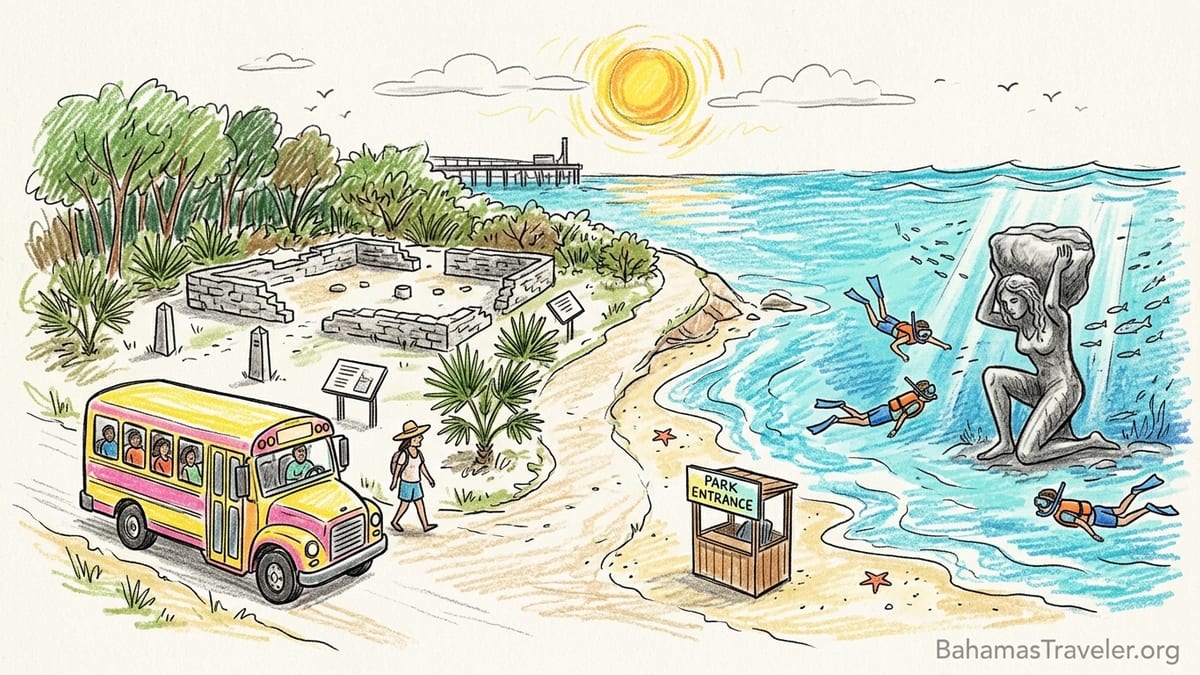
Getting to Clifton from Nassau and Sorting Out Tickets
I started my journey in downtown Nassau, near Rawson Square, where the jitneys fan out across New Providence. To reach the southwestern tip of the island, Clifton Heritage National Park sits roughly 25 kilometers from the city center by road. Taxis cluster around the cruise port and hotels, and several quoted me around 80 to 100 US dollars one way for two people in October 2026, which tracks with recent estimates that a taxi to the park can run close to 100 dollars depending on traffic and bargaining. That felt steep for a solo day trip, so I chose the line 12 jitney instead, which currently runs about 2 to 3 dollars per person for the long ride out west, payable in cash to the driver.
The bus ride itself is part of the experience. We rolled past pastel concrete homes and small churches, then out toward Gambier village and the industrial sprawl near Clifton Pier. Air conditioning is a luxury the jitney does not promise, so the open windows became our ventilation as mid-morning temperatures climbed past 86 degrees Fahrenheit. From Cable Beach or downtown, travelers can expect roughly an hour to an hour and fifteen minutes on the jitney to the stop closest to the park entrance, followed by a short walk along Clifton Pier Road. It is not difficult, but the sun is unforgiving; a wide-brimmed hat and water bottle are not optional.
At the gate of Clifton Heritage National Park, a wooden sign and small booth mark the transition from road noise to bird song. General admission for nonresidents is currently posted at 40 US dollars. This provides entry to the park grounds, access to the beaches and trails, and the ability to explore on your own, but it does not automatically include guided heritage tours or snorkeling. Those experiences are sold as separate products. The official rate for a guided heritage tour is listed at 60 dollars for nonresidents, while the guided snorkeling with gear rental, which covers the underwater sculpture garden including Ocean Atlas, is 75 dollars. Staff at the park strongly encourage verifying which packages include general admission. Some bundled “deluxe” or “premium” experiences sold through partner operators and hotels fold admission and transport into one higher price, while walk-up visitors like me pay à la carte at the park office.
For this visit I paid the 40 dollar nonresident admission plus 60 dollars for the guided heritage tour. I pre-booked the snorkeling session for later in the day at the 75 dollar rate, which included fins, mask, snorkel and a buoyancy vest. Before committing, I asked directly whether the snorkel fee sat on top of the general admission or subsumed it. The staff member clarified that my snorkeling ticket covered the guided water experience and equipment but did not replace the basic park entry fee. Policies can evolve, so anyone planning a trip should double-check what each ticket or tour includes at the time of booking.
Walking Through a Layered Landscape of Bahamian History
The heritage tour met near the visitor center under a shade structure, where our small group gathered with a local guide just after 10 a.m. Clifton Heritage National Park protects roughly 208 acres of coastal coppice, wetlands and rocky shoreline. It is also an archaeological landscape where three eras of Bahamian history meet: the Indigenous Lucayan presence, the Loyalist plantation period after the American Revolution and the communities of formerly enslaved Africans who later built lives nearby. Our guide framed the next two hours as an invitation to move slowly through those layers rather than racing from ruin to ruin.
We began on a sandy path skirting low shrubs and palmettos, the scent of resin and sea carried on the wind. The walking is not technically difficult, but it is exposed, and within fifteen minutes the heat settled like a warm weight on my shoulders. The park advises that the heritage tour involves about one mile of walking over roughly two hours, and that felt accurate. Closed-toe shoes made the uneven limestone and roots more manageable. Along the route, interpretive signs supplement the guide’s stories, but the value of having a person from New Providence tell the history in their own words quickly became clear.
At the site of a former plantation house, only low foundation stones and a few brick features remain, but with the guide’s narration the emptiness became louder than any intact building. He described how Loyalist families, many arriving from the American South in the late 1700s, claimed this remote western headland as a plantation estate while hundreds of enslaved Africans provided the labor. Rather than softening the story for visitors, he stayed with specifics: what crops were attempted in the thin soil, how water cisterns were carved into limestone, where punishments took place and how resistance sometimes manifested in work slowdowns or escapes through the bush.
This part of the tour changed the way I usually move through Caribbean heritage attractions. It did not offer staged re-enactments or glossy soundtracks. Instead, we stood in the glare among half-collapsed stone walls, looking toward the glittering sea, and confronted the contrast between postcard images of the Bahamas and the forced labor that helped finance them. The guide made clear that this was not ancient history sealed off from the present, but a story with descendants and ongoing effects.
The Former Settlement, Sacred Spaces and Coastal Vantage Points
From the plantation core, we walked down toward what remains of the former enslaved settlement area. Small stone outlines mark where cramped dwellings once stood. It is easy for an untrained eye to mistake the ruins for random piles of rock or garden edging. Our guide, however, pointed out doorways, cooking spaces and shared yards. He asked us to imagine these homes full of smoke, voices and small acts of self-determination such as hidden gardens or nighttime gatherings that preserved African traditions beneath the plantation’s official rules.
One of the most moving stops came at a modest memorial space where the park acknowledges those who lived and died on these lands without gravestones bearing their names. Rather than turning this into a photo-op, our guide invited a moment of quiet. Waves crashed faintly against the shore below, and the midday sun pressed down. In that heat, the idea of history as something detached from the body dissolved. I could feel how punishing simple tasks would have been in this climate, and how remarkable survival, community and eventual emancipation were under these conditions.
The path eventually tilted toward the sea, where the bush opened to reveal dramatic coastal cliffs and pocket beaches. From a clifftop vantage point, we looked down at turquoise water shifting in bands from pale aqua over sand to deep cobalt where the shelf drops away. Offshore sat the zone I would later snorkel: the Sir Nicholas Nuttall Coral Reef Sculpture Garden and, within it, Ocean Atlas, the monumental figure created by artist Jason deCaires Taylor. Seeing the area from land first gave me a mental map of where we would enter the water, where the deeper channels lay and how far the swim might feel once waves and current came into play.
By the time we looped back toward the visitor center it was just past noon. The two-hour heritage tour had stretched slightly longer as we lingered with questions, and my water bottle was nearly empty. Clifton’s facilities include restrooms near the entrance, small shaded pavilions and a modest snack area that sometimes offers light bites and cold drinks. I would not rely on the park for a full lunch every day of the week, so I was glad I had packed a simple sandwich and fruit. This pause between the land-based history and the afternoon snorkel became a mental reset, a chance to absorb the stories of the morning before entering the sea where a different form of storytelling waited.
Preparing to Snorkel Ocean Atlas and the Underwater Sculptures
In early afternoon the light turned harsh and almost metallic on the water, but the sea state remained calm enough for our scheduled snorkeling session to proceed. Clifton Heritage National Park runs both guided and self-guided snorkeling, yet for visiting swimmers who are not intimately familiar with local currents, the guided option is the safer and more informative choice. I checked in at the watersports hut near Jaws Beach, a quieter strip of sand on the park’s wild western shore, where our snorkel guide conducted a safety briefing and equipment check.
The 75 dollar guided snorkel fee included mask, snorkel, fins and a buoyancy aid. The gear was basic but serviceable; experienced snorkelers who are particular about fit may prefer to bring their own mask. Our guide asked about each person’s swimming comfort level, emphasizing that while parts of the sculpture garden can be reached from shore, Ocean Atlas itself sits in water around five meters deep, with the top of the sculpture rising closer to the surface depending on tide. That means confident swimmers can view her from above while snorkeling, but touching the seabed or standing on the artwork is both impossible and strictly forbidden.
Conditions can change day by day, so the park does not guarantee access to every sculpture in the garden. On my visit, the sea was relatively flat with mild current, good enough that we could fin out from the beach in a guided group rather than relying on a boat drop. On rougher days, or for certain tour configurations, guides may use a small boat or support vessel to bring visitors closer to the installation. Importantly, the staff did not present the experience as something anyone could casually wander into. They were clear that weaker swimmers should either remain in shallower areas of the garden nearer to shore or skip the deeper swim altogether.
We entered the water from the sand, floating face down in that electric Bahamian blue. Visibility ranged around 10 to 15 meters, slightly milky near shore where waves stirred up the sand but clearer as we moved over darker patches of coral and rock. The guide kept us together, stopping periodically so everyone could rest and re-tighten masks. This was not a race; it was a slow procession toward a submerged figure that had loomed in my imagination long before I saw it with my own eyes.
Meeting Ocean Atlas Beneath the Surface
Ocean Atlas does not appear all at once. At first there was simply a darker shape on the bottom, then the curve of a shoulder, then the unmistakable outline of a kneeling girl holding the weight of something invisible on her back. Created by British sculptor Jason deCaires Taylor and installed in 2014, the piece is widely described as the largest single underwater figurative sculpture in the world. From the surface, snorkelers see her as a ghostly form framed by wavering shafts of light. Freedivers and scuba divers who descend closer encounter the textured details: the braids in her hair, the rough concrete skin designed to host marine life.
I hovered above on my buoyancy vest, looking down as small schools of fish flickered around her arms. The scale is difficult to process. Ocean Atlas stands around five meters tall and rests at about the same depth, which means she nearly fills the water column. On my visit the tide placed the top of her back a few meters below the surface, close enough that stronger swimmers in the group could make short dives down and still return to the surface with air to spare.
For me, a competent but not elite swimmer, the distance from shore combined with the steady pull of current demanded focus. This is not the right excursion for someone who feels anxious in open water, fatigues quickly or is traveling with small children who cannot yet handle a sustained finning effort. Several of the shallower sculptures in the Sir Nicholas Nuttall Coral Reef Sculpture Garden, located closer to Jaws Beach, are more accessible to cautious snorkelers. Trying to reach everything in one outing is unnecessary.
Fish life around the installation on my visit included sergeant majors, blue tangs and a few solitary parrotfish chewing methodically on nearby coral heads. The sculpture is intentionally placed to act as an artificial reef, and over the years algae, sponges and small invertebrates have begun to colonize its surfaces. Peering down, I felt a tension similar to what I experienced at the plantation ruins. Ocean Atlas is beautiful and photogenic, but she also carries a loaded metaphor: a Bahamian girl literally bearing the burden of the sea in a nation reckoning with climate change, coral bleaching and coastal vulnerability. Any impulse to treat her simply as a backdrop for social media selfies faded as I floated there, lungs matching the rise and fall of the small surface swell.
Heat, Effort and the Realities of a Full-Day Visit
By the time we turned back toward shore, I had been in the water for about 50 minutes and on site at Clifton Heritage National Park for roughly six and a half hours. The complete visit, including transport, stretched close to nine hours. That duration matters when planning. Combined with the morning’s walking tour, the experience is immersive but physically demanding. The sun reflected off the sea and limestone amplified the heat, and I was grateful I had started with an early heritage tour rather than attempting it at the peak of the afternoon.
On land, terrain ranges from flat sandy paths to mild inclines and uneven limestone outcrops. For travelers with limited mobility, the full heritage loop could feel strenuous, particularly on hotter days. Some vantage points near the plantation ruins and coastal overlooks require negotiating steps or rocky sections. The park’s basic facilities are comfortable but not luxurious: functional restrooms at the entrance, simple outdoor showers near the beach to rinse off salt, a few picnic tables and shaded gazebos. There is no vast visitor complex or air-conditioned museum hall to retreat into, so visitors should bring what they need for a full day outdoors, including sunscreen that is as reef-friendly as possible.
Photography conditions varied across the day. On the heritage walk, late-morning light offered strong contrasts but also deep shadows among trees and ruins. A basic smartphone camera handled it, yet serious photographers might prefer the softer light of early morning or late afternoon for capturing the plantation walls and settlement outlines. Underwater, midday sun helped illuminate Ocean Atlas and the surrounding sculptures, though the surface glare can be intense. A simple polarized filter or the strategic use of your own shadow can reduce reflections when shooting from the surface. Most importantly, the guides encouraged us to take photos as long as we maintained respectful distance from both the artworks and the natural reef.
Educationally, the combination of on-land interpretation and underwater art created a throughline that surprised me. The heritage guide’s discussion of forced labor, maritime routes and environmental change echoed again in the snorkel briefing, where the focus shifted to reef conservation and the role of artificial structures like Ocean Atlas in drawing attention to human impacts on the sea. By the end of the day, Clifton felt less like a collection of unrelated attractions and more like a single landscape where history, ecology and contemporary Bahamian identity were in constant conversation.
Is Clifton Best for History, Snorkeling or Both?
As the jitney carried me back toward downtown Nassau in the late afternoon, my shoulders tight from sun and swimming, I tried to decide whether Clifton Heritage National Park worked better as a historical visit, a snorkeling destination or a blend of both. In practice, the answer depends on the traveler and on the day’s conditions. For visitors who are deeply curious about Bahamian history, willing to walk in the heat and comfortable engaging with difficult subjects like slavery and colonialism, the guided heritage tour alone justifies the journey. It offers context many beachgoers never encounter and reframes New Providence as more than resorts and cruise terminals.
For strong swimmers and ocean lovers, the snorkeling adds another dimension. Meeting Ocean Atlas in person and exploring the surrounding sculpture garden transforms brochures and online images into something embodied and fleeting. Yet I would hesitate to recommend the deeper swim to Ocean Atlas for every visitor. Those with limited swimming ability, a fear of open water, significant mobility challenges or very young children may find greater enjoyment in the shallower parts of the reef or in simply relaxing on Jaws Beach after a land-based tour.
If I had to choose only one component on a return trip, I would prioritize the heritage tour. The Bahamian guides’ storytelling, grounded in local knowledge and family histories, is not easily replicated elsewhere. I could imagine spending a second visit focusing on less explored corners of the park: birdwatching in the wetlands, revisiting the settlement site at a different time of day or joining a specialized cultural tour if offered. However, if conditions were calm and I felt fully rested, I would absolutely book another guided snorkel, perhaps requesting a slightly extended route to spend more time among the secondary sculptures rather than rushing straight to Ocean Atlas.
Ultimately, Clifton Heritage National Park rewards those who treat it not as a quick “see the statue and leave” stop, but as a place to spend most of a day. Its power lies in the way it insists that Bahamian stories are written in limestone blocks, in unmarked graves, in the posture of a concrete girl beneath the waves and in the living reefs trying to grow on her shoulders.
FAQ
Q1. How much does it cost to visit Clifton Heritage National Park?
The current posted nonresident general admission is about 40 US dollars. Guided heritage tours are listed at 60 dollars, and guided snorkeling with rental equipment at 75 dollars. Some packages sold through tour operators may bundle transport and admission, so visitors should confirm inclusions at the time of booking.
Q2. How do I get to Clifton Heritage National Park from Nassau or Cable Beach?
From downtown Nassau or Cable Beach you can take a taxi, which typically takes around 25 to 30 minutes each way and can cost close to 80 to 100 dollars, or ride the line 12 jitney, which costs roughly 2 to 3 dollars per person and takes about an hour to an hour and fifteen minutes, followed by a short walk to the park entrance.
Q3. Is the guided heritage tour worth the extra cost?
For travelers interested in Bahamian history, the guided heritage tour adds substantial value. It provides context on Lucayan presence, Loyalist plantation life and the experiences of enslaved Africans that you are unlikely to gain by walking the trails alone. The tour also helps interpret ruins and memorial sites that can otherwise look like simple stone piles.
Q4. How difficult is the walking during the heritage tour?
The heritage tour covers about one mile over two hours on uneven paths with some rocks, roots and mild slopes. It is manageable for most reasonably fit visitors but can feel strenuous in the heat, especially in the middle of the day. Closed-toe shoes, sun protection and water are essential, and travelers with mobility challenges may want to discuss options with the park in advance.
Q5. Can anyone snorkel out to Ocean Atlas from the beach?
No. While it is possible to reach the Ocean Atlas sculpture from shore on calm days, the swim involves deeper water, variable currents and a distance that requires solid swimming ability. The park recommends guided snorkeling for safety and does not portray the experience as suitable for all visitors. Those who are not confident in open water should stay in shallower areas of the sculpture garden or skip the deeper swim.
Q6. Do I need to bring my own snorkel gear?
Guided snorkeling packages at Clifton Heritage National Park include mask, snorkel, fins and a flotation aid as part of the 75 dollar fee. However, frequent snorkelers who are particular about fit may prefer to bring their own mask and snorkel. It is still important to verify in advance which specific items are included in your chosen tour product.
Q7. What are water and visibility conditions like for snorkeling?
Conditions vary with weather and tides. On many days visibility ranges around 10 to 15 meters, with clearer water over the reef and a bit more cloudiness near shore where waves stir up sand. Seas can be calm or choppy, and strong winds or swell may limit access to some sculptures or cause tours to be rescheduled for safety.
Q8. How long should I plan to spend at Clifton Heritage National Park?
A combined heritage tour and guided snorkel can easily fill six to seven hours on site, and when you add transport time from Nassau or Cable Beach, the outing can occupy most of a day. Travelers who only do the heritage tour should still plan for at least half a day to allow for walking, rest breaks and time at the beach or viewpoints.
Q9. Are there food and drink options at the park?
Clifton Heritage National Park has basic facilities, and there may be limited snacks and drinks available near the entrance or beach areas, but visitors should not rely on a full-service restaurant being open at all times. Bringing water, light snacks and perhaps a simple packed lunch is a sensible approach, especially for longer visits.
Q10. Is Clifton Heritage National Park suitable for children and older travelers?
The park can be rewarding for families and older visitors, but thoughtful planning is important. Children who enjoy stories and nature may find the heritage tour engaging, yet the walking and heat can be tiring. Older travelers and those with mobility issues may wish to focus on shorter walks, accessible viewpoints and shadier rest areas, and should only consider snorkeling if they are confident swimmers with clearance from their healthcare providers.