


I began my day in Nassau not with a beach towel, but with walking shoes and a notebook. Instead of heading straight for a resort pool or joining the crowds queuing for shore excursions, I stepped off near Prince George Wharf determined to follow my own feet through downtown. My plan was simple: start at the harbor, climb toward the Queen’s Staircase and Fort Fincastle, then loop back through streets where Bahamian history still shows through the pastel paint, the colonial porches and the new murals on cracked concrete.
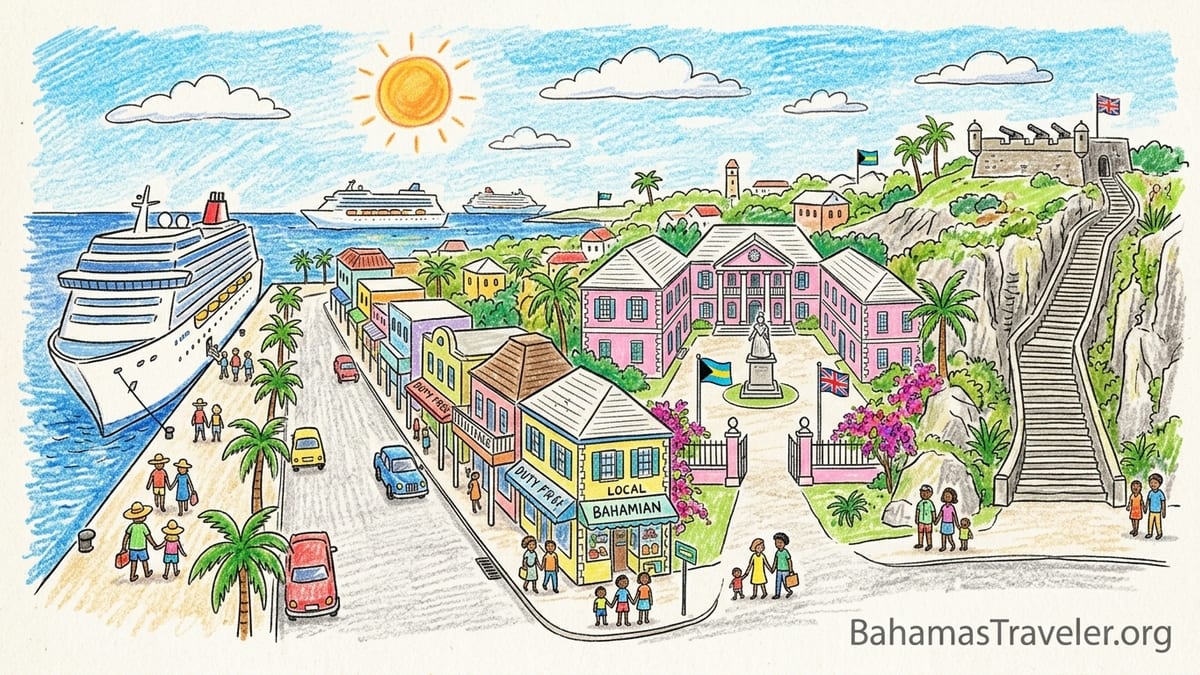
From the Cruise Pier to Bay Street’s First Impressions
Leaving the cruise terminal near Prince George Wharf, I reached Bay Street in barely five minutes of easy walking. The pavement here is busy and flat, with constant traffic and a steady stream of cruise passengers in sun hats. The air smelled faintly of exhaust mixed with fried conch and sunscreen. Crossing the main road required a bit of patience; there are pedestrian lights, but many visitors just follow the locals and cross in small gaps in the traffic. It immediately felt like a working downtown that had learned to live with mass tourism, rather than a strip built only for visitors.
Bay Street is lined with duty-free shops, jewelry chains, souvenir stalls and a few global brands that would not look out of place in Miami. Yet there are also small Bahamian-owned stores selling school uniforms, hair products and everyday household goods. Pausing in front of a narrow storefront selling phone cards and snacks, I could hear a radio talk show discussing local politics, a reminder that this is a capital city first and a cruise port second. The sidewalks are mostly shaded by awnings and balconies, which helped as the late morning sun pushed temperatures above 80 degrees Fahrenheit.
About eight to ten minutes from the pier, walking west along Bay Street at a comfortable pace, the cruise-focused storefronts began to thin and more government buildings appeared. This transition from pure commerce to administration is subtle but important. It is where the story of modern Nassau’s identity shifts from trinkets and duty-free diamonds to questions of power, law and colonial legacy.
Parliament Square and Colonial Facades in Pink and White
Parliament Square is the first place on this route where the architecture demands your attention. After roughly ten to twelve minutes of walking from the cruise terminal, I stepped into a formal space framed by low, cotton-candy pink buildings trimmed in white. These are the House of Assembly and the Senate, flanking a central courtyard that feels almost theatrical in its symmetry. Their style is Georgian-influenced colonial architecture, with shuttered windows and simple columns that speak more to British practicality than Caribbean exuberance.
A statue of Queen Victoria anchors the center of the square, a marble reminder of the monarch whose name appears again later at the Queen’s Staircase. Standing there, I was struck by the quiet. Cars rolled past on Bay Street, but within the courtyard people spoke in low voices and a few office workers crossed diagonally between buildings with files in hand. The square felt like the administrative heart of a small country, not a stage set for tourists, despite the occasional tour group gathering under the shade of the arches.
Looking outward from the square, however, the view turns more contemporary and distinctly Bahamian. Across the road are local banks, law offices and shops with hand-painted signs advertising everything from tailoring to takeout food. Around the side streets leading off Bay Street, new murals have appeared in recent years, painted on the walls of older buildings. One showed a Junkanoo dancer in explosive color, towering over parked cars. Another depicted a Bahamian fisherman in a small wooden skiff, a quiet rebuke to the idea that Nassau is defined purely by resorts and mega-ships.
This contrast between the pastel colonial facades and the murals outside them captures the tension at the heart of downtown Nassau. The city is still living inside the architecture of empire, but its walls are now canvases for local artists reclaiming space. That realization followed me as I turned west again, toward the Straw Market and the denser tide of cruise day commerce.
Through the Straw Market and Along Bay Street’s Everyday Life
It took about five minutes on foot to reach the Straw Market from Parliament Square, continuing west along Bay Street. The sidewalks narrowed and the crowd thickened. A crush of stalls gathers under the covered market roof, selling straw bags, woven hats, wooden carvings and Nassau-branded trinkets. Inside, the air felt more humid and the soundscape shifted to vendors calling gently to passersby, offering to write names on hats or personalize bags. It is a longstanding industry in the Bahamas, historically rooted in women’s straw plaiting, yet today much of the merchandise mixes imported items with locally crafted work.
Walking the central aisle, I appreciated the craftsmanship in some hand-woven bags and the quick hands of vendors braiding hair at plastic chairs beside their stalls. Yet as a historical stop the Straw Market is lighter on context. There were few signs to explain the role straw work once played in rural Bahamian economies or how vendors moved into downtown after earlier markets burned. I had to rely on snippets from conversations and earlier reading to piece together that story. Without a guide, it was easier to see the market as another tourist shopping arcade than as part of Nassau’s social history.
Leaving the market and continuing west, Bay Street gradually becomes less dominated by cruise traffic and more by local businesses and bus stops. Here I passed small eateries serving stewed fish and grits, a bakery selling coconut tarts, and a corner bar where a midmorning dominoes game was in full swing. I crossed the street more than once, choosing shade from overhanging balconies instead of the full sun side. At this point I had been walking close to 40 minutes in total, including pauses to photograph murals and watch a group of schoolchildren in neat uniforms navigate the crossings with casual confidence.
This section of the walk did not offer formal plaques or curated exhibits. What it did offer was a sense of Nassau as a city where people live, argue, shop and eat, framed by colonial architecture but no longer defined by it. If your time in port is constrained, this stretch is easy to skip in favor of headline sights. Yet it was here, amid cracked sidewalks and handwritten chalkboard menus, that downtown started to feel real rather than staged.
Climbing Toward Queen’s Staircase and Fort Fincastle
From central Bay Street, turning south toward the Queen’s Staircase means leaving the relatively flat waterfront and beginning a gentle but definite climb. I used Elizabeth Avenue as my route, a practical and direct path that took about ten to fifteen minutes uphill at a measured pace. The sidewalks varied, sometimes wide and shaded, at other times narrow or briefly absent, requiring a watchful eye on traffic. Nassau’s hills are not steep by alpine standards, but under midday sun the incline is noticeable. I was grateful for a water bottle and a brief pause in the shadow of a breadfruit tree near Government House.
Along this climb, the architecture changes again. Wooden houses with fretwork balconies appear, some carefully maintained, others weathered and leaning. Government House itself sits on a rise behind railings, a grand pink residence that signals its official status. Nearby, smaller churches and civic buildings show layers of paint and occasional hurricane scars. The walk here felt transitional, moving from commercial Nassau to the high ground where the city was once defended and governed.
Near the top of the hill, a sign directed me toward the Queen’s Staircase. The entrance to the site opens almost suddenly into a cool limestone ravine, cut deep into the rock. After roughly 30 to 40 minutes of net walking time from the cruise pier, not counting stops along Bay Street, I had reached the physical and emotional center of this route. The change in temperature and atmosphere was immediate. The air grew cooler and damper, birds called from high branches and water trickled from a small fountain near the base of the steps.
Several local guides waited near the entrance, offering historical explanations for tips. Their presence is important. While signage has improved in recent years, much of the deeper story of this place still lives in oral accounts and local interpretation. I chose to listen to one guide describe how the gorge and the steps came to be, before beginning my climb.
Queen’s Staircase: Limestone, Forced Labor and Memory
Queen’s Staircase, often called the 66 Steps, is both visually striking and historically unsettling. The limestone walls rise above the narrow passageway, their surfaces scored by centuries of weather and the marks of hand tools. Information from Bahamian tourism authorities and local historians agree that enslaved Africans, or later freed and indentured laborers of African descent, carved the gorge and steps in the late 18th and 19th centuries as a strategic route between Fort Fincastle on Bennet’s Hill and the town below. The current staircase counts 65 visible steps, with one believed buried under later paving at the base.
The guide I spoke with emphasized that this work was not done in comfort or safety. Men and women labored in the Caribbean heat with pickaxes and hand tools, carving through solid rock to create a direct access path that could also serve as an escape route from the fort. The plaque installed in recent years acknowledges the enslaved workers and the later renaming of the staircase in honor of Queen Victoria, associated locally with the abolition of slavery across the British Empire in the 1830s. Oral history, however, adds nuance, suggesting layers of labor over time and gaps in written documentation that academic historians are still working to fill.
Climbing the steps themselves takes about three to five minutes if you are reasonably fit and not constantly stopping for photographs. The rise totals roughly 100 feet, and while there is a handrail, the treads are uneven in places. Despite the shade from overhanging trees, the humidity can be high. Older visitors or anyone with knee issues may find the descent more challenging than the ascent. The site is free to enter, though many people choose to tip guides a few Bahamian dollars for explanations or photographs.
What struck me most at Queen’s Staircase was that its beauty continues to compete with its backstory. Cascading plants spill from the rock, and the shaft of light cutting down from the top can make the passageway appear almost romantic in photographs. In person, standing with one hand on the cool limestone, it is harder to forget that this place exists because of forced labor and military anxiety. The staircase is not just a scenic shortcut. It is a carved reminder of the unequal foundations on which colonial Nassau was built.
Fort Fincastle and Optional Extension to Fort Charlotte
At the top of Queen’s Staircase, a short, mostly flat walk of two to three minutes leads to Fort Fincastle. The path is paved and passes a few small vendor stalls and shade trees. Fort Fincastle itself is a compact stone structure dating from the 1790s, built to guard Nassau and its harbor. Its walls form a distinctive ship’s bow shape when viewed from above. On my visit, the entrance fee advertised was a small cash amount per person, collected at a simple booth near the gate. The interior offered a few cannons, vaulted chambers and elevated views over downtown and the cruise ships in port.
Information on site consisted primarily of basic printed boards describing the fort’s construction period and purpose. The context was enough to orient a visitor but lighter than I had hoped on the lives of the garrisoned soldiers, the relationship between this fort and others circling the island, and the experiences of the people who built and serviced the structure. A local guide would have deepened the experience considerably, filling gaps that printed signage left open. As a photographic subject, however, Fort Fincastle delivers, especially where its stone walls frame the harbor and pastel city below.
From here, some brochures imply that Fort Charlotte is an easy continuation, as if all three main forts sit in a convenient cluster. On foot, that is not quite true. Fort Charlotte lies to the west of downtown, roughly 25 to 35 minutes’ walk from Fort Fincastle depending on route, crossing major roads and segments with limited shade. Realistically, visiting both forts plus Queen’s Staircase, Parliament Square and the Pompey Museum in one compact walking loop would stretch far beyond a casual stroll.
If you want to include Fort Charlotte, it is better planned as a separate extension or reached by taxi from central Bay Street. The fort is larger than Fincastle, with dry moat, dungeons and thicker walls, and it can reward the extra effort with broader historical exhibits and more expansive harbor views. However, it requires additional time and energy. For travelers in port only a few hours, Fort Fincastle paired with Queen’s Staircase gives a more geographically practical sense of Nassau’s military past.
Pompey Museum and the Story Behind the Name
Descending from Fort Fincastle, I retraced my steps to the top of Queen’s Staircase and chose to walk down a nearby sloping road rather than tackle the steps in reverse. The downhill walk back toward Bay Street took roughly ten to fifteen minutes, returning me from military heights to commercial waterfront. The Pompey Museum of Slavery and Emancipation sits in a restored 18th-century building on Bay Street, a short distance east of Parliament Square. The structure once served as a marketplace where enslaved Africans were sold and later as a warehouse.
On arrival, I checked the posted opening hours and admission fee, which were clearly marked at the entrance. The museum operates on a modest schedule, often closing on certain public holidays, and charges a small entrance fee in Bahamian dollars. Inside, the climate-controlled galleries offered immediate relief from the heat outside. The exhibitions I encountered focused on the transatlantic slave trade, everyday life under slavery in the Bahamas and the long struggle toward emancipation and beyond.
The museum takes its name from Pompey, an enslaved man from Exuma whose resistance in the 1830s became a symbol of Bahamian determination to claim freedom. Exhibits used artifacts, interpretive panels and personal stories to connect national history to individual lives. Details about ship manifests, plantation routines and punishments were frank and sometimes difficult to absorb. Compared to the interpretive material at the forts, the Pompey Museum provided far richer context on the human cost of the colonial system that built those very defenses.
This was the most emotionally demanding stop of the day, but also the one that taught me the most beyond the level of postcard images. It helped place Queen’s Staircase in a broader narrative of coercion and resistance. For travelers who want to engage with Nassau’s history seriously, I would consider the Pompey Museum central rather than optional, provided it is open during your time in port.
John Watling’s Distillery: Rum, Estate Architecture and Choice
With several hours already on my feet, I weighed whether to add one more cultural stop before ending the walk. John Watling’s Distillery sits at the Buena Vista Estate on Delancy Street, a short but uphill walk from central Bay Street. From the Pompey Museum area, it took me around ten to twelve minutes at a steady pace, including a couple of brief pauses in the shade. The final approach climbs a modest hill, and by midafternoon the sun made this feel more strenuous than the map suggests, so water and a hat were welcome.
The reward is a gracious historic estate house painted in soft hues, with wide verandas, wooden shutters and a sweeping view toward the harbor. The grounds are free to enter, and the standard estate tour is complimentary. Staff members guided a small group through the bottling area, aging barrels and the main house, sharing a mix of brand history and brief references to the property’s past. The tone here is lighter than at the forts or museum, focused primarily on rum production and tasting.
Alcoholic tastings are clearly optional and come with a separate fee if you choose to sample specific rums or cocktails at the on-site bar. Several visitors around me opted simply for a soft drink or water, enjoying the atmosphere without drinking. As a non-obligatory indulgence, John Watling’s works well as a cultural add-on: it showcases traditional Bahamian estate architecture, adds a chapter on rum to the day’s narrative and offers shaded seating under mature trees. The historical interpretation is narrower and more commercial, but the setting contributes to an understanding of how wealth from trade, including goods produced by enslaved labor in earlier eras, flowed through properties like this.
For me, the distillery was worthwhile less for deep historical learning and more as a place to reflect on the day’s heavier themes. Sitting on the veranda, watching a taxi pull up with another small group, I realized how easy it would be to treat Nassau purely as a place for day drinks and trinkets. Having already walked through the sites where forced labor carved stone and where resistance is memorialized, the clink of ice in a glass sounded different.
Would a Local Historical Guide Have Changed the Walk
Throughout this route, I deliberately alternated between moving independently and listening to local guides at specific sites. At Queen’s Staircase, the guide’s explanation added nuance that printed plaques did not. He discussed how oral history in Nassau keeps alive details that do not always appear in surviving colonial records, and he connected the staircase to broader patterns of British fear of attack, labor control and topographical advantage. That kind of interpretation is difficult to recreate from signs alone, no matter how carefully they are written.
At Fort Fincastle, I chose to explore without a guide and later felt I had missed an opportunity. The basic story of cannons and watchtowers is easy enough to grasp, but I left with questions about daily life in the fort, its role during specific conflicts and how it related to Fort Charlotte and Fort Montagu around the island. A guide could also have pointed out smaller details I might have walked past, such as tool marks or modifications made in different eras. Without that, my visit hovered close to the surface.
In downtown streets and at the Straw Market, a guide might have helped differentiate imported souvenirs from locally produced crafts and traced how economic patterns shifted as tourism grew during the 20th century. However, there was also value in simply walking and observing people going about their day, without a fixed commentary channeling what I saw.
In hindsight, I would recommend at least hiring a guide for the Queen’s Staircase and Fort Fincastle portion, whether through an organized walking tour or by arranging locally with a licensed guide. Their fees support local knowledge-keepers, and the added depth would likely convert what is already a memorable climb into a more fully understood encounter with Nassau’s past.
A Practical 90-Minute Route and a Half-Day Historical Walk
By the time I returned to Bay Street, my total walking time, not counting longer museum visits or distillery pauses, was roughly two and a half hours. For most travelers, especially cruise passengers with limited port time, it helps to think in terms of two realistic options. The first is a 90-minute core route focusing on downtown’s essential historical touchpoints without overextending distance or energy.
That shorter loop would begin at the cruise terminal, walk along Bay Street to Parliament Square, detour briefly through the Straw Market, then turn uphill via Elizabeth Avenue to Queen’s Staircase and Fort Fincastle. Climbing the staircase and exploring the fort, then descending back toward Bay Street, fits comfortably into an hour and a half, even with brief photo stops and a water break. This route includes colonial architecture, the seat of government, a taste of local commerce and the most emblematic historical site in Nassau, all through practical walking segments linked by clear streets and moderate hills.
The more complete half-day historical walk adds time at the Pompey Museum and, if your energy and schedule allow, an extension to John Watling’s Distillery. In this version, you would follow the same initial path, then spend 45 to 60 minutes inside the museum on Bay Street absorbing exhibits on slavery and emancipation. After that, you could choose to walk or take a short taxi ride up to the Buena Vista Estate for a complimentary estate tour and optional tasting. Including a relaxed pause there, this extended walk fills roughly four to five hours with meaningful content and still leaves daylight for a late lunch or a brief swim elsewhere.
Along both versions of the route, what surprised me most was how quickly you can move from tourist-facing Nassau to spaces where Bahamians negotiate their own narratives. Queen’s Staircase was more moving than I expected once I focused beyond its photographic drama, and the Pompey Museum carried more weight than any single fort. The only segment that felt less worthwhile as a historical stop was the Straw Market, which offers plenty of color and interaction but limited self-explanation of its deeper roots.
If I were to walk Nassau again, I would start earlier in the morning to avoid the worst heat on the uphill segments, schedule Pompey Museum first before potential crowds, and reserve a guided experience specifically for the fort and staircase corridor. Most of all, I would keep treating Nassau less as an extension of its resort strip and more as a capital city where past and present still share the same streets, steps and stories.
The Takeaway
Walking downtown Nassau from the harbor up to Queen’s Staircase and back is not a perfectly polished museum route. Pavements crack, signage is uneven and the shade comes and goes. Yet this is precisely what makes the experience powerful. You feel the incline under your feet as you climb toward a fort built to guard an empire, you touch the stone carved by people who had little say over their own lives, and you listen to contemporary Bahamians interpret that legacy in their own words.
Separated from the all-inclusive comfort of nearby resorts and the brief, curated excursions that leave from the cruise pier, this walk reveals Nassau as a layered city shaped by forced labor, resistance, administration and adaptation to mass tourism. It shows a capital still working out how to present itself on its own terms while accommodating thousands of day visitors. For travelers willing to trade a few hours of beach time for stone steps, museum panels and conversations on street corners, the reward is a more grounded understanding of the Bahamas beyond the brochure.
In the end, what I discovered on this route was not simply a list of landmarks, but a sequence of vantage points on history. From Parliament Square’s pink facades to the shaded trench of the Queen’s Staircase and the sober rooms of the Pompey Museum, each stop reframed the last. The route can be as short as ninety minutes or expanded into a half day, but its impact depends less on the clock than on how openly you walk it, attentive to the stories etched in stone and painted on concrete.
FAQ
Q1. How long does it take to walk from the Nassau cruise pier to Queen’s Staircase?
At a moderate pace with brief photo stops, it usually takes about 30 to 40 minutes on foot from the cruise terminal near Prince George Wharf to the base of Queen’s Staircase.
Q2. Is Queen’s Staircase free to visit?
Yes, entrance to Queen’s Staircase is free. Local guides at the site offer historical explanations and appreciate tips, but there is no mandatory admission fee.
Q3. How physically demanding is the climb at Queen’s Staircase?
The staircase has 65 visible steps and rises roughly 100 feet. The climb takes about three to five minutes, but the humidity and uneven steps can make it challenging for visitors with mobility or knee issues.
Q4. What should I wear for a downtown Nassau walking tour?
Light, breathable clothing, comfortable walking shoes with good grip, a hat and sunscreen are recommended. Carrying a refillable water bottle is important, especially for the uphill segments in the heat.
Q5. Are Fort Fincastle and Fort Charlotte within easy walking distance of each other?
No, Fort Fincastle and Fort Charlotte are not clustered together. Walking between them can take 25 to 35 minutes along busy roads, so many visitors treat Fort Charlotte as a separate stop reached by taxi.
Q6. Is the Pompey Museum of Slavery and Emancipation worth visiting?
Yes, the Pompey Museum offers detailed exhibits on slavery, emancipation and Bahamian resistance, providing essential context that deepens an understanding of Queen’s Staircase and the forts.
Q7. Do I need a guide for this walking route?
You can walk independently using basic maps, but hiring a local historical guide for Queen’s Staircase and Fort Fincastle can significantly enrich the experience and provide context beyond the signage.
Q8. Is John Watling’s Distillery free to enter?
Entry to John Watling’s Distillery and the standard estate tour are free. Alcoholic tastings or cocktails cost extra, and visitors may also purchase bottles of rum on-site.
Q9. Can this walk be done comfortably during a cruise ship stop?
Yes, a focused 90-minute loop covering Bay Street, Parliament Square, Queen’s Staircase and Fort Fincastle fits into most port calls, while a half-day version with the Pompey Museum suits longer stops.
Q10. Is downtown Nassau safe to walk during the day?
During daylight hours, the main downtown route described is generally busy and feels reasonably safe. Normal city precautions apply, such as being aware of traffic, securing valuables and staying on well-used streets.