


Visitors love Nassau’s turquoise water and pastel streets, but many are stunned when the first restaurant bill or taxi receipt lands on the table. I went to New Providence in September 2026 determined to find out, in concrete numbers, how expensive Nassau really is if you stay outside an all-inclusive resort. Over four days, from September 12 to 16, my partner and I kept a detailed spending diary, photographed receipts and tracked every taxi, jitney ride, conch fritter and beach chair. This article walks through what we actually spent, where the island felt overpriced, where it delivered genuine value, and how you can plan a smarter budget for Downtown Nassau, Cable Beach and the western beaches.
Trip Setup, Ground Rules and What I Budgeted
For this trip I wanted typical, not luxury. We were a party of two adults, flying from the United States to Lynden Pindling International Airport and staying four nights on New Providence. To avoid the insulation of an all-inclusive, we booked a small midrange hotel near Cable Beach and used a mix of restaurants, local food spots and a supermarket. We did not rent a car. Instead, we used official airport taxis, regular taxis, public jitneys where practical, and our own feet. All prices here are in Bahamian dollars, which are kept at parity with US dollars, and all the receipts were settled in cash or by card.
Before traveling, I set a working budget of 275 dollars per person per day, including accommodation but excluding flights. That broke down to about 150 dollars for accommodation and mandatory hotel charges, 55 dollars for food and groceries, 40 dollars for local transport and beach costs, and 30 dollars for activities and miscellaneous spending. The goal was not to live like a backpacker, but to travel the way many couples and small families do when they pick a midrange hotel over a giant resort complex.
To keep numbers realistic, I cross-checked local tax rules while planning. The Bahamas has a standard value added tax rate of 10 percent applied to most goods and services, including restaurant meals and hotel stays, with some groceries now exempt or taxed at a reduced rate at food stores. Hotel invoices in Nassau typically show room rates plus VAT and separate resort or service charges rather than a single all-inclusive figure. That structure matters, because it is one of the first places visitors encounter higher than expected final totals at checkout.
I also assumed we would rely heavily on Nassau’s jitney buses for savings. Guides published in 2026 describe jitneys as the primary low-cost transit network on New Providence, with cash fares that range roughly from 1.25 to 3.50 dollars per ride depending on distance, and most central journeys around Downtown and Cable Beach costing about 1.50 dollars one way. In practice, as I discovered, their limited hours and routes make them extremely useful in some corridors and close to useless for late nights or more remote attractions.
The First Bill Shock: Accommodation, Taxes and Resort Fees
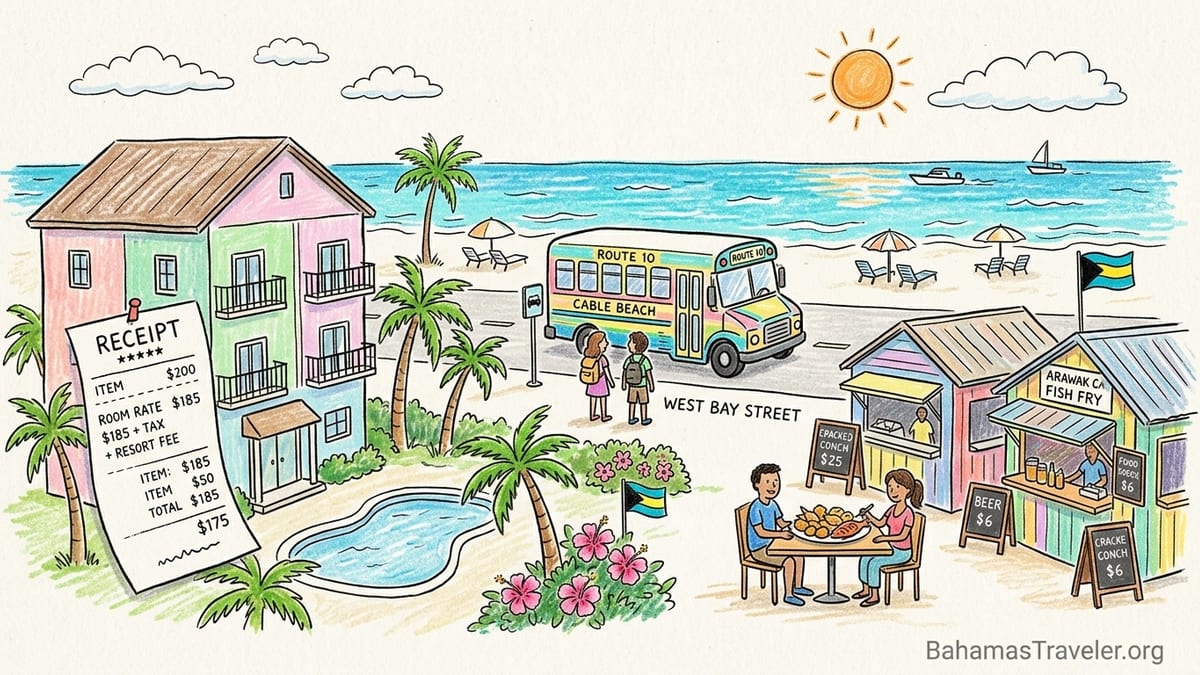
Our base was a small three-star property along West Bay Street in the broader Cable Beach area, not on the sand but an easy walk from the shoreline and the main road for buses. I booked a standard king room directly with the hotel for 185 dollars per night. At first glance, that looked fair for high-season-adjacent dates on a popular Caribbean island. The surprises arrived with the detailed confirmation and the final bill.
On top of the 185-dollar nightly room rate, the hotel added 10 percent VAT. That alone pushed the pre-fee cost of the room to just over 203 dollars per night. There was then a 15 percent service charge applied to the room rate and billed as a mandatory gratuity for hotel staff, which added another 27.75 dollars per night. Finally, a nightly resort or facilities charge of 25 dollars was itemized to cover Wi-Fi, beach towels and access to a modest pool. The result was a true nightly cost of roughly 255 dollars, almost 40 percent higher than the headline room rate I had used when sketching my budget.
Across four nights, accommodation and its associated taxes and charges came to approximately 1,020 dollars. That figure did not include any breakfast or meals; it was simply the cost of having a clean, midrange room in a walkable area. For comparison, I checked rates at one of the large Cable Beach resort complexes for the same dates. Entry-level rooms advertised online around 320 to 350 dollars per night before taxes, with similar VAT applied and resort charges that pushed real nightly costs into the 380 to 420 dollar range per room. In other words, going independent saved a meaningful amount, but not nearly as much as the base rates suggested once mandatory extras were added.
The takeaway for accommodation is that visitors should expect VAT and resort charges to add a significant layer to whatever nightly rate is advertised. On a shorter three-night stay these extras can easily add more than 200 dollars to a couple’s bill. It is absolutely worth requesting a sample invoice or a fully itemized quote from any hotel in Nassau or Cable Beach before you finalize a booking, so you can compare the true nightly cost across independent properties and resort packages rather than just room-only rates.
Getting Around: Airport Transfers, Taxis and Jitneys
Transport was where my expectations diverged most from reality. On arrival at Lynden Pindling International Airport, we followed official signage to the taxi stand. The airport’s posted fare table listed a fixed rate of 29 dollars from the airport to Cable Beach, with surcharges for oversized bags. Online discussions from 2026 referenced real-world fares in the 25 to 35 dollar range for that same route when booked on the spot, depending on traffic, luggage and time of day. Our driver quoted 30 dollars for two people with one checked suitcase and a carry-on, which matched those references closely, and there was no separate VAT line on the handwritten receipt.
For journeys within New Providence, we used both taxis and jitneys. In central Nassau, locals repeatedly advised us to confirm taxi fares before getting in the car, as prices can drift above official tables if visitors do not ask. A ride from the British Colonial area in Downtown Nassau across the bridge to Paradise Island was quoted to us at 20 dollars one way, consistent with recent accounts that mention similar prices for this route, which includes a toll. A short hop along Cable Beach cost 12 dollars in a metered cab late one evening when jitneys had stopped running. Over four days we took five taxis, for a total spend of 112 dollars.
The jitneys were far cheaper, and when they worked, they felt like great value. Guides produced in 2026 describe one-way fares on main routes around Downtown and Cable Beach at about 1.50 dollars per adult, with slightly higher fares up to the western fringe of the island. In our case, riding Route 10 between downtown and Cable Beach, drivers charged 1.50 dollars per person each way, payable in cash on board, exact change preferred. From Cable Beach west toward Love Beach, a jitney driver asked for 2.50 dollars each. We used jitneys for six daytime journeys and spent a total of 21 dollars on public buses across the stay.
The limitations were significant. Jitneys do not operate on a fixed timetable and typically wind down operations in the early evening. Anecdotal accounts suggest that many routes finish around 6 to 7 p.m., with some drivers on western routes stopping earlier on Sundays or public holidays. That matched our experience: after 6:30 p.m., buses along West Bay Street thinned dramatically, and by nightfall we saw none pass our stop. Jitneys also do not go directly to some tourist-heavy areas like the far western resorts or more isolated beaches without route changes. For our early morning excursion and later restaurant dinners, we still needed taxis.
Food Shock: Arawak Cay, Supermarkets and Resort Restaurants
Nassau’s food scene covers everything from inexpensive snack stands to white-tablecloth hotel dining rooms. To understand the budget implications, we made a point of eating in three broad settings: Arawak Cay’s Fish Fry, where multiple local restaurants serve classic Bahamian dishes; a modern supermarket off Cable Beach; and a major resort restaurant in the Cable Beach complex.
At Arawak Cay, menus typically listed conch fritters in the range of 8 to 15 dollars, cracked conch plates around 20 to 35 dollars, and whole fried fish depending on weight that often ended up between 30 and 45 dollars per dish, excluding drinks. A 2025 guide to the Fish Fry described sky juice cocktails running from roughly 5 to 12 dollars and local beer in the 5 to 7 dollar range, which aligned closely with what we saw on laminated menus and chalkboards at several spots across the strip. For one dinner for two we ordered a shared plate of conch fritters, one cracked conch, one grilled snapper, two local beers and one soft drink. The pre-tax total came to 79 dollars. VAT of 10 percent was added automatically, along with a 15 percent service charge printed on the bill, producing a final total of just under 100 dollars.
By contrast, the supermarket felt expensive in unit terms but still offered potential savings over frequent restaurant meals. At a large grocery store near Cable Beach we paid 7.50 dollars for a loaf of sliced bread, 6.25 dollars for a dozen eggs, 6.80 dollars for a small tub of local yogurt, 8.99 dollars for imported cereal and 3.50 dollars for a two-liter bottle of soda. Takeaway rotisserie chicken cost 15.99 dollars for a small bird, and a pre-made salad container was 9.50 dollars. Some staple foods in Bahamian supermarkets have been subject to VAT reductions or exemptions in recent years, so not every item drew a full 10 percent tax, but most labels on the shelves and the final receipt reflected VAT-inclusive pricing. Our total grocery spend for two light breakfasts and one simple room picnic came to around 62 dollars.
The starkest price shock arrived at a well-known resort restaurant in one of Cable Beach’s large integrated resorts. Entrees such as grilled mahi-mahi, steak or pasta generally started around 45 dollars and climbed above 60 dollars, while appetizers hovered between 18 and 28 dollars. Cocktails were routinely priced at 18 to 22 dollars, bottles of local beer at 9 to 11 dollars, and standard desserts at 14 to 16 dollars each. For two people sharing one appetizer, two main courses, two cocktails and one dessert, our pre-tax total landed at 171 dollars. The restaurant then added 10 percent VAT and a 15 percent gratuity automatically. We left a small extra tip in cash, but the printed total before that was already close to 215 dollars for a single dinner.
Across four days we averaged around 160 dollars per day on food and drink for two, including restaurant meals, casual lunches, supermarket runs and snacks. That number alone overshot the 55 dollars per person daily food budget I had set at the planning stage. Visitors can reduce that figure by leaning heavily on groceries and low-cost local takeaway options, but if you intend to enjoy even one or two resort dinners, a trip to the Fish Fry and a couple of beach bar lunches, you should plan on significantly higher daily food expenses than many other Caribbean destinations.
Beach Days and Excursions: Public Sand vs Organized Beach Clubs
New Providence’s public beaches are among its greatest strengths for budget travelers, but they still come with hidden costs. On our first full day we walked from our hotel to a public access stretch of Cable Beach. Lining the sand were independent vendors renting beach chairs and umbrellas. Quotes started at 25 dollars for two loungers and an umbrella for the day, negotiable in quiet periods. We agreed 20 dollars cash with a vendor mid-morning. The beach itself was free, as were our swims in the sea, but we spent 14 dollars on two sodas and a shared order of fries from a nearby shack, and another 10 dollars buying bottled water and snacks from a corner shop on the walk back. Including a jitney ride downtown later that afternoon, the public beach day cost roughly 50 dollars for two people, primarily in chair rental and food.
For comparison, on the third day we booked a structured beach-club excursion on the western side of the island advertised as including round-trip transfers from Cable Beach, a reserved lounger, umbrella access, welcome drink and use of non-motorized water toys. The promotional price for a weekday was 95 dollars per adult before taxes and fees. Our invoice showed 190 dollars for two adults, plus 10 percent VAT, bringing the package itself to 209 dollars. On site, mixed drinks were priced around 16 dollars, local beer at 10 dollars and lunch plates between 22 and 35 dollars. We shared a platter of grilled fish and sides, bought three drinks between us and shared a dessert, adding another 98 dollars to the bill including service charge. The all-in cost of our beach-club day approached 310 dollars for the pair.
From a value perspective, the public beach offered the same water and sand for a fraction of the price, especially if you can do without loungers or pack towels to lie directly on the sand. However, the beach-club excursion delivered predictability: transport was included, there was shade guaranteed, bathrooms were clean and plentiful, and staff kept an eye on belongings while we swam. Families with young children or travelers anxious about taking jitneys or negotiating with on-the-spot vendors may consider that worth the premium. Even so, it is worth pricing each component of any beach package. If you are staying within walking distance of a good public beach and comfortable bringing your own snacks, you can save 150 dollars or more per day compared with organized excursions.
We also tested a couple of classic Nassau attractions that are either free or low cost. The Queen’s Staircase, a historic stone staircase carved into the rock and surrounded by tropical greenery, is free to enter. Local guides offer their services in exchange for tips, which many visitors accept. We tipped 10 dollars after a short, informative tour. John Watling’s Distillery, set in a restored estate on the hill above Downtown Nassau, offered a complimentary self-guided walk through the property, including a brief explanation of rum production. Sampling and cocktails in the on-site bar were charged, with mixed drinks typically in the 12 to 16 dollar range. Used strategically, these experiences provided a half-day of sightseeing for under 40 dollars for two, mostly in optional drinks and tips.
What We Actually Spent: A Four-Day Cost Breakdown
Over four days and four nights between Downtown Nassau, Cable Beach and the western beaches, our spending diary recorded the following approximate totals for two adults, excluding international flights. These are rounded but based on real receipts and daily tallies.
Accommodation including VAT, service charge and resort fees came to 1,020 dollars. Airport transfers, local taxis and jitneys totaled about 163 dollars, including the 30-dollar airport to Cable Beach ride, a 35-dollar return to the airport at the end of the trip, three medium-length taxi hops within Nassau, and six jitney rides. Food and drink, whether eaten at Arawak Cay, small local restaurants, a major resort dining room or bought from supermarkets, amounted to roughly 640 dollars across four days. Beach amenities such as chair and umbrella rental added 40 dollars. Entrance fees and tours including the organized beach-club excursion came to approximately 335 dollars. Miscellaneous expenses, covering bottled water, sunscreen top-ups and small souvenirs, totaled another 90 dollars.
Putting that together, the total trip cost on the ground was about 2,288 dollars for two people over four nights. That worked out to roughly 572 dollars per day for two, or 286 dollars per person per day. On a three-night visit with a similar pattern of spending but one fewer full day of activities, a realistic total for two people would be in the 1,600 to 1,800 dollar range excluding flights, depending on how many resort dinners and structured excursions they choose. Stretching to a week, and assuming a couple moderated their restaurant and excursion habits after the first few days, a seven-night stay could plausibly run between 3,600 and 4,200 dollars for two sharing a midrange room outside an all-inclusive.
A brief look at cost per category highlights the key pressure points. Accommodation accounted for around 45 percent of our on-island spending, even in a modest property. Food represented about 28 percent, excursions and organized experiences around 15 percent, with the remaining share split between transport and incidentals. That balance will shift for families squeezed into one room or for solo travelers bearing full room costs in exchange for lower restaurant and taxi bills, but the underlying structure is stable: sleeping and eating are what make Nassau feel expensive.
Where Nassau Felt Overpriced, and Where It Was Good Value
Everyone’s sense of value is different, but a few patterns emerged clearly during this four-day stay. Accommodation and restaurant dining in tourist-focused areas felt consistently pricey relative to the quality delivered. Our midrange hotel was clean and friendly but not especially stylish, yet by the time VAT and resort charges were counted the nightly cost was on par with solid city hotels in New York or Miami. Multi-course dinners in major resort restaurants were comparable in price to high-end North American venues without matching them in creativity or portion size.
Taxis also added up faster than expected, particularly on evenings when jitneys were not an option. A short string of 20-dollar and 30-dollar rides can silently chew through a couple’s daily transport budget, especially if their hotel is not directly in Downtown Nassau. Limited competition from ride-hailing services and the absence of enforceable meters in many cars contribute to a sense that visitors are paying a premium for basic, sometimes slow-moving rides across the island’s congested main roads.
By contrast, several things felt like good value when judged against the cost of simply being in a high-cost island economy. Public beaches, especially the accessible stretches of Cable Beach and Saunders Beach, offer million-dollar views for nothing more than the effort of walking there. Arawak Cay delivered hearty portions and a lively local atmosphere at prices that, while not cheap, undercut resort dining rooms by a noticeable margin. Jitneys, when caught at the right time of day, were among the best bargains on the island, moving us several kilometers for little more than the price of a bottle of water.
The best overall value, however, came from mixing these pieces intelligently. Combining free attractions such as the Queen’s Staircase and the complimentary estate tour at John Watling’s with only one paid excursion drastically lowered our per-day activity spend. Buying supermarket breakfast supplies meant we could reserve restaurant time for memorable dinners rather than forgettable hotel buffets. Where Nassau punishes the unprepared is at the intersection of convenience and habit: defaulting to taxis, resort restaurants and organized beach days will stack up triple-digit bills in a hurry.
How I Would Organize a Cheaper Return Trip
Knowing what I know now, I would approach a second trip to Nassau differently. First, I would lock in an apartment-style rental or guesthouse with a kitchenette in a walkable area between Downtown Nassau and Cable Beach, even if the nightly base rate were slightly higher. Self-catering a few meals using supermarket groceries and simple local takeaway options could easily shave 40 to 60 dollars per day off food costs for two without feeling deprived. I would ask very direct questions about all mandatory charges before booking, including VAT, service or gratuity fees on the room, energy surcharges and resort or facilities charges, and insist on seeing those amounts in writing.
Second, I would cluster activities geographically to minimize taxis. That means dedicating one full day to Downtown Nassau, visiting the Queen’s Staircase, nearby forts, the Straw Market and John Watling’s on foot from a jitney drop-off, with only one taxi back to Cable Beach in the evening if jitneys are no longer running. Another day would focus on Cable Beach itself, within walking distance of the hotel, using a single jitney ride downtown in the late afternoon for variety. Only on one day would I venture to a western beach-club or more remote shoreline, accepting the higher cost of organized transport for that purpose.
Third, I would cap resort dining at one special-occasion meal and otherwise prioritize Arawak Cay, smaller Bahamian-run restaurants and casual grill shacks that sit back from the waterfront. Even with VAT and automatic 15 percent gratuities, a typical dinner for two in these settings can land in the 60 to 100 dollar range instead of consistently over 200 dollars. Mixed with grocery breakfasts and occasional picnic lunches on the beach, that strategy alone could bring daily food spending closer to 70 to 90 dollars per person instead of 80 to 100.
Finally, I would set a clear cash envelope for discretionary treats such as beach chair rentals, souvenir shopping and cocktails. Knowing that two loungers and an umbrella usually cost about 20 to 25 dollars when negotiated, and that cocktails at beach bars can quietly hit 15 to 18 dollars each, I would either embrace those pleasures with an explicit budget or choose to forgo them in favor of a towel on the sand and a supermarket drink. Nassau is not a place where bargains fall into your lap, but it does reward travelers who decide which aspects of the island they value most and spend consciously there.
The Takeaway
Nassau and the wider island of New Providence are not cheap destinations. For couples staying in midrange independent accommodation, a realistic on-the-ground budget in 2026 starts close to 250 to 300 dollars per person per day once accommodation, hotel charges, food, transport and a few activities are counted. Families sharing a room will benefit from split accommodation costs but face higher restaurant and excursion bills, while solo travelers often find that room rates dominate their spending. All-inclusive resorts can sometimes deliver better headline value for travelers who intend to eat and drink heavily on-site, but they rarely eliminate the need for taxis, independent meals and paid excursions altogether.
The key is to understand where money genuinely goes in Nassau. Accommodation costs rise sharply once VAT and resort charges are factored in. Eating at major resort restaurants gets expensive quickly, but Arawak Cay and local takeaways can soften the blow. Public transportation in the form of jitneys is extremely affordable yet limited in hours and coverage, so some taxi use is hard to avoid. Public beaches, free historical sites and complimentary estate visits are your best tools for building low-cost days into an otherwise expensive island.
For couples, the sweet spot is often a small hotel or apartment in Cable Beach or between Cable Beach and Downtown Nassau, cooking simple breakfasts, using jitneys by day and taxis only when necessary at night, and reserving blowout dinners and beach-club outings for one or two special days. Families with children may prefer the predictability of a resort package but can still save by spending some days on nearby public beaches instead of booking every experience through the hotel. Solo travelers should pay particular attention to location and transport options, as taxi fares that would be reasonable when split between two or three people can feel punitive alone.
If you are deciding between an all-inclusive resort and independent accommodation, start by adding VAT and all mandatory fees to any quoted room rate, then sketch at least one realistic day of spending outside the resort walls. Include a taxi to Downtown Nassau, drinks at Arawak Cay, a stop at a supermarket, jitney fares where practical and a beach chair rental. Those concrete numbers will tell you far more than abstract daily budget figures. In Nassau, understanding how money moves around the island is the surest way to keep your own from disappearing faster than the tide.
FAQ
Q1. How much should I realistically budget per day in Nassau outside an all-inclusive?
For a midrange trip in 2026, many couples will spend around 250 to 300 dollars per person per day once accommodation, taxes, food, local transport and a couple of paid activities are included, assuming moderate restaurant use and one or two excursions.
Q2. Are taxis in Nassau metered or fixed price, and what does an airport transfer cost?
Many taxis in Nassau work with fixed or negotiated fares rather than visible meters. Official airport guidance lists a rate of about 29 dollars between Lynden Pindling International Airport and Cable Beach, and recent travelers report real-world fares in the 25 to 35 dollar range for that route, depending on luggage and time of day.
Q3. How cheap are jitney buses, and can I rely on them instead of taxis?
Jitney buses are very inexpensive, with typical one-way fares around 1.50 dollars between Downtown Nassau and Cable Beach and slightly higher fares toward the western end of New Providence. However, routes are privately run, do not follow strict timetables, often stop in the early evening and do not serve every tourist area directly, so you will likely still need taxis for some journeys.
Q4. What taxes and automatic gratuities should I expect on restaurant bills?
Most sit-down restaurants in Nassau add the country’s 10 percent value added tax to menu prices and many also include a 15 percent service charge or gratuity on the final bill, especially in tourist areas. It is important to read receipts carefully so that you do not double-tip unless you wish to.
Q5. Is food at Arawak Cay really cheaper than eating at resort restaurants?
In general, Arawak Cay’s Fish Fry offers lower menu prices than large resort dining rooms, with substantial main dishes often in the 20 to 40 dollar range and drinks around 5 to 12 dollars. Resort restaurants commonly price main courses from the mid-40s upward and cocktails around 18 to 22 dollars, so two people can easily save 50 to 100 dollars per dinner by choosing local spots instead.
Q6. Are Nassau’s public beaches truly free, and what extra costs should I plan for?
Public access to beaches such as Cable Beach or Saunders Beach is free, and you pay nothing to swim or sit on your own towel. Additional costs arise from optional services like renting loungers and umbrellas, typically quoted around 20 to 25 dollars for two chairs and shade for the day, plus food, drinks and transport to and from the beach.
Q7. What are some genuinely free or low-cost things to do in Nassau?
Free or low-cost options include visiting public beaches, climbing the Queen’s Staircase, exploring central Nassau on foot, and taking the complimentary estate tour at John Watling’s Distillery, where you only pay for optional drinks. Modest tips for guides and small purchases from local vendors help support the community without adding large costs.
Q8. How expensive are organized excursions and beach-club days compared with going on my own?
Organized beach-club packages that include transport, a lounger and basic amenities often start around 90 to 100 dollars per adult before VAT and on-site food and drink. By the time you add lunch and a couple of drinks, a couple can spend 250 to 300 dollars in a day, compared with about 50 to 80 dollars for a self-organized day on a public beach with chair rental and simple snacks.
Q9. Is an all-inclusive resort better value than staying in independent accommodation?
All-inclusive resorts can offer good value for travelers who prefer to eat and drink almost exclusively on property and take only a few outside excursions. Independent accommodation, especially apartments with kitchenettes, often works out cheaper for visitors who are happy to mix self-catered meals with local restaurants and use jitneys where possible. The best approach is to compare the full daily cost of each option, including taxes, fees and off-resort spending.
Q10. What is your main money-saving advice for first-time visitors to Nassau?
The most effective steps are to confirm all hotel taxes and charges before booking, use jitneys during the day and taxis only when necessary, limit resort dining to one or two special meals, and build your itinerary around free public beaches and low-cost cultural sights instead of booking paid excursions every day. Planning where you will spend freely and where you are happy to cut back makes Nassau feel rewarding rather than relentlessly expensive.