


I’ve done the Bahamas three different ways: a city-and-beach base in Nassau on New Providence, a resort-first stay on Paradise Island, and an out-island reset in Exuma where the best day happened offshore. After experiencing each, I don’t think the question is “Which is best?” It’s “What kind of trip are you actually booking?” Because the truth is that Nassau and Paradise Island function like the country’s main gateway and tourism engine, while Exuma revolves around Great Exuma, a scatter of cays, and the kind of boat-access moments you can’t replicate from a pool deck. Here’s how they compared for me, from the first airport hour to the last dinner bill.
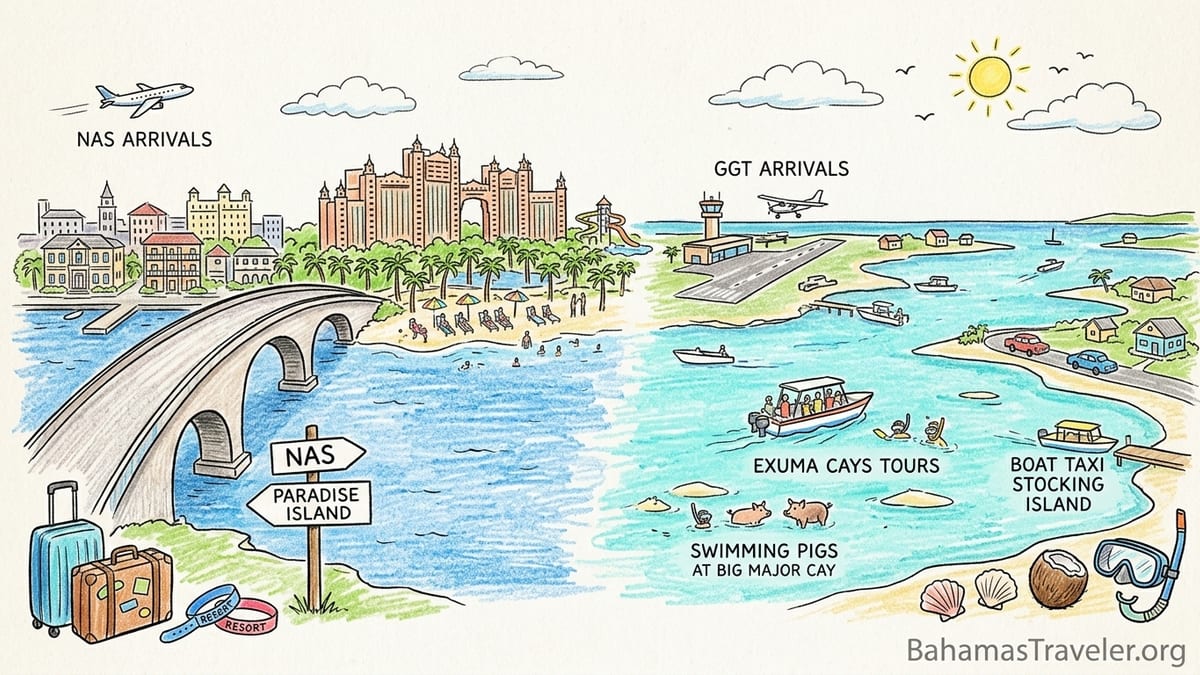
Arrival day reality: Nassau (NAS) vs Exuma (GGT) vs “Paradise Island is still NAS”
Paradise Island is its own island, but you still arrive through Nassau’s Lynden Pindling International Airport (NAS) and then cross over by road. The most memorable part of my Paradise Island arrival wasn’t the flight, it was the psychological switch: once I got over the bridge, the trip felt “contained.” The luggage, the lobby, the wristbands, the dining reservations, the long hallway to the room. It was smooth, but it also quietly signaled: you can spend the entire trip without needing the rest of the island.
Nassau arrivals felt more like a normal city-beach trip. I could land at NAS, get to my hotel, and within the same afternoon be walking to a casual dinner rather than figuring out a resort map. The first time I stayed on New Providence, I remember dropping my bag and immediately thinking, “Okay, I can actually live here for a few days,” not just vacation here.
Exuma’s arrival is the opposite vibe. You typically fly into Exuma International Airport (GGT) near Moss Town, not into a mega-terminal attached to an entire tourism corridor. The first time I landed, the defining moment was how quickly the island felt quiet. No casino billboards, no resort shuttle choreography, just the sense that you’re about to drive past beaches and small roadside spots to wherever you’re staying. It’s not that Exuma is hard, it’s that it’s more independent by default.
Hotel choices: city bases in Nassau, resort bubbles on Paradise Island, and spread-out stays in Exuma
Nassau gave me the widest range of “bookable” styles within a short radius: heritage-feeling hotels near downtown, big properties near Cable Beach, and plenty in between. What made Nassau practical was not just the inventory, but the flexibility. I could choose a place with breakfast, skip the on-site dinner pricing, and spend my money in neighborhoods and local restaurants without making it a project.
Paradise Island, for me, was defined by how dominant the big resort experience is. Atlantis is the gravitational center: the water park, the aquarium habitats, the casino, the marina village. It’s not an all-inclusive resort, which matters for budgeting, but it is a self-contained universe. Atlantis also charges a daily resort fee that includes, among other things, Aquaventure access (Atlantis itself values that access at about $190 per adult and $95 per child), which tells you exactly what kind of trip you’re buying into.
Exuma lodging felt the most “choose your own adventure,” but also the most spread out. You can stay near George Town for convenience, or farther out for solitude, but either way you’re not booking one master resort that answers every need. The night I checked into Exuma, the thing that shaped my expectations was how normal it felt to plan: “We’ll drive to dinner, we’ll stop at a grocery store, we’ll pick a beach tomorrow.” Exuma didn’t try to entertain me automatically, it waited for me to go find it.
Beaches and water: what I could actually swim, snorkel, and lounge in
Paradise Island delivered the most “instant” beach day: wide sand, clear water, and the convenience of towels, loungers, and an engineered comfort zone. But the most honest memory I have from Paradise Island is this: I spent more time inside the resort ecosystem than I expected. Even when I was on the beach, I was still in the resort. It’s relaxing, but it’s also curated, and that’s the deal.
Nassau surprised me with how easy it was to stack beach time with real meals and real wandering. I had days where I’d swim, rinse off, and be eating conch and fried fish without needing a reservation window or a resort dress code. One of the clearest “this is why Nassau works” moments for me was ending up at Arawak Cay, the famous Fish Fry strip. It’s not a single restaurant, it’s a whole stretch of places, and it has that specific energy that only exists where locals and visitors overlap. The Bahamas’ official tourism site even calls out Sunday nights as a time when you’ll see lots of locals there, and I felt that difference when the tables were full of big groups who clearly weren’t on vacation schedules.
Exuma’s water felt like the headline, but not in the “step outside, swim, done” way. The defining Exuma lesson is that the most iconic scenery is often not on Great Exuma itself, but out in the cays. Yes, I had gorgeous swims from shore, but the day that stuck with me was a boat day, because the Exuma Cays are the point. The Bahamas’ official tourism messaging leans into this too, describing Exuma as a place of hundreds of cays and boat-based experiences, and that’s exactly how it felt: the best of Exuma was something I had to go get.
Food and nights out: walkable Nassau, reservation-driven Paradise Island, and low-key Exuma
Nassau was the easiest place to eat well without overthinking it. I remember finishing a beach afternoon, walking to a casual spot, and feeling like I wasn’t paying “resort pricing” for the privilege of eating near where I slept. The Fish Fry at Arawak Cay became my go-to reference point for describing Nassau to friends: a place where you can get conch salad and fried fish, hear music, and feel like you’re in a living neighborhood rather than a controlled entertainment district.
Paradise Island, by contrast, felt like dining inside a campus. There are plenty of options and Atlantis publishes weekly dining and activity schedules, but the trip rhythm can become: breakfast here, lunch there, dinner there, and you’re mostly moving inside the same complex. I’m not saying the food can’t be good. I’m saying the experience is structured. You also feel the cost of convenience more directly, because leaving the resort for dinner is possible, but it introduces taxis, bridge crossings, and the friction of deciding whether “tonight” is worth the effort.
Exuma’s evenings were the quietest. That can be romantic, or it can feel sleepy, depending on what you want. My nights in Exuma were less about cocktails at midnight and more about finishing dinner, hearing the ocean, and realizing I’d be up early for a beach or a boat. If your ideal Bahamas trip includes a busy nightlife scene, Exuma is not where I’d place that bet. If your ideal includes uncrowded mornings and low-pressure evenings, Exuma felt like the reset button.
Excursions: the Atlantis effect vs Nassau day trips vs Exuma’s boat-first identity
Paradise Island is where I felt the strongest pull to buy experiences on-property. The clearest example is Aquaventure. If you’re staying at Atlantis, access is bundled into the stay; if you’re not, Atlantis sells day bookings that include Aquaventure, aquarium habitats, and beach access. Even the way it’s framed encourages you to commit to the resort as your primary attraction. If you love water parks, lazy rivers, and a “one wristband, full day” style, Paradise Island makes it easy.
Nassau is where excursions felt like an add-on rather than the whole purpose. You can do a day pass, a beach club, a half-day on the water, then come back and still have a city evening. Another practical detail that shaped my Nassau opinion: Baha Mar, on Cable Beach, specifically notes that it does not offer general day passes for its pools and beach (those are reserved for guests), but it does sell day passes for Baha Bay waterpark. That distinction matters when you’re trying to plan a “resort day” without actually staying at a resort.
Exuma is the place where excursions are the trip. The moment I fully understood Exuma was mid-boat day, when it clicked that the “must do” list is basically a water map: cays, sandbars, snorkel stops. Plenty of operators run full-day adventures that include classic stops like Thunderball Grotto snorkeling, the swimming pigs at Big Major Cay, and sandbar time. Pricing is not uniform, but it’s not abstract either. For example, one well-known operator lists a full-day Exuma Cays adventure tour at about $290 per adult and $230 per child, while another lists a full-day Staniel Cay-focused tour at about $435 per person. If you’re staying in Exuma and skipping the boat day, you’re skipping what made Exuma feel like Exuma.
Getting around: taxis, bridge tolls, independence, and the true cost of convenience
Nassau and Paradise Island are physically close, but the bridge is a real divider in how the trip feels. There are two bridges connecting New Providence and Paradise Island, and there’s a bridge toll in the mix. Official sources put the taxi bridge toll at $2, and Nassau airport taxi information lists a set fare to Paradise Island of $45, plus that $2 bridge toll. That’s not a horror story, it’s just a reminder that the simple act of going “back and forth” has a price tag and a mental cost, especially if you do it nightly.
In Nassau, I found it easier to explore independently without turning every outing into a mini-budget meeting. Some travelers use jitney buses as a cheap way to get around, but the reality I kept running into is that convenience tends to win at the end of a hot day. Nassau’s taxis are plentiful, but you still want to confirm the fare before you get in because these are not metered rides in the way many U.S. travelers expect. That one habit, ask first, changed my whole stress level.
Exuma felt the most independent and the most car-shaped. If you’re staying on Great Exuma and want to explore beaches and restaurants across the island, a rental car often becomes the trip enabler. And then there’s the boat factor. A very Exuma-specific detail is that some of the most enjoyable nearby escapes, like Stocking Island off Elizabeth Harbour, are reached by water taxi. It’s common to hear travelers quote around $20 to $25 round trip for a basic water taxi ride to Stocking Island, and that’s exactly the kind of “small, constant” expense that adds up in Exuma if you’re hopping around. But unlike a bridge toll, it feels like part of the charm because you’re crossing water to get to your beach day.
Prices, crowds, and what I’d actually book again
If you want the Bahamas with the least friction and the most options per day, Nassau is the most versatile base I experienced. It’s the easiest place to mix a beach morning, a local lunch, a museum or market wander, and an evening that doesn’t require a resort reservation system. It’s also the easiest place to correct course mid-trip. If one beach is crowded, you can pivot. If you’re tired of hotel food, you can walk out the door.
If you want the Bahamas as a resort-centered vacation where the entertainment is built in, Paradise Island is the cleanest match. Atlantis is powerful for families, for multi-generational trips, and for travelers who want to spend most of their time inside a single, amenity-dense property. The trade-off is that your trip can become a “campus stay,” where you have less contact with Nassau unless you deliberately plan it.
If you want the Bahamas as a quieter beach escape and you’re willing to pay for the boat day that defines the destination, Exuma is where I’d go back when I need real calm. Exuma is not a nightlife destination in the way Nassau can be, and it’s not as turnkey as a major resort island. But it delivered the most lasting images in my head: the kind of water that makes you stop talking mid-sentence, and the feeling that the best parts of the day required you to leave shore and go into the cays.
For a first Bahamas trip, I’d personally choose Nassau if you want flexibility and a “little bit of everything” without overcommitting to a resort bubble. For families and resort-focused travelers, I’d choose Paradise Island if Atlantis is the point and the water park is the anchor experience. For couples who want quiet and travelers who dream about boating, sandbars, and snorkeling as the main event, I’d choose Exuma and budget for at least one full-day tour to the cays.
The Takeaway
Nassau and Paradise Island together are the Bahamas’ big gateway: the flights, the resort infrastructure, the dining density, the easy-to-book entertainment. In my experience, the difference is that Nassau let me live outward, walking into local food and building my own days, while Paradise Island tempted me to stay inward, inside one world-class resort ecosystem.
Exuma is a different promise. It’s not trying to compete with the scale of Nassau or the resort gravity of Paradise Island. It’s offering something else: Great Exuma as a base, hundreds of cays as the “real” playground, and boat-access experiences that make the destination feel like an archipelago rather than a single island. If you book Exuma expecting a city-and-nightlife trip, you may feel underwhelmed. If you book it expecting water, space, and cays, it can feel like the Bahamas dream people picture in their heads.
No one place is universally superior. But each one is very good at what it is. The best booking decision is the one that matches how you want your days to feel from the moment you land.
FAQ
Q1. Is Paradise Island separate from Nassau, and do they feel different?
Yes. Paradise Island is connected to New Providence (where Nassau is) by bridges, but it feels more resort-contained, while Nassau feels more like a city-and-beach base.
Q2. For a first-time Bahamas trip, where would you stay?
I’d choose Nassau for a first trip if you want flexibility: beaches, local food, and the option to day-trip to Paradise Island rather than commit to a single resort bubble.
Q3. Is Atlantis Paradise Island all-inclusive?
No. Atlantis is not an all-inclusive resort, so you should budget separately for many meals and extras even though some major amenities are bundled into the stay.
Q4. How much is a taxi from Nassau airport to Paradise Island?
Official Nassau airport taxi information lists Paradise Island at about $45 plus a $2 bridge toll. Always confirm the total before you get in the cab.
Q5. Can you visit Atlantis Aquaventure without staying at Atlantis?
Yes. Atlantis sells day bookings that include Aquaventure and other resort access, but availability and pricing can vary by date, so it’s best to check close to your travel days.
Q6. Does Baha Mar sell day passes if you’re not staying there?
Baha Mar states it does not offer day passes for its pools and beach for non-guests, but it does sell day passes for Baha Bay waterpark.
Q7. Is Exuma worth it if you don’t do a boat tour?
You can still have a great beach trip on Great Exuma, but the signature experiences are in the Exuma Cays. I’d budget for at least one full-day boat excursion.
Q8. What does a full-day Exuma Cays tour typically cost?
Prices vary by operator and itinerary, but it’s common to see full-day tours listed in the roughly $290 to $435 per-person range, with some tours charging additional landing fees for certain stops.
Q9. Do you need a rental car in Exuma?
If you want to explore Great Exuma independently, a rental car is often the most practical way to reach different beaches and restaurants, since lodging and dining are spread out.
Q10. Which destination is best for nightlife?
Nassau generally offers the easiest nightlife variety because it’s more urban. Paradise Island nightlife is often centered inside major resorts. Exuma tends to be quieter at night.