


I went to The Bahamas expecting it to be like Cancun: pick a big beachfront resort, wear a wristband, and never sign a check. That assumption was wrong, and it’s the single biggest reason travelers get disappointed here. In The Bahamas, “resort” usually means a full-service property with restaurants, bars, and activities that you pay for as you go. An “all-inclusive resort” means those meals, drinks, and many activities are bundled into one prepaid rate. The difference sounds small, but in a destination where a casual lunch can feel shockingly expensive once taxes and service charges are added, it can make or break your budget and your mood.
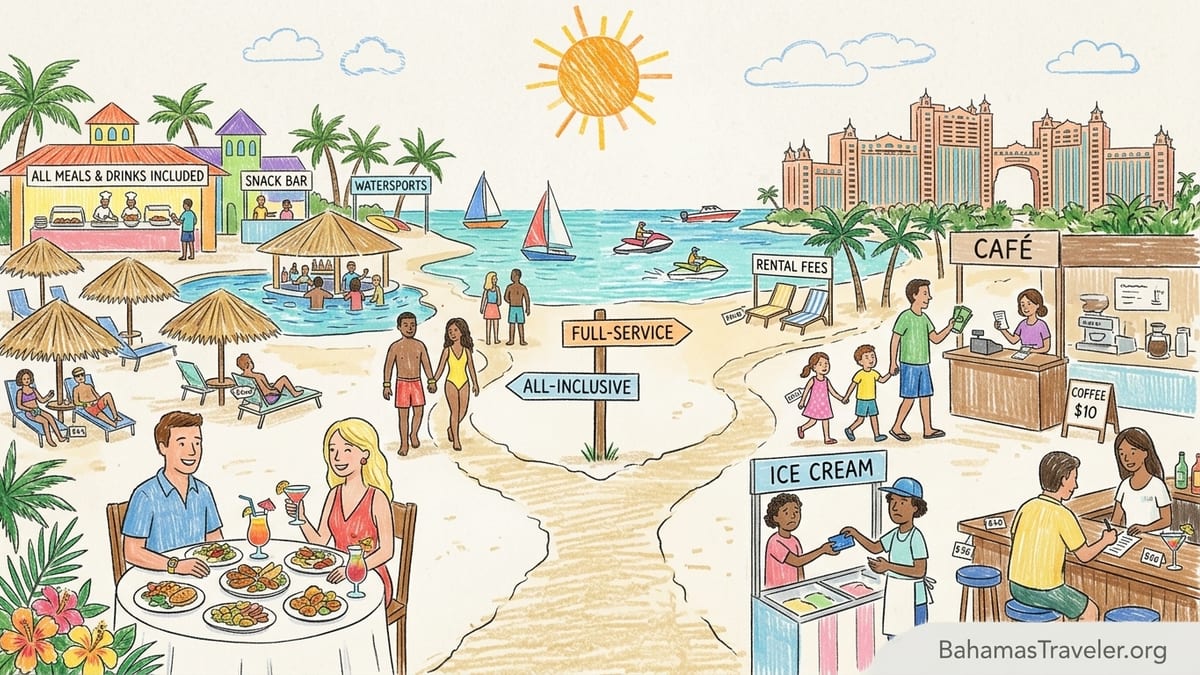
Resort vs. All-Inclusive Resort: The Search Intent Trap In The Bahamas
If you search “best resorts in The Bahamas,” you’ll see famous names that dominate headlines and Instagram, but many of them are not all-inclusive in the classic Caribbean sense. They may sell dining plans, breakfast packages, or resort credits, but your stay still involves lots of pay-as-you-go spending. That matters in The Bahamas because you can end up paying resort-level prices for every coffee, cocktail, and snack, even if you never leave the property.
To make the intent difference painfully clear: Atlantis Paradise Island explicitly states it is not an all-inclusive resort, even though it is one of the country’s most recognizable mega-resorts. It’s full-service with optional dining plans and experience credits, but that’s not the same product as unlimited meals and drinks in the room rate.
Baha Mar has a similar “big resort” footprint, but its hotel brands and dining scene operate on a pay-per-venue basis rather than an all-inclusive wristband model. You can absolutely have an incredible time there, but it requires a different budgeting mindset than a true all-inclusive.
For this article, I focused on places that travelers are currently booking as genuine all-inclusive experiences, then wrote about what that actually felt like: the room, buffet, à la carte restaurants, drinks, beach time, watersports, entertainment, tipping, and the “gotchas” that only show up once you’re on property.
What “All-Inclusive” Actually Means On The Ground (And What It Doesn’t)
In The Bahamas, true all-inclusive usually means your room, meals, snacks, and a defined set of drinks are bundled. But what’s bundled varies a lot by brand. Some resorts include taxes and gratuities in the rate and discourage tipping. Others include the food and drink but still leave room for upsells: premium bottles, specialty experiences, spa services, offsite excursions, and certain motorized watersports.
In practice, all-inclusive is less about “everything is free” and more about “most of what you’ll do daily is prepaid.” Breakfast is where you feel it most. Without all-inclusive, your morning coffee plus a simple breakfast can add up fast, especially if you’re doing it in a resort café rather than a local bakery. With all-inclusive, you’re not watching a running tab by day two.
Another important reality: the Bahamas accommodation market is tilted toward full-service resorts and hotels, not all-inclusives. That means “large” does not equal “all-inclusive,” and “all-inclusive” often means fewer properties to choose from, sometimes with trade-offs like older rooms, a smaller dining roster, or a less glamorous location.
Finally, your value depends on how you vacation. If you’re the type who wants two pool cocktails, a pre-dinner drink, wine at dinner, and a nightcap, you’ll extract a lot more value from all-inclusive here than someone who mostly drinks water, spends all day off property, and eats one big meal at a local spot.
Sandals Royal Bahamian (Nassau): The Polished, “You’re Done Paying” Experience
I stayed at Sandals Royal Bahamian in Nassau specifically because it’s one of the clearest examples of a true, premium all-inclusive in the country. The vibe is adult-only and honeymoon-forward, and the “Luxury Included” positioning is real in the sense that you can eat and drink widely across the resort without thinking about what’s going to land on your folio later.
My room experience felt like the type of all-inclusive that’s designed to keep you on property by making the basics frictionless: a stocked in-room minibar, easy access to bars, and lots of dining variety for an island where many hotels still treat food as a separate revenue engine. Dining was not “one buffet forever.” The resort lists 10 restaurants plus two food trucks, and in daily life that translated to real variety: a buffet option when I wanted speed, and sit-down venues when I wanted a longer evening.
Food was where I noticed the strategy: Sandals wants you to stop comparing it to eating out in Nassau. I did breakfast as a buffet most mornings for efficiency, then treated dinner as the anchor meal. It’s the kind of place where you can go from sushi one night to a steakhouse-style dinner another night without doing mental math. Drinks followed that same “keep it moving” pattern: pool drinks, lobby drinks, pre-dinner cocktails, and post-dinner options were all part of the normal rhythm.
Beach and watersports are also part of the appeal. The resort markets included activities such as non-motorized watersports and even scuba diving for certified divers, which matters because boat-based activities can be a major add-on cost in The Bahamas. I didn’t spend my whole trip chasing excursions because the on-property mix made it easy to feel like I’d “done something” even on a lazy day.
Viva Fortuna Beach by Wyndham (Freeport, Grand Bahama): The Budget-Friendly True All-Inclusive
When I wanted to see what “true all-inclusive” looks like at a more wallet-friendly price point in The Bahamas, I booked Viva Fortuna Beach by Wyndham in Freeport. It’s frequently framed as the island’s only all-inclusive, and it feels positioned for travelers who want simple: beach days, buffet meals, included drinks, and entertainment without the premium price tag of Nassau’s top-tier couples resorts.
The room felt straightforward rather than luxe. If you’re coming from boutique hotels, you’ll notice it. If you’re coming from the idea of “I want a beach, a bed, and not to sign for every meal,” it hits the mark. The real win here was the psychological effect of all-inclusive: I could grab breakfast, a mid-day snack, and dinner without that creeping feeling that every bite was another decision.
Dining followed the classic all-inclusive pattern: buffet as the everyday backbone, plus à la carte options on a schedule. The buffet is where you’ll likely start your day, and it’s also where you’ll go when you don’t want to plan. The à la carte dinners are where you slow down, and the value of those depends on your expectations. I treated the specialty venues as “nice to have,” not a fine-dining replacement for Nassau’s high-end restaurant scene.
On the beach and activity side, the all-inclusive setup mattered because it encouraged me to try things I might have skipped if each activity came with a price tag. Even when the experience is simple, it’s freeing. I spent more time actually being on the beach and less time negotiating what was worth paying for. That, for me, is the hidden value of an all-inclusive in The Bahamas: it buys you mental quiet, not just meals.
Breezes Bahamas (Cable Beach): The Classic Wristband-Style All-Inclusive, With Caveats
I also stayed at Breezes Bahamas on Cable Beach because it’s one of the clearest “one price, everything included” products in Nassau. Breezes states that rooms, meals, drinks, activities, entertainment, Wi‑Fi, and even taxes are included, and it makes a point of saying there are no resort fees or surprise charges. That’s exactly the promise many travelers think they’re getting when they book any “resort” in The Bahamas, and it’s why Breezes remains a relevant option.
What that felt like on-property was a familiar rhythm: buffet meals when you want speed, plus rotating specialty dining when you want a sit-down night. Breezes advertises five restaurants and four bars, including a swim-up bar, which is the kind of detail that matters if you’re choosing all-inclusive specifically for pool days and all-day sipping. In my stay, I defaulted to the buffet for breakfast, then used the specialty dinners to keep the week from feeling repetitive.
Entertainment is part of the Breezes identity. It’s not the kind of property where you expect silence at night. Live music, shows, and a nightclub-style option are part of the package, and that can be either a plus or a minus depending on your trip. I treated it like a “stay-up-late if you want to, sleep if you don’t” resort, but light sleepers should be realistic about that vibe.
The caveat is that all-inclusives in this price lane can come with a trade-off: you’re paying for coverage and convenience more than design-forward rooms or cutting-edge culinary creativity. I liked Breezes best when I leaned into what it is: a practical, beach-first base where the math is easy and the days are simple.
Tipping, Upsells, And The “What’s Actually Included” Reality Check
Tipping is one of the most confusing parts of going all-inclusive in The Bahamas, because policies vary by brand and it’s easy to overthink what’s expected. Some all-inclusives build gratuities into the price and actively discourage tipping in restaurants and bars. Breezes, for example, positions its package as including taxes and gratuities and even frames its “no surprise charges” philosophy as part of the point. In that kind of environment, I treated tipping as the exception, not the rule.
Other all-inclusive experiences, especially at the higher end, can feel more nuanced. Even when the resort rate covers food and drinks, there may be staff categories where tipping is common, or moments where you’ll want to tip for genuinely above-and-beyond service. My practical approach: I followed the resort’s written guidance first, then treated tips as a personal thank-you rather than an obligation for baseline service.
Upsells are also real, even at true all-inclusives. “Included” usually covers standard pours and house offerings, but premium wines, private dinners, top-shelf bottles, spa treatments, and offsite excursions can still add up quickly. The key is to ask one simple question at check-in: “What are the most common extra charges guests are surprised by?” That question saved me from the classic trap of assuming every experience on the property is bundled.
Watersports is where fine print matters most. Non-motorized activities are commonly included, while motorized activities often are not. In The Bahamas, where ocean activities are a major reason you came, that distinction has a bigger impact than it might in a destination where people mostly lounge by the pool.
Did I Leave The Resort, And Did All-Inclusive Actually Save Me Money?
I left the resort less than I expected, and more than I needed. That’s the honest answer. At Sandals Royal Bahamian, I left mainly for the satisfaction of saying I saw Nassau, not because I needed better food access. The all-inclusive setup made it easy to stay put: breakfast was handled, drinks were handled, dinner was handled, and the days didn’t require decision fatigue.
At Viva Fortuna Beach by Wyndham, I left even less. Not because Freeport isn’t worth seeing, but because the resort is built for the kind of trip where you want a contained, low-stress beach routine. The moment you start leaving multiple times a day for meals, you’re recreating the pay-as-you-go structure that all-inclusive was supposed to eliminate.
At Breezes, I was more tempted to wander because it sits on Cable Beach and Nassau is right there. But when I looked at my day honestly, the value of all-inclusive came from not paying resort prices for every casual moment: coffee, beach drinks, lunch, and late-night bites. Even one day of “snacks plus cocktails plus a sit-down dinner” outside can quickly turn into the kind of spending that makes an all-inclusive rate feel rational.
Did it save money? If you drink alcohol daily, eat three meals most days, and plan to stay primarily on property, all-inclusive in The Bahamas can protect your budget and often improve it. If you’re mostly exploring and you’re happy with one paid meal a day, it may not. The real savings, though, isn’t only dollars. It’s predictability in a destination where resort-area dining can be expensive enough to feel like a surprise.
The Takeaway
The best all-inclusive resorts in The Bahamas aren’t necessarily the biggest resorts you’ve heard of. The country’s market has plenty of famous full-service resorts where you pay for dining as you go, and that’s a different trip entirely. If your goal is to prepay your vacation and stop thinking about receipts, you need to book a true all-inclusive product, not just a well-known resort with restaurants on-site.
From my stays, Sandals Royal Bahamian delivered the most polished “don’t think, just enjoy” couples experience, with broad dining variety and a strong all-inclusive rhythm. Viva Fortuna Beach by Wyndham offered a straightforward, beach-first all-inclusive that kept spending simple at a more accessible price point. Breezes Bahamas delivered the classic wristband model on Cable Beach, with lots included and a social, entertainment-forward vibe.
If you’re choosing between them, the best question isn’t “Which resort is nicest?” It’s “How do I actually vacation in The Bahamas?” If you want to lounge, drink, and eat on a schedule that doesn’t require budgeting in real time, all-inclusive is the simplest path. If you’re planning to eat your way through Nassau every night, you may be happier at a non-all-inclusive resort and a deliberate dining budget.
FAQ
Q1. Are most resorts in The Bahamas all-inclusive?
No. The Bahamas has many full-service resorts, but far fewer true all-inclusive resorts than destinations like Mexico or the Dominican Republic.
Q2. Is Atlantis Paradise Island an all-inclusive resort?
No. Atlantis states it is not an all-inclusive resort, although it offers dining plans and other paid add-ons.
Q3. Is Baha Mar all-inclusive?
No. Baha Mar operates as a full-service resort complex where meals and drinks are typically purchased separately, depending on where you dine.
Q4. What did “all-inclusive” cover at Sandals Royal Bahamian?
In my stay, it covered the room, meals across the resort’s restaurants, and unlimited drinks at bars, plus a strong menu of included activities that reduces day-to-day add-on spending.
Q5. What did “all-inclusive” cover at Viva Fortuna Beach by Wyndham?
It covered my room, buffet-style meals plus scheduled à la carte dining, drinks, and on-property entertainment, making it easy to keep daily spending close to zero.
Q6. What’s included at Breezes Bahamas?
Breezes markets its package as including rooms, meals, drinks, activities, entertainment, Wi‑Fi, and taxes and gratuities, which is why many travelers choose it for predictable costs.
Q7. Do all-inclusive resorts in The Bahamas include gratuities?
Some do, some don’t. Always confirm the property’s current policy, because it affects both your budget and what staff expect during your stay.
Q8. Are watersports usually included at all-inclusive resorts in The Bahamas?
Often, non-motorized watersports are included, while motorized activities and certain excursions cost extra. Ask for the included-activities list at check-in.
Q9. Should I leave an all-inclusive resort to eat in Nassau?
You can, but it changes the value equation. If you’re paying for all-inclusive and eating out nightly, you may not be getting the financial benefit you expected.
Q10. When does all-inclusive save the most money in The Bahamas?
It tends to save the most when you’ll drink alcohol daily, eat most meals on property, and want predictable costs in resort zones where dining can be pricey.