


The Bahamas is an archipelago, not one destination, and choosing the right island changes almost every part of the trip: your flight plan, your budget, your beaches, your pace, even what “getting around” means. On my first trip, I treated The Bahamas like it was a single, interchangeable resort backdrop. On my second, I moved between islands and finally understood the point: Nassau and Paradise Island feel like a busy Caribbean city-resort hybrid; Exuma feels like water first, land second; and Eleuthera and Harbour Island feel like the antidote to crowds if you’re willing to work a little harder for it.
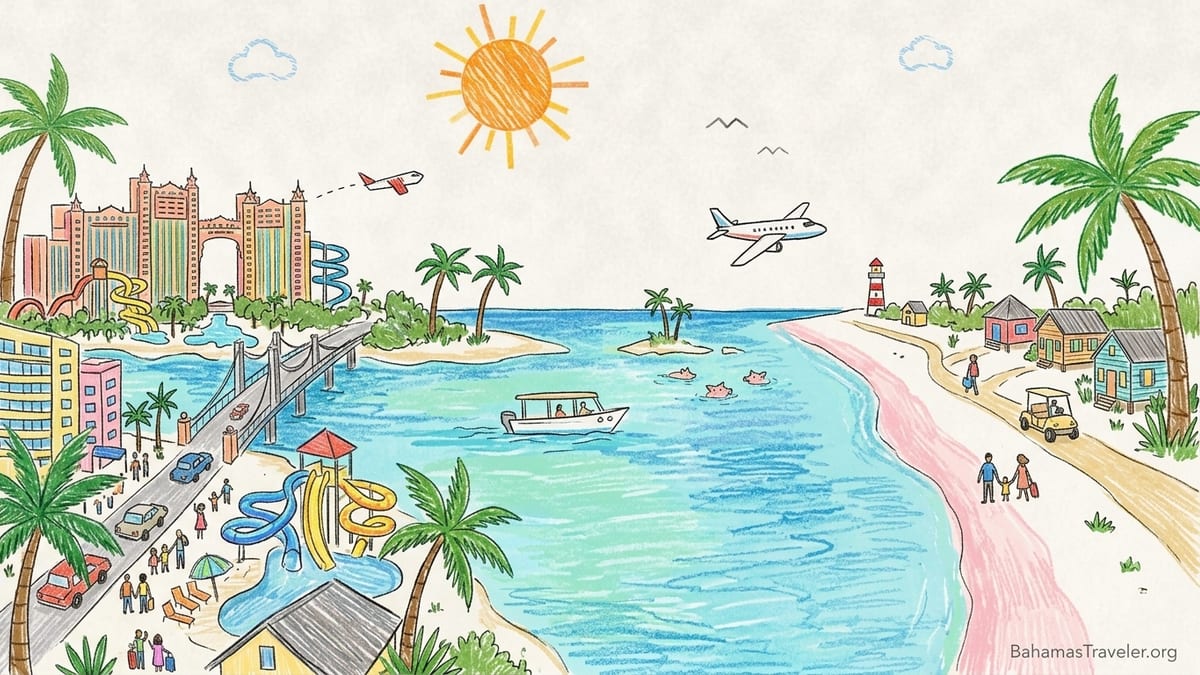
How I Learned the Hard Way: Pick Your Island First, Then Build the Trip
I flew into Lynden Pindling International Airport (NAS) in Nassau because it’s the easiest gateway from the U.S., and it made sense as a first landing. The airport arrival felt familiar in the best and worst ways: efficient enough, but not the kind of place where you linger. Once I was outside, the “Bahamas pricing” hit immediately, not because anyone was rude, but because the whole system is built around taxis, resorts, and short stays.
On that first run, I split my time between Nassau/New Providence and Paradise Island, telling myself I’d add Exuma as a day trip. That was the mistake. The Bahamas rewards travelers who plan by island, not by “activities.” A swim with pigs day tour from Nassau is a long, expensive day built around schedules and sea conditions. Staying in Exuma turns it into a relaxed boat day you actually enjoy.
On later trips, I planned the itinerary like a chain of arrivals: NAS first for city energy and easy logistics, then a short hop to Exuma for water clarity and boat days, then Eleuthera and Harbour Island for that quiet, barefoot, small-road version of the Bahamas that never shows up in big-resort ads.
Arriving in Nassau (New Providence) and Crossing to Paradise Island
Landing at NAS, I kept it simple: I used a regular airport taxi stand rather than trying to negotiate with someone walking up to me. My personal rule in Nassau is to ask the fare before I get in, confirm if the Paradise Island bridge toll is included, and keep small bills handy. Nassau is not a place where I rely on improvisation for transport, because the distance is short but the pricing can feel surprisingly high for what’s basically a quick ride.
I stayed in the Cable Beach area one trip and on Paradise Island another. Cable Beach felt practical: closer to the airport and anchored by large resorts, with a wide stretch of sand and a “vacation machine” feel. Paradise Island felt more like a self-contained world: you’re close to the action, but you pay for that convenience in resort charges and restaurant markups.
What surprised me most wasn’t the base room rate, but the layers that stack on top. At major resorts, you can see multiple taxes and levies plus a daily resort fee, and sometimes a mandatory gratuity structure on top of that. Even when I expected The Bahamas to be expensive, I still had moments at checkout where I thought, “I should have read that fine print more carefully.”
What Nassau Really Felt Like: Crowds, Beaches, and the Parts I’d Repeat
Nassau can feel crowded fast, especially around the cruise port zone and the downtown strip. On days when multiple ships were in, the vibe shifted: more traffic, more lines, more pressure to decide quickly. I learned to treat downtown Nassau like a short, targeted visit rather than an all-day wander. I’d go for one specific thing, then leave.
When I wanted beach time in Nassau, I picked my moments. Some beaches are easy to access but feel busy and “day-trip heavy.” Other stretches feel calmer if you go early, accept that you’ll pay for chairs or a drink, and leave before late afternoon when the heat and crowds stack together. If you’re a traveler who loves a quiet shoreline and hates negotiating space for a towel, Nassau is not the island I’d choose as a beach-first base.
But I’d absolutely repeat Nassau for its convenience and variety. It’s where I found it easiest to book last-minute tours, it’s where flight options were widest, and it’s where I could mix a beach morning with a decent dinner without needing a car. Nassau was the island where I spent the most money without always feeling like I got the most “Bahamas magic,” yet it was also the place that made the rest of my island hopping possible.
Exuma: The Water That Reset My Standards (And the Boat Day I’ll Never Skip Again)
I reached Exuma by flying from Nassau to Georgetown (Great Exuma Airport, GGT). The flight was short enough that it barely felt like a travel day, but the landing changed everything: the air felt quieter, the roads felt slower, and the color of the water looked almost unreal even from the ground. In Nassau, the ocean is beautiful. In Exuma, the ocean is the headline.
My best day in Exuma was a boat day through the Exuma Cays. I’m careful about overselling any single tour because operators, routes, and sea conditions change, but the core experience is consistent: you’re moving through shallow banks and cays with visibility that makes you feel like you’re floating over glass. This is also where the famous swimming pigs are, on Big Major Cay. In practice, it’s a wildlife stop you do respectfully and quickly, not a place to treat like a petting zoo.
The sea conditions mattered more than I expected. I had one day where the water looked calm from shore, but the ride out through open stretches felt choppy enough that a couple of people on our boat were genuinely miserable. If you get motion sickness, Exuma is still worth it, but I would bring medication and I would plan a “recovery afternoon” after a long boat route.
Exuma also taught me a practical lesson about cost: island hopping can save your trip and inflate your budget at the same time. Small-plane flights are time-efficient, but they add up quickly, and you often need taxis on both ends. I didn’t regret paying for the flight because it bought me time and energy, but if I went again, I’d stay longer on Exuma so the transfer cost felt more “amortized” across more days.
Eleuthera and Harbour Island: The Quiet Version of The Bahamas (With a Learning Curve)
Eleuthera felt like the moment my trip finally slowed down. I arrived via a short domestic hop (the island has multiple airports, including North Eleuthera, Governors Harbour, and Rock Sound, and flights vary by carrier and schedule). Even with a quick flight, the experience was noticeably different from Nassau: smaller terminal, fewer people, and that immediate sense that you are now responsible for your own logistics.
Harbour Island was the prettiest “walk-around” place I experienced in The Bahamas, and it’s also where the trip can feel deceptively simple. Getting there usually means coordinating: flight or ferry to Eleuthera, then a short water taxi to Harbour Island. In calm weather it’s easy and even charming. In rougher conditions, it becomes a tiny adventure with spray, luggage juggling, and the feeling that you should have packed lighter.
The payoff was real. The pace felt slower, the streets felt human-scale, and the beach time felt less like competing for space. The trade-off was that everything required a bit more planning: where I’d get dinner, how I’d get back after dark, and whether my accommodation was walkable or needed a ride. If you want the “almost empty” Bahamas, Eleuthera and Harbour Island are where I felt it most, but you have to accept that convenience is not the default setting.
The Practical Layer I Wish I’d Known: Money, Taxes, Tipping, and What Gets Expensive Fast
The currency situation is friendly for U.S. travelers: the Bahamian dollar is pegged one-to-one with the U.S. dollar, and U.S. dollars are widely accepted. In real life, that means I paid with a mix of card and cash, and I often received change in Bahamian currency. I avoided flashing large bills and tried not to rely on $100 notes, because smaller transactions move smoother with smaller denominations.
The part that can make travelers feel nickel-and-dimed is the tax and fee layering. The Bahamas has a standard VAT of 10%, and you’ll see it show up on bills along with service charges or mandatory gratuities in many tourist-facing places. At large resorts, the resort fee itself can be substantial per night, and some properties disclose additional mandatory gratuity structures. My advice is not “avoid resorts” because resorts can be a great fit, but to treat the total cost like airfare: it’s only real when you see the final number with the add-ons.
Tipping is customary, but it’s not always straightforward because some checks already include a service charge. I got into the habit of scanning every receipt for included gratuity before adding more. In taxis, I tipped more when a driver helped with bags, gave clear pricing upfront, or handled a complicated stop. For housekeeping, I preferred leaving a small daily tip rather than one lump sum, because it matched how the work happened day to day.
Unexpectedly expensive items on my trips were the “small” things: short taxi rides that felt overpriced for the distance, bottled water and snacks bought in resort areas, and any meal where I forgot that VAT and service charges would stack. Another surprise: moving between islands is not just the flight or ferry fare, it’s also the ground transport on arrival, and sometimes the simple fact that you pay “tourist pricing” more often on smaller islands where choices are limited.
Weather, Sea Conditions, and Timing: When I’d Go Back (And When I’d Avoid)
Weather in The Bahamas is usually the reason you’re booking the trip in the first place, but the sea is the part that makes or breaks your day. In Nassau, a windy day mostly means a rougher beach experience. In Exuma, it can mean a long, uncomfortable boat ride or a rerouted tour. In Eleuthera and Harbour Island, it can mean that a short water crossing suddenly feels like the main event.
Hurricane season in the Atlantic runs from June 1 through November 30. That doesn’t mean storms happen every day, but it does mean you should treat late summer and early fall as a time when flexibility matters. If I were planning a “once-in-a-decade” Bahamas trip, I’d prioritize a window where the weather risk is lower and sea days are more reliable, even if the room rates are higher. If I were going in peak summer again, I’d buy travel insurance that I actually understand and I’d keep my itinerary less fragile.
What I would change on another trip is simple: I would stay longer on fewer islands, and I would build in buffer days. The Bahamas looks close on a map, but in practice, transfers take mental energy. A short flight is still an airport morning. A ferry is still a schedule and sea-state gamble. I’d rather have two full, unhurried island days than three half-days stitched together by logistics.
The Takeaway: The Bahamas rewards commitment. Pick the island that matches your personality, then let that choice dictate the rest. Nassau and Paradise Island are the easiest entry point and the most turnkey. Exuma is where I felt the water reshape my whole idea of what “blue” can look like. Eleuthera and Harbour Island gave me the quiet, local-paced Bahamas I didn’t realize I was craving. If I could redo my first trip, I’d stop trying to see everything and instead travel like the archipelago demands: one island at a time.
FAQ
Q1. Do I need a visa to visit The Bahamas as a U.S. citizen?
For typical short tourist trips, U.S. citizens generally do not need a visa, but you should travel with a valid passport and proof of onward or return travel.
Q2. Do U.S. dollars work in The Bahamas, or do I need Bahamian dollars?
U.S. dollars are widely accepted, and the Bahamian dollar is pegged 1:1 to the U.S. dollar. You’ll often receive change in Bahamian currency.
Q3. What’s the biggest planning mistake people make with The Bahamas?
Treating it like one destination. The Bahamas is an archipelago, and your island choice changes beaches, costs, transport, and the whole pace of the trip.
Q4. Is it easy to island hop between Nassau, Exuma, and Eleuthera?
It’s doable, but it takes coordination. Short domestic flights are the quickest option, while ferries exist on some routes and can be sensitive to schedules and sea conditions.
Q5. How expensive are resort fees and taxes in Nassau and Paradise Island?
They can be significant. Many major resorts add VAT plus additional levies and daily resort fees, and some also add mandatory gratuities. Always read the full breakdown before booking.
Q6. Is tipping expected in The Bahamas?
Yes, tipping is customary, but many restaurants and resorts add a service charge automatically. Check your bill before tipping extra.
Q7. When is hurricane season in The Bahamas?
The Atlantic hurricane season runs from June 1 to November 30. That doesn’t guarantee storms, but it increases the chance of disruptions and rough seas.
Q8. What are the sea conditions like for Exuma boat tours?
They vary by day. Some days are smooth and glassy, and other days can be choppy enough to make the ride uncomfortable, especially on longer routes through open water.
Q9. What’s the most crowded area I experienced?
Downtown Nassau near the cruise port felt the most crowded, especially on days with multiple ships in. I planned those areas as short, targeted visits.
Q10. If I could only choose one island, which would I pick?
If you want convenience and variety, choose Nassau and Paradise Island. If you want the most memorable water and boat days, choose Exuma. If you want a quieter, small-island pace, choose Eleuthera and Harbour Island.