


I booked the classic “Exuma swimming pigs” day trip from Nassau expecting a photo-op and a long boat ride. I did not fully appreciate how much of the day is actually the crossing, how physical the stops can feel when you’re wet and sunbaked, or how quickly “bucket list” turns into “okay, I need a shower.” This is my full Nassau-to-Exuma excursion as it happened, including where I checked in, what the boat ride really felt like, what I saw at each stop, what felt ethical and what didn’t, and what I’d do differently if I were planning the trip again.
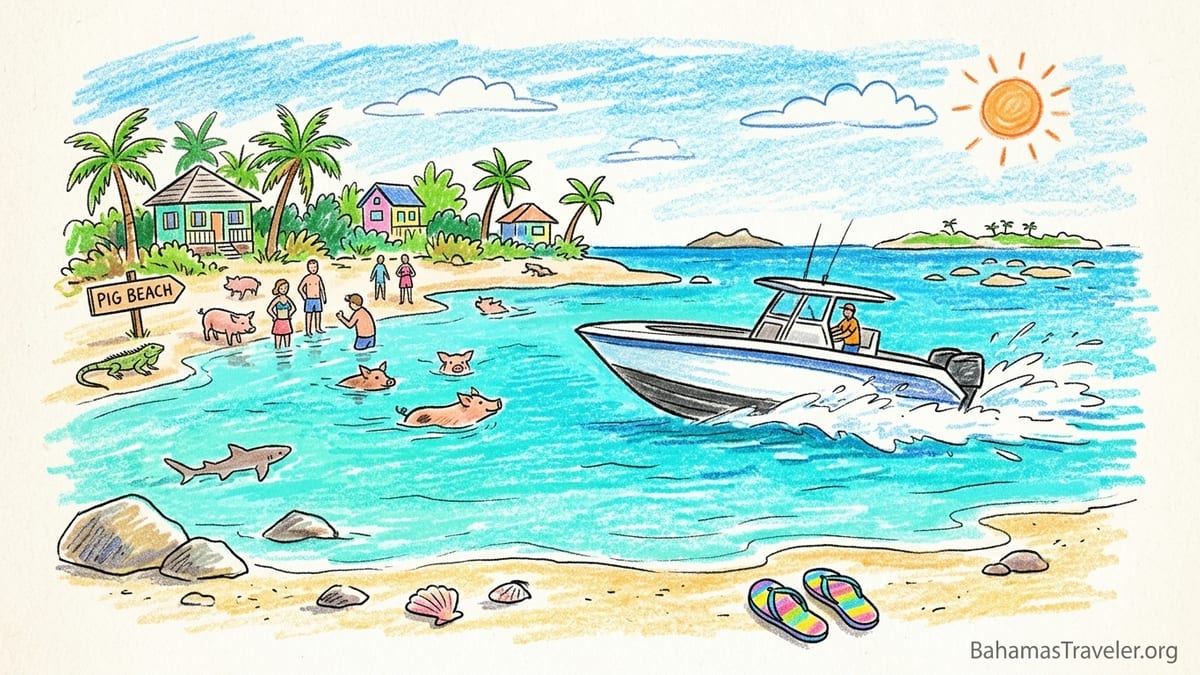
Booking, expectations, and what I verified before I went
I planned this as a single-day hit from Nassau, which is exactly how most visitors try to do it. The Bahamas’ official tourism site is clear on the big fact that matters: the famous pigs are on Big Major Cay (Pig Beach) in the Exumas, and Big Major Cay is only accessible by boat. That matters because plenty of “swimming pigs” tours out of Nassau actually visit closer private islands around New Providence instead of the Exuma cays. I specifically wanted Big Major Cay, even if it meant a punishing day.
Before paying, I sanity-checked what “Nassau to Exuma” could realistically mean. The straight-line distance is long enough that the experience lives or dies on the vessel. The operators that truly run Nassau-to-Exuma by sea typically use offshore performance speedboats, which are fast but still at the mercy of wind chop. I also verified that Nassau-based Exuma excursions are actively offered right now, and that at least one Nassau operator advertises a multi-island day that includes the pigs plus stops like nurse sharks, iguanas, and a sandbar.
Pricing was the next reality check. A true Nassau-to-Exuma run is not the same price as a half-day pig encounter near Nassau. I found current pricing that illustrates the spread: one Nassau-to-Exuma day tour listing shows $449 per person for ages 7+ (with younger-child pricing lower), and a well-known Nassau operator advertises a $299 per adult option plus tax for a private-island style pig experience. Those numbers are useful because they tell you what market you’re shopping in, and they also hint at what kind of day you’re buying: big distance, lots of fuel, and a long time on open water.
Departure morning in Nassau: check-in, timing, and first impressions
My day started early because the only way to make Exuma work as a day trip is to leave Nassau in the morning, before the sun is high and the wind has had all day to build the chop. I treated it like an airport day: closed-toe shoes for the dock, swimwear underneath, a thin long-sleeve shirt for sun, and a small dry bag for my phone and sunscreen.
I departed from the Paradise Island side, which is common for operators that stage out of the Atlantis area and the nearby ferry terminal. Check-in was the part I’m glad I took seriously. There is usually paperwork, wristbands, and a last-minute gear check that you do not want to rush. Even when a tour advertises a clean departure time, you should mentally budget extra time for the human factors: late arrivals, seat assignments, and the guide’s safety briefing.
The pre-departure briefing was not just a formality. The crew emphasized three things that ended up shaping the day: keep your hands out of the water while the boat is idling near docks and animal stops, step carefully on wet decks, and follow the wildlife instructions exactly. It was obvious they’ve seen every version of tourist behavior, including the one where someone tries to cuddle a pig like it’s a petting zoo animal.
The boat ride to the Exumas: seat comfort, spray, and seasickness reality
The boat itself was a high-speed offshore-style powerboat with tight seating and a practical layout. “Comfort” on a day like this is relative. If you’re picturing a plush ferry seat, reset that image. You sit forward-facing, close together, and you brace with your legs and core when the boat hits waves at speed. The ride is fast, but it is not gentle.
Sea conditions are everything. On my day, the weather was bright and warm, with enough breeze to kick up chop on the crossings. That translated into a ride that alternated between smooth bursts and jarring slaps of the hull. The boat’s speed is thrilling when the water cooperates and punishing when it doesn’t. Spray came over the sides at times, the kind that leaves a crust of salt on your sunglasses and makes you grateful you packed something to wipe lenses.
I did not get fully seasick, but I had that borderline feeling, the low-grade nausea that arrives when you stop looking at the horizon and start checking your phone. If you are even mildly prone to motion sickness, treat it proactively. This is not the day to “wait and see.” Once the nausea sets in, you still have multiple animal stops, swimming, and another long run back to Nassau.
Stop-by-stop in the Exuma Cays: what I actually saw and did
By the time the water shifted to those unreal Exuma greens and electric blues, my body was already tired from bracing on the boat. That visual payoff is real, though. You see the cays appear like low brush on the horizon, and then the sand shows through the water as if someone turned on the saturation.
At the nurse shark stop, the scene was more controlled than I expected. The sharks I saw were nurse sharks, and the encounter happened in shallow, clear water near a docked area rather than out in deep open sea. The guide’s tone changed here. The instructions were blunt: move slowly, don’t splash, keep distance, and do not block the animal’s path. Even if an operator describes the sharks as docile, they are still animals, and the safest interactions are the ones where you let them pass and you keep your hands to yourself.
The iguana stop felt like a fast burst of excitement rather than a long, contemplative wildlife moment. I saw rock iguanas scramble in a way that made it very clear they have learned the routine: boat arrives, tourists gather, food appears. The guide controlled the feeding and kept people from crowding too tightly, which helped. It was a good reminder that in the Exumas, “wildlife experience” can easily turn into “wildlife conditioned by snacks,” and the difference often comes down to how strict the crew is about rules.
One of the most memorable moments was the sandbar. On the right tide, it feels like the ocean has been pulled back to reveal a pale runway of sand in ankle-deep water. The depth depends on the tide and the exact spot, but the feeling is consistent: warm, clear water, a horizon that looks like it has been cleaned, and people drifting around taking the kind of photos you usually roll your eyes at until you’re standing there doing the same thing.
Pig Beach at Big Major Cay: crowds, water depth, behavior, and the ethics
Pig Beach was the stop I had built up in my head, and it landed with a mix of wonder and discomfort. The first thing I noticed was that it did not feel private. Boats come and go. Groups stack up. You can absolutely get your moment, but you are sharing it, and at peak times it can feel like a rotating stage set of arriving tours.
The pigs behaved like animals that know the program. I saw them wade and swim out toward approaching boats, sniffing for food, then pivot back toward the beach when the action shifted. In the shallow water near shore, the depth was generally manageable, and that’s part of why the experience works: you can stand, laugh, take photos, and still feel in control. But the pigs can be assertive. When food is involved, they surge. The guide repeatedly warned people not to hold food out in a way that invites lunging, and not to kneel down at pig level.
This is where the ethical line started to feel personal. The most comfortable moments were when I kept my hands empty, gave the pigs space, and treated it like observing an animal at close range rather than trying to “pose” with it. The moments that felt uncomfortable were the ones where tourists tried to crowd a pig for a close selfie, or where someone attempted to touch a pig that clearly wanted to move through the group. The guide’s best instruction, and the one I followed, was to let the pigs choose the interaction. If a pig walks past you, you don’t block it. If it swims out and turns away, you don’t chase it.
I also paid attention to what the guide discouraged. They were firm about not grabbing, not lifting, and not feeding in a chaotic way that makes pigs compete. I appreciated that, because it reduces the “mob” behavior that can lead to bites and stress. Still, Pig Beach can feel crowded, and the more crowded it feels, the more important it is to treat the animals as animals and not props.
Lunch, fatigue, and the long ride back to Nassau
Lunch mattered more than I expected. Not because it was a gourmet moment, but because by that point I was running on saltwater, sun, and adrenaline. The best part was simply sitting down, getting shade, and drinking something cold while my body stopped bracing for impacts. Some tours advertise a full meal and an open bar style setup, while others keep it simpler, but either way, lunch is the reset that makes the second half of the day possible.
After lunch, the exhaustion hit me in a delayed wave. That’s a pattern with these trips: you don’t realize how much physical effort you’re spending until you stop moving. Wet clothes chafe, sunscreen mixes with salt, and you start negotiating with yourself about whether you have energy for one more swim stop or if you’re happy just sitting on the boat watching the water.
The ride back to Nassau felt longer than the ride out. Part of that was the wind, part of it was fatigue. People got quieter. Sunglasses stayed on. Some passengers slept with heads tilted against the seatbacks, and the rest of us did the posture-shift routine of someone trying to avoid a sore lower back. When we finally pulled into Nassau, I was the kind of tired you feel after a full beach day plus a workout, and I still had to do the logistics of getting back to my hotel, rinsing gear, and trying to look human for dinner.
What I’d book next time: same day trip or stay in Exuma instead
Would I do the same long day trip again from Nassau? Only in a very specific scenario: if I had limited time in The Bahamas and Big Major Cay was a true priority, the kind of once-in-a-lifetime checkbox I didn’t want to miss. The day is doable, but it is not relaxing. It is a long, physical excursion, and the boat ride is the defining feature, not an afterthought.
Next time, I would seriously consider staying in the Exumas instead of treating it like a commute. If you base yourself closer to the cays, you can do shorter boat hops, arrive earlier or later to avoid the most crowded moments, and you can spread the highlights over more than one day. It also gives you flexibility if marine conditions cancel or force a reroute. Many operators can adjust stops for safety, and the final decision is typically made by the captain based on conditions.
If I had to book from Nassau again, I would book with my body in mind, not just my camera. I would pick the operator that is transparent about what is included, what the day’s timing really is, and what the wildlife rules are. I would also choose a trip that emphasizes controlled feeding and clear animal-handling boundaries. The pigs are famous, but the best memory of the day is not a single photo. It’s the combination of Exuma water color, the sandbar, and the feeling of moving through the cays, as long as the wildlife interactions are handled with restraint.
The Takeaway
The Nassau-to-Exuma pigs day trip is not a quick excursion. It’s a long, high-speed, open-water day that just happens to include one of the internet’s most famous beaches. If you go in expecting a relaxing cruise, you’ll be disappointed. If you go in expecting a fast-paced island-hopping adventure where the boat ride is half the story, you’ll have a great time.
Pig Beach at Big Major Cay is real, and it is special, but it can feel crowded and it requires good judgment. The ethical version of this experience is the one where you keep your distance, follow the guide, and don’t force contact for photos. If you want more calm and more control, consider staying in the Exumas and doing shorter local tours instead of compressing everything into a single Nassau day run.
If I could give one practical piece of advice, it’s this: book the trip like you’re booking a small adventure, not a beach day. Bring motion-sickness prevention if you’re even slightly susceptible, prioritize shade and hydration, and choose an operator that is explicit about wildlife rules and weather-related changes. The better prepared you are, the more you’ll remember the Exumas for the water and the landscape, not for how sore and sunburned you felt on the ride home.
FAQ
Q1. Are the famous swimming pigs really on Big Major Cay?
Yes. Big Major Cay, also called Pig Beach, is the best-known home of the famous pigs, and it is in the Exumas.
Q2. Can you reach Big Major Cay from Nassau without a tour?
Not realistically for most travelers. Big Major Cay is only accessible by boat, and Nassau-to-Exuma is a long open-water run, so most visitors go with an organized operator or stay in Exuma and boat from there.
Q3. How much do Nassau-to-Exuma swimming pigs day trips cost right now?
Verified current examples include tours listed around $449 per adult for an Exuma day trip from Nassau, and another operator advertising $299 per adult plus tax for a private-island style pig excursion.
Q4. How long is a Nassau-to-Exuma pigs excursion day?
Plan for a full day. Many tours are essentially morning departure and afternoon return, with multiple stops and a long boat crossing each way.
Q5. What animal interactions are typically included besides pigs?
Many multi-stop itineraries include nurse sharks, iguanas, and a sandbar stop, though the exact stops can change depending on conditions and operator routing.
Q6. Is the speedboat ride comfortable?
It depends on sea conditions and your tolerance for motion. Expect a fast, bumpy ride at times, with spray and a lot of bracing in your seat when the water is choppy.
Q7. Do tours cancel for weather?
Yes. Marine conditions can force cancellations or adjustments, and the final decision is typically made by the operating captain for safety.
Q8. Is it ethical to swim with the pigs?
It can be more ethical when interactions are controlled: no grabbing or lifting, no chasing, minimal feeding chaos, and letting the animals choose distance. Crowding and forced contact are the red flags.
Q9. What should I bring for a Nassau-to-Exuma pigs tour?
Bring reef-safe sunscreen, a towel, a dry bag for electronics, water shoes for slippery landings, and motion-sickness prevention if you’re prone to it.
Q10. Should I stay in Exuma instead of day-tripping from Nassau?
If you have the time, staying in Exuma can make the experience less exhausting and more flexible, with shorter boat hops and better chances to time Pig Beach around crowds and conditions.