


The first time I booked a Bahamas trip, I did it the way many of us do now: a dozen browser tabs, a notes app full of confirmation numbers, and a stubborn belief that piecing everything together would automatically save money. It worked, and I had an incredible time, but I also paid for a few lessons the expensive way: surprise resort fees on Paradise Island, last-minute transfer costs, and the hidden complexity of “easy” island hopping. After researching current Bahamas package options now that I know where the friction really is, here’s how I’d book my next trip, especially if I were aiming for a package-friendly Nassau or Paradise Island stay at a major resort, with a reality check on when Exuma, Eleuthera, or Abaco still demands independent planning.
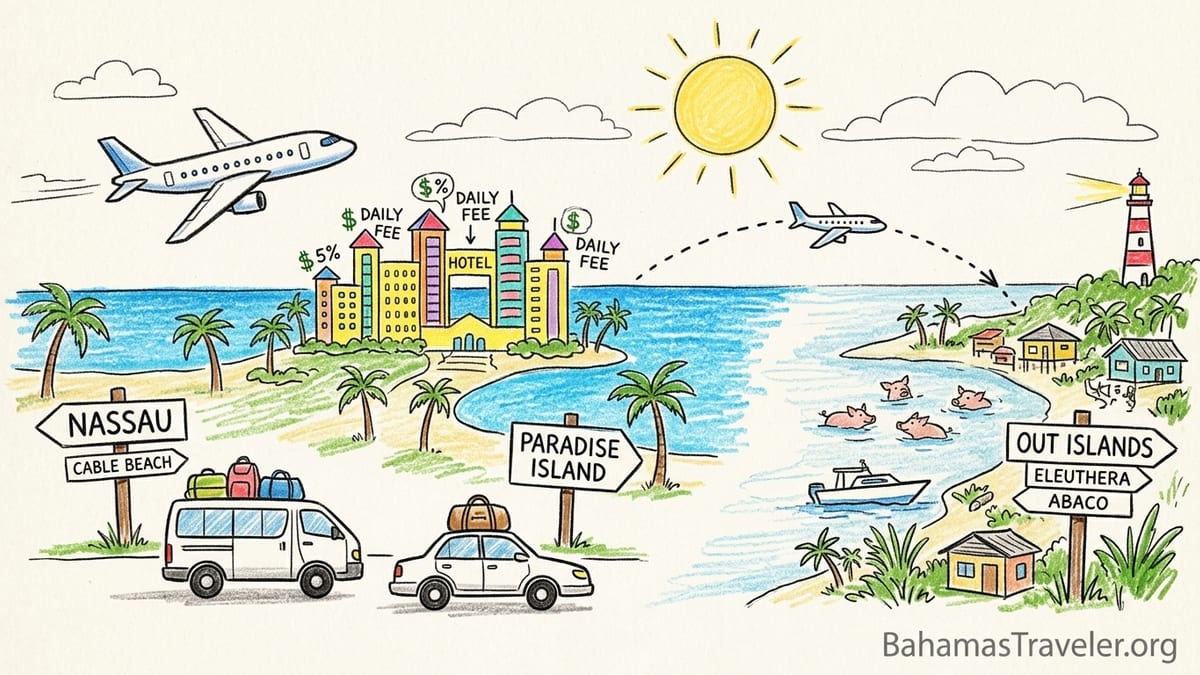
What I Actually Booked Separately (And Where the Bahamas Got Complicated)
On my DIY trip, I booked four core pieces separately: flights into Nassau (NAS), the hotel, airport transfers, and activities. That sounds simple until you remember that Nassau and Paradise Island are two different logistics realities. Nassau is drive-and-arrive: you land, clear formalities, and you’re usually a 20 to 40-minute transfer from Cable Beach, downtown, or your resort. Paradise Island is close in distance, but the cost stack is heavier because the biggest resorts bundle convenience with mandatory fees and daily charges that don’t always show up in your mental budget when you first see the nightly rate.
The first “I should have known” moment was how quickly a resort stay can turn into a math problem. At Atlantis, for example, the resort publishes a layered set of add-ons that can materially change your total: utility service fees (a percentage-style package of VAT and levies), a daily resort fee that differs by tower, and a mandatory gratuity structure that can apply per person, per night. Even when a room rate looks comparable to another hotel, those fixed daily charges can move the total cost by hundreds of dollars on a weeklong stay, which is exactly the kind of thing a flight plus hotel package can sometimes simplify by rolling it into one quote.
The second surprise was transfers. When I booked everything separately, I had to decide if I wanted a shared shuttle, private transfer, or taxi and I had to know where I was going, down to the correct entrance and tower. On Paradise Island, that matters more than you’d think, because a driver dropping you at the wrong lobby can mean dragging bags across a resort complex in heat and humidity while you’re still figuring out where check-in actually is.
Finally, activities were easy to book but harder to time. If you’re only doing Nassau or Paradise Island, you can usually add excursions as you go. But once you start adding a second island like Exuma or Eleuthera, “we’ll decide later” can fail fast, because inter-island flights have limited frequencies and delays ripple across your whole plan.
Nassau and Paradise Island: Where Packages Actually Make Life Easier
If you want the Bahamas with minimal friction, Nassau and Paradise Island are where today’s packages are most useful. Flight plus hotel providers are actively marketing Nassau as a bundle destination. JetBlue Vacations, for example, markets Nassau packages with published sample pricing for four-night windows and positions the bundle as an “everything in one booking” approach. American Airlines Vacations also promotes Bahamas packages and highlights time-bound incentives like limited-time bonus miles offers tied to purchasing a package within specific booking windows.
That convenience matters because Nassau and Paradise Island trips have a predictable cost structure. You generally do not need a rental car if you’re staying at a major resort and spending most days on property or on organized excursions. You do need to budget for transfers, on-resort meals, and daily fees at some properties. This is where a package quote becomes a useful benchmark even if you don’t book it: it gives you a baseline for flights plus lodging, and then you can compare that to your DIY build and see whether the delta is explained by seat selection, bag fees, refundable hotel terms, or inclusions like breakfast or resort credit.
Major resorts can also introduce “sticker shock” on add-ons, which is why I’m now cautious about comparing a room-only DIY booking against a bundle that already assumes the resort fee is paid or includes an on-property credit. Atlantis is a clear example because its published fee structure is unusually explicit: daily resort fees vary by tower and are charged alongside a set of nightly taxes and levies, and the resort also publishes mandatory gratuity amounts depending on room type and age. When you book independently, you have to watch those line items like a hawk. When you book through a bundle, you still need to read the fine print, but at least you can start with a single all-in quote and then verify what is and isn’t included.
Another reason packages fit Nassau and Paradise Island: the transfers are straightforward. NAS to Cable Beach resorts like Baha Mar is a simple drive. NAS to Paradise Island is also a simple drive, and there’s no inter-island flight timing risk. That means a flight plus hotel package doesn’t just save you a few clicks, it can reduce the number of separate vendors you might have to deal with if weather, delays, or schedule changes happen.
Real Costs That Can Sneak Up On You in Paradise Island (And How Packages Can Help You See Them)
On Paradise Island, the gap between “nightly rate” and “trip cost” is where many travelers get burned, and I include my past self in that category. When you book independently, you see a hotel rate, you add flights, and you think you’re done. But at resorts like Atlantis, the published reality includes: nightly VAT and levies calculated as a combined utility service fee, a daily resort fee (with a separate VAT charge on that fee), and mandatory gratuities that may apply per person per night depending on the tower and room type. The fees are not a secret, but they can be psychologically easy to ignore until you’re staring at the folio.
This is one area where packages can be helpful even when they are not cheaper. A bundle can force the true “per person” cost into view early, because it often presents an all-in vacation price that you can compare against another property. If you are choosing between a Paradise Island mega-resort and a more traditional Nassau beachfront resort, the easiest way to compare is to equalize the tax-and-fee burden. If you don’t, the seemingly higher nightly rate hotel can actually be the more predictable total spend.
I also learned that “resort credit” is not the same as “trip credit.” Resort credits usually have limitations. Even at properties that offer credits, the fine print often excludes certain charges, and some programs restrict applying credits to taxes, tips, and mandatory fees. So when I see “$25 daily resort credit” or “$100 suite credit,” I now treat it as a value only if I know I’ll use it on eligible items I would have purchased anyway, like a casual lunch, spa treatment, or non-motorized activity add-on.
In practical terms, if you’re doing a first Bahamas trip and you want Atlantis specifically, I now see a strong case for at least pricing a bundled offer before you commit to DIY. Atlantis actively markets an air-and-hotel “Bundle and Save” style promotion that includes a daily resort credit and advertises percentage savings based on date and tower, while also listing the taxes, levies, resort fees, and mandatory gratuities that apply. That transparency makes it possible to compare like-for-like if you take the time to align dates, tower, and room category.
What I’d Choose Today in Nassau: Room-Only vs Breakfast vs Resort Credit vs All-Inclusive
After doing it myself, I think of Nassau stays as a menu of four booking styles rather than a single decision. The first is room-only, which can be ideal if you plan to explore downtown Nassau, eat off-resort, and treat the hotel mainly as a base. The second is a breakfast-included style, which is underrated if you’re traveling with family or you know your mornings will start early with tours or beach time. The third is a resort-credit style, which can be great when you know you’ll spend on-property anyway. The fourth is all-inclusive, which is less common in Nassau than in some Caribbean destinations, but can be a relief if you want predictable spend.
Current offers show how these categories play out in real marketing. Margaritaville Beach Resort Nassau, for example, is promoted on the official Bahamas tourism site with a “Cyber Deal” framing that includes up to 30% savings plus a suite credit for 2026 stays. Margaritaville also promotes offers directly that combine percentage discounts with credits like a $50 daily resort credit on certain deals or a smaller resort credit with a discount in holiday windows. Those are classic “resort-credit” promotions: they’re not free money, but they can be meaningful if you already planned to eat and drink on property.
British Colonial Nassau is another good example because it sits in a different Nassau niche: downtown location with a private beach setup that’s walkable to the city core. It advertises special offers with date ranges extending through late 2026, and it appears in the Bahamas official listings with Florida and Georgia resident-focused promotions that can include both percentage savings and a food-and-beverage credit. Those are the deals that can make a short Nassau getaway feel easier without going full all-inclusive.
For all-inclusive in the Nassau and Paradise Island zone, travelers commonly look at adults-only options. RIU markets flight-inclusive package deals for the Bahamas under its packages channel, and Nassau has well-known all-inclusive footprints like Warwick Paradise Island, an adults-only all-inclusive property that actively promotes direct-booking savings. The right move depends on your eating style: if you’re the type who orders cocktails at the pool, grabs lunch without thinking, and prefers resort convenience, all-inclusive can be rational. If you like local restaurants, day trips, and flexible schedules, room-only plus a targeted credit offer often wins on fit, even if it doesn’t “win” on headline price.
Flight + Hotel Packages in 2026-27: How I’d Compare Like-for-Like Without Fooling Myself
I no longer ask, “Is a package cheaper?” I ask, “Is this package cheaper than the same trip I would actually take?” The only fair comparison is like-for-like dates, same number of nights, similar flight times, similar baggage assumptions, and the same cancellation flexibility. If the package uses a basic economy flight and my DIY plan includes seat selection and a checked bag, then the package isn’t magically cheaper, it’s just not the same product.
One useful way to benchmark is to price a known travel window with a major package provider and then rebuild it. American Airlines Vacations publishes live package examples and updates, including sample per-person pricing for specific departure cities, four-night stays, and named Nassau resorts. Those quotes help you anchor the market for a specific time frame. JetBlue Vacations similarly markets Nassau bundles with a published example tied to exact four-night dates, which is helpful because it forces you to compare a real travel window rather than a hypothetical. I like these examples not because they’re always the best deal, but because they are grounded in an actual date range and show what a bundle might look like for a typical U.S. traveler.
Then I rebuild the same trip in DIY form: I price the flight on the airline site, I price the same room category on the hotel’s site, and I add the known resort fees and mandatory charges. For Paradise Island mega-resorts, I also price the “credit” promotions carefully. A $25 daily credit sounds like $100 on a four-night stay, but it isn’t the same as $100 cash, and it may not apply to the purchases you care about most. Meanwhile, a “fourth night free” deal can be powerful, but only if it’s not offset by higher nightly rates on the paid nights or stricter cancellation terms.
Finally, I check whether the package includes transfers. Many flight plus hotel bundles do not, and that’s fine in Nassau, but it changes your planning. Nassau taxis and private transfers are easy, yet on a first trip, it is still a point of friction, and it is exactly the kind of friction a reputable all-in package or resort-arranged transfer can eliminate.
Why Island Hopping to Exuma, Eleuthera, or Abaco Still Pushes You Toward Independent Planning
After doing an island-hopping style trip, I’m convinced the Out Islands are where the Bahamas truly feels like the Bahamas. They are also where the planning burden rises sharply. The main reason is air and ferry schedules. Nassau is the hub, and inter-island flights can be limited in frequency, which means your entire itinerary must be built around flight times, not the other way around. Even when the flight time is short, the schedule constraints are real.
For Exuma, for example, published schedule overviews indicate multiple weekly nonstop flights between Nassau and Great Exuma, operated by carriers like Bahamasair and Western Air, but the frequencies and times vary and can change. For Eleuthera, routing can involve North Eleuthera (ELH) and sometimes multiple options depending on which end of the island you need. Abaco travel often centers around Marsh Harbour, and schedules can be seasonal. This is where packages exist but behave more like custom itineraries than click-and-buy bundles.
There are providers that build island-hopping programs, but the best ones tend to be consultative rather than instant checkout. Majestic Holidays, for instance, markets island-hopping packages and custom Bahamas planning, and the broader Bahamas ecosystem also promotes “Two Fly Free from Nassau” style offers tied to Out Islands stays, with blackout windows and conditions like showing proof of separate flights at check-in. Those deals can be great, but they’re not a single-button solution; they are a deal layer you apply on top of your flight planning, and they require careful date alignment.
The other island-hopping pain point is transfers on the Out Islands. In Nassau, you can decide transfers after you land. In Exuma, Eleuthera, or Abaco, that can mean you’re suddenly negotiating a taxi on arrival, dealing with limited car inventory, or realizing your lodging is a long drive from the airport. If you’re moving islands, you also need buffers for flight changes and delays. I’ve seen travelers try to build tight same-day connections in Nassau when they are on separate tickets, and that’s a risk I now avoid unless I have generous padding. When I hop islands again, I’ll either book the domestic segments on one ticket where possible or I’ll build a Nassau overnight as a buffer.
The Takeaway
If you want Nassau or Paradise Island, I’d start by pricing a flight plus hotel package as your baseline, even if you think you’ll book independently. It will immediately show you whether your DIY build is missing fees, taxes, or realistic flight assumptions. For major resorts, it also forces you to reckon with daily resort fees and mandatory charges early, which is better than discovering them at checkout or on your folio.
If you want the Out Islands like Exuma, Eleuthera, or Abaco, I’d treat packages as specialized tools rather than defaults. Deals exist, and custom island-hopping planners can be worth it, but the real work is still in the inter-island flight plan, the transfer plan, and the buffer plan. That is the kind of trip where independent planning is not just about saving money; it is about controlling risk and building an itinerary that still works if one flight shifts.
And if you’re using the official Bahamas tourism site to hunt for 2026-27 resort offers, you’re doing the right first step. The Bahamas is clearly marketing active deal search intent right now, and the best strategy is to use those offers as building blocks: pick the island first, then pick the booking style, then compare packages to a like-for-like DIY version before you commit.
FAQ
Q1. Are Bahamas vacation packages always cheaper than booking separately?
Not always. Packages can be competitive, but you need to compare the same dates, similar flights, and the same hotel room type and cancellation terms.
Q2. What’s the most package-friendly Bahamas destination for a first-timer?
Nassau and Paradise Island are the easiest for packages because flights are frequent and transfers are simple, especially to major resorts.
Q3. What costs most often surprise travelers at Paradise Island mega-resorts?
Daily resort fees, mandatory gratuities, and taxes or levies can add up quickly and should be treated as part of the true nightly cost.
Q4. Is a resort credit the same as cash off the total?
No. Resort credits often have restrictions and may not apply to taxes, tips, fees, or certain purchases, so they only help if you’ll use them on eligible items.
Q5. When does breakfast-included make more sense than a resort-credit deal?
If you reliably eat breakfast on-property, especially with family or early tour days, breakfast-included can be more practical than a credit you might not fully use.
Q6. Are all-inclusive resorts worth it in Nassau?
They can be if you want predictable spending and expect to eat and drink mostly on-property. If you plan to explore restaurants and day trips, room-only or credit deals may fit better.
Q7. Do flight plus hotel packages usually include airport transfers in Nassau?
Often they do not. Always check the inclusions, because you may still need to arrange taxis or private transfers separately.
Q8. Why is island hopping to Exuma or Eleuthera harder to package?
Inter-island flights have limited schedules and changes can ripple across your itinerary, so you need more buffering and transfer planning than a single-island Nassau stay.
Q9. How much connection time should I plan in Nassau for a separate domestic flight?
If you’re on separate tickets, give yourself generous padding or consider an overnight in Nassau. Tight same-day connections add risk if the inbound flight shifts.
Q10. What’s the best way to compare a package to DIY booking without guesswork?
Start with a real travel window, then rebuild the same trip independently, adding resort fees, taxes, and realistic flight costs like bags and seat selection.