

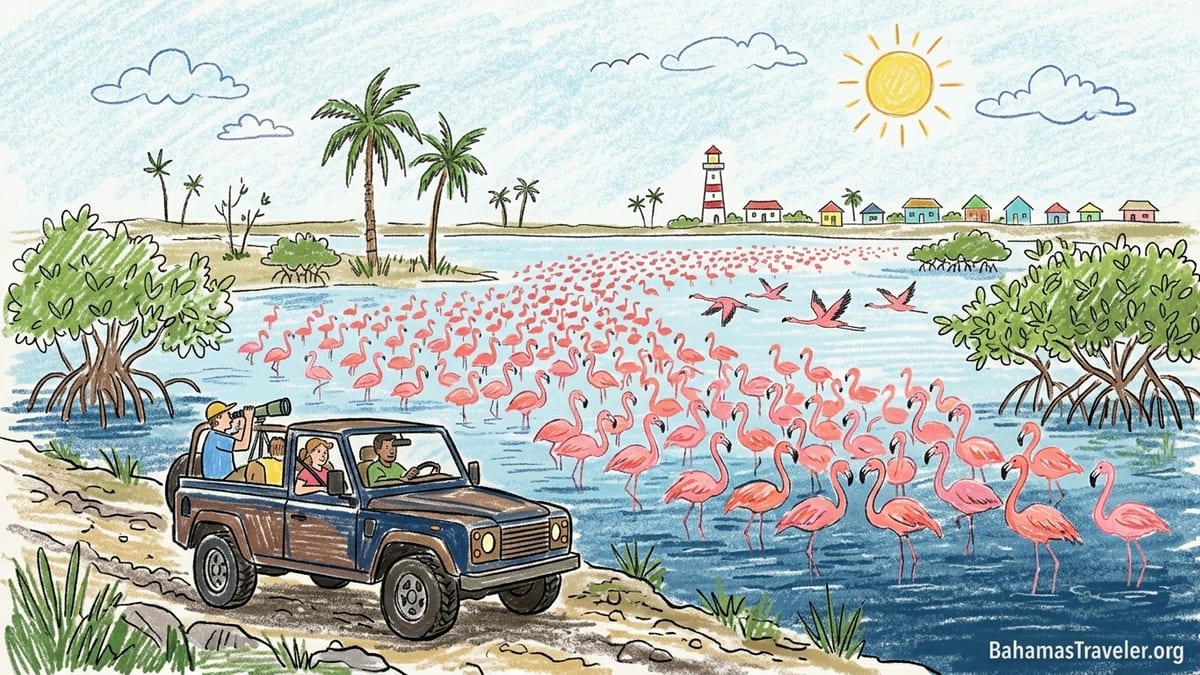
Far in the southern Bahamas, Great Inagua feels a world away from Nassau’s resorts. Here the landscape opens into pale salt pans, scrub forest and the vast, shallow expanse of Lake Rosa, centerpiece of Inagua National Park and home to one of the Caribbean’s most important flamingo colonies. For birdwatchers and photographers, a visit is less a casual detour and more a deliberate pilgrimage to see West Indian flamingos in a protected stronghold, under the guidance of the Bahamas National Trust and local tour operators based in Matthew Town.
Why Inagua National Park Is a Flamingo Stronghold
Inagua National Park was established in 1965 and covers much of the interior of Great Inagua, enclosing all of Lake Rosa, also known as Lake Windsor. The Bahamas National Trust manages the park with a particular focus on its West Indian flamingo colony, which has become one of the best known conservation success stories in the region. The colony recovered from near collapse in the mid twentieth century and is now widely described in official tourism material as the world’s largest breeding colony of West Indian flamingos.
Current estimates suggest that tens of thousands of flamingos use the wetlands here, with reputable conservation and government sources typically quoting figures in the range of roughly 50,000 to more than 80,000 birds across the island and its associated wetlands. Exact numbers fluctuate from year to year as birds move around the wider Caribbean, and visitors should understand that any population figure is an informed estimate rather than a precise, permanent count. What remains consistent is the sense of scale: at peak times the distant pink line of birds across Lake Rosa can feel almost continuous.
Lake Rosa itself is a broad, shallow, hypersaline lake in the center of the island. Flamingos feed here on tiny crustaceans and other invertebrates in the briny water, and the exposed mudflats and low islands offer suitable nesting areas when conditions are right. Surrounding wetlands and marshes support herons, egrets, spoonbills and ducks, making the park far more than a single-species destination. Visitors who hire knowledgeable guides often discover that the outer ponds and mangroves are just as absorbing as the main flamingo roosts.
Because the park is managed first as a wildlife sanctuary, tourism here remains low-key and controlled. Access is through rough interior tracks that are not signposted or suited to casual rental vehicles, and the Bahamas National Trust relies on trained wardens and licensed guides to balance visitor access with the needs of nesting birds and fragile wetland habitat. For visitors, this creates a more intimate, field-based experience than at many better known coastal resorts.
Understanding the Role of the Bahamas National Trust
The Bahamas National Trust, created by an Act of Parliament in 1959, is responsible for managing Inagua National Park and more than 30 other protected areas across the country. In Inagua, Trust staff and wardens are based in and around Matthew Town, from where they oversee park access, monitor bird populations, and work with local guides, conservation partners and the Morton Salt operation that dominates parts of the island. The Trust has been central to flamingo recovery here through anti-poaching measures, habitat protection and public education.
For visitors, the Trust’s presence matters in practical ways. Travel information on Inagua published by the Trust emphasizes that access to the interior and the main flamingo viewing areas should be arranged with wardens or approved guides using appropriate vehicles. In practice, this often means traveling in a four wheel drive truck or SUV driven by a local guide who knows the current track conditions and where birds are feeding or resting that day. The Trust also periodically supports training for bird guides and community-based tourism, in collaboration with the Ministry of Tourism and international partners such as Audubon.
Communication channels for visitors are still quite traditional. Many travelers planning a dedicated birding trip begin by contacting the Bahamas National Trust headquarters in Nassau by email or phone, then request up to date contacts for the Inagua warden and recommended guides. Others rely on local operators whose details appear on official Bahamas tourism materials. Whichever route you choose, it is important to confirm that your tour is recognized by the Trust or arranged in coordination with its staff, especially if you expect to access the interior of the park rather than simply birding near Matthew Town.
The Trust’s wardens have authority over where vehicles can travel in the park, how close groups can approach nesting areas, and whether conditions on a given day are suitable for particular routes. In periods of high water, deep mud or sensitive nesting activity, some tracks may be temporarily off-limits. A reputable guide will explain these constraints clearly and adjust your itinerary to comply, even if that means longer viewing distances or a focus on different wetlands.
Booking Flamingo and Birdwatching Tours from Matthew Town
Matthew Town is the island’s only settlement and the practical base for all visits to Inagua National Park. From here, visitors typically arrange half-day or full-day excursions with local operators who specialize in birding and island tours. One long established operator promoted through official Bahamas tourism channels is Great Inagua Tours, run by a local guide with decades of experience leading birding, wildlife and island tours. Another name that appears in recent local business listings is Friendly Tours Inagua, based on Victoria Street in Matthew Town. Both represent the kind of small-scale guiding enterprises that work closely with park authorities and other local institutions.
Because these operations are small and conditions can change, visitors should plan to make direct contact well ahead of their trip rather than relying on automated booking engines. Phone and email are still the preferred methods. When you reach out, ask specific practical questions instead of simply requesting a “flamingo tour.” These might include whether the guide is currently arranging entries into Inagua National Park itself, what type of vehicle is used, whether binoculars or spotting scopes are provided, and how many photography stops are planned near wetlands, mangroves or salt ponds.
As of late 2026, published tour prices for Inagua birding remain limited and often out of date. Older materials for Inagua park visits through conservation programs have referenced broad budget ranges rather than fixed public tariffs. For an accurate sense of current costs, travelers should ask guides to quote directly for half-day and full-day options in Bahamian dollars, specifying group size. Given the island’s remoteness and the wear on vehicles, prices are likely to be higher than casual sightseeing tours on New Providence or Grand Bahama. Visitors should budget at least a few hundred Bahamian dollars per vehicle for a customized day out, but only the operator can confirm real, current rates.
When you inquire, it is also worth asking about minimum participant numbers. Some Inagua guides will take out single travelers or couples but may quote a flat rate per vehicle rather than per person. Others might prefer a minimum of three or four guests to make a long drive into the interior economical. Clarify whether the price includes park access arrangements coordinated with the Bahamas National Trust, the cost of fuel, hotel pick up in Matthew Town, and simple refreshments or drinking water.
Half-Day vs Full-Day Experiences at Lake Rosa
Half-day tours usually focus on one main objective, such as seeing flamingos feeding or roosting on parts of Lake Rosa, combined with a few stops at accessible wetlands or coastal viewpoints. A typical half-day outing might leave Matthew Town early in the morning, when the light is softer and air temperatures are more comfortable, and return around midday. In that timeframe, guides can often drive to a vantage point that looks across Lake Rosa toward distant flocks, set up a scope or encourage guests to use their binoculars, and point out other species such as herons, egrets and spoonbills along the route.
Full-day tours allow a more rounded experience of Inagua’s habitats. With a whole day, guides sometimes combine time at the national park’s interior wetlands with visits to the lighthouse, coastal shorelines or even a look at the commercial Morton Salt works from approved viewing areas outside operational zones. Some “complete island tours” promoted through official tourism descriptions include wildlife viewing at the park, a look at wild donkeys, stops at caves and a short visit to the museum or lighthouse near Matthew Town. For serious birders, a full day also offers the chance to explore different habitats at different times of day, from dry forest edges where Bahama parrots may appear to small ponds that attract ducks and waders in the late afternoon.
From a practical standpoint, full-day tours are more likely to justify the fuel and wear of traveling the rougher interior tracks, especially if the flamingos have shifted to more distant sections of the lake. However, visitors should understand that driving all the way to the literal edge of the main nesting islands is neither realistic nor appropriate in most situations. Guides balance the desire for closer views with the need to avoid disturbing feeding or resting flocks, and you should expect to spend significant time observing through optics at a respectful distance rather than standing directly among the birds.
Whether you choose a half-day or full-day experience, always ask the operator up front to confirm exactly what is included. Check if park access has been cleared with the Bahamas National Trust, if a portion of your fee supports conservation, what vehicle you will travel in, and how much time is allocated at each stop. Also ask what happens if heavy rain or unusually high water levels make particular tracks impassable. Responsible guides will have alternative routes or a clear cancellation and refund policy for days when interior access is not possible.
When to Visit: Flamingo Courtship, Breeding and Other Wildlife
Flamingos in Inagua are present year round, which means visitors at almost any time of year have a realistic chance of seeing flocks on Lake Rosa or surrounding wetlands. However, courtship and nesting activity are more seasonal and heavily influenced by rainfall and water levels. In wetter years, when suitable islands and mudflats form, birds may engage in dramatic mass displays and build mud nests on exposed banks. Conservation accounts describing Inagua’s colony often highlight the sight of thousands of birds in synchronized courtship marches and large crèches of chicks herded in the shallows.
In broad terms, courtship displays and nesting may take place in late winter and spring when conditions align, with chicks present later in the season, but there is considerable variation from year to year. Visitors should not expect guides to promise active nests or chick crèches during a specific week or month. Instead, ask your guide what the birds have been doing in recent weeks and prepare to appreciate whatever natural behavior is visible, from feeding and preening to flight displays at dawn or dusk. Ethical operators will avoid approaching any active nesting area closely, even if that limits photographic opportunities.
Beyond flamingos, Inagua is recognized by Bahamian tourism and conservation agencies as a birdwatching hub, with well over a hundred recorded species. Highlights include the Inagua woodstar, a hummingbird endemic to The Bahamas, as well as Bahama parrots, Bahama pintails, brown pelicans, tricolored and reddish herons, snowy egrets, double-crested and Neotropic cormorants, roseate spoonbills and birds of prey such as American kestrels and burrowing owls. Many of these can be seen in and around Matthew Town, along coastal roads or near smaller ponds without yet reaching the main body of Lake Rosa.
Seasonality matters for some species. Migratory shorebirds may be more numerous during spring and autumn passage periods, while waterfowl numbers can rise when conditions on the wetland complex are especially favorable. Conversely, intense heat in the peak of summer can make birding in the middle of the day challenging. For a balanced mix of more temperate weather and active birdlife, many birders aim for the drier months outside the height of hurricane season, while remaining flexible about exactly which weeks they travel to accommodate flight availability and guide schedules.
Park Interior vs Commercial Salt Ponds: Knowing the Difference
Visitors to Great Inagua quickly notice the vast commercial salt operation that dominates much of the island’s southern and central area. The Morton Salt facility uses large evaporation ponds to produce sea salt, and its geometric basins, levees and roads are visible from the air and from some coastal viewpoints. While wildlife can and does use some of these manmade ponds, they are fundamentally industrial spaces operated by a private company rather than parts of Inagua National Park.
By contrast, the park’s core wetlands, including Lake Rosa and associated marshes, are set aside primarily for conservation and limited, controlled visitation. The Bahamas National Trust’s remit is to protect these habitats, and public access usually takes place only under the supervision of wardens or licensed guides. This distinction matters for visitors who may assume that any stretch of water or salt pan is fair game for exploration. In reality, some dikes and service roads are strictly off-limits, either for safety reasons at the salt works or to prevent disturbance in the protected wetlands.
Responsible tour operators are careful to clarify where their vehicles can travel and where guests may walk. A typical itinerary might include a roadside stop where salt operations are visible from a safe distance, combined with separate entry into Trust-managed land where wardens have authorized a particular track for that season. It is essential not to drive private rental vehicles along unmarked dikes, through locked gates or deep into the interior without clear permission. Besides the risk of getting stuck in deep mud or damaging infrastructure, unaccompanied visitors can easily stray too close to sensitive nesting or roosting sites.
For birdwatchers who enjoy exploring independently, the best alternative is to focus on public roads and easily accessible habitats near Matthew Town, the lighthouse and coastal areas, then book at least one guided excursion into the true interior. This approach respects local regulations, supports community-based tourism and sharply reduces the risk of inadvertently disturbing protected colonies.
Ethical Wildlife Viewing and Appropriate Distances
In a place like Inagua, where the flamingo colony carries global conservation significance, ethical behavior in the field is not optional. The Bahamas National Trust and its partners routinely emphasize the need to keep well back from nesting areas and to avoid any action that might flush birds from feeding or roosting sites. In practical terms, this means observing the main flocks through binoculars or a spotting scope rather than approaching until individual birds fill the frame of a smartphone camera.
There is no single universally published distance rule for every situation, because wind, terrain and bird behavior all matter. However, many field guides and conservation groups recommend staying at least many tens of meters away from waterbird colonies, and in the wide open expanse of Lake Rosa that often translates into much more. Guides watch for signs of stress, such as birds craning their necks, bunching together or beginning to walk away from the water’s edge, and will typically advise guests to stop or back away if these behaviors appear. Guests should follow these instructions immediately, even if it means fewer close-up images.
Ethical viewing also includes simple practicalities: keeping group sizes modest, speaking quietly, never playing bird calls to lure birds closer and strictly avoiding drones. Small unmanned aircraft in particular can cause severe disturbance to nesting and roosting birds, and visitors should leave them at home. Tripods, long lenses and spotting scopes are all preferable tools for photographers who want frame-filling images without encroaching on the birds themselves.
Crucially, visitors should remember that no specific sighting can be guaranteed. Wild birds move freely across the landscape and may shift feeding or roosting areas in response to water levels, food availability or weather. While the flamingo colony is large enough that seeing at least some birds is very likely on any guided visit, there is always a chance that conditions on a given day limit viewing or push flocks farther from accessible vantage points. Understanding this uncertainty is part of traveling responsibly in a genuine wildlife destination rather than an artificial attraction.
Getting There, Staying in Matthew Town and Staying Comfortable
Reaching Inagua requires a bit more planning than hopping to better known Bahamian islands. From Nassau, the primary option is the domestic carrier Bahamasair, which operates scheduled flights to Inagua Airport near Matthew Town on limited days of the week. Recent departure information from Nassau’s airport and independent flight schedule summaries indicate that services to Inagua currently operate on specific weekdays, often including at least one early-week and one late-week flight. Schedules can change, so travelers should check directly with Bahamasair and plan for possible adjustments or weather-related disruptions.
Because flight frequency is low, it is wise to build flexibility into your itinerary. Many visitors overnight in Nassau on either side of their Inagua trip, allowing time to connect between international flights and the domestic service to Matthew Town. When you book, consider the implications of delays: missing the only flight to Inagua on a given day could mean waiting several days for the next available seat. Travel insurance that covers missed connections and schedule changes is prudent for anyone committing to a dedicated birding trip here.
Lodging in Matthew Town remains limited and relatively low-key. Recent traveler reports and regional travel guides describe a small selection of guesthouses and simple hotels, with nightly rates that are generally more modest than high profile resort islands but higher than remote camping or homestays. Because properties can change hands or close, there is no comprehensive, always-current list of options. Prospective visitors should contact the Bahamas National Trust, local tourism representatives or their chosen guide for up to date recommendations and then book directly with the property.
Conditions on the ground are straightforward but can be demanding for those used to resort environments. Sun exposure is intense, especially in the dry season, and there is little shade on the open tracks around Lake Rosa. Visitors should bring wide-brimmed hats, high SPF reef-safe sunscreen, lightweight long-sleeved shirts and sunglasses. Insects can be significant near wetlands, particularly at dawn, dusk or after rains, so packing a strong insect repellent and light, loose-fitting trousers is important. Guides usually bring drinking water, but travelers should not rely on this alone and are wise to carry their own refillable bottles and electrolyte tablets, especially on full-day tours.
Photography and Field Gear for Serious Birders
Photographers and keen birders will get far more from Inagua if they arrive with appropriate optics and expectations. For flamingos on Lake Rosa, a good quality pair of 8x or 10x binoculars makes a huge difference, turning distant pink dots into clearly recognizable birds. A spotting scope on a sturdy but portable tripod is even more valuable when viewing large, static flocks at long range. Some guides carry scopes and are happy to share, but serious birders should not assume one will always be available and may prefer to travel with their own compact field scope.
For still photography, a telephoto lens in the 300 to 600 millimeter range on a DSLR or mirrorless camera body is ideal. On crop-sensor cameras, even a 300 millimeter lens can provide satisfying images of flamingos and other waterbirds without getting close enough to disturb them. Image stabilization and a decent monopod or lightweight tripod help when shooting at high magnifications. Many photographers find that environmental images showing the scale of Lake Rosa and the shimmering lines of birds on the horizon are just as compelling as tight portraits.
The combination of heat, salt and rough tracks means that gear protection and transport require thought. Dust and salt spray can accumulate quickly, so bring cleaning cloths, a blower, lens wipes and dry bags or padded cases that can sit in the back of an open truck. Batteries and memory cards should be easy to access, since changing them in a moving vehicle or on a dusty roadside is not ideal. Charging options in Matthew Town accommodations may be limited to standard outlets in a common room or basic guest rooms, so a multi-outlet travel adapter and power strip can be useful for those traveling with multiple bodies, laptops and hard drives.
Keen record-keepers might also pack field notebooks or birding apps preloaded with regional checklists for Inagua, so they can log sightings offline. While mobile reception in parts of the island may exist, it is not something to rely on for navigation or identification tools once you are deep in the interior. Offline map downloads that show major tracks, the approximate park boundary and landmarks such as the lighthouse add a modest extra layer of security and context to your guided excursions.
The Takeaway: Who Inagua Suits and When It Is Worth the Journey
Inagua National Park is not a casual add-on to a Nassau beach holiday. It is a destination for travelers willing to invest time, effort and some uncertainty in exchange for time in one of the Caribbean’s most significant flamingo habitats. Casual wildlife visitors who are already in The Bahamas may find that a short side trip is justified if they can secure flights that align with their dates and confirm a day tour from Matthew Town. For them, a single full day in the park, combined with simple walks around town and the coast, may provide enough flamingo views and island character to feel rewarding.
Serious birders, on the other hand, often plan multi-day stays of three to five nights in Matthew Town. This allows time for at least two or three guided outings into the interior, repeated chances to see target endemics such as the Inagua woodstar and Bahama parrot, and flexibility around weather or temporary access restrictions. For this group, choosing travel dates outside the most active hurricane period, budgeting for private guiding and building buffer days on either side of the domestic flights is part of the experience rather than an inconvenience.
Photographers who specialize in birds or conservation subjects may want even longer stays, especially if they hope to capture varied light conditions, behavioral sequences or a mix of aerial-like landscape images and shore-level views. However, they should arrive with a clear understanding that nesting activity and dramatic courtship displays cannot be scheduled in advance and should never be pursued at the expense of the birds’ comfort or breeding success. Inagua rewards patience, respect and a willingness to work with whatever nature offers each day.
Whether Inagua is worth a dedicated journey from Nassau ultimately depends on your priorities. If you are content with resort amenities, accessible snorkeling and casual birding from hotel grounds, the capital region and nearby islands already offer plenty. If, instead, you value remote landscapes, conservation stories and the chance to watch great sweeps of flamingos move across a wild Bahamian lake under the guidance of local experts, then planning a focused trip to Great Inagua and its national park can be one of the most memorable wildlife experiences in the Caribbean.
FAQ
Q1. How many flamingos will I see at Inagua National Park?
The flamingo population on Great Inagua is generally estimated in the many tens of thousands, but the number visible from a given viewpoint on your visit will vary with water levels, weather and where the flocks are feeding or roosting that day. Guides can usually locate substantial groups, yet no specific number or viewing distance can be guaranteed.
Q2. Can I visit Lake Rosa on my own without a guide?
It is strongly discouraged to attempt independent drives into the interior of Inagua National Park. Tracks are rough, poorly marked and highly sensitive, and unaccompanied visitors risk getting stuck, entering restricted areas or disturbing nesting birds. The Bahamas National Trust recommends arranging visits through wardens or licensed local guides based in Matthew Town.
Q3. What is the best time of year to see flamingo courtship and nesting?
Flamingo courtship and nesting activity at Inagua tend to occur in seasons when water levels and weather patterns are favorable, often in late winter and spring, but timing varies widely from year to year. Because rainfall patterns and lake conditions shift, no operator can responsibly promise active nests or chick crèches on specific dates.
Q4. How do I book a birdwatching tour from Matthew Town?
You will normally contact local operators such as long established island tour companies or smaller guiding outfits by phone or email and then coordinate with the Bahamas National Trust warden if interior park access is planned. Ask about vehicle type, park permissions, what equipment is provided and confirm current prices and minimum group sizes directly with the operator.
Q5. What kind of vehicle is needed to reach the flamingo viewing areas?
Access tracks around Lake Rosa and through the park interior are rough and often muddy, so a high clearance four wheel drive vehicle driven by an experienced local guide is the norm. Standard rental cars are unsuitable for these routes, and visitors should not attempt to drive them into the park on their own.
Q6. Are binoculars and spotting scopes provided on tours?
Some Inagua guides carry binoculars and a spotting scope for guests to share, especially on bird-focused tours, but this cannot be assumed. When booking, ask explicitly whether optics are included, and if you are a keen birder consider bringing your own binoculars and, if practical, a compact scope for the best viewing.
Q7. What other bird species can I expect to see besides flamingos?
In addition to West Indian flamingos, visitors commonly look for the endemic Inagua woodstar and Bahama parrot, as well as Bahama pintails, pelicans, herons, egrets, cormorants, roseate spoonbills, American kestrels and burrowing owls. The exact mix on any trip depends on season, water levels and how much time you spend in different habitats.
Q8. What should I pack for a full day in the park?
For a comfortable full-day excursion, pack a wide-brimmed hat, high SPF sunscreen, insect repellent, lightweight long sleeves, sturdy closed shoes, a refillable water bottle, snacks or a packed lunch, and whatever optics or camera gear you plan to use. A light scarf or buff can help with dust on open truck rides, and a dry bag or padded case protects electronics from bumps and salt.
Q9. How many days should I spend on Great Inagua?
Casual wildlife visitors often stay two or three nights, which usually allows for at least one full day in the park plus time to explore Matthew Town and the coast. Serious birders and photographers may prefer three to five nights to accommodate multiple guided outings, changing weather conditions and the chance to search for a broader list of target species.
Q10. Is Inagua suitable for families or very casual travelers?
Inagua can be rewarding for families and casual travelers who are enthusiastic about nature and comfortable with basic infrastructure, bumpy roads and early starts. However, it is not a resort-style destination, and those seeking pools, nightlife and a broad choice of restaurants may be happier basing themselves around Nassau or other more developed islands and treating Inagua as a focused wildlife side trip only if they are genuinely interested in birds and remote landscapes.