


On a map, Ragged Island looks like a small comma at the very southern end of the Bahamian archipelago, a single inhabited dot at the tail of the long Jumentos Cays chain. In person, reaching Duncan Town, the island’s only settlement, feels less like planning a side trip and more like organizing a mini‑expedition. There are no scheduled ferries, no regular commercial flights, almost no tourist infrastructure and very few services. Visiting is possible, but only if you treat transport, logistics and expectations with the same seriousness you would give to a remote field assignment rather than a casual beach getaway.
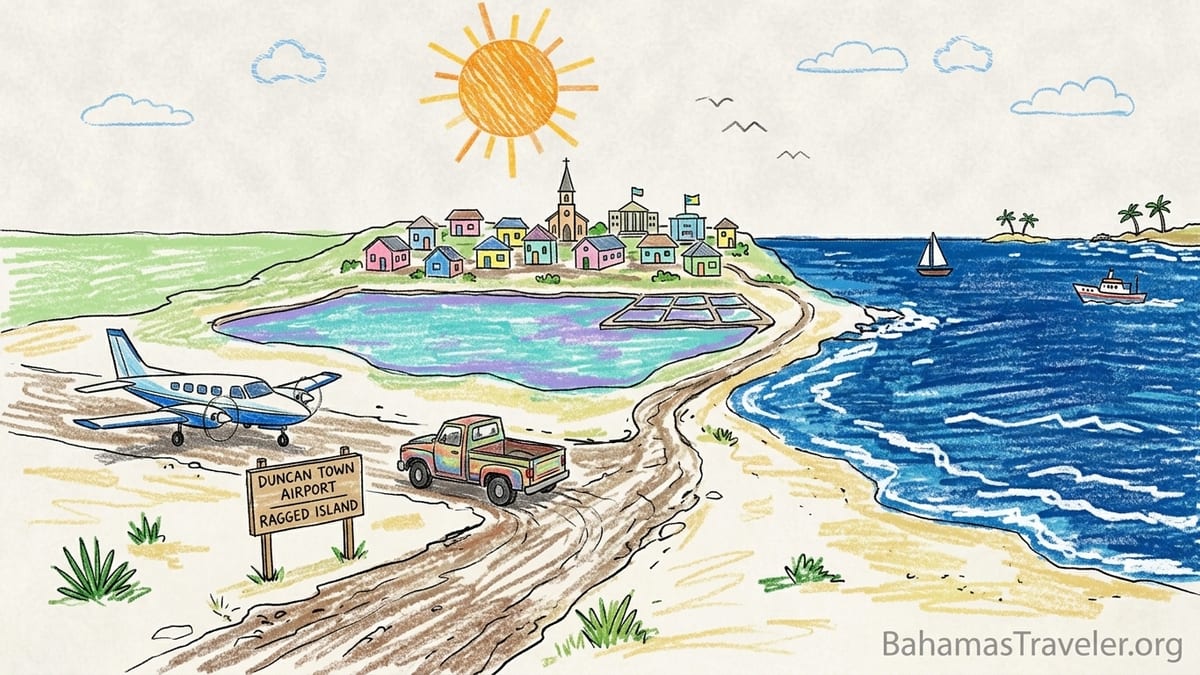
Why Ragged Island Is Different From the Rest of the Bahamas
Ragged Island is not one more stop in the usual Nassau–Exuma–Harbour Island conversation. It is the southernmost inhabited island in the Bahamas, with Duncan Town as its lone settlement and administrative center for the wider Ragged Island chain and nearby Jumentos Cays. The whole island is only a few dozen square kilometers, and the town sits on a low ridge above a broad salt pond, with shallow banks on one side and deep ocean on the other. Before Hurricane Irma in 2017, the population was already small. When the storm passed almost directly over the island, it shredded houses, the school, clinic and utilities, and the community was temporarily evacuated. Years later, the population remains in the dozens rather than the hundreds, and reconstruction has focused on making the island livable again for residents, not creating a tourism hub.
This physical and demographic reality explains almost everything about access. There is a small airport near Duncan Town, but at present there are no scheduled commercial flights from Nassau or any other island. The national airline lists connections to several remote islands in the southern Bahamas, yet Ragged Island is absent from timetables. Instead, that narrow runway is used by charter aircraft, government planes and medical evacuations. Out at sea, Ragged Island lies far beyond any of the domestic passenger ferry routes that connect Nassau to Spanish Wells, Harbour Island, Andros or the northern Exumas. Supply boats and mailboats come through on an intermittent schedule to serve the residents, not visitors, and they are not bookable online as a simple round trip.
It is important to separate Ragged Island itself from the broader Ragged Island chain, sometimes referenced together with the Jumentos Cays. Much of what experienced cruisers and yacht charter companies praise in this region lies outside the main island: long, uninhabited cays, deep anchorages, and remote fishing grounds stretching northward toward the Exumas. Those areas have no formal tourist facilities at all. Duncan Town is the one place where you find a school, a government dock, a church, a few clustered homes and some basic utilities. Visitors arrive either because they have come all this way by private boat, or because they have gone to the effort and expense of arranging a private flight or charter to the island itself.
All of this creates a very different decision profile for would‑be visitors. For most Bahamian islands a traveler can reasonably assume there will be a seat on a domestic airline or a ticket on a scheduled ferry, and some choice of hotels or guesthouses that can be booked online. Ragged Island resists that kind of casual planning. You can go, but only if you start by accepting that transport will be bespoke, that accommodation options are limited and informal, and that the people you are dealing with are organizing a practical trip to a remote hometown rather than operating a polished tourism product.
Planning the Journey: From Online Curiosity to Actual Enquiries
The research process for Ragged Island illustrated just how quickly the usual Caribbean trip‑planning tools run out of road. General flight search engines showed Duncan Town Airport as a code on the map, but produced no results when queried for dates months in advance. The official tourism site for the Bahamas explained connections to many Out Islands and noted that some are served only by charters, without listing Ragged Island as an active commercial destination. There were no standard ferry options, and mainstream booking platforms returned zero hotels in Duncan Town or Ragged Island district.
That left two realistic options for actually setting foot in Duncan Town. The first was to charter a small aircraft from Nassau with a licensed domestic operator. Regional charter brokers and aviation service companies confirmed that the runway at Duncan Town can accept light twin‑engine aircraft. A published on‑request schedule for inter‑island medical and charter flights listed a typical Nassau to Duncan Town leg of about ninety minutes each way in daylight, reinforcing that this is treated as a custom route, not a regular commuter hop. The second option was to arrive by private boat as part of a longer cruise through the Jumentos Cays, either on a crewed yacht or under one’s own command on a chartered sailboat or power catamaran based in Nassau or the Exumas.
For this investigation, the most controlled way to document costs and constraints was to organize a private flight and then arrange a short local boat charter out of Duncan Town. Initial email enquiries to charter brokers in Nassau produced a spread of indicative prices. Operators who regularly move small groups between Nassau and the more developed Out Islands quoted figures around 2,800 to 3,500 US dollars for a same‑day return in a six‑seat piston twin, including taxes and landing fees, if fuel prices remained stable. A turboprop that could carry eight or nine passengers would cost more, in the region of 4,000 to 5,000 US dollars for the aircraft, but with a lower cost per seat if fully occupied.
Those numbers change with season, aircraft type, fuel and weight. Brokers were frank that Ragged Island is considered a remote leg. Charter companies that publish prices for more common Nassau routes, such as Nassau to North Eleuthera or Nassau to Staniel Cay, typically show round‑trip charters for a five‑ to nine‑seat plane starting a little above 1,000 US dollars and rising to more than 3,000 US dollars for distant cays. When asked to extend that model to Ragged Island, operators emphasized that the extra distance and the lack of alternate traffic on the route keep costs high. None claimed Ragged Island as a standard scheduled stop. All described the flight as a special request that would run only with a full charter agreement in place.
The Actual Transport: Charter Flight, Local Captain and Real Costs
In the end, a workable arrangement emerged with a Nassau charter broker who had previously flown survey teams and government staff to Duncan Town. The aircraft was a six‑seat twin‑engine piston with a pilot and co‑pilot. The quoted price for a two‑day, one‑night itinerary, Nassau to Duncan Town and back, came to 3,250 US dollars for the aircraft, plus 10 percent value‑added tax and approximately 150 US dollars in additional landing and handling fees spread across both airports. The total bill was a little under 3,750 US dollars. This was for up to five passenger seats, as one seat was occupied by the second crew member.
The charter was shared among four passengers, all traveling with soft duffel bags to stay within the aircraft’s strict weight and balance limitations. The per‑person transport cost from Nassau therefore worked out at just under 940 US dollars for the return flight alone. The pilot was explicit that in marginal weather the flight would be postponed, or in poor visibility potentially cancelled, because there are no instrument approach procedures into Duncan Town and no runway lighting for night operations. That meant building a margin of at least one extra day into the wider Bahamas itinerary in case conditions required shifting the flight. This level of weather dependence is quite unlike booking a commercial jet into Nassau or even a daily turboprop to a larger Out Island.
On Ragged Island itself, the next challenge was finding a local captain with a seaworthy boat who was both licensed and comfortable taking visitors to nearby cays. Conversations with residents ahead of the trip suggested that only a handful of islanders operate small commercial vessels suitable for charter, mostly for fishing or supply work rather than sightseeing. Through local introductions it was possible to arrange a half‑day boat hire on a center‑console skiff with a Bahamian captain. The agreed price was 450 US dollars for about four hours on the water, fuel included, for up to four people, again with an understanding that wind and sea conditions would dictate whether the run stayed within sheltered banks or could safely push out toward nearby cays.
Taken together, these figures illustrate why an independent traveler cannot treat Ragged Island as a casual extension of a Nassau beach holiday. Even with cost sharing and modest expectations, transport dominated the budget. There was no possibility of offsetting this with a cheap ferry, low‑cost airline seat or large‑group tour, as one might do to reach popular islands closer to the capital. Everything was bespoke, and the prices reflected the reality of moving small numbers of people to a very remote community with limited fuel, maintenance and backup options.
Arrival in Duncan Town: First Impressions of a Barely Visited Settlement
Approaching Ragged Island from the air felt very different from descending into a busy resort island. The aircraft crossed the deep blue of the Old Bahama Channel before banking over pale green banks and narrow cays, then touching down on a short, sun‑bleached runway with no terminal building, only a simple structure and a parking area. There were no taxis waiting, no rental car kiosks, just two pickup trucks whose drivers were clearly expecting specific passengers. Pre‑arranging a vehicle transfer from the airport into Duncan Town, a drive of just a few minutes, was less a matter of comfort than basic practicality. Without that, walking would have been possible, but awkward with luggage under the midday sun and heat.
Duncan Town itself sits on slightly higher ground between the ocean and the salt pond. The settlement consists of a small cluster of houses, some brightly painted and recently repaired, others still boarded or damaged from previous storms. A single church steeple and a compact school complex orient the visitor, along with government buildings and a clinic that serves the island. There are no rows of restaurants, no bars with chalkboard cocktails, and no souvenir arcades. The streets are quiet for much of the day, and almost everyone encountered on foot is a resident or someone visiting family.
Walking through town quickly reveals the long maritime history that underpins Ragged Island’s existence. Along the salt pond are remnants of the old salt industry that once exported to markets as far as Cuba, including traces of salt pans and causeways. Locals point out where families once worked the ponds and shipped cargo through the harbor. The sea remains central. Small fishing boats lie hauled up near the waterfront, and a weathered government dock marks the connection to the wider Bahamas. Older residents speak of subsistence fishing, mailboat supply runs, and the long distances covered by small craft to reach productive grounds or larger markets.
It is crucial for visitors to approach this environment with a respectful attitude. Unlike resort islands where tourism is woven into daily life, Duncan Town remains primarily a place where people live and work, not a destination organized around outsider expectations. Photography is welcome, but asking permission before pointing a camera at individuals or private property is courteous. Conversations begin with introductions, and questions about life after Hurricane Irma or the rhythms of fishing and schooling are best asked slowly and with an ear for how much someone wants to share. There are no organized cultural tours to buy; human encounters happen informally, on the street or at the dock, if you are patient and polite.
What You Can Actually Do on Ragged Island
With so little formal tourism infrastructure, the main activities for visitors on Ragged Island fall into four overlapping categories: walking and observing Duncan Town itself, exploring the immediate coastline within easy reach, engaging with local history and conversation, and arranging small‑scale excursions into the surrounding waters when conditions, regulation and local willingness align. Each of these is constrained in ways that can surprise travelers accustomed to islands designed around visitor entertainment.
Within walking distance of most accommodation options, the town offers a circuit that runs from the ridge down toward the salt pond and back toward the ocean shore. This loop takes in modest churches, the school, the clinic and some of the hurricane‑damaged buildings that have yet to be fully rebuilt. It is a short route and can be covered in less than an hour, but slowing down makes it more rewarding. From certain vantage points you can see both the pond and the sea, emphasising the narrowness of the island and the exposure that made past storms so destructive. Traces of marine life are everywhere: fishing gear stored under houses, conch shells used as garden edging, and lines hung to dry.
Reaching the coastline on foot is straightforward in several directions, although there are no built promenades or lifeguarded beaches. Paths and sandy tracks lead to low ironshore, small coves and stretches of sand. Swimming is possible in calm weather, but currents and sharp rock require caution, and there are no services on the shore. Carrying drinking water and basic first‑aid supplies is non‑negotiable, because there are no beach kiosks or nearby shops once you leave the settlement. For photographers, the rewards come in the form of expansive sea views, changing light on the banks and the feeling of standing at the very edge of the archipelago, looking toward open ocean.
Excursions by boat expand the possibilities but depend entirely on local captains. Fishing can be excellent in the waters around Ragged Island and along the Jumentos Cays, yet foreign visitors need to respect Bahamian fishing regulations and local practice. That means arranging any fishing or snorkeling trip through someone who understands closed seasons, protected species and no‑take zones, rather than hiring an unregulated boat for a casual outing. In practice, most visitors who do manage to get out on the water from Duncan Town end up on highly customized trips to nearby cays or banks, often focused on line fishing, spearfishing where legal, or simply exploring uninhabited beaches for a few hours before weather and daylight call them back.
It is important to emphasize what Ragged Island does not offer. There are no formal dive shops, no guided kayaking outfitters, no horseback rides, beach clubs, or curated day tours. There is no nightlife in the conventional sense, and evenings tend to be quiet, centered around private homes or small, informal social gatherings. For travelers who equate a successful trip with a checklist of attractions, this can feel like deprivation. For others, the absence of structure is part of the appeal. Time is filled by reading on a porch, watching the light shift across the salt pond, listening to wind and roosters, and engaging with neighbors when they happen by, rather than rushing from booking to booking.
Food, Water, Accommodation, Connectivity and Safety
Basic necessities on Ragged Island exist, but not in the frictionless form many travelers expect. Food is one of the clearest examples. There is no lineup of restaurants catering to visitors. Instead you find small groceries that stock dry goods and whatever fresh items have arrived on the most recent boat, and possibly one or two local cooks who, by arrangement, will provide home‑style meals. For this trip, accommodation and food were organized through personal contacts. The group stayed in a modest guesthouse owned by a Ragged Islander who normally rents rooms to visiting technicians and government staff. Meals consisted of simple Bahamian dishes, fish caught nearby, rice, peas, and whatever vegetables were available that week.
Water supply is reliable but finite. The island relies on a combination of rainwater catchment, storage and modern desalination, with systems that have been upgraded during the post‑hurricane rebuilding process. Guests are expected to use water conservatively. Long showers and wasteful washing are discouraged, partly because of cost and partly because repair or replacement of equipment takes time and coordination. Carrying a refillable bottle and topping up at your accommodation is the most practical approach, particularly for long walks or any time spent away from the settlement.
Accommodation options for independent travelers are limited to a small number of guest rooms and houses that are not widely advertised. There are no branded hotels or large resorts, and you will not find Ragged Island listed on major package holiday platforms. Contacts are often shared informally, and bookings are handled by phone or direct message, typically requiring flexibility on dates because the same rooms may be needed for visiting nurses, technicians or construction crews. Prices can vary significantly depending on season and services included, but during this visit the cost for a basic, clean room with air conditioning, private bathroom and shared access to a kitchen fell in the approximate range of 100 to 150 US dollars per night per room, paid directly to the owner.
Mobile coverage exists, though it may be patchy indoors or in remote corners of the island. The national telecommunications network reached Ragged Island years ago via fiber‑optic cable, but hurricane damage and subsequent reconstruction have meant that coverage quality can fluctuate. In practice, a modern smartphone with a Bahamian SIM or roaming agreement picked up signal in most parts of Duncan Town, allowing calls and basic data use. However, speeds were not comparable to Nassau or major tourist islands. For emergency assistance, visitors rely on the small local clinic, community contacts, and the ability of authorities to coordinate evacuations by air or sea when necessary. There is no hospital on Ragged Island, and serious medical issues would require transport to a better‑equipped island or Nassau, reinforcing the need for good travel insurance and a conservative attitude to risk.
Ragged Island vs the Ragged Island Chain and Jumentos Cays
Much of the confusion around Ragged Island in travel discussions stems from the way the name is used interchangeably for several overlapping geographic ideas. There is Great Ragged Island, which hosts Duncan Town and the runway. There is the district of Ragged Island, which administratively covers this territory. Then there is the longer chain of Ragged Islands and Jumentos Cays stretching northward, a string of low cays and islets that are a quiet favorite among long‑range cruisers and crewed yachts.
For most yacht charter companies, this wider chain is the draw, not Duncan Town itself. High‑end charters that start in Nassau or George Town in the Exumas sometimes offer extended itineraries that run south along the Exuma Cays, then into the Jumentos and Ragged Islands. These trips emphasize uninhabited anchorages, undeveloped beaches, excellent fishing where legal, and the sense of being far from mainstream routes. However, such charters typically treat Ragged Island as a provisioning and administrative reference point rather than a destination loaded with activities. In fact, several yacht operators explicitly note that serious provisioning is done before leaving Nassau or George Town because Duncan Town cannot support resupply for large yachts beyond very limited basics like fuel or ice when available.
Hog Cay, one of the better known cays in the region among cruisers, illustrates this distinction. It lies away from the main settlement and is usually accessed by private boat rather than from Duncan Town. Visiting involves anchoring offshore, landing by dinghy where permitted and self‑sufficiency for food, water and safety. There are no public ferries shuttling day‑trippers to Hog Cay, no kiosks, no lifeguards. This is a playground for people who already have a capable vessel, navigational skills and a deep respect for currents, reefs and weather patterns, not a product designed for visitors with a beach bag and flip‑flops.
For land‑based travelers who fly into Duncan Town, day trips to nearby cays are contingent on persuading a local captain to organize them. Those trips will be modest in scope compared to the roaming freedom of a cruising yacht. Sea conditions, fuel availability and the captain’s own commitments define what is realistically possible. In good weather, a few hours on an uninhabited beach or snorkeling over clear banks can be unforgettable. In poor weather, boats may stay tied up, and the activity list shrinks to walks on the island and conversations under verandas. Understanding this difference between the settlement and the surrounding chain is essential when deciding whether Ragged Island aligns with your style of travel.
The Journey I Expected, The Arrangements I Made and What It Cost
On paper, the initial idea was simple. Fly into Nassau on a regular commercial flight, spend a couple of days there, then “hop down” to Ragged Island for two nights in Duncan Town before returning to Nassau. The expectation, shaped by experience in other parts of the Bahamas, was that there would be at least an occasional scheduled flight, or a way to book onto a mailboat service as a passenger. It seemed reasonable to imagine finding a small guesthouse online. The mental image was of a remote, quiet island that was nonetheless plugged into the same tourism framework as its better‑known neighbors.
The reality required a complete reset. There were no scheduled flights to book, so I had to negotiate a full aircraft charter, accept non‑refundable deposits and coordinate exact dates that worked both for the operator and for a Ragged Island host. Mailboat schedules were opaque and designed around cargo, not passengers, and using them in either direction would have absorbed several extra days for a short stay. Without knowing someone on the island willing to host visitors, there was no obvious accommodation to reserve. Eventually, with local introductions, the pieces aligned, but only after significantly more correspondence, phone calls and flexibility than are needed for more visited Bahamian islands.
The financial outcome reflected that complexity. For a two‑night stay, the four‑person group spent just under 3,750 US dollars on the Nassau to Duncan Town return charter flight, which translated to roughly 940 US dollars per person. Accommodation for two nights, shared across two modest rooms in a local guesthouse, came to about 500 US dollars in total, including some meals prepared by the host. The half‑day local boat charter added 450 US dollars. Ground transfers on Ragged Island were informal and handled as gestures of hospitality, with appropriate contributions for fuel. Adding everything, the direct trip costs tied to Ragged Island, excluding the international flights to and from Nassau, fell in the area of 1,200 to 1,300 US dollars per person for a two‑night, roughly forty‑eight‑hour visit, with no luxury trimmings.
That calculation is crucial for prospective visitors. A traveler who imagines spending the same amount on an entire week in a beachside guesthouse on a more accessible island will find Ragged Island dramatically more expensive on a per‑day basis. On the other hand, if a group of five or six adventure‑minded people were to fill the charter aircraft and share a house, the transport cost per person would drop and the equation would become more favorable. The limiting factors would still be the availability of beds in Duncan Town, the willingness of local hosts to accommodate larger groups, and the weather windows needed for safe flights and boat outings.
What Made Ragged Island Memorable and Where Frustrations Crept In
The most memorable aspects of Ragged Island were also the simplest. Standing on a low headland and seeing nothing but sea and sky, with no resort structures, beach umbrellas or jet skis within sight, is increasingly rare in the Caribbean. Watching the sun sink behind the salt pond, with the hum of generators and quiet voices from neighboring houses the only soundtrack, felt like a glimpse into a way of island life that predates mass tourism. Conversations with residents offered candid insight into the struggles and resilience of a community that has endured depopulation, a devastating hurricane and slow rebuilding, yet still takes pride in its home.
There was also something powerful about the scarcity of distractions. Without a list of attractions to tick off, days took on a slower, more observational rhythm. Time spent at the dock watching boats load and unload, or on a porch listening to stories about fishing grounds and past storms, became the heart of the experience. The short boat charter out of Duncan Town, threading between cays, watching the color of the water change with the depth, and stepping onto a small uninhabited beach for an hour of absolute quiet, justified much of the effort and expense. For photographers, the combination of low, weather‑marked buildings, working docks and vast seascapes provided an abundance of material.
At the same time, frustrations were impossible to ignore. The cost exerted a constant pressure, especially knowing that any additional weather delay would add accommodation expenses in Nassau or force changes to onward flights. The lack of flexible transport options meant that missing a charter window would not simply result in catching the next flight; it might mean being effectively stuck for days. Limited dining choices, while expected, still required mental adjustment after time in more developed parts of the Bahamas, where fresh fruit, restaurant menus and varied cuisine are far easier to find.
The greatest tension lay in wanting to explore more of the surrounding Ragged Island chain while recognizing that pushing for additional boat trips would strain local capacity and budgets. With only a small pool of captains and vessels and with fuel both expensive and precious on the island, every request had to be weighed against practical realities. The idea of multiple days of cays‑hopping from Duncan Town gave way to a single, carefully planned outing. For a visitor used to booking a package of day tours elsewhere, this constraint could feel limiting, though from the perspective of residents it is simply the way life works in a remote settlement with finite resources.
The Takeaway: Who Ragged Island Suits and Who Should Think Twice
For boaters already planning to cruise the southern Bahamas under their own power, Ragged Island is not a separate destination to be weighed in isolation. It is a natural extension of a voyage that may already include the Exumas, Long Island and the Jumentos Cays. In that context, Duncan Town becomes a point of contact with shore, a place to meet people, perhaps take on a small amount of fuel or supplies, and glimpse the land‑based side of a remote seafaring community. The costs are folded into the larger charter or ownership expenses, and access is defined by the boat and crew rather than by commercial transport.
For serious anglers, Ragged Island holds real appeal, provided they are prepared to do the necessary homework on regulations and to work with local captains. The surrounding banks and cuts can offer rich fishing, and being based in Duncan Town rather than a busy resort area means lines go into relatively unpressured waters. However, the combination of charter costs, weather dependency and limited infrastructure means this is not an entry‑level fishing destination. It suits anglers who have already experienced more accessible Bahamian islands and are now motivated to invest both time and money in reaching wilder grounds.
Photographers and documentary‑minded travelers may find Ragged Island uniquely rewarding. The visual contrast between rebuilt homes and lingering storm damage, between the ordered geometry of old salt ponds and the living sea beyond, and between the isolation of the settlement and the expanse of sky all lend themselves to thoughtful work. Yet this is a place where building trust with residents and working at their pace is essential, especially for anyone pointing a lens at private spaces. Arriving with a clear ethical framework and ample time will repay the effort far more than a rushed visit imposed between tightly scheduled flights.
Adventurous couples and travelers whose main priority is “a beautiful beach without complicated logistics” should approach Ragged Island with caution. There are indeed beautiful beaches and clear water, but almost everything about reaching and staying on the island is more complicated and more expensive than alternatives in the Bahamas. Islands such as Exuma, Eleuthera, Abaco or Long Island offer expansive sand, turquoise shallows and a sense of escape while still benefiting from regular flights, more varied accommodation, and a network of tour operators who can be booked in advance. Unless the journey itself and the remoteness of Ragged Island hold specific fascination, most beach‑focused travelers will find better value and less stress elsewhere.
Personally, would I return to Ragged Island? As a travel writer interested in how remote communities navigate change and how geography shapes daily life, yes, provided I had a clear purpose, a flexible schedule and a group to share costs. As a casual vacationer looking for sun and sea at a reasonable price, no. Duncan Town is a remarkably honest place to spend a few days, and the island’s edges linger in the memory long after departure. But the path there is narrow, demanding and expensive. That is precisely what keeps Ragged Island as it is, and why any traveler considering the trip should think carefully about whether they are seeking a rare glimpse of a remote Bahamian community or simply chasing another photograph of white sand and blue water.
FAQ
Q1. Can I book a regular commercial flight from Nassau to Ragged Island?
There are currently no scheduled commercial flights to Duncan Town from Nassau or any other island. Travelers must charter a small aircraft through a licensed operator if they want to fly in.
Q2. Is there a passenger ferry service to Ragged Island?
No regular passenger ferry connects Nassau or the major islands with Ragged Island. Cargo and mailboats serve the community, but they do not operate as simple bookable ferries for tourists.
Q3. How much should I budget for a private flight to Duncan Town?
Recent charter enquiries suggest a return flight from Nassau in a small six‑seat aircraft can cost around 3,000 to 4,000 US dollars for the whole plane, depending on aircraft type, fees and season.
Q4. Are there any hotels I can book online in Duncan Town?
There are no mainstream hotels or resorts. Accommodation is limited to a few guesthouses and rental rooms typically arranged directly with local owners rather than through large booking platforms.
Q5. What is there to do on Ragged Island for visitors?
Activities focus on walking through Duncan Town, exploring the coastline on foot, learning about the island’s salt and fishing history, and arranging small boat excursions or fishing trips with local captains when conditions allow.
Q6. Can I visit Hog Cay and other nearby cays from Duncan Town?
Visiting nearby cays such as Hog Cay usually requires hiring a local captain and boat. Trips depend on weather, fuel availability, regulations and the captain’s willingness to take visitors that day.
Q7. What are food and water options like on the island?
Food options are simple, centered on small groceries and home‑style cooking arranged with hosts. Water comes from local systems and desalination, so visitors are expected to use it conservatively.
Q8. Is there mobile coverage and internet access on Ragged Island?
Mobile phone service generally reaches Duncan Town, though coverage and data speeds can be inconsistent. You should expect slower, less reliable connectivity than on major Bahamian islands.
Q9. How safe is Ragged Island for travelers, and what about medical care?
Ragged Island feels socially safe and crime is low, but medical facilities are basic. There is a clinic, yet serious issues require evacuation to better equipped islands or Nassau, so travel insurance is essential.
Q10. Who is Ragged Island best suited for as a destination?
Ragged Island suits experienced boaters, dedicated anglers, photographers and travelers specifically seeking remote communities. Those wanting easy beaches and amenities will be better served elsewhere in the Bahamas.