


On paper, Inagua National Park sounds like the ultimate flamingo pilgrimage: the largest breeding colony of West Indian flamingos in the world, spread across a vast saltwater lake at the far southern edge of The Bahamas. In reality, reaching Great Inagua is expensive, slow, and often uncomfortable, and the famous flamingos rarely pose for the close-up photos that many travelers imagine. After completing the full journey, staying in Matthew Town, and joining a properly arranged park excursion, I came away with a much clearer sense of who this trip is really for.
What I Expected From Inagua’s Flamingo Spectacle
Before I booked a single flight, my mental picture of Inagua was shaped by tourism-board images and conservation stories. I imagined standing at the edge of Lake Rosa while a dense pink cloud of West Indian flamingos lifted off at sunrise, close enough that I would not need more than a basic zoom lens. Every article I had read mentioned figures like “tens of thousands of birds,” and it was easy to translate that into an expectation of constant, cinematic flamingo drama.
I also expected that once I made it to Matthew Town, logistics would be relatively straightforward. I assumed there would be several small guesthouses to choose from, clear information on park excursions, and perhaps even a modest visitor center with regular tours. In my mind, Inagua would feel like an emerging eco‑tourism hub, still quiet but clearly geared to birdwatchers.
Finally, I expected that spending this much on a remote-trip centerpiece would buy me a certain guarantee of spectacle. I knew wildlife is unpredictable, but I believed that traveling to the world’s largest breeding colony would almost automatically translate to close views, loud calls, and dense masses of birds on the water, regardless of season or water levels.
Those expectations were only half right. Inagua delivered moments of wild beauty and conservation success that felt almost sacred. It also delivered distance, heat, waiting, and the humbling realization that the flamingos’ needs come first, not my camera.
What I Actually Paid to Reach Great Inagua
The first surprise came when I added up the cost of simply getting to Great Inagua from the United States. From the East Coast, most travelers route via Nassau. Recent round-trip fares from Miami or Fort Lauderdale to Nassau often fall in the 250 to 400 US dollar range in shoulder season, but prices climb around holidays and school breaks. From the northeastern US, return fares to Nassau are frequently in the 400 to 700 dollar bracket, depending on airline and timing.
From Nassau, reaching Matthew Town requires a Bahamasair flight to Inagua Airport, also known as Matthew Town Airport. Current schedules list limited service, most commonly one or two flights a week that may route via the neighboring island of Mayaguana. A return ticket on this domestic leg typically falls somewhere in the region of 250 to 400 US dollars per person, but prices fluctuate and seats are limited, so flexible dates and early booking are essential.
Because of the sparse schedule, many travelers need at least one overnight stop in Nassau in each direction. Midrange hotels near Nassau’s main areas commonly run 180 to 300 US dollars per night before taxes and fees, and even basic guesthouses often start well above 100 dollars. In my case, a single night each way in an affordable, non‑resort property added a little over 300 dollars to the trip.
Matthew Town itself has only a small number of accommodation options, some of them informal guesthouses or rooms arranged directly with local owners. For a simple, clean room with air conditioning and private bathroom, I found that rates commonly land in the 100 to 150 US dollar per night range, sometimes higher when availability is tight. Two nights there added roughly another 250 to 300 dollars to my costs.
The Hidden Logistics: Ground Transport, Guides and Extra Nights
On Great Inagua there is no taxi rank waiting at the airport in the way visitors might expect from more touristed Bahamian islands. I arranged ground transportation in advance through my guesthouse, which coordinated an airport pickup and local transfers around Matthew Town. Airport pickup and drop‑off together cost the equivalent of around 40 to 60 US dollars, paid in Bahamian dollars or US cash.
To access Inagua National Park and Lake Rosa, you must travel several miles inland along rough salt‑pan and dirt roads. Visitors are not encouraged to drive themselves unless they are very experienced on remote tracks, and most travelers hire a local guide who combines naturalist knowledge with high‑clearance transport. For a half‑day flamingo excursion, including park access and guiding, expect to pay in the region of 150 to 250 US dollars for one or two people, with an additional per‑person fee if your group is larger. Prices vary depending on length of trip and fuel costs, which are high on remote islands.
Because Bahamasair flights to and from Inagua do not operate daily and schedules can shift, I built in an extra night on the island as a buffer against delays or weather cancellations. That meant three nights in Matthew Town instead of two, and one extra day to fill in a settlement where there are no beaches lined with restaurants or packaged excursions. Food costs also add up: simple local meals at takeaways or small cafés ranged from about 10 to 20 US dollars, with more for larger dinners. Self‑catering is limited by the small size of local grocery stores and the high cost of imported items.
By the time I added international flights, domestic legs, Nassau overnights, three nights in Matthew Town, ground transport, guide fees, and food, the flamingo trip portion of my journey had cost well over 1,500 US dollars as a solo traveler from the US mainland, and that was without any luxury upgrades. For a couple or family, the expense rises quickly.
What I Actually Saw in Inagua National Park
I visited in late winter, outside the peak hurricane and heavy‑rain months but before the most intense summer heat. Our guide picked us up before sunrise in an aging but sturdy SUV and drove inland along gradually rougher roads bordered by salt ponds and low mangroves. The first flamingos appeared as faint pink smudges on the horizon, backlit by early light that made the salt flats glow.
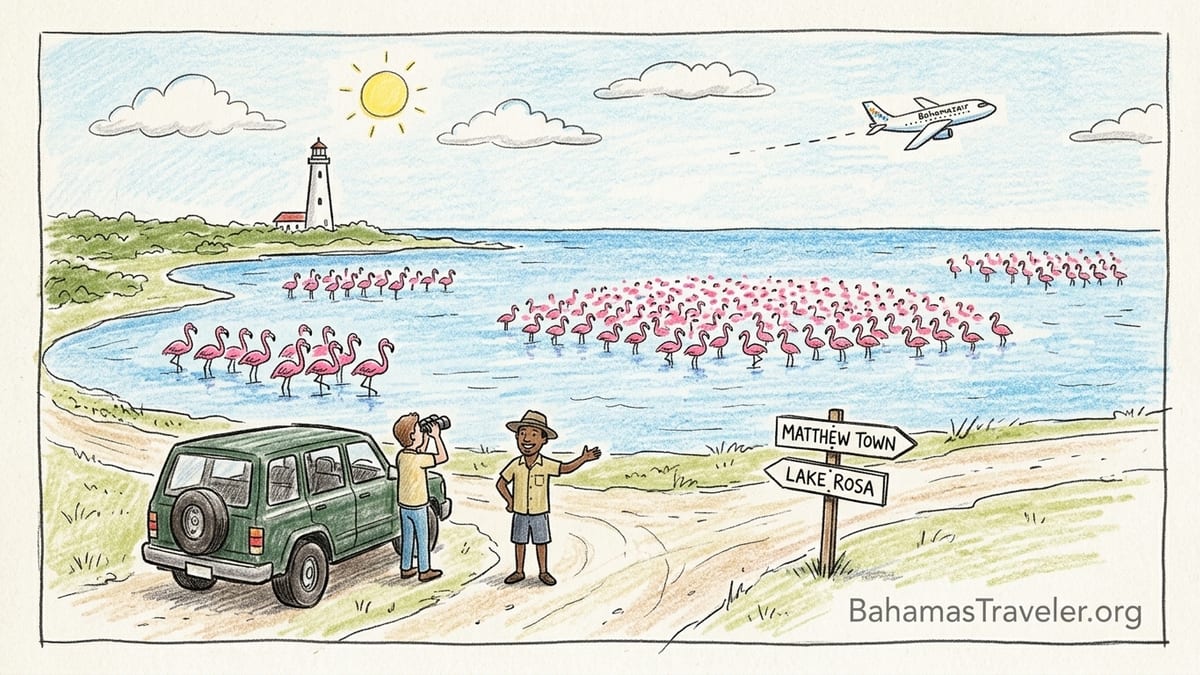
At our main viewing spot near the edge of Lake Rosa, the famous flocks were there, but not in the saturated, wall‑to‑wall pink I had imagined. Over the course of several hours, we saw several distinct groups, each ranging from a few dozen to perhaps a few hundred birds, spread across the wide expanse of shallow water. At the closest point, the main group was still several hundred meters away. To the naked eye, the birds were clearly flamingos, but leg bands, fine feather detail, and subtle color gradations were only visible through binoculars.
Photography was challenging. From our designated viewpoint, a 300 mm lens on a full‑frame camera produced environmental shots where flamingos were the subject but still relatively small in the frame. A 400 to 600 mm focal length would be more appropriate for tight portraits without heavy cropping. Our guide was careful not to approach nearer than agreed buffer distances, explaining that disturbing the birds could cause them to abandon feeding or resting areas, especially in sensitive breeding periods.
Weather on the day was clear and dry, with bright sun by mid‑morning and little wind. Heat rose quickly from the salt flats, and by 10 am it was uncomfortably hot in the open. We spent a total of about four hours inside the park and surrounding salt pans, of which perhaps two were devoted to watching flamingos. The remainder included slow drives, stops for other bird sightings such as Bahama pintail ducks and herons, and brief explanations of the island’s salt industry.
Why Flamingos Keep Their Distance From Tourists
Flamingos on Inagua have survived precisely because they are allowed to remain shy and undisturbed. Historical accounts describe how widespread hunting and disturbance once pushed West Indian flamingos to the brink of local extinction, with populations dropping to just a few thousand birds across the region by the mid‑20th century. Conservation efforts led by Bahamian wardens and the Bahamas National Trust focused on protecting remote nesting and feeding grounds and restricting low‑flying aircraft.
Flamingos are highly sensitive to human presence. They nest and feed in shallow, mineral‑rich waters where food resources can quickly be depleted or disturbed. If vehicles, boats, or people approach too closely, birds often stop feeding, become alert, and may move away en masse, burning valuable energy. In breeding seasons, repeated disturbance can cause colonies to abandon nests or chicks. For this reason, wardens manage access carefully, and reputable guides keep to established viewing distances instead of trying to score closer looks for guests.
Viewing conditions also change with water levels and breeding activity. In wetter periods, birds can spread out across larger flooded areas, which may push them farther from accessible shorelines. In drier spells, they may concentrate in smaller, deeper pools, which can create denser groups but not always where roads reach. During active nesting, authorities may restrict access to protect breeding sites altogether. Travelers who arrive expecting guaranteed close views will be disappointed if conservation needs require a more cautious approach while they are there.
In short, the same factors that have allowed Inagua’s flamingo population to recover to many tens of thousands of individuals make it unlikely that visitors will stand a few meters away from relaxed birds. This is a place where flamingos dictate the terms of any encounter. Accepting that reality is essential before committing the time and money required to reach the island.
On‑the‑Ground Experience: Guides, Roads, Heat and Facilities
The quality of guiding on Inagua is central to the experience. My guide was a local naturalist who had worked with visiting researchers and conservation staff. He provided detailed explanations about flamingo behavior, the history of the Bahamas National Trust, and the role of the Morton Salt operation in maintaining certain water levels. He set expectations early, warning that flamingos might remain distant that day and emphasizing that we would not chase them with the vehicle. That honesty was invaluable and aligned with responsible wildlife tourism.
Road comfort, however, was limited. Beyond Matthew Town and the main saltworks, surfaces deteriorated rapidly into rough gravel and dirt, often corrugated and potholed. Our vehicle was appropriate for the terrain, but the ride was bumpy enough that anyone with back or neck issues would find it difficult. We drove slowly for long stretches, partly to spare the suspension and partly to scan for birds. That slow pace added to the sense of remoteness but also extended the time between main viewing stops.
Facilities in and around the park are minimal. There were no toilets at our viewing site, no shaded shelters, and no formal picnic areas. Our guide advised guests to use facilities in town before departure and again on returning. We brought our own drinking water, snacks, and sun protection, and by late morning the heat on the flats felt punishing. Between bright reflections off the salt water and high humidity, this is not an easy environment for young children, older travelers, or anyone sensitive to heat.
Waiting is part of the process. Flamingo watching is not a fast‑moving safari but a patient, often still activity. Periods with little visible movement alternate with sudden bursts of synchronized feeding or short flights across the water. Travelers who expect constant action may find the long, quiet hours frustrating, especially after investing so much money and effort just to reach the island.
What Disappointed Me About the Flamingo Experience
My single biggest disappointment was viewing distance. Even with good binoculars, I had hoped for at least one encounter where a group of flamingos fed within 100 to 150 meters of our vantage point. Instead, the main flocks stayed considerably farther away for the entire morning. I came away with strong memories and respectable documentary photos, but not the tight, frame‑filling shots I had secretly envisioned.
The second disappointment was the lack of a clear, visitor‑friendly framework around the experience. There is no dedicated national park visitor center in Matthew Town with exhibits, scheduled daily tours, or posted prices. Arranging guides and transport required a patchwork of phone calls, emails, and local introductions. While that informality reflects the island’s small population and remoteness, it contrasts sharply with the premium cost of reaching Inagua.
I was also struck by how narrow the flamingo experience can feel if you do not actively lean into other aspects of the island. If your primary interest is flamingos and conditions on your visit keep birds distant or relatively quiet, it can be hard not to fixate on what you did not see, especially when you calculate the per‑hour cost of actual flamingo watching against the total outlay for flights and lodging.
Finally, the trip’s environmental harshness is real. The combination of rough roads, intense heat, lack of shade, and limited facilities may catch some travelers off guard, particularly those whose image of The Bahamas is shaped by resort islands like New Providence or Grand Bahama. On Inagua, there are no swim‑up bars to retreat to after a hot morning on the flats.
What Made the Journey to Inagua Special
Despite those disappointments, several elements made the journey feel deeply worthwhile on a personal level. First was the sense of witnessing a genuine conservation success story. Inagua’s flamingos came close to vanishing in the 20th century, and decades of protection, research, and local stewardship have helped the population rebound to tens of thousands of birds spread across an immense, largely undisturbed habitat. Knowing that the distant, pink bands across Lake Rosa represented a species that locals and conservationists fought hard to save gave each sighting emotional weight.
The second highlight was the broader wildlife context. Alongside flamingos, we saw Bahama parrots flying over dry forest, herons and egrets stalking along pond edges, and wild donkeys moving slowly across the saltworks. These were not curated encounters in a heavily visited park but glimpses of an island where wildlife continues to live on its own terms. That sense of authenticity is something many mainstream Caribbean destinations have lost.
Time with local residents added further depth. In a town of fewer than a thousand people whose main employer is the Morton Salt facility, everyone seems to know everyone else, and the flamingos are woven into daily conversation. Several longtime residents spoke about how the birds had become a point of pride, a symbol that tiny Inagua matters far beyond its shores. Hearing these stories while looking out over the salt pans created a connection that went beyond birdwatching.
Finally, there was a quiet satisfaction in traveling somewhere that still feels like the end of the line. Sitting on the seawall in Matthew Town at sunset, watching a freighter ease toward the salt pier while the sky turned the same pastel shades as the birds inland, I felt I was seeing a corner of The Bahamas that most visitors never even hear about. For travelers who value remoteness and rawness more than comfort, that in itself can justify the journey.
Would I Pay This Much Again for Inagua’s Flamingos?
For me, the answer is yes, but with important qualifications. I would return to Inagua if I could commit more time on the island and plan the trip primarily around its conservation story and overall wild character, not just around flamingo photography. I would also go in with even more modest expectations about viewing distance and photographic opportunities, and I would bring longer lenses if images were a priority.
From a strictly cost‑benefit perspective, travelers should recognize that seeing flamingos on Inagua is not efficient. Most visitors will spend at least four days door‑to‑door for perhaps two half‑day outings near Lake Rosa. The per‑hour cost of actual flamingo watching, when measured against flights, accommodation, and guide fees, is extremely high compared with more accessible birding destinations in North America or Europe.
I would not recommend this trip to travelers whose only goal is a brief, close‑range flamingo encounter or a handful of social media photos. There are other locations in the Caribbean and beyond where semi‑tame flamingos approach people more closely in hotel lagoons or small wetlands. Those situations come with their own ethical questions, but they are far easier and cheaper to access than Great Inagua.
For travelers who care deeply about seeing a massive wild colony in a place where conservation has clearly taken precedence over convenience, Inagua offers something rare. It is not the grand spectacle of constant, dense flocks at your feet that marketing blurbs sometimes imply, but it is a vivid lesson in what it takes to protect a species at scale, and in what it means to accept nature on its own terms.
The Takeaway: Who Inagua Is Really For
For casual tourists, particularly those already planning a beach holiday on another Bahamian island, diverting to Inagua purely for flamingos is difficult to justify. The extra flights, overnights, and logistical work deliver relatively little time on the ground with the birds, and conditions can be harsh. If you simply want to add a wildlife highlight to a Nassau or Exuma vacation, a day trip to a more accessible nature reserve or boat tour may provide better value and comfort.
For families, the calculus depends heavily on age and temperament. Older children and teenagers with a strong interest in animals or conservation could find the experience powerful, especially if combined with reading or school projects about endangered species recovery. However, the lack of shade, toilets, and entertainment in the park, along with bumpy rides and long waiting periods, make Inagua a challenging destination for younger kids. Parents should also be prepared for the possibility that children will not see the close, animated flocks they may imagine from picture books.
Serious birdwatchers, on the other hand, are the group for whom Inagua makes the most straightforward sense. For those already traveling through The Bahamas, adding several days to reach Great Inagua can deliver not only West Indian flamingos but also a suite of endemic and regional specialties in a single, little‑visited location. These travelers are also more likely to appreciate distant scope views, variable conditions, and the thrill of simply knowing that tens of thousands of flamingos are present, even when not all are visible at once.
Wildlife photographers sit somewhere between these groups. For portfolio‑level flamingo images with tight detail and dramatic behavior, Inagua is not a guaranteed win unless you can invest extended time, bring appropriate long lenses, and accept that ethical distances may keep you farther back than you would like. However, for photographers interested in broader conservation storytelling, atmospheric landscapes with small flamingo figures, and portraits of the people whose lives intersect with the birds and the salt industry, Inagua offers rich material that cannot be replicated in more manicured, tourist‑oriented locations.
FAQ
Q1. How many days should I plan for an Inagua flamingo trip?
Most travelers should plan at least four to five days door‑to‑door, including overnights in Nassau, three nights in Matthew Town, and two mornings reserved for park excursions.
Q2. Can I visit Inagua National Park without a guide?
In practice it is difficult and not recommended. Access roads are rough, signage is minimal, and local guides coordinate closely with wardens to avoid disturbing sensitive areas.
Q3. Will I definitely see huge flocks of flamingos?
No. While many tens of thousands of flamingos use Lake Rosa, what you actually see depends on water levels, breeding activity, weather, and how close birds choose to feed that day.
Q4. How close will the flamingos be during a typical visit?
Visitors usually view flamingos from several hundred meters away. Binoculars are essential, and serious photographers benefit from 400 to 600 mm lenses.
Q5. What time of year is best for seeing flamingos on Inagua?
Conditions vary year to year. Many guides favor the cooler, drier months outside peak hurricane season, but water levels and breeding cycles are more important than any fixed calendar date.
Q6. Are there toilets or shade structures in the park?
Facilities are very limited. You should use restrooms in Matthew Town before departure, bring your own water, snacks, hat, and sun protection, and be prepared for several hours without shade.
Q7. Is Inagua suitable for young children?
The heat, rough roads, lack of toilets, and distant views make it challenging for young kids. Families with strong nature interests and older children may cope better.
Q8. How far in advance should I book flights and guides?
Because flights are infrequent and seats limited, booking several months in advance is sensible. Guides should be arranged before you arrive, ideally as soon as flights are confirmed.
Q9. Can I combine Inagua with other Bahamian islands on one trip?
Yes, but expect to route most combinations through Nassau. Some Bahamasair services link Inagua and Mayaguana, yet schedules change, so build in extra buffer nights.
Q10. Is Inagua worth it if I only care about getting close‑up flamingo photos?
Probably not. Close, guaranteed flamingo portraits are rare here because guides prioritize the birds’ welfare. The trip makes more sense if you value conservation and wildness over proximity.