


By the time I stepped off the skiff at sunset, legs humming from ten miles of wading and my casting arm tired in a way gym workouts never quite mimic, I finally understood why serious anglers whisper about Acklins as one of the last truly wild bonefishing frontiers in the Bahamas. It is beautiful and remote, but it is also humbling. A single guided day on the Bight of Acklins taught me more about reading tides, wind, light and fish behavior than a stack of fly-fishing books ever did, while also clarifying what it really costs in money, comfort and effort to chase bonefish here.
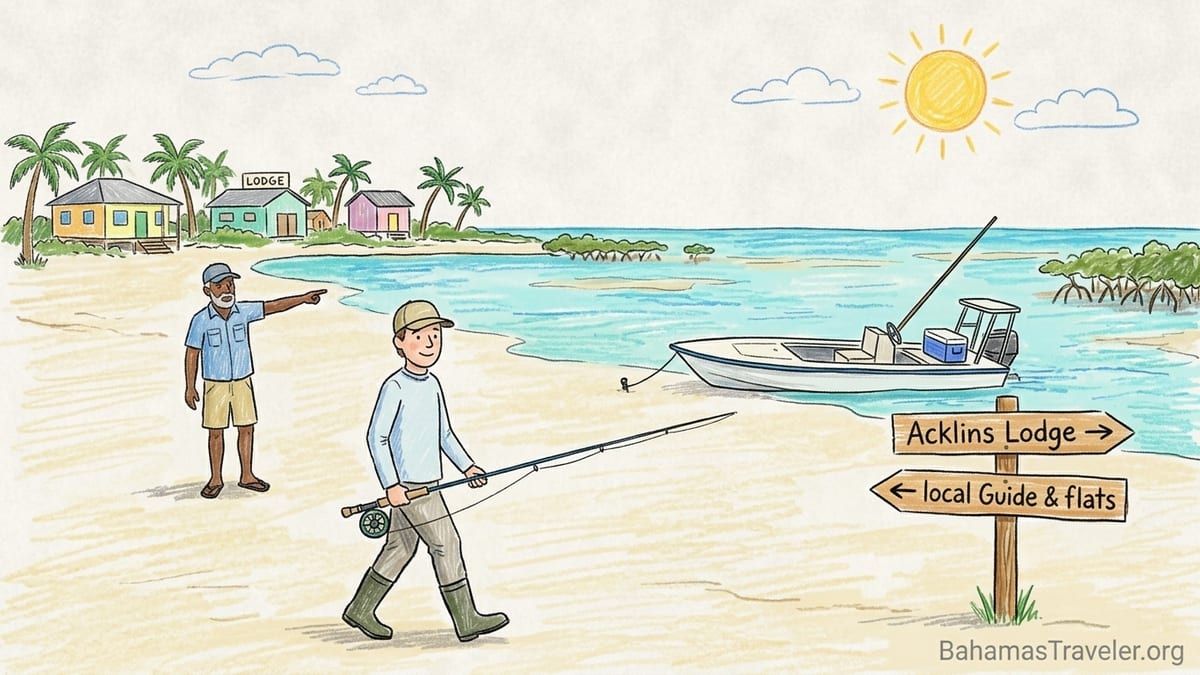
Choosing an Acklins Base and Booking a Local Guide
I based myself at a small, fishing-focused lodge on the south end of Acklins, one of several modest properties strung along the island rather than a big-name international operation. Rooms were simple, with tile floors and quiet air conditioning, but the lodge’s real asset was its access to the Bight of Acklins and a network of local guides who grew up fishing the surrounding flats. I booked my fishing through the lodge rather than trying to arrange a guide from afar, which turned out to be the single best logistical decision of the trip. The manager called two guides, checked the tide tables for the Bight and matched me with a skiff guide who preferred to combine poling from the boat with long wades on hard-bottom flats.
The financials are significant and worth laying out plainly. In late 2026, full-day guided bonefishing in the Acklins and Crooked Island area is typically priced around 650 to 750 US dollars per skiff for one or two anglers, depending on the operator and whether fuel surcharges apply. My day rate was 700 dollars, paid in cash to the lodge, which then settled with the guide at day’s end. On top of that, I had already purchased the required Bahamas flats fishing license online through the government’s MyGateway portal, which currently offers short-term permits for visiting anglers. The cost for my short-stay license came in under 100 dollars, a fraction of the guide fee but an essential legal step if you plan to target bonefish on the flats.
Booking through the lodge also simplified timing. The manager built my fishing day around the tide cycle, not an arbitrary clock. We chose the date because the mid-morning low would expose broad white flats at the eastern edge of the Bight, ideal for wading, with a steady incoming tide after lunch. That advance planning, rather than simply picking any open day, dictated when we would leave the dock and how long we could realistically fish.
For equipment, the lodge had loaner rods and reels, but I chose to bring my own 8-weight saltwater setup with a floating line designed for tropical conditions. I packed a small box of bonefish flies tied on size 4 to 8 hooks, mostly Gotchas and simple shrimp patterns, plus long-nose pliers, nippers, polarized sunglasses with copper lenses and a lightweight waterproof pack. The only items the lodge insisted I carry from their gear locker were a VHF handheld radio and an extra sun buff, both reminders that this is still a sparsely populated outer island where self-reliance matters.
The Night Before: Tides, Weather and Setting Expectations
The planning session the evening before our trip did as much to shape my experience as anything that happened on the water. After dinner, my guide, a soft-spoken man in his fifties who had been guiding and fishing these flats since his teens, sat down at the dining room table with a paper tide chart, a notepad and the next day’s marine forecast on his phone. He traced a finger across the times for low and high water in the Bight of Acklins and explained how wind direction could speed or slow the apparent tide on different shorelines. With a light east-southeast breeze predicted and a mid-morning low, he suggested we run north at first light to a series of ocean-side flats where bones would push shallow with the dropping water, then slide into the interior bight as the tide turned.
He was also realistic about the challenges. Over conch chowder and rice, he told me that Acklins flats see far less fishing pressure than islands like Abaco or Andros, but that did not mean the bonefish were naive. On calm, clear days, the fish can be very spooky in ankle-deep water, while on gusty, cloudy days, seeing anything at all becomes the main battle. I admitted I had some saltwater fly-fishing experience but was far from expert, and that I had not cast much in true 15 to 20 knot wind. He nodded and advised me to be ready for quartering headwinds, long shots up to 60 feet and very fast, accurate presentations when a school suddenly appeared within range.
We agreed on a 6:45 a.m. departure from the lodge dock, with breakfast at 6:00 and a packed cooler for lunch. The lodge charged a modest fee for the cooler and sandwiches, but water and ice were included. I set out clothes for the next day: long-sleeve sun shirt, quick-dry pants, a wide-brimmed hat, buff, fingerless gloves, and neoprene-sole flats boots tough enough for coral rubble. I also mixed electrolyte packets into two one-liter bottles, knowing that in the Bahamian winter or spring, temperatures can quickly climb into the high 80s Fahrenheit on the flats, with little shade other than the skiff’s shadow.
Mentally, I tried to recalibrate my expectations. I had seen glossy photos of anglers hoisting multiple large bones from Acklins, but my guide’s matter-of-fact tone made clear that success here still depended on skill, luck with weather and a willingness to walk long distances. I promised myself I would count every close encounter, missed chance and refusal as part of the experience, not judge the day solely on grip-and-grin photos.
Running to the Bight: Transfers and Actual Fishing Time
The following morning unfolded on island time, but anchored to the tide. I ate quickly and walked down to the dock in dawn half-light. My guide already had the 18-foot flats skiff fueled and loaded, with rods on the deck, push pole lashed along the gunwale and a small cooler tucked near the console. The run from the south-end lodge to our first flat took roughly 40 minutes at a comfortable cruising speed, first along a narrow mangrove-fringed creek, then across open turquoise shallows that hinted at the vast size of the Bight of Acklins lagoon between Acklins and Crooked Island.
Advertised fishing day lengths in this part of the Bahamas often claim eight hours on the water, and in gross terms my day matched that. We left the dock just before 7:00 a.m. and did not return until nearly 4:30 p.m. However, only about six and a half of those hours involved active fishing with a fly in the water. The rest of the time went to boat transfers between flats, a half-hour lunch stop in the skiff’s shade, and a few short breaks to re-tie leaders, change flies and simply rest legs and eyes.
Our first flat was a broad, hard sand expanse along the eastern edge of the bight, exposed on the dropping tide. The guide eased the skiff into knee-deep water, dropped the anchor and suggested we wade rather than pole. He reminded me that wading often gives a beginner more stability for casting and a better low-angle view into the water, while the boat can throw a long shadow that spooks fish in skinny water. I clipped the small waterproof pack around my waist, slid into the warm clear shallows and immediately felt tiny ridges in the sand under my boots.
By 7:50 a.m. we were fully engaged in the day’s real work: scanning for bonefish. If you count from dock departure to the last cast before we headed home, my nine-and-a-half-hour “fishing day” boiled down to something closer to six and a half functional hours of sight-fishing, with the rest necessary but invisible in brochure descriptions. Travelers budgeting their time should recognize that even a perfectly planned day on Acklins will have similar rhythms.
Learning to See: Spotting Bonefish and Reading Water
The first lesson my guide hammered home was that seeing bonefish is an acquired skill, especially on a bright flat in the Bight of Acklins where the water shifts from milky turquoise over sand to deep jade over turtle grass. At first, all I saw were glittering ripples and my own anticipation. My guide walked a few paces behind and to my left, higher and more relaxed, scanning far ahead. Within ten minutes he touched my shoulder and quietly pointed. “School, eleven o’clock, forty yards, moving left to right.” I stared, saw nothing but a slightly darker smear. He explained that early in the day, when the sun angle is low, it is easier to see the faint shadows or the so-called “ghost” shapes than to pick out individual fish.
He crouched and traced a line in the water with his finger, showing how bonefish often travel along subtle depth contours no more than a few inches deeper than the surrounding flat, like invisible highways. The wind, which had picked up to perhaps 15 knots from the east, pushed small wind chop across the flat that turned the surface into a sheet of flickering light. To adapt, he instructed me to narrow my search to a cone about 30 degrees wide in front of us, rather than sweeping my head back and forth. “Look for movement that is different from the waves,” he said, whether that was a faint push of water, a tail tip in slightly deeper troughs, or the thin V of a fish waking in ankle-deep water.
Reading the tide was equally important. On the lower water of the morning, he directed me to focus near the edge where the flat dropped into slightly deeper channels. These edges acted as transition zones where bones would slide up to feed then retreat with the falling water. Later, as the tide turned and began to flood, we shifted to the interior of the Bight of Acklins, where incoming water spilled over white sand and coral rubble, bringing cooler water and more food. At one point, he pointed to a shallow finger of water creeping over a previously dry bar and predicted we would see singles and pairs cruising within fifteen minutes. He was correct, and one of my best shots of the day came exactly on that call.
The hardest part was training my eyes against changing water color. Over pure sand, a bonefish might show as a pale green-grey, while over turtle grass it could vanish entirely unless its tail broke the surface. When clouds slid over the sun, the contrast dropped sharply, and we would sometimes stop and wait for the light to improve rather than waste effort on random blind casting. That discipline, sometimes frustrating, proved central to making the most of limited shots.
Boat or Boots: Approaching Fish on the Flats
Over the course of the day, we alternated between wading and fishing from the skiff, with clear reasoning each time. On the first morning flat, the water was knee-deep to ankle-deep and the bottom firm. My guide argued that wading silently, with the sun behind us, gave us the best chance to approach fussy, tailing fish. He coached me to take smaller, flatter steps, rolling my foot from heel to toe to avoid pushing obvious pressure waves ahead of me. When we did see fish within 50 or 60 feet, he would have me stop and watch for a moment rather than rush into a cast, letting the school settle into a predictable direction of travel.
Later, around midday, we re-boarded the skiff and he poled us along a channel edge where the water deepened to waist level. Here, wading would have meant uneven footing and slower reactions. From the poling platform, he could see down into the green water much farther than I could from wading height. The trade-off, however, was balance. Standing on a casting deck in constant wind while the skiff pivoted with each push took a different kind of stability. Several times, as I set up for a shot at an approaching fish, a gust caught the line and slapped it against the rod or my shirt, spooking the target before the fly even landed.
Approaches were always angled with both wind and sun in mind. If we were wading with the wind at our backs, he would try to work downwind, knowing that long downwind casts are easier, even if they make line management trickier. When poling, he often maneuvered to get the sun somewhere over my casting shoulder, reducing glare. On more than one occasion, he chose to bypass fish that would have required a straight into-the-wind cast beyond my realistic range, saving time and frustration in favor of more workable angles.
For a visitor, the choice between wading and boat fishing in the Bight of Acklins is not really either-or but a fluid response to conditions. Having a guide who understands how subtle shifts in depth, current and light affect bonefish routes made those decisions feel purposeful rather than random.
The Reality of Casting, Wind and Missed Opportunities
No amount of backyard practice quite prepared me for the wind and mental pressure of real bonefish shots. By mid-morning, the breeze had freshened to a steady 15 to 18 knots, occasionally gusting higher. My guide estimated our average cast length at 50 feet, with several longer attempts when fish were skittish. On one early opportunity, a pair of bones approached from my right. In my haste, I made three false casts instead of two, the line waved high in the wind, and the fly landed almost on top of the nearest fish. The fish bolted in a sheet of white water. My guide simply said, “Less air time. Put it there quick and let it sink.”
Line management on the flats introduced its own difficulty. When wading, stripped line coiled in the water around my legs and occasionally snagged on coral rubble. From the boat, the loose line would find every possible cleat and hatch corner. Twice, I had a fish eat the fly, feel the weight, and surge off, only for the line to snare on my boot or a deck fitting and snap the tippet. Those were the most painful losses, because I had done the hard part of spotting and presenting well, only to be undone by simple mechanics.
Over roughly six and a half hours of active fishing, we probably had around fifteen genuine shot opportunities within my realistic casting range. Out of those, I delivered maybe ten acceptable presentations. I hooked three bonefish and brought two to hand, each in the two- to three-pound class, bright and strong. Another fish came unbuttoned after a short run when the hook pulled. I had at least as many refusals or non-committal follows, watching a fish track the fly briefly then veer away. Importantly, my guide never exaggerated these numbers. At the end of the day, when we tallied the encounters, he emphasized how normal it is for even experienced anglers to miss or blow more shots than they convert on challenging days.
What made the difference on the successful hookups was not distance but accuracy and timing. Both landed fish ate when I managed to place the fly two to three feet ahead of the fish’s nose, slightly off to the side, then made two short strips to get their attention and paused. The line came tight almost imperceptibly, and the guide’s earlier instruction to strip-strike instead of lifting the rod paid off. Those few seconds of controlled tension, followed by long, blistering runs into the backing, justified every earlier flub in an instant.
Comfort, Safety and Respecting a Fragile Habitat
Physically, a full day of wading the flats around the Bight of Acklins is more demanding than many visitors anticipate. By mid-afternoon, my legs ached from hours of sliding through ankle- to knee-deep water over sand and occasional coral rubble. Even with sturdy flats boots, small shell pieces worked their way into my socks, and once I stepped on a hidden conch shell and twisted slightly, thankful for the ankle support. Balance was a constant concern, especially when turning quickly for a sudden call of “Fish, two o’clock.” Without the boots, I would almost certainly have cut my feet on coral or sharp rock outcrops.
Sun protection and hydration were non-negotiable. Despite wearing a long-sleeve shirt, buff, hat and polarized glasses, I reapplied high SPF, reef-conscious sunscreen to my hands, ears and neck several times. We drank steadily, finishing the cooler’s water and my electrolyte mixes by about 2:30 p.m. The guide remarked that on the hottest summer days, he has had anglers show early signs of heat exhaustion if they neglect fluids. The combination of full reflection from the water, constant walking and the focus required for sight fishing can easily mask how dehydrated you are becoming.
Respect for the habitat was built into my guide’s routine. He insisted we handle every fish with wet hands, kept them in the water while removing the hook with pliers and released them facing into the current, reviving them only as long as necessary. We avoided wading through clearly marked turtle grass nurseries and steered wide of small stingrays whenever we spotted them. Lunch was a simple affair of sandwiches and fruit eaten in the skiff’s shade, with all trash bagged and stowed. The flats around Acklins support not only bonefish but also a web of invertebrates, birds and other fish species, and he was keenly aware that the island’s small population depends on healthy marine ecosystems for both tourism income and subsistence fishing.
Comfort back at the lodge took on new meaning after such exertion. A cold shower, simple Bahamian dinner and early night felt more appropriate than any celebratory drinks. The day confirmed that travelers considering a guided day on the Bight of Acklins should be reasonably fit, comfortable on their feet for long periods and honest about any mobility issues when booking.
Costs, Tipping and Whether a Beginner Would Enjoy It
All in, my single guided day on the Bight of Acklins represented a tangible financial commitment, especially when viewed in the context of a longer trip. The guide fee was 700 dollars for the boat, which I fished alone. The mandatory flats fishing license purchased online before travel added under 100 dollars, depending on duration, amortized over several days of fishing. The lodge’s packed lunch and cooler service cost an additional modest charge, and I tipped the guide 100 dollars in cash at the end of the day, roughly in line with common recommendations of 15 to 20 percent for a full, hard-worked day. Transportation, lodging and meals formed the larger trip budget, but for this single day, it would be fair to say that I spent close to 850 dollars when you factor in license, extra food and gratuity.
Was it worth it? From a value perspective, the answer depends heavily on your goals and your starting skill level. For an angler who has never fly fished before, jumping straight into a windy, sight-fishing-only environment like Acklins could prove overwhelming. My guide was patient and willing to coach casting and line management, but there is only so much remedial instruction that fits into a tide-driven day. Without at least some prior practice making 40- to 50-foot casts and managing line in wind, a true beginner might end the day frustrated, aware they had been surrounded by opportunity but unable to capitalize on it.
On the other hand, for someone with basic casting competence who wants to accelerate their learning curve, a local guide on the Bight of Acklins is almost priceless. The nuanced guidance on reading flats, interpreting clouds and sun, and understanding how bonefish move with the tide is knowledge that would take years to accumulate alone. In my case, the two fish landed were almost incidental compared with the hours spent spotting, stalking and sometimes spooking fish under a watchful coach. I came away with a mental playbook that will inform every future saltwater trip.
From the guide’s perspective, the fee reflects not just a day’s labor but also years of intimate familiarity with a complex, sparsely marked marine landscape and the ongoing costs of maintaining a seaworthy skiff in a salt-heavy environment. It is expensive fishing, but not extravagant in the context of remote Bahamian bonefishing, and considerably more affordable than the all-inclusive rates at some headline lodges on other islands that package multiple guided days into week-long stays.
What Surprised Me and What I Would Change Next Time
Several aspects of Acklins bonefishing surprised me. The first was just how empty the water felt in human terms. Over an entire tide cycle on the Bight, we saw only one distant skiff and a local conch fisherman in a small boat, despite fishing what my guide considered prime flats. Coming from more developed saltwater destinations, I was used to sharing flats or at least seeing other anglers in the distance. Here, the sense of having miles of habitat to ourselves was both exhilarating and, at times, a little daunting.
The second surprise was how mentally tiring sight-fishing can be. Hours of intense focus on the water’s surface, constantly adjusting to glare and ripple patterns, left my eyes and brain more drained than my casting arm. By late afternoon, I noticed it took me longer to identify the subtle shadows of approaching fish, and I made poorer decisions on when to cast. If I return, I would consider scheduling two guided days with a rest or DIY exploring day in between, rather than concentrating all that learning and effort into a single marathon session.
In terms of equipment, I would change a few key items. I would bring a dedicated stripping basket for wading to control loose line and prevent it from snagging on coral or my boots. I would also carry a second pair of lightweight socks in a dry bag so I could switch midday and reduce the chance of hot spots turning into blisters. On the fly side, I would expand my selection to include a few slightly heavier patterns with small lead eyes for deeper edges and some very lightly dressed flies for ultra-shallow ankle water, tailoring each to specific tide phases.
Strategy-wise, I would work more on my short game before the next trip. Several shots inside 35 feet felt surprisingly awkward, because much of my practice had focused on longer casts. Yet on windy days with spooky fish, being able to deliver a quick, accurate, low false-cast presentation at close range may matter more than heroic 70-foot shots. Finally, I would invest more time on a local beach or dock practicing roll casts and side-arm deliveries in real wind the day before meeting the guide, rather than assuming muscle memory from freshwater rivers would automatically translate.
The Takeaway
My guided day on the Bight of Acklins did not produce armfuls of trophy bonefish or a photo album full of grip-and-grins. It produced something subtler and, for me, more lasting. I left with a realistic understanding of what it takes to fish this remote Bahamian outpost well: the cost, the fatigue, the humility in the face of shifting tides and invisible fish, and the crucial role that a skilled local guide plays in turning an empty-looking lagoon into a living, legible landscape.
For anglers considering Acklins, the decision to book a local guide for at least one full day is, in my view, justified by the combination of education, access and safety it provides, even at a day rate that will make you think twice. The experience is not geared to casual, first-time fly casters but rewards those willing to meet the flats halfway with some preparation. If you come ready for early mornings, long wades, strong wind and honest feedback, the Bight of Acklins will likely repay you with more than just fish numbers. It will sharpen your senses and expand your idea of what bonefishing can be.
Would I do it again? Absolutely. I would arrive with more casting practice in the bank, a few gear tweaks and a better plan for pacing my energy. But I would return to the same kind of small Acklins lodge, ask for another tide-focused day with a local guide who knows the lagoon by heart, and once again step off the skiff at sunset with tired legs and a mind full of pale sand, green water and the sudden silver flashes that keep anglers coming back.
FAQ
Q1. Do I really need a local guide for bonefishing on the Bight of Acklins?
While confident anglers can explore a few roadside flats on their own, a local guide dramatically improves your chances of finding fish, reading complex tides and staying safe in a vast, shallow lagoon with few landmarks. For a first visit, at least one guided day is highly recommended.
Q2. How long is a typical guided bonefishing day on Acklins?
Most guided days run roughly eight to nine and a half hours dock to dock, often from just after sunrise to late afternoon. Expect around six to seven hours of true sight-fishing once you subtract boat transfers, lunch and short breaks.
Q3. What does a full day with a bonefishing guide on Acklins cost?
Recent rates in the Acklins and Crooked Island area are commonly in the 650 to 750 US dollar range per skiff for one or two anglers, plus a gratuity of around 15 to 20 percent for good service, along with your separate flats fishing license and food costs.
Q4. How do I get the required flats fishing license for the Bahamas?
Visitors must obtain a Bahamian flats fishing license, which can be purchased online through the government’s digital portal or arranged with some outfitters. You choose a duration that matches your stay and carry a printout or digital copy while fishing.
Q5. What level of fly-fishing experience should I have before booking a day on Acklins?
You do not need to be an expert, but you should be comfortable making 40- to 50-foot casts, handling line in wind and understanding basic strip-strike technique. Total beginners will likely struggle to take full advantage of the opportunities a guide creates.
Q6. What rod, line and flies work best for Acklins bonefish?
An 8-weight saltwater fly rod with a tropical floating line is a versatile choice. Bring a selection of shrimp and small baitfish patterns, such as Gotcha-style flies in sizes 4 to 8, in both light and slightly heavier versions to match different depths and tide stages.
Q7. Is wading or boat fishing better on the Bight of Acklins?
Both play important roles. Guides often choose wading on hard, shallow flats where stealth matters, and use the skiff to cover deeper edges and reach remote flats. A flexible mix of wading and boat fishing typically yields the best overall experience.
Q8. What should I wear and bring for comfort and safety on the flats?
Plan on long-sleeve sun clothing, a wide-brimmed hat, polarized sunglasses, sturdy flats boots, high SPF reef-conscious sunscreen and ample water or electrolyte drinks. A lightweight waterproof pack for small gear and a buff for face protection are also very useful.
Q9. How physically demanding is a full bonefishing day on Acklins?
Expect several hours of walking on uneven sand and rubble, often in knee-deep water under strong sun and steady wind. Most reasonably fit travelers can manage it, but anyone with balance or mobility issues should discuss limitations with the lodge and guide in advance.
Q10. Is bonefishing on Acklins suitable for non-anglers or mixed-interest trips?
The island primarily attracts dedicated anglers, but non-fishing companions can enjoy quiet beaches, birdlife and the slow pace of a sparsely populated outer island. However, those seeking nightlife or resort-style amenities may find Acklins too remote and low-key.