


I took the Fort Lauderdale to Bimini fast ferry because I wanted a Bahamas hit without packing for a full cruise. The promise is simple: show up at Port Everglades early, flash your passport, and be on Bimini in about two hours. The reality is still easy, but it’s a lot more “airport day” than most people expect, with real check-in deadlines, security bottlenecks at the port entrance, and a few comfort quirks onboard that can make or break a short trip. Here’s exactly how my ferry day went and what I’d change next time.
Booking the ferry: schedule, fares, and choosing the right day
Baleària Caribbean currently operates the Fort Lauderdale to Bimini fast ferry, and the schedule is not a “show up any day” situation. The sailing calendar shifts, and the safest way to confirm your exact travel day is to run a fresh search on Baleària’s booking engine right before you commit. Around late September 2026, third-party timetable aggregators commonly show a 9:00 a.m. departure with an approximately 11:00 a.m. arrival for the Fort Lauderdale to Bimini run, matching Baleària’s advertised two-hour crossing on many days.
Price-wise, Baleària advertises Fort Lauderdale to Bimini fares “from $180,” but the number you actually pay can jump depending on date, demand, and whether you’re booking a one-way, round-trip, or a day-trip product. If you’re doing a same-day return, you’ll often see day-trip promos marketed around $250 and up, and Baleària has promoted limited-time day-trip offers that bundle a Resorts World Bimini day pass with certain day-trip departures. Because those offers are time-limited and can change, I treat them like airline sales: great if they match your date, irrelevant if they don’t.
My practical tip: pick your travel day based on what you want on the island, not just the cheapest fare. If your goal is a beach club style day, a day-pass bundle can be good value. If your goal is to explore Alice Town, eat conch salad, and roam, you may be better off focusing on maximizing time on the ground rather than optimizing for a “deal” that keeps you within a resort bubble.
Getting to Port Everglades: the part everyone underestimates
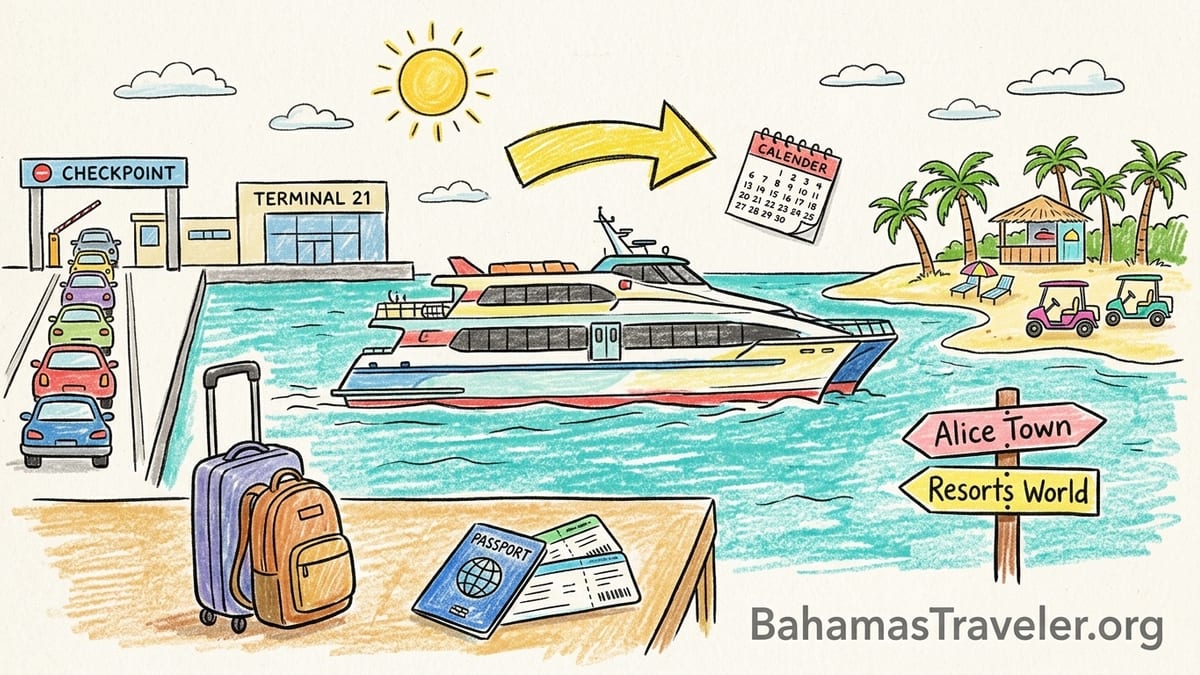
Port Everglades is close to Fort Lauderdale-Hollywood International Airport, but “close” doesn’t mean “fast” once you factor in port security and morning traffic. Baleària’s own guidance is blunt: plan to arrive to the actual port at least one hour prior to departure because you may run into traffic congestion entering the port. That warning is real. I watched cars stack up at the entrance, then creep forward through a checkpoint like it was a mini border crossing.
The ferry generally uses Terminal 21 at Port Everglades. For navigation, I used Terminal 21 and the Terminal 21 street address (commonly shown as 2021 Eller Drive, Fort Lauderdale, Florida 33316). In practice, rideshare drivers know Port Everglades, but not all of them know the ferry terminal versus the cruise terminals. I said “Terminal 21, the Baleària ferry,” and kept the terminal number visible on my phone in case the driver started drifting toward a cruise terminal drop-off.
Parking and drop-off logistics depend on your situation. If you’re local, driving yourself can be the simplest, but build in time to find the right entrance and lot. If you’re staying near the beach or downtown Fort Lauderdale, rideshare is painless. If you’re coming straight from FLL airport on an early-morning flight, I’d pad your timeline aggressively because any flight delay puts you into a no-mercy check-in window.
Terminal and check-in: think “early flight,” not “casual ferry”
The biggest thing I’d tell a first-timer is that Baleària runs this like a tight international departure. For departures from Fort Lauderdale, Baleària states check-in starts at 6:00 a.m. for a 9:00 a.m. sailing, and the terminal doors close at 8:00 a.m., one hour before departure. They even suggest arriving in a narrow sweet spot, roughly between 6:15 a.m. and 6:45 a.m., to avoid getting caught behind the crowd but still have services open.
I aimed for that early window and I’m glad I did. The terminal experience felt like an airport’s international section on a small scale: lines form quickly, and if you’re late you’re not just “late,” you may be denied boarding because the operator can’t guarantee embarkation beyond the deadline. I saw stressed travelers showing up closer to the cut-off, trying to negotiate their way forward. It’s not a vibe you want on a vacation morning.
Documents were straightforward but strict. Baleària requires a valid passport for travel. I kept mine in a zip pocket and had a backup photo of the passport ID page on my phone, not because that replaces the passport, but because it helps if you need to re-enter a booking number or confirm spelling. If you’re traveling with kids, treat this like any international trip: bring whatever documentation you’d bring for an international flight, including any consent letters if one parent isn’t traveling, and confirm the latest rules in Baleària’s help center before you go.
Passport control, security, and the boarding process
Once I cleared check-in, the flow moved into the security and passport-control rhythm. This is still Port Everglades, and the port itself is a secured facility. You’re not walking up to a pier with a ticket and a smile. Expect multiple checkpoints, staff directing lines, and the general rule that you keep your passport and boarding documents handy until you’re seated.
What I wish I’d known: the process is easier if you pack like you’re going through an airport screening. I put liquids in a small pouch, kept electronics accessible, and avoided burying essentials at the bottom of a bag. The more you can keep your bag organized, the less you’ll be the person holding up the line while you dig for something you were just told to present again.
Boarding itself felt like a mass movement. When the call happens, people stand up fast. If you care about sitting with your group, don’t wander off to the far end of the waiting area when boarding gets close. Also, if you get motion sickness, board early enough to choose a seat that helps you, because seat choice matters more than it does on a plane.
Luggage rules: what’s free, what costs extra, and what can trip you up
Baleària’s current luggage policy is more specific than most travelers expect. As a courtesy, each adult passenger is allowed one carry-on item free of charge, up to 26.5 pounds, with maximum dimensions of 22 inches by 18 inches by 10 inches. If you’re traveling with infants or children, Baleària notes an additional piece may be allowed for the child (within similar size and weight limits), which can be helpful if you’re hauling kid essentials for a day trip.
Where people get dinged is “one bag means one bag.” If you show up with a rolling carry-on, a backpack, and a beach tote, you might be paying for that extra piece. Baleària lists extra or overweight bags as subject to fees, and the numbers published for excess luggage are meaningful: $30 per bag one-way or $50 round-trip for bags exceeding the allowance, with oversize items such as bicycles, kayaks, and scuba equipment listed at higher fees. They also note that oversized luggage and equipment may require registration with U.S. Customs and Border Protection 24 hours in advance, which is the kind of detail you only discover after you’ve already planned a “quick” weekend dive run.
My practical packing approach for this route is simple: one rolling carry-on that fits the dimension rule, and inside it a packable day bag. Once I’m on the island, the packable bag becomes my beach bag, and I’m not juggling “extra pieces” at the terminal. If you plan to bring snorkel fins or bulky gear, confirm the oversize rules before you buy your ticket, because it can change the math fast.
Onboard reality: seating, air conditioning, food and drinks, and sea conditions
The Baleària fast ferry is designed for speed and volume, not luxury. Seating is airline-style in a large cabin. If you’ve ever taken a high-speed catamaran or fast ferry in Europe, it’s that energy: functional, bright, and meant to get you there fast. I went in expecting “mini cruise ship,” and it wasn’t that. It felt closer to a big commuter aircraft cabin, except you can stand up more freely once underway.
Air conditioning was strong on my crossing, strong enough that I was happy I brought a light layer. This is one of those travel truths: South Florida at sunrise is humid, but inside a fast ferry cabin, the temperature can feel like a refrigerated grocery aisle. If you’re traveling with kids or anyone who runs cold, toss a thin hoodie into your bag even for a day trip.
Food and drink options onboard exist, but I treated them as backup rather than a plan. My move was to eat a real breakfast before arriving and carry a sealed snack for later. If you’re trying to prevent seasickness, an empty stomach is not your friend, but neither is a heavy greasy meal. I went with the boring, effective approach: water plus something simple like crackers or a granola bar.
Sea conditions are the wild card. Baleària advertises an approximately two-hour crossing, and that timing can hold, but the comfort level depends on weather and wave action. On a calm day, it’s an easy ride and you mostly forget you’re on the ocean. On a choppier day, the ferry can bounce, and people who “never get seasick” suddenly remember they have an inner ear. If you’re prone to motion sickness, I’d choose a midship seat where motion is typically less pronounced, skip alcohol before boarding, and bring a proven remedy you’ve used before (not a brand-new pill you’re testing on vacation day).
Personally, I felt mild queasiness for a short stretch, the kind that goes away if you stop staring at your phone and look at the horizon. I saw a few passengers who had a rougher time, and that was enough to convince me that if you know you’re sensitive, you should medicate proactively, not after you’re already uncomfortable.
Arrival in Bimini: formalities, Resorts World access, and getting around
Arriving in Bimini felt like arriving at a private resort port rather than a traditional city ferry terminal. The ferry docks in the Resorts World Bimini area, and the resort infrastructure is immediately visible. That’s great if your plan is to do a pool or beach day there, but it can surprise travelers expecting to step off into a walkable “town center” with taxis lined up like an airport.
Formalities on arrival can vary by day and staffing, but the core reality is consistent: you’re entering The Bahamas, so you should expect immigration processing and passport checks. Resorts World Bimini notes that everyone must have a valid passport to enter The Bahamas, and their materials describe immigration and customs facilities as part of the broader arrival ecosystem on property. In other words, this is not a casual domestic hop. It’s an international arrival and you should keep your documents accessible until you’re fully cleared.
Once I was out, transportation was the next decision. Resorts World Bimini promotes a complimentary tram system around the resort property, and it’s genuinely useful if you’re staying within the resort footprint. If you’re going beyond the resort zone, the most common next steps are taxi or golf cart rental. For a short stay, golf carts are the classic Bimini move because they turn the island into something you can explore at your own pace, but they also add cost and require a little street confidence. If you’re only on the island for a few hours, a taxi to Alice Town for lunch and a beach stop can be more efficient than figuring out rentals.
The key practical point is timing. A same-day return is doable, but it’s tight. You’ll lose time to arrival processing, then lose time again getting back to the departure point for the return sailing. Baleària’s own guidance for departures from Bimini is that doors close one hour before departure and check-in starts two hours before departure, and you should treat that as a hard constraint. If you’re thinking, “I’ll just wander and come back whenever,” you’re setting yourself up to sprint back sunburned and stressed.
The Takeaway: would I take the ferry again, or fly next time?
I would take the Fort Lauderdale to Bimini ferry again for the right kind of trip: a relaxed day trip where the journey itself is part of the experience, or a two-night stay where the early check-in time doesn’t feel like it’s eating your entire vacation. When the sea is calm, the ride is genuinely enjoyable, and arriving by water makes Bimini feel like a real island escape rather than a quick flight that could have landed anywhere.
But if I were doing a very short stay, especially a one-night trip, I’d seriously consider flying instead. The ferry day starts early, and the check-in rules effectively force an “up before dawn” schedule. Add in port-entry congestion and the time buffers you need for international processing, and the time advantage of a two-hour crossing shrinks. In other words: the ferry can be quick on paper, but the total door-to-door day can still feel like a full travel day.
My decision rule now is simple. If I want to maximize island time with minimal friction, I’d price out a flight and compare the full cost including luggage allowances and ground transport. If I want a straightforward, scenic, predictable experience and I’m okay with the early start, I’d pick the ferry and pack smart: one compliant bag, a light layer for the cold cabin, and a plan that respects the check-in deadlines on both sides.
FAQ
Q1. Where does the Fort Lauderdale to Bimini ferry depart from?
It generally departs from Terminal 21 at Port Everglades in Fort Lauderdale. Use Terminal 21 as your navigation target and confirm the terminal on your booking confirmation before travel.
Q2. What time should I arrive at Port Everglades for the ferry?
Baleària states check-in starts at 6:00 a.m. for a 9:00 a.m. departure, and terminal doors close at 8:00 a.m. Plan to be at the port early because security congestion can delay entry.
Q3. How long is the ferry ride from Fort Lauderdale to Bimini?
Baleària advertises an approximately two-hour crossing, and many published timetables commonly show about 9:00 a.m. to 11:00 a.m., though real conditions can affect timing.
Q4. Do I need a passport for the Fort Lauderdale to Bimini ferry?
Yes. Baleària requires a valid passport for travel, and you should expect immigration processing when entering The Bahamas.
Q5. What is the current fare for the ferry?
Baleària markets fares from about $180, but the price you see can vary by date and product. Day-trip promos are often marketed around $250 and up, and limited-time bundles may include a Resorts World Bimini day pass on select departures.
Q6. What luggage is included, and what are the baggage limits?
Baleària’s published policy allows one complimentary carry-on per adult up to 26.5 pounds and up to 22 x 18 x 10 inches. Extra, overweight, or oversized items are subject to additional fees, and large equipment may require advance registration.
Q7. Is the ferry cold inside?
It can be. The cabin air conditioning is often strong, so bringing a light layer is a smart move even if it’s hot outside.
Q8. Will I get seasick on the crossing?
It depends on sea conditions and your sensitivity. If you’re prone to motion sickness, choose a midship seat, avoid heavy meals and alcohol before boarding, and bring a remedy you know works for you.
Q9. Where do you arrive in Bimini, and how do you get around?
The ferry arrival is in the Resorts World Bimini area. From there, you can use the resort’s complimentary tram within the property, and typically rely on taxis or golf cart rentals for exploring beyond the resort zone.
Q10. Is the ferry worth it for a same-day trip?
It can be, especially if you want an easy beach-and-lunch day and you respect the strict check-in deadlines for the return. If you’re trying to squeeze in a lot in a few hours, the time buffers for international processing may make flying more appealing.