


I keep a private list of beaches I’d happily swim again, not because they look good on a screen, but because my body remembers them: the first cool slip of water over my ankles, the sand that doesn’t scratch, the way the bottom drops (or doesn’t), and whether I ever felt I needed to keep one eye on the current. In the Northern Bahamas, the best swims often come with a small catch: a park gate that closes earlier than you expect, a golf cart road that turns to powder, a tide window that makes a sandbar appear like a stage, or a reef that’s close enough to change the whole texture of the sea.
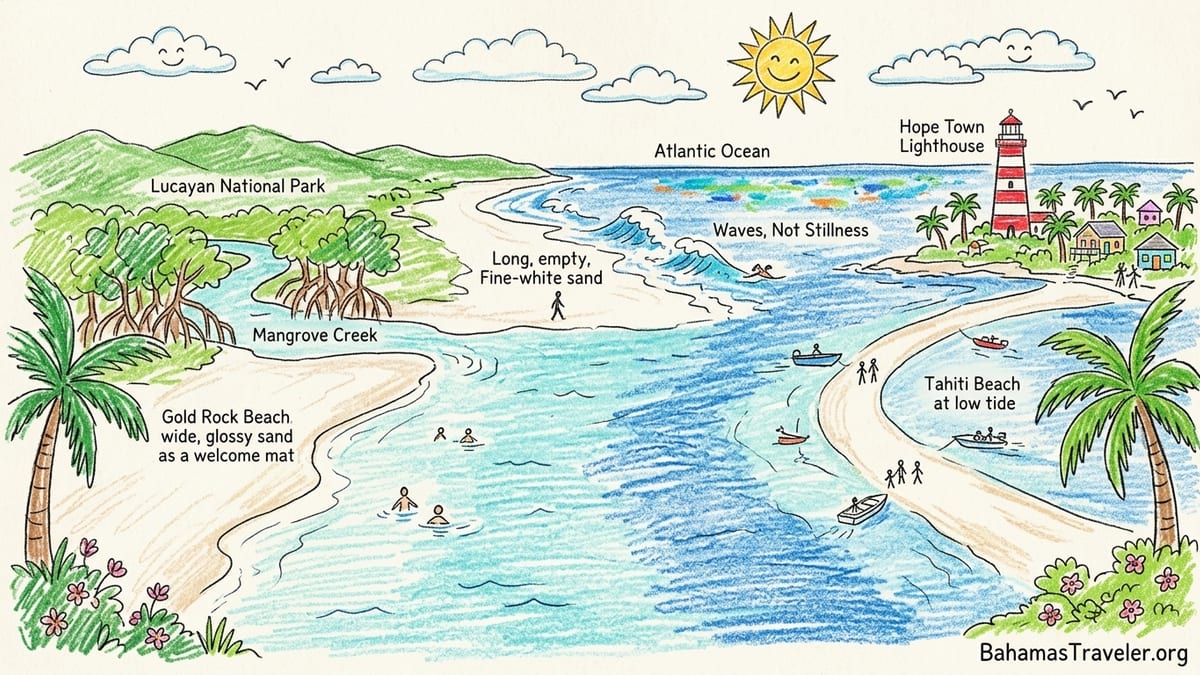
Gold Rock Beach, Grand Bahama: The “Welcome Mat” That’s Actually a Swim
Gold Rock Beach sits inside Lucayan National Park, and it really does feel like an arrival. The first time I went, I understood the nickname “welcome mat” the moment the tide backed off and the shoreline widened into a long, glossy apron of sand. It is the kind of beach where the horizon looks polished and the light makes even a simple wade feel ceremonial.
The sand here is pale and fine, more floury than gritty, and it stays firm underfoot close to the waterline. In the shallows, the bottom is mostly smooth with the occasional small ripple where the water has combed it. When I swam, the water was bathtub-warm in that late-summer Bahamian way, with a gentle temperature shift as you moved from knee-deep to waist-deep. The depth increases gradually, and the wave action depends on wind and tide, but on calm days the surface looks like lightly wrinkled glass.
What surprised me most was how quiet it felt for a beach that’s so often promoted. Even when the park was open, it didn’t have the constant parade of vendors or music you get at resort-adjacent sands. I had long stretches where the only sounds were seabirds and the faint hiss of small waves sliding up the shore. Swimming-wise, this is not a “charge straight out” beach for everyone. I stayed mindful around the creek area and any visible channels, because moving water always deserves respect, and I timed my longest swims for conditions that looked settled.
Access and rules matter here. Gold Rock is within Lucayan National Park, managed by the Bahamas National Trust, and entry is controlled by the park. The Bahamas National Trust lists day pass admission at $15 per adult (15 to 59), $10 for seniors (60+), and $8 for children (6 to 14). The Trust also publishes Lucayan National Park hours, and because park operating hours can differ by season and update cycles, I treated the park website as the final word when planning. On the day I checked, Lucayan National Park was listed as open 9 a.m. to 5 p.m. (with a separate BNT operating-hours page also noting Lucayan as open every day 9 a.m. to 5 p.m.). The facilities are limited and that’s part of the point: think restrooms and a visitor setup at the park area, then a natural beach experience without the built-up beachfront services you’d find near Freeport hotels.
Elbow Cay’s Tahiti Beach: A Sandbar Swim With a Tide Clock
Tahiti Beach, at the southern end of Elbow Cay near Hope Town, is the Northern Bahamas beach I’ve revisited most in my head. The experience changes dramatically with the tide, and that makes it feel like you’re arriving at a place that’s only fully “open” for a few hours each day. When the water is low enough, a bright sandbar curves out into the Sea of Abaco, shallow on both sides, and you can float in water that stays gentle and clear as long as the wind behaves.
The sand here is soft and pale, and the best part is the texture underfoot when you’re wading: it’s smooth enough that you don’t brace for sharp coral bits. The water over the sandbar is usually knee to waist deep, which makes it ideal for long, lazy swims that are more about drifting than distance. It’s also the kind of place where you see families and cautious swimmers staying comfortable because they can stand up almost anywhere on the bar if they want to reset.
But Tahiti Beach asked more effort of me than I expected the first time, not because it’s impossible, but because the last stretch feels longer in the heat. Getting there is part of the filtering mechanism that keeps it from feeling overrun. From Hope Town, you can walk south along the shoreline, take a golf cart or bicycle, or come by boat and wade in. Several local guides and operators describe it as roughly 15 minutes from Hope Town by cart, and about a 30 to 45 minute walk if you do it on foot along the beach. In practice, the effort is less about the clock and more about sun exposure and what you’ve packed. If you don’t bring water and shade, that “quick” trip starts to feel like a mission.
Facilities are minimal right on the sand. I treated it like a bring-your-own day: water, a snack, and a plan for getting back before the late-afternoon weather turns. Because the water stays shallow, it’s a wonderful place to swim, but it’s not the best spot for snorkeling off the beach itself. I saw small fish in the shallows and the occasional shadow flicking along the edge of deeper water, but this is more of a wading and floating beach than an underwater safari.
Hope Town’s Atlantic Side: Where I Swam for Waves, Not for Stillness
When I wanted to feel the Atlantic rather than the lagoon, I crossed to the ocean side near Hope Town. The mood flips. The Sea of Abaco side can feel like a protected swimming pool on the right day, while the Atlantic side gives you the honest, rhythmic push of open water. The sand is still bright and fine, but the shoreline is more dynamic, with wave patterns that change by the hour.
This is where I went when Tahiti’s sandbar felt too calm and I wanted a swim that felt athletic. The water clarity can still be excellent, but it’s more dependent on swell and wind. On one visit, the waves were small and friendly and I stayed in for a long time, bodysurfing in short runs and then walking back up the beach with salt on my lips. On another, the ocean had a harder edge and I kept my swim closer to shore, using the break as a natural boundary.
Shade here is mostly self-made unless you’re close to a developed area or you’ve brought your own umbrella. I learned quickly that the Bahamas sun turns a “quick swim” into a full-body day. If you’re staying in Hope Town village, the convenience is that you can return to town for food and water rather than depending on beachfront vendors.
Crowds on Elbow Cay felt situational instead of constant. When boats gather near the sandbar areas (especially closer to Tahiti Beach at peak times), you can feel the social gravity. But on stretches of the ocean side, I had moments where it was just a handful of people spread far apart, the kind of spacing that makes a beach feel private even when it isn’t.
Great Guana Cay, Abaco: The Swim That Turns Into a Beach Walk
Great Guana Cay is the beach I’d recommend when you want variety: a swim, then a long walk that keeps getting better as you put distance between yourself and the busiest access points. The island’s beach reputation is real, and the feeling I remember most is space. Even when the social scene is active near the well-known beach bars, you can walk a few minutes and find your own section of shoreline with almost no footprints.
The sand is fine and white, soft enough that you can walk barefoot for a long time without thinking about it. Swimming conditions shift with the Atlantic mood, but the nearshore reef influence helps on typical days by breaking up the energy of incoming swell. When the water was calm, I swam out and back parallel to shore, watching the color gradient shift from bright turquoise to a deeper blue. When the ocean was more active, I treated it as a nearshore swim and let the waves do some of the work, staying alert for any lateral pull.
Snorkeling is possible on Great Guana Cay in the right conditions, especially near rocky and reefy sections when visibility is up. On a calmer day, I slipped on a mask and saw classic reef fish in the shallower reef zone: parrotfish with their blunt profiles, small snappers flashing in a loose group, and sergeant majors hovering like little sentries. I didn’t treat this as a guaranteed “big wildlife” snorkel from shore. It felt more like a bonus activity when the sea was cooperative, rather than the main reason to come.
Access and boundaries are part of the Guana story. The northern tip includes Baker’s Bay, a private club development, and that reality shapes how you move around the island and where you expect public beach access to feel straightforward. The best “swim day” on Guana, in my experience, came from embracing what’s easy: pick a stretch, swim when conditions look safe, then walk until you feel like you’ve left the louder version of the island behind.
Radio Beach, North Bimini: My Most Repeatable Swim Day
If you asked me for the Northern Bahamas beach I could repeat with the least friction, I’d answer: Radio Beach on North Bimini. It’s close to Alice Town, it’s easy to reach compared with more remote cays, and the water behaves in a way that makes swimming feel welcoming. On my last swim there, the sea was calm enough that I could relax into a long float, then stand up and chat, then wade back out again without feeling like I needed to “commit” to the ocean.
The sand is bright and comfortable underfoot, and the water color is the kind of clear aquamarine people come to the Bahamas for. The reason it swims so nicely is protection: reef structure offshore helps buffer swell, and in many conditions the nearshore water stays gentle. That doesn’t mean you ignore the sea, but it does mean the default is calmer than you might expect on an island that feels so close to the open Atlantic.
For snorkeling, I stayed closer to the rocky reef sections at the edge rather than the main swimming area. In those rockier patches, I saw parrotfish and smaller reef fish weaving in and out of the structure, and I had that familiar snorkeler’s feeling of being on the edge of two worlds: bright sun above, a quieter city of fish below. I did not see turtles or sharks on my own swims here, and I wouldn’t promise them. What I can say is that the reef and rock make it more interesting than a pure sand-bottom beach.
Crowds were the main variable. Radio Beach can feel “popular but manageable” when you arrive earlier in the day, and it can feel like a social hub later, especially when more visitors are on island. The busy section clusters near the easiest access points, where you’re more likely to see chair setups and vendors. When I wanted quieter water, I simply walked farther along the curve of sand until the noise softened. One practical note that can save a trip: Radio Beach water quality monitoring exists through organizations participating in the Swim Guide platform, with sampling information posted for Radio Beach. I like having that extra layer of reassurance when I’m choosing a swim spot in a small harbor area.
Great Harbour Cay, Berry Islands: Sugar Beach and the Reward for Showing Up
Great Harbour Cay feels like a secret that keeps getting out, largely because the beaches are legitimately beautiful in that clean, understated Out Island way. Sugar Beach is the name that comes up most, and it earns it. The sand is the soft, pale kind that makes you slow down automatically. When I walked onto it the first time, the beach felt wide and open, and the water looked like it had been filtered.
Swimming here is what I’d call confidence-building: the entry is easy, the bottom is sandy, and the water clarity is often excellent when conditions are settled. The waves can be present depending on which side you’re on and what the weather is doing, but on a calm day I had a long, unrushed swim that felt like the Bahamas at its simplest. No soundtrack, no crowd choreography, just a big, bright shoreline and water warm enough that you stay in longer than planned.
Facilities are not the point on Great Harbour Cay beaches. You plan like you’re visiting a place that expects you to be self-sufficient. I brought water, a snack, and sun protection, and I didn’t count on shade beyond what I could find naturally. That’s part of the appeal, but it’s also why I consider this beach slightly more effort than the “headline” makes it sound. The island is reachable, but it’s not the kind of place where you step off a cruise ship pier and you’re instantly on your towel.
To verify access and logistics, I checked current operator information for flights into Great Harbour Cay and confirmed that scheduled service listings exist through official tourism channels that publish approved operators and routes. For arriving by boat, Great Harbour Cay Marina publishes “getting here” guidance aimed at cruisers, including notes about approach and clearing procedures. On the ground, the practical reality remains: once you’ve made the effort to get here, the swimming payoff is huge, but you’ll enjoy it more if you arrive prepared and not expecting resort-level beachfront infrastructure.
The Takeaway
If I’m choosing purely for swimming, not just a photo, I’d put Radio Beach and Tahiti Beach at the top for repeatable, low-stress water time, each for different reasons. Radio Beach is the easiest “I can swim all day” option with nearby town convenience. Tahiti Beach is the most playful swim because the tide creates that sandbar magic, but it demands timing and a little effort.
Gold Rock Beach is the one I’d choose when I want solitude and a sense of scale, with the important caveat that it’s tied to park hours and rules and the day’s conditions. Great Guana Cay is the best blend of swim and walk, a place where the beach keeps improving the farther you go. Great Harbour Cay is the reward beach: it’s not the most convenient, but when you’re standing on Sugar Beach with clear water in front of you, convenience stops being the point.
One final, very current note: the Northern Bahamas are in a time of year when thunderstorms can build quickly, and today’s conditions (Monday, September 21, 2026) show active weather patterns across Grand Bahama, Bimini, Abaco, and the Berry Islands, with showers and thunderstorms in the forecast. I planned my swims around the sky as much as the sea, and I’d urge you to do the same. The best beach day here isn’t about braving bad weather. It’s about catching the clean window, then getting out of the sun and water before the afternoon turns loud.
FAQ
Q1. Which Northern Bahamas beach is best for pure swimming rather than photography?
Radio Beach on North Bimini is the most consistently swim-friendly because the water is often calm and the entry is easy, with nearby services in Alice Town.
Q2. Which beach felt the most tide-dependent?
Tahiti Beach on Elbow Cay. The famous sandbar experience is best around low tide, and it changes the whole swim and wading setup.
Q3. Do I need to pay to access Gold Rock Beach?
Gold Rock Beach is within Lucayan National Park, which has an admission fee set by the Bahamas National Trust. Check the current BNT fee schedule before you go.
Q4. What are current Lucayan National Park hours?
The Bahamas National Trust lists Lucayan National Park hours on its website; the park has been listed as open 9 a.m. to 5 p.m. on recent BNT operating-hours updates and the park page.
Q5. Is Tahiti Beach easy to reach from Hope Town?
It’s reachable, but it takes effort. You can walk (often described as about 30 to 45 minutes), rent a golf cart or bike, or come by boat and wade ashore.
Q6. Where did you actually snorkel from shore in these islands?
I snorkeled at the rocky and reefy edges of Radio Beach and on Great Guana Cay in calmer conditions, seeing parrotfish and small reef fish like snappers and sergeant majors.
Q7. Which beach required more effort to reach than expected?
Tahiti Beach surprised me. The last stretch feels longer under the sun, especially if you’re walking or if you didn’t pack water and shade.
Q8. How crowded was Radio Beach when you visited?
The busiest section clustered near the easiest access points. Walking farther along the curve of the beach quickly reduced the noise and the density of people.
Q9. Are there facilities like restrooms and food right on these beaches?
It varies. Radio Beach is near town and can have vendors, while Tahiti Beach and many Great Harbour Cay stretches have few to no fixed facilities, so plan to be self-sufficient.
Q10. What weather should I expect right now in the Northern Bahamas?
As of Monday, September 21, 2026, forecasts for Grand Bahama, Bimini, Abaco, and Great Harbour Cay include showers and thunderstorms. Plan swims for clearer windows and watch the sky.