


The northern Bahamas is where I go when I want big-animal adrenaline without sacrificing warm-water ease. It is also where I’ve learned, repeatedly, that the “best” dive trip is really a chain of smart decisions: the right island for the season, the right operator for your experience level, and the right place to stay if you’re doing multiple days on the water. This is the itinerary I would happily repeat, with the specific resorts and operators I’d book again, and the dives that felt genuinely worth the flights, ferries, and early alarms.
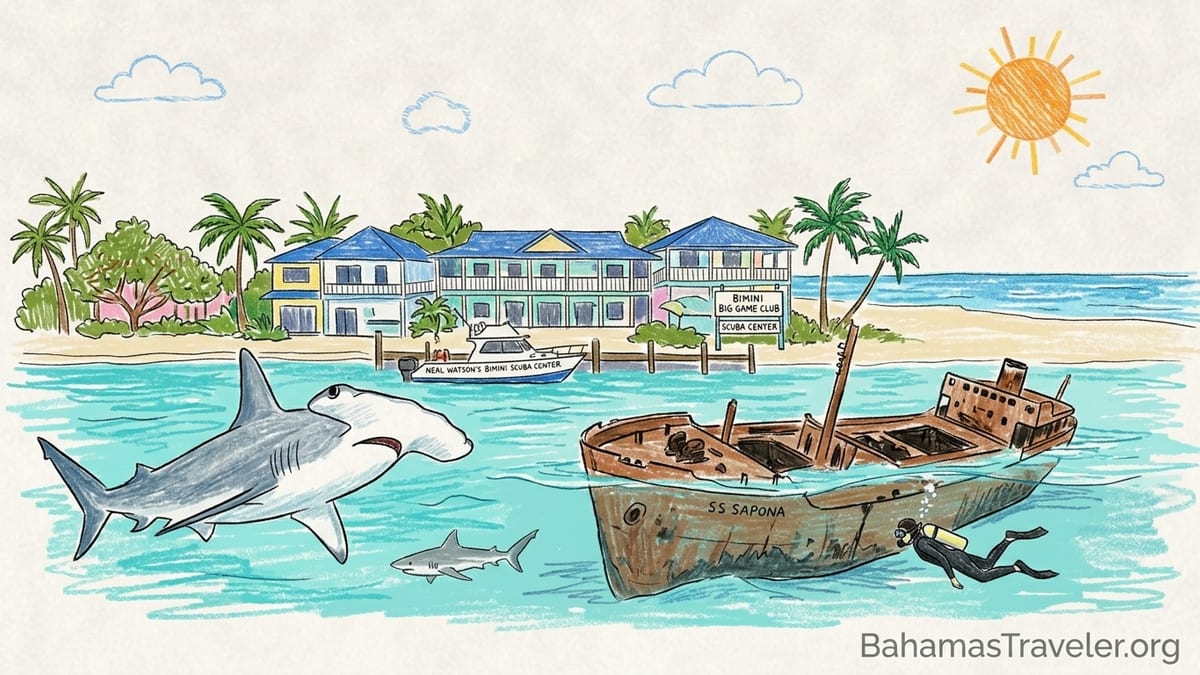
Bimini: Hammerheads, The Sapona, And Why I’d Base Myself At Bimini Big Game Club
If I could only pick one northern Bahamas island for a short, high-impact dive fix, Bimini would be it, especially from November through April when great hammerheads reliably show up. What makes Bimini unusually easy is how tightly the diving can be bundled: Neal Watson’s Bimini Scuba Center is based at Bimini Big Game Club Resort and Marina, so you can roll out of your room, walk to the dock, and be back for lunch without turning every dive day into a logistics project.
For accommodation, my repeat choice is straightforward: I’d stay at Bimini Big Game Club specifically to simplify consecutive dive days with Neal Watson’s operation. Their published “Dive + Hotel” packages spell out the value for divers who want multiple boat days. For example, their 4-night “Explorer” package is listed at $1,251 per person double occupancy and includes one great hammerhead safari plus two other days built around reef sharks, the SS Sapona, and a stingray and Honeymoon Harbour day. If I wanted to go all-in on hammerheads, their 4-night “All The Sharks” package is listed at $1,460 per person double occupancy and includes two hammerhead safaris plus a reef shark and Sapona day, with a seasonal bull shark cage dive as a bonus when offered.
The hammerhead day is the signature, and it is not a “new diver’s first boat dive” even if the profile itself can be manageable. The operation’s own notes push real thermal protection: a full 5 mm wetsuit plus hood and gloves is specifically recommended for comfort in the winter season. When I plan this dive, I plan it like a long, still, camera-focused encounter rather than a swim-along reef tour: you are typically low, steady, and very aware of your buoyancy and finning so you do not kick up sand or crowd other divers. Expect an advanced mind-set even when the depth does not feel extreme.
For the rest of the trip, Bimini is an easy win for newer divers because Neal Watson’s menu includes standard two-tank “Captain’s Choice” diving listed at $160 plus 10% VAT, and the “Reef Shark Safari + Sapona Adventure” is also listed at $160 plus 10% VAT for divers. The Sapona itself is the recognizable Bimini wreck, and I treat it as a confidence-builder: a famous structure in shallow water where you can practice buoyancy around big, photogenic lines and openings without the pressure of a deep, current-swept descent.
What The Bimini Dives Actually Feel Like: Conditions, Bottom Time, And Who They Fit
I plan Bimini as a two-pace trip. One day is “sit still and watch giants,” and another is “fun, shallow, relaxed.” On the shark and wreck days, I’m usually in the water long enough to appreciate why Bimini attracts both photographers and people who just want their first real shark memories. On the shallow wreck and reef portions, it is realistic to have longer bottom times than you would on deeper wall diving, because your limiting factor often becomes temperature and air consumption rather than no-decompression limits.
On winter hammerhead days, I pack for cooler water by Bahamas standards. Operators in the area describe seasonal temperatures in the low to mid 70s Fahrenheit during the cooler months, which matches the “5 mm plus hood” advice I follow. Visibility in Bimini is often the make-or-break detail for photography: when it is clear, the silhouettes of big sharks look impossibly crisp against pale sand. When it is hazier, the encounter becomes more intimate and sudden, with sharks materializing from blue-gray distance. Either way, good buoyancy and calm positioning matter more than speed.
For newer divers, I’d steer them toward the standard two-tank reef days or the Sapona-focused trips first. Those are typically shallow enough that you can settle in, adjust weights, and practice relaxed finning with a guide close by. The hammerhead safari is better when you already have comfort hovering without sculling your hands, and when you can hold position without drifting into other divers. If you are newly certified but confident and well-supervised, you can still enjoy it, but it is not the day I’d choose to test a brand-new regulator setup or a brand-new dry skill set.
Gear quality is where staying with a dive-focused operation helps. When I’m doing consecutive days, I prefer a shop that can quickly swap a leaky inflator hose, provide rental spares, and keep tanks, weights, and belts as part of the plan rather than an add-on. Neal Watson’s published trip pricing commonly includes tanks and weights, which removes the little frictions that snowball on day three when you’re tired and sunbaked.
Bimini Hammerheads, But Make It Turnkey: How Short Packages From Florida Really Work
If you want Bimini’s shark hits without building the whole trip yourself, the market now has very specific, published weekend-style packages departing South Florida. I look at these as “time compression tools.” You trade some flexibility for a clean itinerary, which is ideal if you can only grab a weekend and you want someone else to synchronize lodging and boats.
One example is a two-day “Hammerhead Weekend Getaway” package sold for April 18 to 19, 2026 at $1,465, with flight, hotel, and dives included. The itinerary is written with shallow profiles called out clearly: a bull shark cage dive around 10 feet, a hammerhead and tiger shark dive around 20 feet, then a Sunday two-tank day with a reef shark dive around 25 feet and the SS Sapona around 15 feet. I like how explicit this is: it tells newer divers the depth is not the scary part, while also signaling that it is still a shark-focused trip where calm behavior and good briefings matter.
Another Florida-based example is a Bimini hammerhead trip built around Bimini Big Game Resort, ferry transport, and a set itinerary priced at $1,250 per person double occupancy for late November 2026, with a stated requirement for dive accident insurance. When I see “insurance required” spelled out by a seller, I take it as a clue that the operator wants to filter for prepared travelers. Even when a dive is shallow, the remoteness and the nature of shark interactions makes it smarter to arrive with coverage and a conservative personal safety plan.
Who should book these packages? If you are a newer diver who wants structure, they can be excellent, because you are less likely to miss a boat time or underestimate transfers. If you are an experienced diver who wants maximum underwater time, you might prefer booking directly in Bimini for more flexible schedules and additional two-tank days. Either way, I always confirm what gear is included and whether rentals are extra, because shark weekends often assume you bring your own core kit for fit and familiarity.
Grand Bahama: Tiger Beach From Freeport, Day Boats Versus Liveaboards
Tiger Beach is the northern Bahamas trip that feels like stepping into a documentary, and official dive coverage correctly ties it to Freeport, Grand Bahama. The decision that matters most here is not just “which operator,” but “which format.” Day trips and liveaboards deliver very different experiences, and I would pick based on whether you care more about comfort between dives or the intensity of repeating shark sites for days.
For a day-boat style option, West End Watersports sells Tiger Beach excursions that run roughly 8 a.m. to 4 p.m. and include the boat, captain, trained shark feeder, tanks, weights and belts, lunch and refreshments, and chum bait. They also explicitly offer two paths: a scuba certified “face to face” trip and a “caged” trip for non-certified guests. That split is important if you’re traveling with family members who want the tiger shark experience without full scuba training.
On the liveaboard side, Tiger Beach is now a core itinerary for Aggressor Adventures out of Freeport on Saturday-to-Saturday schedules. Their Tiger Beach itinerary document was updated April 28, 2026 and lists Freeport as the home port at Bradford Marine. For travelers who want maximum immersion, a liveaboard is the “sharks all day” version of Tiger Beach: more drops, more chances at different individuals, and more time to dial in camera settings and personal comfort around large animals.
Then there’s the boutique small-group angle. SharkDiver advertises Tiger Beach packages with six divers on a 65-foot vessel and lists inclusive pricing at $3,395 per person. I pay attention to details like “six divers” because it changes everything underwater: less fin wash, less crowding around the feeder, and a calmer, more controlled feeling when a large tiger shark turns broadside in front of you.
Tiger Beach Dive Reality Check: Experience Level, Conditions, And The Animals You’re Actually There For
I treat Tiger Beach as an “experience required” trip, even if the depths are often manageable. The hard part is not deep decompression. The hard part is composure, buoyancy discipline, and situational awareness when multiple large sharks move through a small visual space. If you are a newer diver, I’d rather see you build confidence on Bimini reefs and wrecks first, then come back to Tiger Beach with calm, steady hovering skills and a practiced response to task loading.
Conditions off Grand Bahama’s south side are often marketed as consistently clear, and one Grand Bahama shark dive listing describes visibility as clear and consistent year-round with water temperatures averaging roughly 72 to 78 Fahrenheit depending on season. Those numbers matter for planning exposure protection and realistic bottom time. If you are cold, your breathing rate goes up, and your bottom time drops, which is the opposite of what you want when you are paying for a shark-focused day where patience is the currency.
Certification requirements are not ambiguous on at least one active Grand Bahama shark product: a two-tank “Shark Dive” listing states Open Water certification or higher is required, and it describes a typical day with a first dive as a free swim at a site called Shark Wall and a second dive as a feeding dive with a dedicated feeder. This is a good snapshot of how structured these experiences can be: one dive to acclimate and observe behavior, one dive where the action concentrates.
Wildlife expectations should be kept honest. Tiger Beach is famous for tiger sharks first, with other species often part of the mix depending on the day. The “best” observation I can give is behavioral: you notice individual sharks by how they approach, how they angle into the current, and how they react to diver spacing. That’s why I prefer smaller groups. It is also why I prefer operators who brief hard rules and enforce them. The goal is not thrill by chaos. The goal is controlled, repeatable encounters where you come home with photos and stories, not close calls.
Abaco: Reefs, The Pelican Cays, And Where Cavern And Cave Diving Gets Serious
Abaco is the northern Bahamas curveball: it can be a laid-back reef destination, and it can also become a true specialist trip if you chase caverns and caves. Official dive coverage calls out Pelican Cays and “Coral Caverns” among the major northern experiences, and that tracks with how divers talk about Abaco when they want something different than “sharks and sand.” The practical issue, though, is that Abaco diving is more operator-dependent than Bimini or a Tiger Beach liveaboard. You need to verify who is actively running what, from which base, right now.
For serious underground diving, the most clearly verifiable active specialist is Bahamas Underground, based in Marsh Harbour. They position themselves as providing training and guided diving services to blue holes and underwater caves in Abaco. If you are a recreational diver who just wants a “cavern taste,” you need to be careful about assumptions. Some of Abaco’s famous sites are not casual cavern tours; they are full overhead environments with strict requirements.
One current, third-party Abaco cave site description states that Dan’s Cave requires full cave certification through agencies such as NACD or IANTD, that diving there is guide-only through Bahamas Underground, and that there is no open-water or cavern-only option. I include that here because it is exactly the kind of detail that prevents trip-planning heartbreak. If you show up with Advanced Open Water and a sense of adventure, you may still be locked out of the marquee cave dives, and rightly so.
So how would I do Abaco if I wanted both reef ease and underground spectacle? I would split the goals. I’d schedule reef days in and around the Pelican Cays Land and Sea Park for coral scenery and fish life, then book a separate, purpose-built day with Bahamas Underground only if I had the right cave credentials and the right equipment configuration. If I did not have those credentials, I would keep the trip reef-focused and plan a future return after proper cavern or cave training rather than trying to “shortcut” overhead diving.
Berry Islands (Only If Operator Inventory Supports It): Chub Cay As The Practical Add-On
The Berry Islands can be an incredible northern Bahamas add-on, but I only recommend them when you can confirm you have a real operator with real boats running during your dates. Right now, the cleanest, most verifiable option is Chub Cay Divers, which operates exclusively for guests of Chub Cay Resort and Marina. That exclusivity is actually a benefit if your goal is low friction: stay on property, dive from the marina, and avoid the “who is picking us up where” problem that can happen on smaller islands.
Chub Cay Divers publishes a simple, current price list: one dive is $150, two dives are $230, and three dives are $330, excluding 10% VAT and gratuities. They also spell out that rental equipment is not included in those dive prices, and that a full set of rental gear for the day is $60 per person. I like this transparency, because it lets you compare true cost against other islands where “cheap” dive pricing quietly becomes expensive once you add gear and taxes.
For newer divers, Chub is positioned as an unusually friendly place to start because of the shallow reef surrounding the island and the ability to practice first in a heated pool. Their Discover Scuba Dive option is described as a pool session plus an ocean dive to a maximum depth of 40 feet, with the combined price listed at $280 per person including rental gear. That is exactly the sort of controlled, shallow profile that helps brand-new divers build confidence before moving on to higher-intensity shark sites.
On the water, Chub Cay dives are described as ranging from roughly 10 feet to 100 feet, with boat rides to sites as short as five minutes. They also emphasize that they observe reef sharks without chumming or feeding. For me, that makes Chub Cay a smart palate cleanser between Bimini’s structured shark safaris and Tiger Beach’s high-intensity predator focus: you can still see sharks, turtles, rays, and healthy reef life, but the tone is calmer and more exploratory.
The Takeaway
If I were booking the northern Bahamas again, I would build the trip around how much decision fatigue I want to eliminate. For Bimini, I’d base myself at Bimini Big Game Club and dive with Neal Watson’s Bimini Scuba Center because it compresses lodging and boat diving into one walkable routine, and because their published packages make multi-day diving financially and mentally simple. I’d prioritize hammerheads in season and use the Sapona and reef days as the relaxed counterbalance.
For Grand Bahama, I’d pick Tiger Beach when I want sharks as the main event, not a bonus. Newer divers can still experience it in the right format, especially if they choose caged options or work up from calmer dives first, but the best Tiger Beach days reward divers who can hover steadily and follow strict briefings without drifting, crowding, or panicking. I’d choose day trips for convenience, and a liveaboard or small-group boat when I want the full immersion and the best chance of uncrowded encounters.
For Abaco, I’d be honest about my qualifications. Reef days around the Pelican Cays are a beautiful, accessible reason to go. Cave and cavern names can be tempting, but Abaco’s premier cave dives have real barriers to entry, and that’s exactly how it should be. If I had the right full-cave credentials, I’d book guided cave diving with the specialist that is clearly active and based in Marsh Harbour. If I did not, I’d keep it reef-forward and plan training for a future return.
And if I wanted a Berry Islands add-on, I’d only do it with inventory I can actually confirm, which is why Chub Cay is the practical recommendation right now. Staying at a dive-focused property there is the difference between “we’ll see if we can dive” and “we dove three times today and still made it to dinner.”
FAQ
Q1. What is the best season for hammerhead shark diving in Bimini?
Hammerhead season in Bimini is typically November through April, when operators market great hammerhead safari trips most heavily.
Q2. Do I need to be Advanced Open Water for Bimini hammerhead dives?
Requirements vary by operator and conditions, but the bigger issue is skill: you should be comfortable hovering calmly, managing buoyancy, and following strict shark briefings, even on moderate depths.
Q3. How much does it cost to do a Bimini hammerhead dive?
Neal Watson’s Bimini Scuba Center lists a Great Hammerhead Safari at $349 plus 10% VAT (tanks and weights included) when in season.
Q4. Is the SS Sapona wreck dive suitable for newer divers?
Yes. The Sapona is commonly treated as a shallow, confidence-building wreck experience, especially when paired with a guided reef or shark safari day.
Q5. Where is Tiger Beach located, and what island do you base from?
Tiger Beach is associated with Grand Bahama, with trips commonly operating out of the Freeport area or West End depending on the operator.
Q6. Can non-certified travelers experience Tiger Beach shark encounters?
Some operators advertise caged options for non-certified guests, while certified divers can do face-to-face scuba trips. Always confirm current rules before booking.
Q7. Are Tiger Beach dives deep, and do they require technical training?
Tiger Beach is not primarily a technical-depth destination, but it is experience-intensive because shark proximity, task loading, and group control demand strong buoyancy and awareness.
Q8. Is Abaco good for recreational reef diving even if I do not cave dive?
Yes. Abaco and the Pelican Cays area are widely recognized for reef and coral scenery, and you can plan a reef-first itinerary without doing overhead environments.
Q9. Can any Open Water diver do Abaco’s famous cave dives like Dan’s Cave?
No. Some premier Abaco cave sites are described as requiring full cave certification and guide-only protocols, with no open-water or cavern-only option.
Q10. What is the most practical Berry Islands dive base right now?
Chub Cay is the easiest confirmed option because Chub Cay Divers operates for resort guests, publishes current dive pricing, and offers beginner-friendly training and shallow reef diving.