


Nassau can be confusing for first-time visitors. Cruise passengers pour into downtown looking for a “free beach,” resort guests at Cable Beach wonder where the public sand actually begins, and many people mix up New Providence with neighboring Paradise Island. This guide untangles the options and focuses on what matters in real life: where you can actually get to the beach, how clear the water is, what it costs to spend the day there, and which stretch of sand really fits your style.
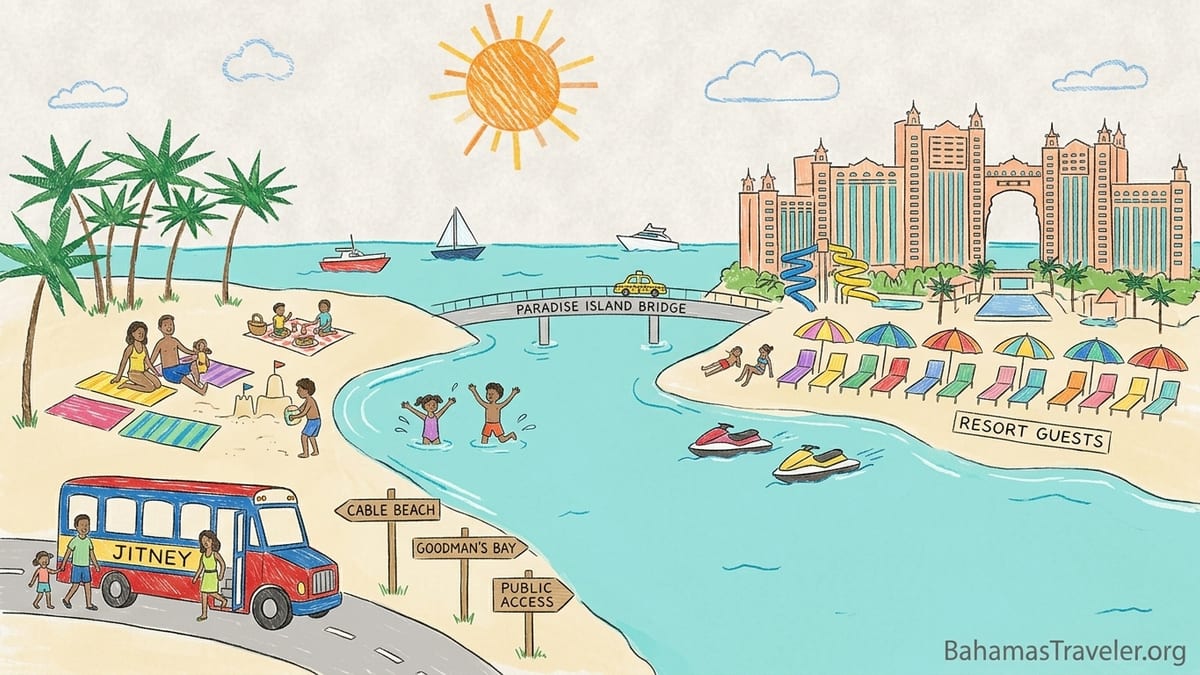
Understanding Nassau’s Beaches: Public vs Resort vs Paradise Island
All beaches in the Bahamas are public up to the high-water mark, but that does not mean every stretch of sand is easy to reach. On New Providence, where Nassau sits, some of the most famous waterfront is lined with large resorts that control the pathways, loungers and pools behind the beach. Travelers often arrive at Cable Beach or Paradise Island expecting to walk in from the road and use resort chairs, only to learn that the shoreline is free but the facilities are not.
The most important distinction is between New Providence beaches and Cabbage Beach on Paradise Island. Cabbage Beach is one of the most publicized names in cruise forums, but it lies across the harbor from Nassau, over the Paradise Island bridges. That means a separate taxi ride or water transport and a very different atmosphere dominated by Atlantis, RIU and other hotels. For this guide, Cabbage Beach is best treated as a nearby alternative, not a Nassau city beach.
On New Providence itself, main public-access beaches along the north coast include Junkanoo Beach close to the cruise port, Saunders Beach and Goodman's Bay between downtown and Cable Beach, the long resort-lined arc of Cable Beach, and farther west, Love Beach and Jaws Beach near the airport side of the island. Beyond these, smaller local stretches exist around areas such as Orange Hill and the western and southern shoreline, but they have fewer services and limited public transport.
Transportation also shapes the choice. There is no rideshare service like Uber in Nassau, so visitors rely on taxis, the local “jitney” buses and, in a few cases, hotel shuttles. Government-published taxi zone fares show typical one-way prices from Lynden Pindling International Airport of about 29 Bahamian dollars to Cable Beach and 36 dollars to downtown Nassau, with similar United States dollar values because the currencies are kept at parity. From the cruise port, reported fares to Cable Beach are often around 20 to 25 dollars per taxi, while jitney buses between downtown and Cable Beach commonly cost just over 1 dollar per person, paid in cash.
Cable Beach and Goodman's Bay: Resorts, Public Sand and Swimming
Cable Beach is New Providence’s classic resort strip, a several-kilometer sweep of pale sand running west from just beyond Goodman's Bay. Major properties such as Baha Mar, Sandals and Breezes line this coast, each with manicured beachfronts, security at the entrances and organized water sports. The sand and sea in front of these hotels are still public, but practical access for day visitors usually requires using a public access lane or paying for a resort day pass that includes loungers, restrooms and pools.
Goodman's Bay, at the eastern end of the strip, is where many independent visitors first meet Cable Beach. Set right off West Bay Street, it offers a large free parking area, direct sand access, shaded trees and a wide, gently shelving bay that works well for swimming. There are basic facilities such as public restrooms and food vendors during busier times. Visitors report chair and umbrella rentals available from local operators on many days, though they are not guaranteed every morning in low season. There are no permanent lifeguard towers here, so families should treat it as an unsupervised beach and keep children within arm’s reach in the water.
The difference between Goodman's Bay and the resort frontage is important. At Goodman's Bay, anyone can drive up, park without charge, and walk directly onto the sand. Continuing west, various signed public paths give access to Cable Beach between resorts, but parking is more limited and you often walk between or around private properties to reach the waterline. Once on the sand you may stand or sit on your own towel anywhere up to the high-water mark, yet resort loungers and umbrellas on the upper beach are for registered guests or day-pass holders, with staff politely but firmly enforcing that distinction.
For swimming, the entire Cable Beach area usually offers calm, clear water in settled weather, protected by offshore reefs and islands. Clarity can drop after strong winds or heavy rain, and like much of New Providence, you may see patches of seagrass in the shallows. Offshore snorkeling from the public beach is modest; experienced snorkelers often book boat trips to nearby reefs instead. For families staying in town or arriving by cruise who want nicer water than Junkanoo Beach but still some services, Goodman's Bay and the public ends of Cable Beach are an excellent compromise, reachable by the number 10 jitney bus from downtown for a low cash fare and around 20 minutes of travel time depending on traffic.
Saunders Beach and Nearby Local Shores: Family-Friendly and Free
Just west of downtown Nassau, Saunders Beach is one of the most convenient free public options for visitors who want a more local scene without going all the way to the resort strip. Upgrades in the last few years added a children’s playground, a beachfront promenade, shaded picnic structures, showers and public restrooms. A small but useful parking lot sits directly beside the sand. Families from Nassau use this beach heavily on weekends and public holidays, when the atmosphere becomes social but still focused on swimming and picnicking rather than loud music.
The water at Saunders Beach is usually calm and shallow for a good distance, which works well for children who want to splash near shore. At the eastern end of the beach there are some rocky sections and small reefy outcrops where confident swimmers can use a mask to look for fish, although it is not considered a dedicated snorkeling destination. As with most public beaches on New Providence, there are no permanent government lifeguards on duty here, so adults must supervise kids closely, especially near the rocky ends where the bottom changes underfoot.
Facilities are straightforward. Restrooms and showers are typically open during daylight hours, though visitors occasionally report short closures for cleaning or maintenance. There are no built-in chair or umbrella stands, so most beachgoers bring towels and small shade tents, or rely on natural shade from trees and picnic shelters. Food options directly on the sand are limited to periodic vendors and food trucks, although West Bay Street behind the beach has small restaurants and takeaway spots.
From the cruise port or downtown Nassau hotels, Saunders Beach is a short taxi ride that often takes about 10 minutes outside rush hour, or a ride on the same number 10 jitney that continues onward toward Cable Beach. Because jitneys can be crowded and do not have dedicated space for strollers or coolers, many families with small children prefer a taxi despite the higher cost. For visitors who want a free, family-friendly public beach with basic amenities, gentler crowds than Junkanoo, and a strong local feel, Saunders Beach is often the most practical answer.
Junkanoo Beach: Walkable Cruise Stop with a Party Edge
Junkanoo Beach, sometimes also called Western Esplanade Beach, is the default choice for many cruise passengers because it is within walking distance of the Nassau harbor. From the cruise piers near downtown, most visitors need about 15 to 20 minutes to walk through the port area and along the waterfront to the sand, depending on ship location and crowding. There is no entry fee, and the water here is usually calm, although this part of the harbor sees more boat movement than beaches farther west.
The atmosphere on cruise days is lively and can feel crowded, especially when several large ships call at once. Colorful shacks line the beach selling cold drinks, conch fritters and grilled seafood, and there are informal package deals that pair loungers, umbrellas and open-bar wristbands. Speakers often play music at high volume, and organized games take place directly on the sand. Visitors who enjoy a beach party find this appealing, while those looking for a quiet swim often leave with the impression that Junkanoo Beach is hectic.
Facilities here are geared toward day visitors. Vendors offer chair and umbrella rentals across much of the sand, and several operations advertise jet skis, banana boat rides and other water sports. Recent visitor reports frequently mention personal watercraft operating close to the swimming area, with some expressing concern about distance to swimmers. Local operators do mark swim zones and keep an eye on traffic, but rules are not enforced as strictly as at some resort beaches, so cautious swimmers may prefer to stay nearer shore and use bright-colored flotation devices when the beach is at its busiest.
Restrooms are available in nearby bars and beach clubs, generally for guests or customers. There are no clearly signed public bathrooms right on the sand. Families with younger children often use Junkanoo Beach only for an hour or two, combining it with a visit to downtown landmarks such as the Straw Market, the Queen’s Staircase or local ice cream and coffee shops. For a more upscale but still walkable alternative, the Margaritaville resort and water park complex stands near the eastern end of Junkanoo, selling day passes that include pools and slides while still offering direct access to the public shoreline.
Love Beach and Jaws Beach: Clear Water, Snorkeling and Quieter Days
Farther west along New Providence, beyond most of the main resorts, Love Beach and Jaws Beach feel more like classic island getaways. They are still on the same island as Nassau and fully accessible by paved road, but their distance from downtown and the cruise pier keeps crowds lower. Both beaches are public, free to access and known for clearer water in settled weather and proximity to offshore reefs.
Love Beach stretches along the northern coast not far from Lynden Pindling International Airport. A small reef system sits offshore, and on calm days the water between the beach and the reef can be ideal for snorkeling. Visitors report easy entry over mostly sandy bottom with some scattered rocks, and fish life that becomes more interesting as you swim out toward the reef line. The popular access point for travelers is near a small beach bar, where staff often rent chairs and umbrellas and sell food and drinks. There is typically an informal charge for use of loungers, restrooms and showers, but there is no fee to step onto the sand itself.
Conditions at Love Beach can change with wind and tide. On windy days facing from the north or northeast, waves and surface chop reduce underwater visibility and make the swim to the reef more tiring. After storms, seagrass and debris sometimes collect near shore. Another factor is aircraft noise. Love Beach sits under or near several of the approach and departure paths for Nassau’s main runway, so commercial jets periodically pass overhead and interrupt the otherwise quiet setting. For most visitors this is an occasional curiosity rather than a constant disturbance, but travelers who are very sensitive to noise should be aware of it.
Jaws Beach lies at the western end of the island near the Clifton Heritage area, in a more remote and undeveloped setting than Love Beach. The shoreline here offers shallow, usually calm water with good clarity and a sandy bottom in many areas, backed by casuarina and palm trees. There are no built-up facilities directly on the beach: no formal bathrooms, no fixed bars, and no organized chair rentals. Some days local vendors set up small stands, but visitors should not count on it and are better off bringing their own water, snacks and sun protection.
Reaching Love Beach or Jaws Beach from downtown or the cruise port typically requires a taxi, which might cost roughly 30 to 40 Bahamian dollars one way depending on the exact location and negotiation. Travel time is often 25 to 35 minutes in normal traffic. Local jitney routes change periodically and do not reliably serve the far western end of the island, so independent travelers who want a relaxed, all-day beach with snorkeling often budget for round-trip taxi fares or arrange private drivers in advance through their accommodation.
Other Accessible Shores: Western and Southern Coastline Options
Beyond the headline names, New Providence has several smaller public-access stretches of sand that appeal mainly to visitors who prioritize quiet over services. Along the north-western coast, areas such as Sandyport, Sea Beach and Orange Hill offer pockets of sand between residences and low-rise hotels. Access points might be no more than a break in the roadside wall or a path between properties, so it helps to ask taxi drivers or hotel staff for the nearest recognized public entry. Parking tends to be limited to roadside pull-offs, and there are usually no public restrooms or lifeguards.
These western beaches often have clear water and soft sand similar to Cable Beach, but their narrow size means they feel full when only a handful of families are present. Sea conditions can vary with the wind direction; a strong onshore breeze brings waves and floating seagrass, while calm mornings show off turquoise water ideal for a quick swim. Because these stretches lack chair rentals, visitors either sit on towels or bring compact travel chairs and shade umbrellas bought or rented in town.
The southern shoreline of New Providence, around communities such as Adelaide and Coral Harbour, offers yet another character. Here the beaches face deeper open water, and offshore sandbars can create picturesque scenes at low tide. Travelers who reach these areas, often by rental car or prearranged taxi, find fewer people and a stronger sense of local life, with fishermen working from small boats and children playing in the shallows after school. Amenities, however, are minimal, and the water can feel rougher on windy days than on the north coast.
For most short-term visitors staying in Nassau without a car, western and southern beaches beyond the main ones described earlier are best seen as optional add-ons rather than core choices. They reward those willing to trade convenience for solitude, but they do not solve the common search needs of many travelers, such as walkable access from downtown, guaranteed bathrooms, or easy chair and umbrella rentals.
Paradise Island’s Cabbage Beach: A Nearby but Separate Option
Cabbage Beach deserves mention mainly because so many visitors assume it is part of Nassau itself. In reality it lies on Paradise Island, across the harbor from downtown, and is ringed by large resorts including Atlantis and RIU. Public access to the sand is still guaranteed by Bahamian law, yet reaching it from a ship or hotel in Nassau involves crossing the Paradise Island bridges by taxi, water taxi or organized tour.
The character of Cabbage Beach differs from the north-coast beaches of New Providence. The Atlantic exposure can bring stronger waves and a more noticeable undertow on windy days, which creates a spectacular view but requires more caution for weaker swimmers and young children. On calmer days, however, the water turns a brilliant blue and can feel like the classic postcard image people associate with the Bahamas. Vendors on or near the beach offer loungers, umbrellas, drinks and jet ski rides, though regulations and the exact lineup of operators change frequently.
Taxi rates published for travel between downtown Nassau and Paradise Island show approximate one-way fares in the range of 20 Bahamian dollars, plus a small toll for the bridge in some cases. The driving time is usually 5 to 15 minutes depending on traffic around the bridge approaches. This makes Cabbage Beach viable for cruise passengers, but it adds extra cost and a layer of logistics that can surprise those who thought it was simply “the Nassau beach.”
For travelers focused purely on New Providence beaches, Cabbage Beach works best as an optional full-day excursion, perhaps combined with a resort day pass at Atlantis or a water park visit. It is not the most efficient choice for those who only have a few hours and want quick, low-cost shore time.
Transport, Costs and Choosing the Right Beach Type
Getting between Nassau’s beaches is relatively quick in distance but can vary in time depending on traffic and ship days. From the cruise port or downtown, Junkanoo Beach is the only truly walkable option, taking a 15 to 20 minute stroll each way. Saunders Beach and Goodman's Bay are short taxi rides of 10 to 15 minutes, while Cable Beach resort entrances and Love Beach require 20 to 35 minutes by road. Jaws Beach and the southern-coast beaches often take a similar or slightly longer time because of their more remote positions.
Government and tourism sources list airport zone taxi fares of around 29 Bahamian dollars from the airport to Cable Beach, 36 dollars to downtown and slightly more to Paradise Island, with taxis unmetered but expected to follow published maximum fares. From downtown or the cruise port to nearby beaches, typical one-way taxi prices reported by visitors cluster around 10 to 15 dollars for Saunders Beach and Goodman's Bay, 20 to 25 dollars for the central Cable Beach area, and roughly 30 to 40 dollars for Love Beach or Jaws Beach depending on negotiation, group size and time of day. Tips of about 10 to 15 percent are common.
Local buses, called jitneys, provide a budget-friendly alternative for several of the main beaches. The number 10 jitney travels along West Bay Street from downtown past Saunders Beach, Goodman's Bay and Cable Beach, charging a modest flat fare per person in cash that is generally just over 1 dollar. Buses run during the day but not late at night, and they do not operate as strictly scheduled services; they leave once reasonably full and stop frequently. Jitneys are not recommended for visitors with limited mobility or very young children due to the step up and the sometimes crowded interior.
When comparing beach options, it helps to think in terms of what you want most: guaranteed facilities, quiet swimming, snorkeling, a party atmosphere or very low cost. Resort day passes on Cable Beach can run from tens to over a hundred dollars per person depending on inclusions, while all of the beaches discussed here remain free to enter if you bring your own towels and shade. Beach clubs and vendors set their own prices for chair and umbrella rentals, often charging a set fee for two loungers and an umbrella for the day, and may bundle drink specials into these packages. As policies change often, it is wise to confirm the price and what is included before sitting down.
Half-Day vs Full-Day: Practical Decision Guide
For a half-day visit, such as a cruise stop of six to eight hours, distance and transport time matter as much as scenery. Junkanoo Beach suits passengers who want to avoid transport costs and do not mind crowds or a party feel. Those willing to pay for a short taxi or jitney ride find Saunders Beach and Goodman's Bay more relaxed, still close enough that they feel safe watching the clock for ship departure. Cable Beach’s public access sections also work for a half-day, provided you factor in taxi time and cost and accept that you might end up sitting on towels rather than resort loungers unless you buy a day pass.
Full-day beach seekers, especially those staying several nights in Nassau or at Cable Beach resorts, gain more by venturing farther west. Love Beach is one of the best fits for travelers who want a combination of clearer water, casual snorkeling from shore and a laid-back beach bar scene where they can rent chairs and order lunch. Jaws Beach is ideal for experienced independent travelers who prioritize quiet surroundings over amenities and are comfortable arranging their own transport and bringing supplies.
Families with younger children might structure their days differently. A morning at Saunders Beach or Goodman's Bay offers shallow swimming, playground time and visible locals enjoying the same facilities, followed by a return to town for naps and indoor activities. Older kids and teens who enjoy more activity often prefer the resort pools and slides that come with Cable Beach day passes or the water park complexes near Junkanoo Beach, using the adjacent public shoreline mainly for a short swim.
Beach clubs along the north coast generally charge for loungers, umbrellas and food rather than for shoreline access itself. The sand and sea remain free, but in practice, comfort for a long stay without paid amenities depends on how much shade you can find and whether you are happy to sit on the sand. Travelers who prioritize budget sometimes combine a paid umbrella at a single base, such as a bar at Love Beach or a vendor at Junkanoo, with periods of walking along the shore to quieter sections before returning for drinks and bathroom breaks.
FAQ
Q1. Which New Providence beach has the clearest water for swimming?
On calm days, many visitors find that Love Beach and parts of Cable Beach have especially clear water, thanks to their position along the north coast and proximity to offshore reefs. Conditions can change with wind and tides, so early mornings often offer the best visibility.
Q2. Where can I snorkel from shore without booking a boat tour?
Love Beach is the most popular option for snorkeling directly from the sand, with a reef system offshore that supports fish life in calm weather. Jaws Beach and the rocky ends of Saunders Beach and Goodman's Bay can also offer casual snorkeling, though they are less consistent than dedicated boat-access reefs.
Q3. What is the best free public beach for families with small children?
Saunders Beach and Goodman's Bay are strong choices for families. Both offer shallow, relatively calm water, easy road access, free parking and public restrooms. Saunders Beach adds a children’s playground, while Goodman's Bay has more open sand and shade trees.
Q4. Are there lifeguards at Nassau’s public beaches?
Most public beaches on New Providence, including Junkanoo Beach, Saunders Beach, Goodman's Bay, Love Beach and Jaws Beach, do not have permanent government lifeguards. Some resort fronts on Cable Beach employ private lifeguards for hotel guests, but visitors should always assume they are swimming at their own risk.
Q5. How much should I expect to pay for a taxi from the cruise port to Cable Beach?
Published zone fares and recent visitor reports suggest that a one-way taxi from downtown or the cruise pier to the central Cable Beach area generally runs around 20 to 25 Bahamian dollars per vehicle during daytime hours. Always confirm the price with the driver before starting the ride, as taxis are unmetered.
Q6. Can I use Cable Beach if I am not staying at a resort there?
Yes. The shoreline along Cable Beach is public, and there are public access points near Goodman's Bay and between some resorts. You can walk and swim for free, but resort loungers, umbrellas and pools are reserved for registered guests or day-pass holders, and staff may ask you to move if you sit in hotel-managed seating areas.
Q7. Is Junkanoo Beach safe and suitable for kids?
Junkanoo Beach is generally considered safe during the day, and many cruise passengers visit with children. However, it can be crowded and loud when multiple ships are in port, with active beach bars and water sports. Families who want a quieter environment often prefer Saunders Beach or Goodman's Bay.
Q8. How do I get to Love Beach and Jaws Beach without a rental car?
The most straightforward way is by taxi from downtown, the cruise port or Cable Beach resorts. One-way fares typically fall in the 30 to 40 Bahamian dollar range depending on negotiation and exact distance. Jitney buses do not reliably serve Jaws Beach, and walking from the nearest main stop would be long and exposed to sun.
Q9. Are jet skis a problem near swimmers in Nassau?
Some recent visitors have reported jet skis and other watercraft operating relatively close to swim zones at busy beaches such as Junkanoo and parts of Cable Beach. Local operators mark boundaries and try to manage traffic, but practices vary. If you are concerned, choose quieter areas of the beach, avoid swimming near marked water sports lanes and stay closer to shore when conditions are busy.
Q10. What is the difference between Cable Beach and Cabbage Beach?
Cable Beach is on New Providence, west of downtown Nassau, and is lined with several major resorts plus public-access sections. Cabbage Beach is on neighboring Paradise Island across the harbor and is dominated by resorts such as Atlantis. Each has public shoreline, but they involve different transport routes, sea conditions and overall atmospheres.