


I arrived at Arawak Cay, better known as the Fish Fry, with a notebook in one hand and a powerful craving for conch in the other. Over several days in Nassau in 2026, I ate my way through sit down restaurants and open front stalls here at different times of day, tracking what I ordered, what I paid, and which Bahamian dishes were worth coming back for. This is a practical, first hand guide to eating at one of Nassau’s most recognizable food districts, written for travelers who want to taste the real Bahamas and still know what the bill will look like when it lands on the table.
Getting to Arawak Cay and Understanding the Scene
Arawak Cay is a low, man made island just west of Downtown Nassau, built from the dredging of Nassau Harbour and today packed with colorful seafood shacks and mid sized restaurants clustered along Fish Fry Street. From the redeveloped Nassau Cruise Port and Rawson Square downtown, it is roughly a 20 to 25 minute walk along West Bay Street, depending on how often you stop to look at the water or traffic. A taxi from downtown during my April 2026 visit ran 12 to 15 dollars for two people, negotiated before departure. From Cable Beach resorts on the other side, the ride took around 10 minutes and cost 18 to 22 dollars, with most drivers happy to wait or offer a return pickup time.
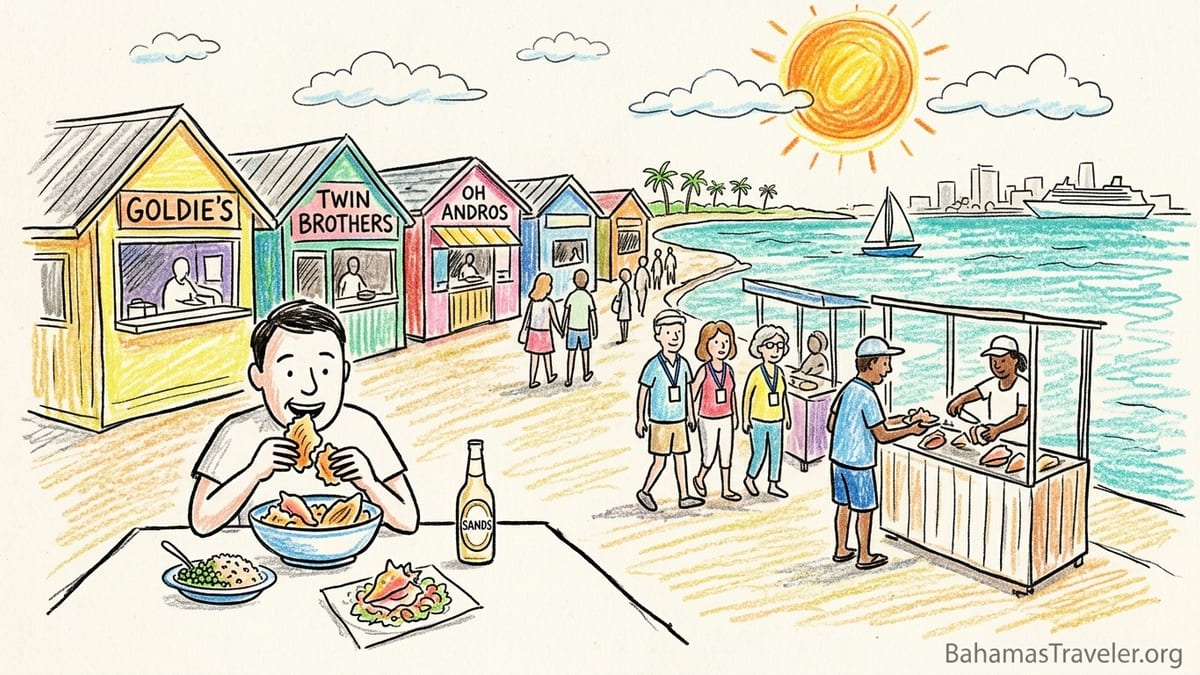
Arriving from downtown by foot, the first signal you are close is the cluster of painted signs for Goldie’s, Twin Brothers, and Oh Andros, followed by the smell of hot oil, garlic, onion, and wood smoke. The buildings here range from simple one story shacks with open fronts and plastic chairs to larger restaurants with indoor dining rooms, full bars, and printed menus. Local families drift in from the parking lots and side streets, tourists in cruise lanyards and resort wristbands walk in from the main road, and by early evening the whole strip feels like a single long outdoor dining room with different soundtracks.
For this guide, I made three focused visits. The first was a mid afternoon lunch at Twin Brothers on a weekday, chosen because they publish their menu and prices online and are often recommended for first timers. The second was an early evening session at Goldie’s Conch House, which locals and frequent visitors often name for conch salad and cracked conch. The third was a later night dinner at a smaller stall style spot on the strip, Da Lil Hut, to compare more casual counter service, pricing, and atmosphere. Between these visits and conversations with vendors, I built a clearer picture of what to expect in terms of menus, costs, and crowd patterns at Arawak Cay.
One practical note before you sit down anywhere at the Fish Fry. Bahamian value added tax was 10 percent at the time of my visit, and most sit down spots on Arawak Cay add both VAT and a service charge, often 15 percent, to the final bill. Twin Brothers lists a 15 percent service charge plus 10 percent VAT on their current menu, and several neighboring restaurants follow a similar structure. That means a 30 dollar menu total can land on your table as roughly 37 to 40 dollars once tax and tip are included, which is important when you are comparing the Fish Fry to resort dining.
How to Choose a Restaurant Once You Arrive
First timers often arrive at Arawak Cay, see a line of bright buildings with names painted on the walls, and freeze. The trick is to ignore the touts for a moment, walk the strip once, and then double back to the place that feels right for you. On my first pass at around 2 p.m., Twin Brothers was about half full inside with a steady mix of local office workers, harbor staff, and visitors. Goldie’s had more of a bar vibe at that hour, with a few locals drinking Sands beer and one conch salad stand in front already in action. Da Lil Hut, slightly farther up the strip, was not yet open for its 4 p.m. shift, which is typical of several stalls that focus more on late afternoon and evening trade.
Menus are usually posted outside or along the counter. At Twin Brothers, a laminated menu at the entrance listed conch salad, conch fritters, cracked conch, whole snapper, peas and rice, macaroni, plantains, and other Bahamian standards. Online and printed menus both showed conch salad at 15 dollars, cracked conch dinner at 27 dollars, conch fritters at 9 dollars, and whole fried snapper listed at market price. At Goldie’s, prices were handwritten on a board and confirmed verbally before ordering: conch salad was quoted at 15 dollars for a generous portion, cracked conch plates between 25 and 28 dollars depending on sides, and conch fritters at 8 to 10 dollars. Da Lil Hut posted a compact menu with side dishes like peas and rice or macaroni and cheese in the 5 to 7 dollar range and seafood mains between 18 and 26 dollars.
If you want a place that clearly attracts both locals and visitors, look for mixed tables. Twin Brothers checked that box during all my visits. At lunch I saw two cruise passengers in matching shirts sharing a platter of conch fritters beside a table of three local women in work uniforms smiling over bowls of stew fish and macaroni. At Goldie’s later that evening, half the stools at the bar were filled by people on first name terms with the bartenders, while nearby tables rotated through small groups from resorts and cruise ships. The smaller stalls like Da Lil Hut leaned more toward locals and island workers, especially later in the night, but I still heard American and European accents scattered among the Bahamian Creole.
Service style also helps you choose. Sit down restaurants such as Twin Brothers and Oh Andros are good if you want table service, printed checks, and a little more structure, which suits families and anyone keeping close track of spending. The open front stalls and smaller counters are more informal but can be faster and a bit cheaper. They are ideal if you want to hop between places, ordering conch salad from one vendor and cracked conch or grill fish from another.
Lunch at Twin Brothers: Conch Salad, Cracked Conch and Sides
I started my research with a weekday lunch at Twin Brothers, one of the longest running names at the Fish Fry and a place that does brisk business with both locals and cruise passengers. I arrived just after 2 p.m. and was seated indoors at a plastic topped table with a view of the bar and the open kitchen. Service was quick at this hour; I had menus in hand within two minutes and my order was taken within five. Overhead fans moved the air, Bahamian soca played at a comfortable volume, and the room smelled of fried fish, citrus, and rum.
To anchor prices and portion sizes, I ordered several classics. A Bahamian conch salad was listed at 15 dollars. Prepared fresh, it arrived in a shallow white bowl piled with diced raw conch, tomato, green pepper, onion, and bits of orange flesh, dressed in a bright mix of lime and orange juice. The portion could easily serve two as a starter. The conch was firm yet tender, with a pleasant chew but no toughness, and the citrus was assertive without burning. I asked the preparer about spice, and he explained that they build heat with minced goat pepper on request. I chose medium heat, which produced a gentle tingle that grew slowly, never overwhelming the clean briny flavor of the conch.
Next was the cracked conch dinner at 27 dollars. The plate held several large pieces of conch that had been pounded thin, dredged in seasoned flour, and deep fried until golden. The batter clung well, and each piece had a crisp shell that gave way to surprisingly tender meat. Alongside came a mound of peas and rice and a square of Bahamian baked macaroni, both included as sides. The peas and rice, built on pigeon peas, rice, tomato, onions, and thyme, had a slight smokiness and a moist, almost pilaf like texture. The macaroni was dense, cut in a block from a casserole, with a browned cheese crust and rich, almost custard like interior. Portion sizes were generous; one cracked conch dinner was enough for a hungry adult, especially combined with salad.
To round out the plate, I added fried plantains for 6 dollars. These arrived in a small side dish, thick slices fried until the rims caramelized. The sweetness balanced the salt and crunch of the battered seafood. With a nonalcoholic drink at 4 dollars, my pre tax total came to 52 dollars. After the automatically added 15 percent service charge and 10 percent VAT, the final bill landed just under 66 dollars. For two people sharing conch salad, sides, and cracked conch, this works out to around 30 to 35 dollars per person, which is comparable to or slightly below many casual resort lunches in Nassau.
Evening at Goldie’s: Conch Salad Show and Grilled Fish
For contrast I returned to Arawak Cay one evening for dinner at Goldie’s, a long standing shack style restaurant that spreads along the water with a mix of covered tables, bar seating, and a conch salad station out front. I arrived just before sunset and the atmosphere was very different from midday. Music from several neighboring spots overlapped in the air, a live band at another restaurant was warming up with steel pan and drums, and bartenders were already lining plastic cups with ice and mixing sky juice and Bahama Mamas.
At Goldie’s, the conch salad experience begins at the front counter where fresh conch shells rest in a tub of water. The vendor pulled a live conch, cracked it with a short blade, and extracted the meat in front of me, then rinsed and trimmed it before dicing. I ordered one regular conch salad for 15 dollars and asked the preparer to explain what goes into it as he worked. He described traditional Bahamian conch salad as a kind of island ceviche built from raw conch, finely chopped tomato, onion, green pepper, lime juice, orange juice, and sometimes cucumber or celery. The citrus juices help “cook” the conch by denaturing proteins, changing the texture from slippery to pleasantly firm. Heat comes from minced goat pepper or bird pepper, which they add at the end to taste.
The result at Goldie’s was punchier and slightly rougher than the polished version at Twin Brothers. The chop was a bit coarser, the lime more pronounced, and the pepper heat more insistent. Portion size, however, was even larger, easily enough for two to share before a main. For a cooked course I ordered grilled snapper with peas and rice and plantains, priced at 26 dollars plus 5 dollars for plantains. The fish arrived whole, scored, and grilled over open flames, brushed with a savory marinade that tasted of garlic, thyme, and a hint of allspice. The skin was crisped, the flesh moist and flaky, and the plate carried the slightly smoky aroma you only get from a live grill.
Service at Goldie’s was friendly but looser than at Twin Brothers. Menus were on a chalkboard and staff repeated prices verbally. The line at the bar for drinks moved slower than the kitchen, and from order to the arrival of my grilled fish took roughly 25 minutes, which matched the crowd level just after 7 p.m. A chorus of roosters from a neighboring yard, children weaving between tables, and the thump of bass from the next restaurant over made this feel like a community hangout rather than a tourist show. My overall bill for the night, including two Sands beers at 6 dollars each and the conch salad and fish, came out in the high 60s after tax and the customary 15 percent service charge that was clearly written on the check.
In terms of value, Goldie’s offered slightly better portion to price ratio on conch salad, while Twin Brothers felt more structured and predictable. The grilled snapper at Goldie’s, eaten with fingers under strings of lights while the band across the way moved from covers into rake and scrape, was one of my favorite meals of the trip, and delivered the clearest sense of Arawak Cay as a living local food hub.
Comparing Casual Stalls and Smaller Venues
To understand the more casual end of the Fish Fry, I tried a later night visit, arriving after 9 p.m. when the bigger restaurants were still humming but many day trippers had left. This time I chose Da Lil Hut, a smaller operation with a counter, a few indoor tables, and extra seating under a covered outdoor area. Compared with the full service restaurants, prices at Da Lil Hut were marginally lower and the feel was almost like a neighborhood takeaway that happens to be a few steps from the sea.
Here I ordered cracked conch as a smaller plate rather than a full dinner, listed at 20 dollars, plus sides of peas and rice and macaroni for 6 dollars each. The cracked conch arrived in smaller pieces than at Twin Brothers, more like strips or nuggets than broad fillets, with a rougher batter. It was well seasoned, with a noticeable salt and garlic hit, but the meat bordered on chewy in the thicker pieces, suggesting slightly less pounding before frying. The peas and rice were flavorful and moist, but the macaroni was the one dish that disappointed over my three visits. It arrived warm rather than hot, with a pale top and less structure, more like a loose casserole than the firm, sliceable slabs served at the other two spots.
On the plus side, service at Da Lil Hut was quick. From order to plate was about 12 minutes, helped by the fact that the kitchen was working primarily on a few duplicated dishes at that moment. A small crowd of local regulars surrounded the bar television and debated a baseball game, and one table nearby celebrated a birthday with a homemade cake, which the staff was happy to serve alongside purchased drinks. The check, including a local beer at 5 dollars, cracked conch and two sides, came in just under 45 dollars including VAT and a discretionary tip I added in cash, as there was no automatic service charge printed on my receipt.
This experience highlighted the distinction between restaurant style venues and casual stalls at Arawak Cay. The smaller places often offer slightly lower prices and faster service but can be less consistent in execution and have simpler seating and restrooms. They are excellent for repeat visitors or those happy to improvise, but some first timers may feel more comfortable starting at a better established restaurant for their first Fish Fry meal, then exploring the smaller spots for snacks or a second round later in the evening.
Traditional Conch Salad vs Cooked Conch Dishes
Across all three visits to Arawak Cay, conch in one form or another was the central character. To understand the difference between traditional conch salad and cooked conch dishes, I spoke with two different vendors about how they handle this national ingredient. At Goldie’s, the salad maker described raw conch salad as a dish that lives or dies on freshness and balance. They crack live conch to order, trim away darker parts, and dice the white meat before tossing it with tomato, green and red bell pepper, onion, and often cucumber. Citrus is crucial: lime supplies sharp acid, orange adds sweetness and aroma, and a bit of salt ties it together. The mixture sits only briefly before serving, so the conch retains a crisp but tender bite and a clear ocean flavor.
By contrast, cooked conch dishes like cracked conch, conch fritters, and conch chowder depend more on texture developed through pounding and time in heat. At Twin Brothers, a cook showed me a tub of conch that had already been cleaned, then demonstrated how they lay each piece between plastic and pound it with a mallet to break down the muscle fibers. Seasoned flour and hot oil then create a shell that keeps the meat moist inside. In conch fritters, chopped conch is folded into a seasoned batter, spooned or formed into balls, and deep fried until crisp. The same ingredient that tastes bright and briny in a salad becomes rich, savory, and almost meatlike once battered and fried.
Food safety is a quiet but important undercurrent in conversations about raw conch. Several conch shacks in the broader Nassau area, including under the Paradise Island bridge at Potter’s Cay, have dealt with periodic closures or health inspections in past years when officials were concerned about sanitation. At Arawak Cay during my 2026 visits, vendors emphasized that they were sourcing fresh conch and rinsing it well in clean seawater and prepared water before chopping. Raw seafood always carries some inherent risk, and while I did not experience any problems, travelers with sensitive stomachs or compromised immune systems should weigh their comfort level with raw shellfish before ordering large portions of salad.
Cooked conch, thanks to high frying or stewing temperatures, may feel like a safer choice for cautious eaters, though no vendor made absolute guarantees. If you are uncertain, you can always start with a small shared portion of conch salad to taste the flavor, then move on to cracked conch, stew conch, or chowder for the bulk of your meal.
Lunch vs Dinner: Atmosphere, Crowds and Live Music
One of the most revealing parts of eating at Arawak Cay is how different it feels at midday compared with evening. At lunch, especially on weekdays, the Fish Fry functions almost like a local canteen for Nassau workers. The parking lots are busier than the sidewalks, and you will see electricians, office staff, and harbor workers in uniform arriving for quick plates of stew fish, baked chicken, peas and rice, and mac and cheese before heading back to shifts. Music tends to be background level, often radio or playlists. Lines are short, food arrives faster, and the overall feel is relaxed and practical.
Portion sizes at lunch were the same as at dinner during my visits, but plates leaned more toward everyday comfort dishes. Several neighboring diners at Twin Brothers ordered stew fish rather than the more expensive grilled seafood platters, and many had a single cold drink or juice instead of mixed cocktails. If you prefer to experience Arawak Cay as a local lunchtime spot and want to minimize waiting times, midday visits are ideal. Expect food to arrive within 10 to 20 minutes at most sit down restaurants when the room is half full.
Evenings, particularly Thursday through Sunday, transform the strip into something closer to a block party. Strings of lights, louder speakers, and insulated coolers of beer and cocktails appear. Live bands or solo performers set up at some venues, and guest participation rises with every round of sky juice and Bahama Mamas. Waiting times for food can stretch to 30 minutes or a bit more for grilled orders at peak hours, especially if there are large groups or cruise tours seated together. On my evening at Goldie’s, the crowd felt at least 70 percent visitor by 8 p.m., though a strong local core held court at the bar and near the conch salad stand.
In terms of enjoyment, lunch and dinner each offer something different. Lunch wins for clarity of flavors, shorter waits, and easier conversation with staff about preparation methods. Dinner wins for energy, live music, and the layered experience of eating grilled fish or cracked conch under warm air threaded with salt breeze and bass. For first time visitors who can manage it, an ideal approach is to visit once at midday for a straightforward plate and then return one night to see the Fish Fry fully alive.
Spending at Arawak Cay vs Resorts and Downtown Nassau
One of my goals in tracking spending at Arawak Cay was to compare it with what you might pay at a sit down lunch or dinner in a Cable Beach resort or a downtown tourist restaurant. On my Nassau stay, a sample lunch at a Cable Beach beachfront restaurant that caters heavily to resort guests came to 29 dollars for a grilled fish sandwich with fries, 8 dollars for a side of macaroni, and 16 dollars for a cocktail, for a menu subtotal of 53 dollars. With 10 percent VAT and a 15 percent service charge automatically added, the final bill was close to 67 dollars before any additional tip.
In downtown Nassau near the cruise port, an early dinner at a popular visitor facing restaurant that advertises Bahamian inspired fare cost me 22 dollars for a plate of fried fish tacos, 6 dollars for conch fritters served as an appetizer, and 14 dollars for a draft beer and tax inclusive soft drink. After VAT and service charge, the total hovered around 50 dollars. Portions were respectable but more in line with North American gastropub standards, and the atmosphere felt clearly oriented toward cruise schedules and coordinated tour groups.
Compared with those meals, my Fish Fry experiences landed in a similar overall range but delivered more food and a more distinctly Bahamian context. At Twin Brothers, two people could share a conch salad, cracked conch dinner with peas and rice and macaroni, and one extra side plus nonalcoholic drinks for roughly 70 dollars to 75 dollars after VAT and service. At Goldie’s, a conch salad shared by two, a whole grilled snapper with sides, and two beers cost about 65 to 70 dollars. At Da Lil Hut, a more modest order of cracked conch, two sides, and one beer came in under 45 dollars.
In straightforward terms, you are not visiting Arawak Cay to save huge amounts of money compared with every downtown cafe. Seafood, especially conch and whole fish, is never a budget item here. What the Fish Fry offers is higher value within the same general price band. For roughly the cost of a hotel sandwich and cocktail by a resort pool, you can sit outdoors by the harbor with a plate of food that expresses the Bahamas more directly, surrounded by locals doing the same.
The Takeaway
After several meals at Arawak Cay in 2026, my favorite plate combined elements from all three visits. The single best dish was the whole grilled snapper at Goldie’s, eaten with fingers until only bones and lime wedges remained, paired with peas and rice and sweet, caramelized plantains. Close behind was the conch salad at Twin Brothers, which struck a near perfect balance between bright citrus, sweet vegetables, and tender chew, and proved that raw conch can be as satisfying as any fried platter when handled with care.
The one dish that missed the mark for me was the macaroni and cheese at Da Lil Hut on my late night visit. It arrived underbrowned and a little soft at the center, more like a reheated casserole than the baked, sliceable Bahamian macaroni that anchors so many local plates. To be fair, it was late in the evening, and turnover on side dishes can vary at smaller stalls. Other diners around me seemed perfectly content with their fried fish and cracked conch, and one less than ideal portion is not enough to dismiss a venue that otherwise offered friendly service and fair pricing.
If I were planning another trip and had just one main meal to spend at Arawak Cay as a first time visitor, I would choose a late afternoon to early evening slot, arrive before 6 p.m., and sit down at a full service restaurant like Twin Brothers or Goldie’s for a structured meal. I would start with a shared conch salad to experience the raw, citrus bright heart of Bahamian seafood, follow with cracked conch or a whole grilled fish served with peas and rice, macaroni, and plantains, and add one of the local drinks like sky juice or a Bahama Mama if I wanted a cocktail. Afterward, I would wander the strip with a small order of conch fritters from one of the smaller stalls, using that snack as an excuse to soak up more music and conversation.
For travelers who are cautious about raw seafood, starting with cooked conch dishes and grilled fish is entirely reasonable. You can always ask to taste a small spoonful of conch salad from a friendly vendor before committing to a full bowl. Ask questions about how dishes are prepared, watch the conch salad show at the front counters, and be open to staff suggestions. Arawak Cay works best when you treat it not just as a restaurant cluster, but as a living neighborhood of cooks, servers, and regulars who are proud of their food. If you come with curiosity, the Fish Fry will feed you well.
FAQ
Q1. How much does a typical meal cost at Arawak Cay Fish Fry in 2026?
For a sit down meal with conch salad to share, a main dish like cracked conch or grilled fish, and a drink, most travelers can expect to spend around 30 to 40 dollars per person once 10 percent VAT and a 15 percent service charge are included at the larger restaurants. Smaller stalls can come in slightly lower, closer to 20 to 30 dollars per person for a main with sides and a beer.
Q2. Is it safe to eat raw conch salad at Arawak Cay?
Vendors at Arawak Cay prepare conch salad from freshly cleaned conch and rinsed vegetables, and during my 2026 visits I did not encounter any issues. However, raw shellfish always carries some inherent risk, and people with very sensitive stomachs or weakened immune systems should consider focusing on cooked dishes like cracked conch, stew conch, or chowder. If you are unsure, try a small shared portion first.
Q3. What is the difference between conch salad and cracked conch?
Conch salad uses raw conch that is diced and marinated in lime and orange juice with tomato, peppers, onion, and hot pepper, resulting in a bright, ceviche like dish. Cracked conch starts with conch that is pounded to tenderize it, dredged in seasoned flour or batter, and deep fried until golden, producing a crunchy, savory plate usually served with peas and rice and macaroni.
Q4. How do I get to Arawak Cay from the Nassau cruise port?
From the Nassau Cruise Port and downtown area, Arawak Cay is about a 20 to 25 minute walk along West Bay Street, or a short taxi ride that typically costs around 12 to 15 dollars for two people when agreed before departure. Many visitors choose to walk there in daylight and take a taxi back after dark or after a few drinks.
Q5. Is Arawak Cay better to visit for lunch or dinner?
Lunch is quieter, faster, and feels more like a local canteen, with many Nassau workers grabbing plates of stew fish, peas and rice, and macaroni. Dinner brings live music, fuller crowds, and a more festive atmosphere, but also longer waits for food and busier bars. If time allows, visiting once at midday and once in the evening offers the fullest picture.
Q6. Do restaurants at the Fish Fry accept credit cards and U.S. dollars?
Most established restaurants at Arawak Cay accept major credit cards and are used to visitors paying in U.S. dollars as well as Bahamian dollars, which are pegged at the same value. Smaller stalls may prefer cash and may not always accept cards, so it is wise to bring some cash in small bills for sides, drinks, and tips.
Q7. What Bahamian side dishes should I not miss at Arawak Cay?
Peas and rice, made with pigeon peas, rice, tomato, onion, and thyme, and Bahamian baked macaroni and cheese, served in firm, casserole style squares with a browned top, are essential. Fried plantains, coleslaw, and potato salad also appear frequently, and combining two or three sides with seafood makes a classic Fish Fry plate.
Q8. How do I tell which restaurants are popular with locals as well as tourists?
Look for places where you see a mix of people in work uniforms or local casual dress alongside visitors in resort wear or cruise lanyards. Twin Brothers and Goldie’s both drew a steady mix during my visits, while some smaller stalls leaned more toward local regulars. Busy conch salad stands with locals chatting at the counter are usually a good sign.
Q9. Are portions at Arawak Cay large enough to share?
Portions at many Fish Fry restaurants are generous. A single conch salad can easily serve two people as a starter, and cracked conch dinners or whole grilled fish plates with peas and rice, macaroni, and plantains can be shared if you are not extremely hungry. Sharing a few dishes is a good strategy for sampling more of the menu without overspending.
Q10. How does eating at Arawak Cay compare to dining at Cable Beach or downtown tourist spots?
Prices at Arawak Cay for seafood and drinks are broadly similar to sit down resort and downtown restaurants when tax and service are included, but the Fish Fry typically offers larger portions and a more distinctly Bahamian setting. Instead of international hotel menus, you will find conch salad, cracked conch, peas and rice, and grilled local fish prepared in front of you, surrounded by locals as well as visitors.