


Choosing between Acklins and Crooked Island for a once-a-year bonefishing trip is not a theoretical exercise when you are about to wire several thousand dollars. Over the last season I fished both islands with local guides, stayed in dedicated bonefishing lodges, and kept notes on everything from tide and wind to transfer times, room comfort and how my non-angling partner felt after a week in each place. This is a practical comparison for anglers who want to know where their money and precious vacation days will be best spent.
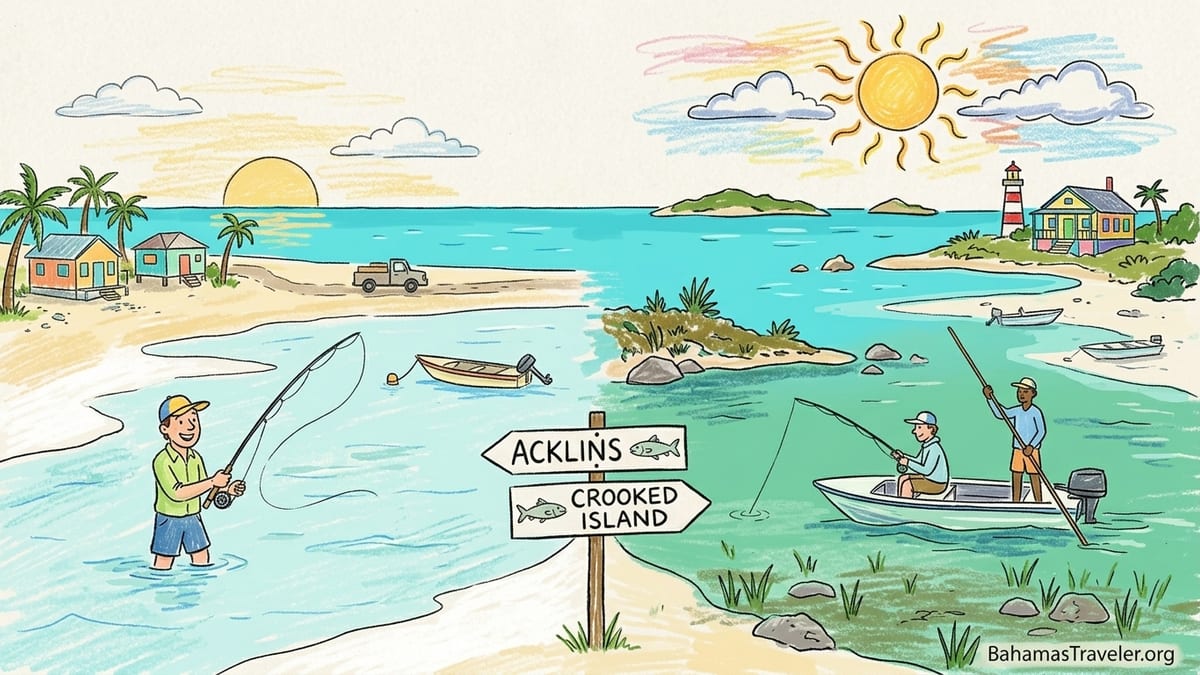
How I Fished Both Islands and What This Comparison Is (and Is Not)
On Acklins I based myself at a small bonefishing lodge near the central part of the island, similar in style and price point to Grey’s Point Inn and Acklins Creekside Bonefish Lodge, which currently market air-inclusive or transfer-inclusive packages aimed squarely at flats anglers. Packages on Acklins for four to seven nights with guided fishing, meals and airport transfers tend to run in the range of several thousand dollars per angler, with free inter-island tickets from Nassau occasionally bundled into promotions for longer stays. I booked a standard six-night, five-day guided package and added one unguided walk-wade afternoon on the “home” flat in front of the lodge.
On Crooked Island I stayed at a classic out-island fishing lodge near the northeastern tip, comparable to Crooked Island Lodge and the villa-based operations on Major’s Cay that package accommodation, meals, a vehicle and six days of guided fishing for roughly mid four thousand dollars per angler for two anglers sharing. Lodge-based packages on Crooked Island generally exclude international and domestic flights, alcoholic drinks and some transfer costs, so I tracked those carefully to understand the real total for a four- or seven-night stay.
Across both islands I insisted on fishing at least four full days with licensed local guides, with a mix of poling from skiffs and wading. Each fishing day I recorded the guide’s name, departure time from the lodge, run time to the first flat, time off the water, tides, wind strength and direction, approximate visibility, and whether we focused on classic shallow tailing bonefish water or deeper edge habitats. I also logged the hours my non-fishing partner spent on other activities and how easy it was to be comfortable and occupied while I was chasing fish.
This article does not claim that my handful of days on each island proves that one destination consistently produces larger bonefish. That kind of statement would require years of logbooks from many anglers and guides. Instead, I focus on what you can reasonably expect in terms of logistics, access, guiding, comfort and overall feel if you book a similar guided lodge package on either Acklins or Crooked Island in the current season.
Travel, Location and Daily Logistics on the Flats
Both Acklins and Crooked Island are true outer islands of the Bahamas, reached by a short domestic hop from Nassau. Bahamasair and smaller Bahamian carriers publish scheduled services into Spring Point on Acklins and Colonel Hill on Crooked Island, although frequencies and days can shift with seasonal demand. In my case I flew from the United States into Nassau, overnighted once on the way out, and then took morning domestic flights to each island on separate trips. Door-to-door, from Miami to my lodge room, the total transit time ran to almost a full travel day in each direction when you include layovers.
On Acklins my lodge was less than a 30-minute drive from Spring Point Airport along a straightforward paved and then partially unpaved coastal road. The transfer was included in the lodge rate, and we were rigging rods shortly after arrival. Most fishing days started with a 15- to 25-minute truck ride followed by a 10- to 20-minute skiff ride to reach the main flats systems, with one day devoted to walking straight out from the lodge at low tide. I recorded average transit time from breakfast to first cast on Acklins at about one hour, including the inevitable delays of coffee, last-minute fly changes and loading coolers.
On Crooked Island, the lodge I chose sat closer to a cluster of productive flats but farther from the airport. Ground transfers between Colonel Hill and the lodge cost around one hundred dollars each way per vehicle, a fee consistent with current third-party descriptions of Crooked Island operations, and that transfer took about 45 minutes in each direction. Once at the lodge, the daily skiff runs tended to be shorter, typically 10 to 15 minutes from the dock to the first flat, so our breakfast-to-first-cast time averaged very similar to Acklins despite the longer initial airport transfer.
From a pure convenience perspective, the key difference was the “home flat” dynamic. Both islands offer wadeable water directly in front of some lodges, but Acklins stands out for expansive ankle- to knee-deep hard-bottom flats that you can step onto in suitable tides. That meant an extra one to two hours of unguided fishing most days on Acklins when wind and light allowed, simply by walking out after lunch or before dinner. On Crooked Island, my lodge also faced the water, but the immediate shoreline was more broken coral, turtle grass and patchy sand, which limited the casual solo wading options and made me rely more on the skiff and my guides.
Conditions, Tides and Actual Time on the Water
I fished Acklins in late winter and Crooked Island in early spring, periods chosen deliberately to compare two high-percentage parts of the Bahamian bonefish season. Over five guided days on Acklins, wind ranged from about 8 to 18 knots, mostly from the east-northeast, with three partly cloudy days and two largely sunny ones. Water temperatures on the flats were warm enough that bonefish remained active through most of the tide cycle, but we still structured our days around incoming tides on key flats. Most sessions ran from about 8:30 in the morning until 4:00 in the afternoon, giving roughly seven hours of effective fishing time after allowing for boat runs and lunch.
On Crooked Island I encountered slightly stronger wind, often in the 12 to 20 knot range with higher gusts on two days, and more variable cloud cover. The guides adjusted by poling more leeward shorelines and spending longer periods on deeper edges where bonefish cruised in thigh-deep water instead of tailing in shin-deep sand. That choice kept us in fishable water but reduced shots at classic shallow, easy-to-see fish. On my log sheets, average time with a fly in the water on Crooked was virtually identical to Acklins, around six and a half to seven hours per full day, but the percentage of that time spent wading versus standing on a skiff was noticeably different.
Wind affected visibility more on Crooked Island because the flats we fished were more open to the prevailing direction, and several locations had softer turtle grass bottoms that clouded when the skiff swung in the chop. On Acklins, I spent close to 60 percent of my fishing time wading independently or alongside the guide, a ratio that flipped almost exactly on Crooked Island, where I was on the skiff for most of the day while the guide poled and called out fish at distance. For anglers prioritizing hours on foot, this felt like a meaningful distinction.
One lesson from keeping detailed notes was that lodge location matters as much as overall island shape. Some Acklins properties, such as dedicated bonefish inns built around specific wading flats, clearly optimize for walkable water. Others rely more heavily on boats. The same is true on Crooked, where operations near natural channels and reef edges have an easier time mixing bonefish with occasional shots at permit or other species. In practical terms, if you want to minimize time in transit and maximize time on the flats, the conversation with any prospective lodge on either island should be very specific about typical run times and how often guests can wade from the property itself.
Wading vs Skiff Fishing, Water Clarity and Guide Skill
Acklins is often described as a wade-fisher’s island, and my days there reinforced that reputation. Many of the flats I fished were broad, white-sand or firm marl plateaus that allowed easy ankle- to knee-deep wading in lightweight flats boots. I carried an eight-weight fly rod with a tropical floating line, a simple saltwater reel and a small sling pack with leaders and flies. Because the bottom was so forgiving, we frequently left the skiff anchored on the edge of a flat and walked for more than an hour at a time, spreading out just enough that I could work my own water while still listening for the guide’s low-key instructions.
On Crooked Island, there were still excellent wading opportunities, but they required more selective timing and often came as shorter interludes between longer sessions of skiff fishing. Some shorelines shelved quickly into deeper turtle grass, and several classic flats had scattered coral heads or soft pockets that demanded more attention with each step. It was not unsafe, but it was more tiring, and my non-fishing partner, who joined one half-day, chose to stay in the boat rather than walk. If your knees or balance are not what they once were, you may find the proportion of skiff time on Crooked a relief, while committed wade anglers may feel that Acklins offers longer, more continuous walks in shin-deep water.
Water clarity and fish visibility were very good on both islands when the sun was out and the wind manageable. On bright late-morning tides we could frequently spot bonefish on Acklins at 60 feet or more over pale bottom. On Crooked Island, over darker grass and patchy sand, typical spotting range shortened to maybe 40 to 50 feet, even with polarized glasses. That difference meant my guides on Crooked had to work harder, constantly adjusting boat angle and speed to give me cross-wind shots where I could see the fish in time.
The quality of guiding on both islands was a highlight. Acklins guides, some of whom have been poling those flats for decades, had an almost casual confidence about tides and fish movements, and were happy to let me push ahead and make my own mistakes as long as I stayed roughly on the right line with the light. Crooked Island guides brought equally deep local knowledge, but the environment demanded a slightly more technical approach. One guide spent an entire afternoon coaching my backhand casting into a quartering headwind so we could put the fly in front of fast-moving schools before they spooked in skinny water. Across both islands, most guides worked on the standard Bahamian expectation of one or two anglers per skiff, with gratuities and fishing licenses not included in the base lodge rates.
Pressure, Solitude and Overall Experience for Different Skill Levels
If your primary goal is solitude on the flats, both Acklins and Crooked Island deliver. Over five days on Acklins I saw other skiffs on only two occasions, each time at a distance, and I never shared a flat with another party. On Crooked Island I crossed paths with at least one other lodge’s skiff on three of six days, but again there was no sense of crowding. These are quiet islands, with small local populations and limited lodge capacity, and most operations naturally spread boats out over large areas each day.
Beginners, however, will experience the two islands differently. On Acklins, the long wades in forgiving depths and the abundance of modest-sized bonefish made it easier to practice presentations without fear of blowing a single precious shot. My partner, who had never cast at saltwater fish before, managed to hook several bonefish on Acklins while wading beside the guide, thanks to short 30-foot shots at cruising singles and pairs over clean bottom. The relaxed pacing and space between shots gave him time to reset and listen to instruction.
On Crooked Island, where more of the fishing occurred from a skiff and shots often came at moving schools in slightly deeper water, the learning curve for new saltwater fly anglers was steeper. Wind exposed mistakes in timing and line management quickly, and several times we watched good opportunities slide past because a cast did not straighten fully into the breeze. For an intermediate or advanced angler comfortable with an eight-weight rod, double hauling into fifteen knots and making quick adjustments with the guide’s clock-face directions, this can be invigorating fishing, with some larger average fish in the mix. For a first-timer, it might feel more intense.
Fishing pressure in the sense of “educated” bonefish that have seen many flies was low in both places on my trips. Most fish reacted naturally to standard small shrimp patterns, and refusals seemed more related to presentation or light than to any deep-seated wariness. I did not find enough evidence to claim that one island’s fish were systematically larger or spookier than the other’s, and conversations with long-time guides on both islands suggested that average fish size and shot counts can vary more with weather and tide during any given week than with which island you choose.
Lodges, Rooms, Meals and What It Really Costs
Bonefishing trips to the Bahamian outer islands are not inexpensive, and Acklins and Crooked Island are no exceptions. Current promotional material from Acklins Creekside Bonefish Lodge, for example, advertises limited-period air-inclusive packages where a four- to six-night stay with single or double occupancy and guided fishing can include one or two free domestic airline tickets from Nassau for bookings that meet specific date and occupancy conditions. A separate long-standing Acklins property, Grey’s Point Inn, publishes inclusive packages through agents that cover airport transfers, room, meals and daily boat and guide, with pricing that reflects the remote location and specialist nature of the operation.
On Crooked Island, villa-based operations on Major’s Cay market fully guided six-day packages at around four thousand three hundred fifty dollars per person for two anglers sharing, including accommodation, all meals, a rental vehicle and six days of guided fishing for two anglers per guide. Traditional lodges like Crooked Island Lodge commonly structure rates by number of nights and days fishing, with higher per-person costs for single occupancy or solo angler packages. Some agents note that airport transfers from Colonel Hill run around one hundred dollars each way per vehicle, a detail that can surprise travelers who expect all ground costs to be included.
The single occupancy premium is particularly important for anglers who travel alone or with non-fishing companions. Many Bahamian lodges, not just in Acklins or on Crooked, quote base rates assuming double room occupancy and two anglers sharing a boat, then apply a surcharge for a private room and single boat. Industry examples from other islands show surcharges of up to roughly seventy-five percent on top of the double-occupancy per-person rate for a single room and private skiff in the 2024 and 2025 seasons, and some Bahamas operations list nightly single supplements of a few hundred dollars where packages are priced per room rather than per angler. While exact numbers vary by lodge and year, it is realistic to expect that fishing alone with your own guide for a week on Acklins or Crooked can add several thousand dollars to the final bill.
When I tallied my actual expenses, including international flights from the United States to Nassau, domestic hops to the islands, lodge package costs, tips, fishing licenses, drinks and incidental meals in Nassau, the total for a six-night, five-day guided trip on each island landed in the broad range that independent analysts currently cite for premium Bahamian flats lodges, roughly five and a half to eight and a half thousand dollars per angler for a week once everything is counted. In my specific case Acklins came in slightly lower because of a promotion that bundled domestic flights, while Crooked Island edged higher due to separate transfer fees and a modestly more expensive lodge nightly rate.
In terms of comfort, both islands offered clean, air-conditioned rooms, hot showers and plenty of hot food after long days in the sun. Acklins accommodations felt slightly more rustic, with simple tile floors, firm beds and functional en-suite bathrooms. Meals were hearty and home-style, heavy on fresh fish, rice, peas and baked dishes. Crooked Island’s lodge leaned a bit more toward a traditional “sporting lodge” atmosphere, with a central bar, broader wine and spirit selection and plated dinners that felt a touch more polished. My partner rated the overall room comfort similar on both islands but enjoyed the evening social scene marginally more on Crooked, where more guests congregated in a single shared space after fishing.
Non-Fishing Companions, Off-Day Options and Combining Both Islands
Acklins and Crooked Island are, first and foremost, fishing destinations. You do not come here for shopping, nightlife or spa menus. That said, a non-fishing companion can still be happy for a week if they value quiet beaches, reading time and genuine detachment from busy life. On Acklins, my partner spent her days walking empty stretches of sand near the lodge, swimming in clear water when the tide was in, and occasionally joining us in the skiff for the morning before returning to the shade with a book. There were few, if any, organized excursions beyond beach walks and the occasional drive to a nearby settlement.
On Crooked Island, non-fishing options were slightly more varied. Some lodges sit on attractive swimming beaches and keep sea kayaks available so guests can explore sheltered coastline on calm days. My partner took advantage of this, paddling short loops inside the reef while we fished nearby flats, and on one non-fishing afternoon we snorkeled a shallow coral patch accessible from shore. The island is also known for diving and general beach relaxation, which helps if a partner wants more than a chair and a book but still does not require resort-style programming.
One practical question many anglers ask is whether they can fish both Acklins and Crooked Island in a single trip while staying in one lodge. Geographically the islands form part of the same general group in the far southeastern Bahamas, but in practice they are separated by considerable water and limited scheduled transport. There is no realistic scenario in which you would base on Acklins and casually run to Crooked by boat for a day of guided fishing, or vice versa, in the way you might hop between cays in more compact archipelagos. Chartering a private boat or plane to link the two mid-trip is possible in theory but would add substantial cost and logistical complexity.
In the real world, if you want to sample both islands in one vacation, you are better off constructing a split itinerary with separate lodge stays and domestic flights routed through Nassau or another hub that serves both Spring Point and Colonel Hill. That might mean three or four nights on one island and another three or four on the other, with a travel day in between. For most anglers, the extra cost and lost fishing time will not justify the benefit. A more sensible plan is to pick one island per trip and return another season to try the other.
What I Did Not Like About Each Island Experience
No destination is perfect, especially when judged through the unforgiving lens of a hard-earned vacation budget. On Acklins, my biggest frustrations were related to wind sensitivity and limited backup options on certain tides. Some of the broadest, most beautiful wading flats were very exposed. On one particularly gusty day we spent long periods slogging into the wind with spray blowing off the chop and very few visible fish, simply because there were not many sheltered alternatives within reasonable reach in that tide window. Flexibility was also limited by the lodge’s small guide pool; when another pair of anglers requested the same guide for two consecutive days, my own schedule had to be adjusted, and we could not always match the ideal guide to the conditions.
Transfers on Acklins, while short, could be rough on unpaved stretches, and one day a mechanical issue with the truck delayed our departure by almost an hour. The lodge handled it well and extended our afternoon accordingly, but it was a reminder that outer-island infrastructure is basic. Packages also excluded certain items that add up over a week, such as bar drinks and, in some cases, rental fees for high-end rods and reels if you prefer not to travel with your own equipment.
On Crooked Island, what I liked least was the combination of longer initial transfer from the airport, slightly more complex travel routing, and the cumulative cost of extras. Paying separately for ground transfers to and from Colonel Hill, fuel surcharges for long runs on special days, and higher-priced drinks at the bar nudged the final bill upward beyond the neat round numbers in the brochure. There were also occasional constraints on flexibility. For cultural and logistical reasons, some guides do not work on Saturdays, which meant one of my potential fishing days became a mandatory rest day. Depending on your schedule and religious observances, that could be a welcome pause or an unwelcome gap in a tightly planned week.
From a fishing perspective, the most challenging aspect of Crooked Island was the physically demanding mix of wind, glare and sometimes tricky footing. After several days of balancing on a rocking skiff deck while throwing eighty-foot casts into a stiff breeze, my casting shoulder and lower back felt it more than they had on Acklins, where the emphasis on wading spread the strain out differently. Finally, while the lodge ambience was convivial, there was a subtle sense that the operation was geared primarily to serious anglers. My non-fishing partner still enjoyed herself but felt slightly more like a tagalong than a co-equal guest on Crooked compared with the more intimate family-style feel on Acklins.
The Takeaway
After fishing both islands with local guides, keeping detailed logs of conditions and costs, and listening carefully to my non-fishing partner’s impressions, I would make three different recommendations depending on the type of trip.
For a dedicated bonefishing trip where the angler’s priority is long wades, quiet flats and maximum time hunting fish on foot, I would book Acklins again. The combination of broad, hard-bottom flats, low visible pressure and the ability to walk straight out from the lodge on the right tides made it feel like a giant, semi-private training ground for those who love classic sight-fishing in shallow water. When promotions include domestic flights from Nassau, the value proposition becomes especially attractive.
For a mixed fishing-and-beach holiday with a non-fishing companion who wants more varied activities, I would lean toward Crooked Island. The slightly better-developed lodge amenities, attractive swimming beaches and access to kayaking and snorkeling gave my partner more to do on non-fishing days while I was on the skiff. If you are willing to accept a bit more wind, some longer casts and higher incidental costs, Crooked Island offers a satisfying blend of fishing and low-key tropical downtime.
For a first fly-fishing adventure, especially for someone new to saltwater, my verdict is more measured. If the beginner is confident with basic casting and eager to learn through repetition, Crooked Island can be a rewarding classroom, but I would still choose Acklins for a true novice. The easier wading, shorter average shots and sheer number of forgiving opportunities at modestly sized bonefish make early success more likely, and nothing builds confidence like seeing the backing knot on day one. Either way, both islands deliver the essence of Bahamian bonefishing: clear water, honest guides and the possibility, on any given flat, of the fish that will define your season.
FAQ
Q1. Which island is cheaper for a week-long guided bonefishing trip, Acklins or Crooked Island?
The total trip cost is similar once you include international and domestic flights, lodge packages, tips and extras, but in my experience Acklins came out slightly cheaper because of occasional promotions that bundled domestic flights from Nassau, while Crooked Island edged higher due to separate airport transfer fees and slightly more expensive lodge rates.
Q2. Is Acklins really better for wading than Crooked Island?
Both islands offer wadeable flats, but Acklins stands out for large areas of firm, shallow bottom where you can comfortably walk for long stretches, sometimes directly from the lodge, whereas Crooked Island tends to mix shorter wades with more skiff-based fishing over patchier bottom and turtle grass.
Q3. Which island is more suitable for a beginner saltwater fly angler?
Acklins is generally more forgiving for beginners because you can make shorter casts to fish in very shallow, clear water while wading, with more time to set up each shot, whereas Crooked Island often demands longer, quicker casts from a skiff in breezier, slightly deeper conditions.
Q4. Can my non-fishing partner enjoy a week on either island?
Yes, as long as they are looking for a quiet, nature-focused break rather than nightlife, with Acklins offering long empty beaches and true unplugged relaxation, and Crooked Island adding a bit more variety through better swimming beaches, kayaking and easy-access snorkeling.
Q5. Is it practical to fish both Acklins and Crooked Island on the same trip?
It is technically possible using domestic flights or charters routed through Nassau, but the extra cost and lost fishing time make it impractical for most travelers, so it usually makes more sense to focus on one island per trip and plan to visit the other on a future journey.
Q6. Do I need to worry about fishing pressure on either island?
Fishing pressure is low on both Acklins and Crooked Island compared with more famous Bahamian destinations, and during my trips I rarely saw other boats on the same flats, so bonefish generally behaved naturally and responded well to standard flies and careful presentations.
Q7. How big is the single-occupancy premium if I travel alone?
Many Bahamian flats lodges structure their base rates around double occupancy and shared boats, then add substantial surcharges, sometimes approaching the majority of the base rate, for a private room and solo guide, so anglers traveling alone to Acklins or Crooked should budget several thousand dollars more than the headline per-person double-occupancy prices.
Q8. What rod and reel setup works best for these islands?
An eight-weight saltwater fly rod with a tropical floating line and a reliable reel with a smooth drag is the standard choice for bonefish on both Acklins and Crooked Island, with a ten-weight handy if you hope to cast at larger species when the opportunity arises and your lodge supports it.
Q9. How much walking is involved on a typical day?
On Acklins you might walk several miles in shallow water over the course of a day if you choose to focus on wading flats, while on Crooked Island you will likely split your time more evenly between standing on the skiff deck and walking shorter stretches of shoreline or select flats when bottom and tides allow.
Q10. If I have only one serious bonefish trip in the next few years, which island should I choose?
If your main goal is classic wade fishing for bonefish in very shallow water with minimal distractions, Acklins is the safer choice, while if you want strong guided fishing combined with better beaches and more non-fishing options for a partner, Crooked Island is likely to deliver a more balanced overall holiday.