


I learned the hard way that in the Family Islands of the Bahamas, the “hotel” is rarely the booking decision. The location is. On paper, Great Exuma, Harbour Island, the Abacos, and Andros all promise clear water and quiet beaches. In real life, your day rises and falls on how long it takes to leave the airport, whether you can grab groceries after 6 p.m., if you can walk to dinner, how you meet a boat tour without a car, and what happens when the one nearby restaurant closes early. This is the part most accommodation roundups miss, and it is exactly what determines whether a stay feels blissfully remote or inconveniently isolated.
Below are the islands and specific areas where I actually spent nights, with the practical details I wish I’d prioritized earlier: real transfer times, what I drove for breakfast and supplies, whether a rental car or golf cart was essential, and where I would stay differently next time. I also used current research to double-check airports, ferry docks, transport options, and the present-day lodging and ferry landscape so you can book the part of the island that matches how you want to travel right now.
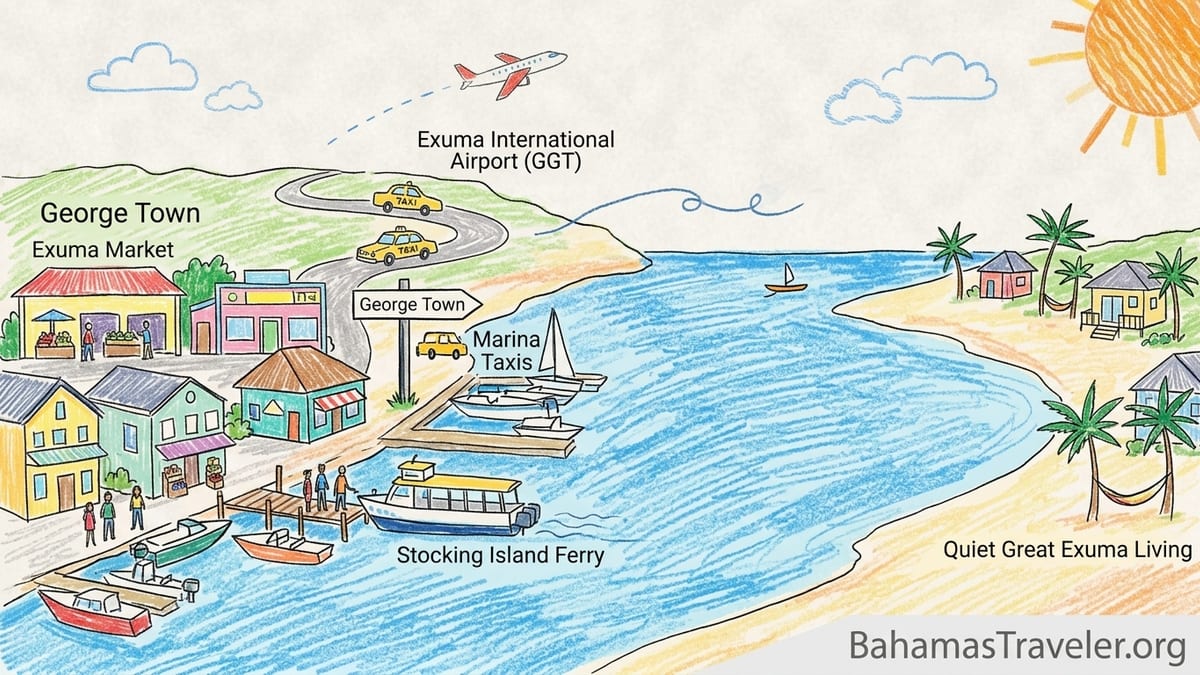
Exuma: George Town Convenience vs Quieter Great Exuma Living
On Great Exuma, the first decision is whether you want to be based around George Town or commit to a quieter stretch of Great Exuma or Little Exuma and accept the daily driving that comes with it. Exuma International Airport (GGT) sits by Moss Town, and in current local taxi guidance, the ride to George Town is commonly described as about 20 minutes, while “end-to-end” coverage across Great Exuma down toward Little Exuma is often framed around roughly 40 minutes depending on where you land on the map. That tracks with how my arrival felt: the transfer itself was quick, but the island is long enough that “it’s on Exuma” can still mean a meaningful commute.
I stayed in the George Town orbit first, and that base made the island feel easy. I could land, get settled, and still make it to Stocking Island plans without overthinking logistics. It also mattered for groceries. Current store-hour listings for Exuma Market show a predictable rhythm: open Monday through Saturday into the early evening, and a short Sunday window in the morning. In practice, that meant my first afternoon was for stocking up early, not “whenever.” When I stayed farther from town on another part of Great Exuma, the same shopping run became a commitment rather than a quick errand.
Breakfast and basics were where location quietly set the tone. In George Town, my “do we have coffee and something to eat?” moments were solvable without a long drive. Farther out, I found myself planning the day around a single supply loop: leave early, do groceries and any pharmacy-type needs, then head back out to beaches or a quieter rental. If dinner plans changed late, the distance back to town made spontaneity expensive in time and fuel.
Where I would stay differently next time: if I were doing Exuma without a rental car, I would book closer to George Town and the main service spine, period. If I wanted that quiet-outpost feeling again, I would still do it, but only with a car reserved from day one and a first-stop grocery plan locked in before I ever picked up the keys.
Exuma Booking Decision: Walkable George Town vs “Remote” That Becomes a Daily Drive
Great Exuma can feel like two different vacations depending on whether you can walk to anything. In George Town, you can build a trip that is not entirely car-dependent. You are not exactly in a big city, but you are in the island’s practical center: you can get to groceries during posted hours, find taxis, and coordinate boat days with less friction. That matters if you want to do popular on-the-water days, because the meeting point is often “in town” or near town-adjacent docks, and arriving stressed from a long drive is a preventable way to start a day on the water.
When I stayed in a quieter area outside the main cluster, I loved the silence, the dark skies, and the feeling of having my own beach moments. But the trade-off was that I drove for almost every decision: breakfast, a bag of ice, an extra sunscreen, a casual dinner. On a map, it looked minor. On an island day, it added up. I also noticed how quickly the “after restaurants close” window arrives in the Family Islands. If you are not near the small core of options, your evening plan becomes “eat early or eat in.” That is not bad, but it needs to be chosen, not discovered by surprise.
A small but real detail: because grocery hours on Exuma commonly end around early evening on weekdays and are limited on Sunday mornings, a late flight arrival can force an expensive workaround. You either pay for a higher-cost mini-mart basket somewhere, lean on a restaurant meal, or ask your accommodation to pre-stock. None of those are fatal, but they are avoidable with a George Town base or a “shop before you leave town” habit.
Where I would stay differently next time: if my goal was beach time with minimal driving, I would book close enough to George Town that a grocery run is not a half-day project. If my goal was total seclusion, I would book farther out again, but I would treat it like a cabin trip: arrive with food, plan simple dinners, and assume nights are quiet.
Harbour Island vs Mainland Eleuthera: The Dock-to-Dinner Reality
Harbour Island is small enough that people talk about it like a neighborhood rather than a destination, and that is exactly why location matters so much. The “getting there” chain is part of the stay: fly into North Eleuthera Airport (ELH), take a taxi to the dock, then hop a short water taxi to Dunmore Town on Harbour Island. Current local destination guidance still describes that flow as the standard way to do it, with taxis described as plentiful to the dock. In my experience, the transfer was more steps than distance: you are never far, but you are always transitioning.
What generic guides often skip is that Harbour Island is also a golf-cart island in real daily life. You can walk in parts of Dunmore Town, but most visitors quickly end up with a cart for beach runs, dinner flexibility, and that “we’ll just pop over there” feeling. Current rental pricing varies widely by cart style and season, but the reality is clear from current operators: you can find simpler carts around roughly $90 per day at some companies, while premium electric and “high-roller” options can push much higher. The point is not the exact number, it is that your island mobility is an additional line item and should be treated as such when you pick where to sleep.
I stayed on Harbour Island and loved the feeling of being able to reach dinner without a long highway drive. Even when I used a cart, the distances were short. Nights felt lively by Family Island standards: you could find a place still serving, or at least find somewhere for a final drink before things wound down. That is the key difference versus parts of mainland Eleuthera, where a gorgeous beach rental can be isolated enough that dinner becomes “who is open, and how far is it?”
Where I would stay differently next time: if I want the classic pink-sand-and-stroll vibe again, I would still book Harbour Island, but I would choose lodging that either includes a cart or makes the pickup process effortless. If I want more space and lower costs, I would stay on Eleuthera proper, but only in an area where I can walk to at least one reliable restaurant and a small grocery, or I would accept that I am essentially self-catering.
Abaco: Marsh Harbour Base vs The Cays (And Why It Changes Everything)
The Abacos are where the “location is the booking decision” lesson becomes unavoidable. Marsh Harbour is the commercial hub on Great Abaco. It is practical: it has the airport, more services, and the kind of infrastructure that makes a short stay easy. But it is not the same experience as sleeping on a cay like Elbow Cay (Hope Town) or Great Guana Cay, where you wake up to village life, marina rhythms, and water in every direction.
I stayed in Marsh Harbour and then on a cay, and the difference was immediate. In Marsh Harbour, I could handle errands and logistics. On a cay, I could walk into the day: coffee, harbor views, and a sense that I was exactly where I wanted to be without “commuting” to the good part. Current operator information supports the classic connectivity here: ferries run between Marsh Harbour and key cays, and local ferry services publicly describe regular transportation to places like Hope Town, Man-O-War Cay, and Guana Cay, with cancellations in high winds reminding you that the sea is part of the schedule.
Here is what generic accommodation guides miss: if you book Marsh Harbour but plan to spend most of your time on cays, you are also booking the daily friction of meeting boats. You need to get to the ferry dock, time your crossings, and accept that weather and schedule changes can reshape a day. If you book the cay itself, you trade that friction for a smaller dining scene and fewer late-night options. The win is that your “walkability” increases dramatically, because the cay villages are built around being compact.
Where I would stay differently next time: if I have only a few nights, I would skip the “base in Marsh Harbour and day-trip the cays” plan and sleep on the cay that matches my vibe. If I have a longer trip with errands, provisioning, or multiple cays on the agenda, I would split the stay: a short practical Marsh Harbour segment, then a longer cay segment where the trip actually feels like the Abacos.
Abaco in Practice: Meeting Boat Tours, Getting Dinner, and What Happens After Closing
On Great Abaco, I liked Marsh Harbour for how straightforward it felt to land and get moving. Current flight and destination listings continue to position Marsh Harbour (MHH) as a key access point for Great Abaco, and current tourism listings still treat it as the gateway for reaching the surrounding cays. In real life, that meant I could arrive, grab essentials, and coordinate ferry timing without feeling stranded.
But the “what happens after restaurants closed?” question was answered differently depending on where I slept. In Marsh Harbour, if one place was done for the night, there was usually another option, or at least a place to grab something simple. On the cays, nights were quieter. That was part of the charm, but it also meant I planned dinner earlier and treated groceries like a priority. If you are the kind of traveler who likes a late dinner or wants multiple choices after dark, your best move is to book closer to a cluster rather than a lone beach stretch.
Meeting a boat tour was easier when my lodging and the departure point were aligned. When I stayed on a cay, the “meet here” instructions were simple because everything funnels toward a small harbor area. When I was on Great Abaco and needed to connect outward, the day could start with a short taxi or drive to the ferry dock before the actual boat day even began. That may be fine, but it is a different feel. You are not stepping out of your room into vacation. You are starting with logistics.
Where I would stay differently next time: if my priority is being on the water without morning friction, I would book on Elbow Cay or another cay village where I can walk to the dock. If my priority is flexibility and supplies, I would book Marsh Harbour but plan at least one “stay local” day so it does not feel like I am forever commuting to my own vacation.
Andros: Choose Your Section Carefully (Central Convenience vs South Andros Isolation)
Andros is huge by Bahamian standards, and it behaves like a big island with multiple “centers” rather than one cohesive place. This is why you should match your airstrip to where you actually plan to sleep. Current references consistently describe multiple airports across Andros, and current travel reporting and operator guidance continue to emphasize that rentals and transfers are available but that you should plan transportation rather than assume you will figure it out on arrival.
I stayed in the central zone around Fresh Creek and Andros Town, and I also had a South Andros experience that made the “pleasantly remote vs inconveniently isolated” question crystal clear. In central Andros, it felt possible to do basics with less stress. You can arrange taxis, find small clusters of services, and coordinate diving or bonefishing operators with fewer moving parts. I still found that a vehicle meaningfully expanded what I could do, but I did not feel trapped without one in the same way I would have on a more remote stretch.
South Andros is where isolation becomes the point, and you should book it only if you actually want that. Current resort transfer guidance for South Andros stays makes it explicit: from Congo Town Airport, a typical arrival flow can include a short drive and then a short boat ride to reach certain properties. That is not a negative. It is the experience. But it means you cannot casually “pop out” for groceries, you are not walking to a strip of restaurants, and you are not improvising dinner at 9 p.m. because you changed your mind.
Where I would stay differently next time: I would choose central Andros again for a first Andros trip or for travelers who want independence and a bit of variety. I would choose South Andros again only when the goal is a lodge-style stay where the property, the water, and the planned activities are the trip, and I would not pretend it will function like a normal island town vacation.
The Takeaway
If you remember one thing, make it this: in the Family Islands, you are not just booking a room. You are booking your daily radius. George Town on Exuma makes the island easy, while quieter Great Exuma and Little Exuma stays are best treated as self-catering beach escapes with a car and a grocery plan. Harbour Island is compact and social by Family Island standards, but it comes with a golf-cart economy you should price in up front. In the Abacos, Marsh Harbour is the practical gateway, while the cays are where the destination feeling lives, and splitting the stay is often the smartest play. Andros rewards careful “section” planning: central areas suit independent travelers, while South Andros is best when you want true remoteness and are happy to live inside the lodge’s rhythms.
So when you ask, “Which island and which part of that island should I book?” start with your tolerance for transfers and your need for walkability. Then book the place that makes your mornings simple. In the Bahamas, that is what makes the whole trip feel effortless.
FAQ
Q1. If I want the easiest Exuma trip, which part should I book?
Book near George Town so groceries, taxis, and common boat departure points are close, and the airport transfer stays simple.
Q2. Can I do Exuma without renting a car?
Yes if you stay near George Town and plan your days around taxis and walkable needs, but a car becomes much more important the farther you stay from town.
Q3. What is the real airport transfer time on Great Exuma?
Recent local taxi guidance commonly pegs GGT to George Town at about 20 minutes, while far ends of Great Exuma can be closer to about 40 minutes depending on the destination.
Q4. Harbour Island or Eleuthera mainland for first-timers?
Harbour Island is simpler for a compact, walkable vacation with dining close by, while mainland Eleuthera is better for space and solitude if you are comfortable driving.
Q5. Do I need a golf cart on Harbour Island?
Most visitors find a cart effectively essential for beach access and flexible dinners, and current operators show daily rentals ranging from basic carts to premium options.
Q6. Marsh Harbour or the Abaco cays: where should I sleep?
Sleep in Marsh Harbour for errands and flexibility, but sleep on a cay like Elbow Cay if you want to walk to the dock, wake up in the village, and reduce daily ferry friction.
Q7. How easy is it to meet a boat tour in the Abacos?
It is easiest when you stay on the same cay as the departure point or within walking distance of the dock; staying on Great Abaco often adds a drive or taxi plus a ferry connection.
Q8. What should I know about ferry reliability in the Abacos?
Ferry services run frequently, but operators publicly note cancellations during high winds, so build schedule slack into travel days and do not stack tight connections.
Q9. Which part of Andros should I book for a first visit?
Central Andros around Fresh Creek and Andros Town is a strong first base because it is more practical for transfers, supplies, and operator meetups than more remote sections.
Q10. When is South Andros the right choice?
Choose South Andros when you want deliberate remoteness and a lodge-style trip, where transfers can include both road and boat segments and nightlife and dining choices are intentionally limited.