


I landed in Nassau thinking the hard part was over. I had already crossed an ocean, survived the cramped cabin, and pictured myself on a quiet Family Island beach by late afternoon. Instead, Nassau taught me the real rhythm of Bahamian inter-island travel: domestic flights that feel like commuter runs, last flights that quietly sell out, luggage that gets weighed, and schedules that can look simple online but get complicated fast on the ground. The good news is that once you understand the system, flying from Nassau to the Family Islands is straightforward, often scenic, and usually the fastest way to get where you actually came to The Bahamas to be.
Arriving In Nassau And Connecting To A Family Island: The Clock Starts At Immigration
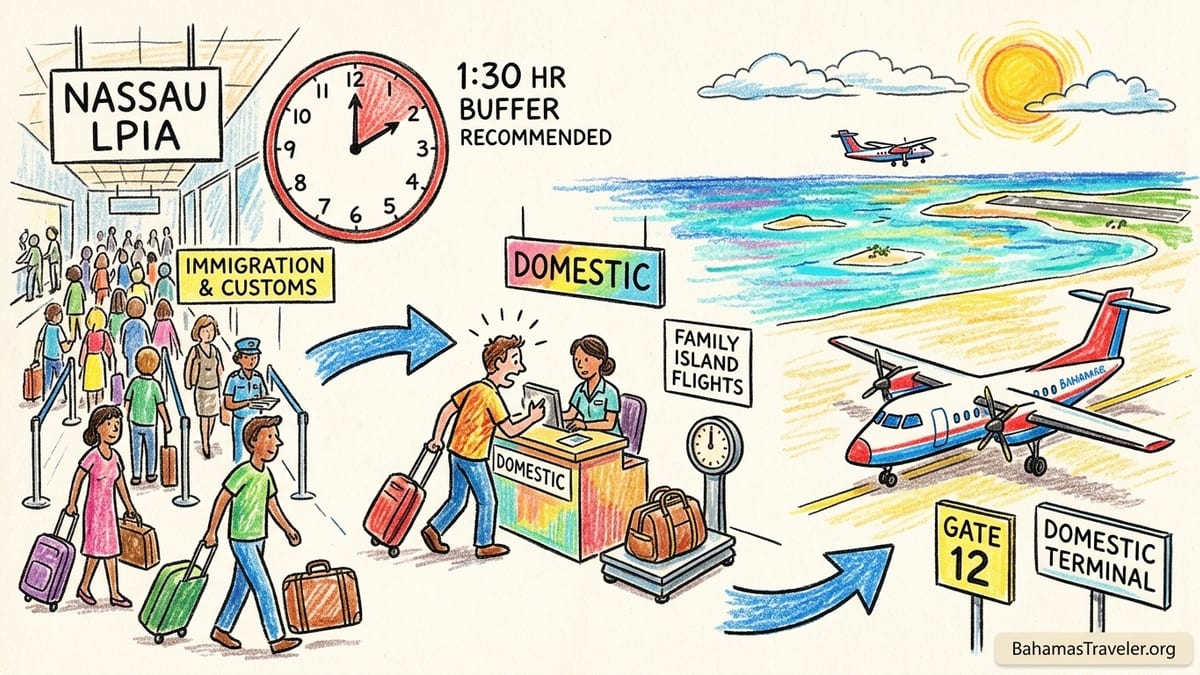
If you are arriving internationally into Nassau and connecting onward to a Family Island, plan your connection like you would for a small regional hub, not a big North American airport with dozens of backup flights. The official Bahamas tourism guidance currently recommends allowing at least 1.5 hours after an international arrival to clear Immigration and Customs, then proceed to the domestic terminal to check in for your domestic flight. It also flags a common gotcha: some regional airlines do not appear on major online travel agencies, which matters if you assume you can “just book something at the airport” if plans change.
On my arrival, the process was: off the international flight, into Immigration lines, then to baggage claim, then through Customs, and only after that could I think about the domestic hop. That sequence is non-negotiable when you enter The Bahamas in Nassau. If your domestic flight is on a separate ticket, treat it as a fully separate trip that begins after Customs. That means you need enough time not only to clear formalities but also to physically relocate, find the correct counter, and comply with the domestic check-in cutoff.
The detail that surprised me most was how quickly a “reasonable” connection can become unreasonable if anything slips. A 15 to 30 minute delay on your international arrival can be the difference between calmly rechecking bags and arriving at a closed counter. In Nassau, missing the last flight of the day to a smaller island can easily become an unplanned overnight, because there may not be another departure until the next morning.
Nassau Airport Layout And Terminal Changes: What It Feels Like In Real Life
Lynden Pindling International Airport is the country’s main gateway and the place many Family Island trips funnel through. In practice, it operates like a set of linked spaces for different traffic flows. Even when the buildings are connected, the experience still feels like you are switching worlds: international arrivals processing on one side, then the more local, commuter-like domestic operation on the other.
I learned to stop thinking in terms of “gate-to-gate.” The key steps are counter-to-counter: getting from international arrivals to the right domestic airline desk, rechecking any bags, and getting through the next security checkpoint. If you are traveling with a family, surf gear, fishing gear, or heavy checked luggage, the domestic segment becomes the part of the day where logistics matter most.
One practical tip that made everything easier was to keep a screenshot or written note of my domestic airline name and my destination airport code. In the Family Islands, you may be flying into airports that sound similar but are not interchangeable, especially on Eleuthera and Andros where multiple airports serve different parts of the island. “Eleuthera” is not a single airport in the way many travelers assume.
How I Booked My Nassau To Family Island Flights And What I Wish I Knew First
I booked my Nassau to Family Island segments directly with the regional carrier rather than relying on an online travel agency. I did this for two reasons: first, because Bahamas’ own official guidance warns that some regional airlines do not appear on major OTAs; and second, because when you are dealing with small aircraft and limited daily frequencies, the ability to contact the airline directly matters when weather, weight, or schedule changes intervene.
The biggest “wish I knew” item was that domestic flights here behave more like essential transport than like a packaged vacation product. Seats can be limited, schedule changes happen, and the last flight of the day is a hard stop. Booking early is not about chasing deals as much as it is about securing a workable arrival time for your hotel check-in, your rental car pickup, or the last ferry of the day.
I also wish I had understood how often a trip can involve mixed airline ecosystems, even on the same short route. For example, Nassau to North Eleuthera is served by multiple carriers over time, including Bahamasair, Pineapple Air, Southern Air Charter, and Western Air. That competition is great for options, but it also means you cannot assume every carrier will have the same baggage rules, counter location, or rebooking flexibility.
Finally, I learned to be cautious with “self-connecting” itineraries where my international flight and domestic flight were on separate tickets. If your international arrival is late and you miss a separately-ticketed domestic flight, you are usually dealing with a new purchase or a rebooking situation that is very different from being protected on a single through-ticket.
Check-In, Baggage Weighing, And Small-Plane Reality: What Happens At The Counter
Family Island flying is where you feel the difference between a jet network and a regional one. On the domestic side, baggage weighing is not a formality. It is part of how small aircraft are loaded and balanced. I watched agents weigh bags and, in some cases, weigh carry-ons that would have sailed through unnoticed on a big U.S. domestic flight. The takeaway is to pack like you will be weighed, because you probably will be.
Bahamasair publishes baggage guidance online, including cabin baggage sizing and notes about how hand-carried items may be weighed, tagged, and placed into the baggage compartment. Even if you are used to airlines overlooking small overages, this is one place where you should not count on it. Small aircraft have tighter limits, and the airline staff are trying to keep the operation safe and on-time.
At the counter, the rhythm felt closer to checking in for a ferry than for a transcontinental flight. You check in, you confirm your destination, your bag goes on the scale, you listen carefully for boarding instructions, and then you wait. If you are carrying anything fragile or essential, I found it smarter to consolidate valuables into one personal item that stays with me, because gate checks and last-minute moves are common.
If you are arriving internationally, remember the most important operational detail: you are not “already checked in” just because you hold a domestic reservation. You still have to satisfy whatever check-in cutoff the domestic airline enforces, and you still need time for that after Immigration and Customs.
What The Flights Actually Feel Like: Aircraft Size, Seating, Boarding, Delays, And The View
My Nassau to Family Island flights felt short, functional, and surprisingly memorable. Depending on the route and carrier, you may be on a small regional turboprop or a compact regional jet. On some Nassau routes, aircraft types in the market include models such as ATR-series turboprops and smaller commuter aircraft like the Beechcraft 1900, and on certain routes Western Air has been associated with regional jet service such as the Embraer RJ145. The practical consequence is that boarding can be quick and personal, seating is tight, and overhead space can be limited.
Boarding was also more hands-on than what I was used to. You may be asked to gate-check a bag that you thought would fit. You may be told where to sit to balance the aircraft. And if weather is building, you can feel the operation tighten up. In The Bahamas, short hops over water are beautiful but exposed to changing conditions, and a pop-up delay is not unusual.
When the flight is on time, the payoff is immediate. The views are the best part: the turquoise flats, the shallow sandbars, and the way Nassau shrinks into a patchwork of color. If you can, grab a window seat and treat the flight as part of the trip rather than an inconvenience between “real” vacation moments.
What I learned about delays is simple: do not schedule anything fragile on the far end. If you are meeting a boat, a guide, or a rental car agent who leaves at a strict hour, build slack. On some islands, a delay does not mean you arrive 45 minutes late; it can mean you arrive the next day if you miss the last departure or your plane is swapped.
Current Route Planning From Nassau: Abaco, Eleuthera, Exuma, Andros, Bimini, Cat Island, And More
Before publication, I checked the routes the way I now recommend every traveler check them: as close to departure as possible, and with at least one source that reflects near-term schedules. The headline is that Nassau remains the connective hub for many Family Island itineraries, even though The Bahamas has an airport network of 20 international airports receiving scheduled international commercial service. In other words, yes, you can sometimes bypass Nassau, but many trips still route through Nassau because it is where the domestic network concentrates.
Abaco (Marsh Harbour, MHH) is one of the classic Nassau connections. In the current schedules I reviewed, Nassau to Marsh Harbour appears with service offered by more than one carrier over time, including Bahamasair and Western Air. This route is a good example of why you should verify the specific day-of-week timing: it can show as daily on some tools, but individual flight numbers may run on specific dates. If you are aiming for a same-day arrival to a specific Abaco settlement, confirm ground transport plans from Marsh Harbour before you finalize your flight time.
Eleuthera is where airport choice becomes the trip. North Eleuthera (ELH) is the gateway for Harbour Island and Spanish Wells, and it is also one of the Nassau routes with multiple carriers listed in the market. Governor’s Harbour (GHB) and Rock Sound (RSD) serve different parts of Eleuthera and can cut your drive time dramatically depending on where you are staying. If you book the wrong airport, you can turn a quick hop into a long island drive and lose half a day.
Exuma (George Town, GGT) is another route where Nassau connections are common. The flight is short, but the island experience on arrival can vary depending on where you are staying. Great Exuma’s main airport puts you in range of George Town and nearby resorts, but if your goal is an Exuma Cays experience, you may still be arranging onward transport by taxi, boat, or a resort transfer.
Andros deserves special attention because it is both close to Nassau and operationally complex. Andros has multiple airports serving different parts of the island, and some services are limited by day of week. If you are headed to a specific lodge or beach area, confirm which Andros airport they actually want you to use before you book. I have found this is one of the easiest places to make a booking mistake because “Andros” is often used as shorthand.
Bimini (BIM) is the quick-hit getaway that looks easy on paper but can be tight on frequency. In the schedules I checked, Nassau to Bimini shows limited weekly service on some carriers and timelines. That makes Bimini a place where missing the day’s flight can reshape your whole itinerary, so I would not treat it as a casual day trip unless you have verified the departure and return options on your exact dates.
Cat Island (Arthur’s Town, ATC) is a reminder that some of the most rewarding islands are also the least forgiving if you mis-time your travel day. Flights can be less frequent, and you should treat the last flight as sacred. If you are connecting from an international arrival, this is exactly the kind of island where I would rather overnight in Nassau than gamble on a tight same-day connection.
Other Family Islands that commonly appear in Nassau-oriented planning include Long Island (Deadman’s Cay, LGI), San Salvador (ZSA), and the Berry Islands. If your goal is to avoid a Nassau connection, it is worth checking whether your chosen island has seasonal or limited international service, but many travelers still choose Nassau because it offers more fallback options when weather or maintenance disrupts the day.
The Takeaway
What Nassau taught me is that Family Island flying rewards realism. Build time after your international arrival, because Immigration, baggage claim, Customs, and domestic check-in are a chain that only moves as fast as its slowest link. Book directly with the regional carrier when you can, because the Bahamas’ own guidance notes that some airlines may not appear on major OTAs and because direct contact matters when things shift. Pack like your bags will be weighed, because they often are, and do not assume your carry-on will stay with you on a small aircraft.
Most importantly, choose your destination airport with intent. Abaco, Eleuthera, Exuma, Andros, Bimini, and Cat Island are not just names on a map; they are specific airfields with specific schedules and very different ground logistics on arrival. Once you match the right flight to the right airport and give yourself enough time, the rest of the experience becomes what it should be: a short, beautiful hop over bright water that lands you in a quieter version of The Bahamas.
FAQ
Q1. How much connection time should I leave in Nassau after an international arrival?
Official Bahamas guidance recommends allowing at least 1.5 hours to clear Immigration and Customs, then proceed to the domestic terminal to check in for your domestic flight.
Q2. Do I have to collect my checked baggage in Nassau if I’m connecting to a Family Island?
If Nassau is your first point of entry into The Bahamas, you should plan to collect your bags, clear Customs, and then recheck them for the domestic flight.
Q3. Are Nassau to Family Island flights available on major booking sites?
Not always. Official Bahamas guidance warns that some regional airlines do not appear on major OTAs, so booking direct is sometimes necessary.
Q4. Which airlines commonly fly Nassau to North Eleuthera?
Depending on season and schedule, carriers that appear on the Nassau to North Eleuthera route include Bahamasair, Pineapple Air, Southern Air Charter, and Western Air.
Q5. What is the most common mistake when booking flights to Eleuthera?
Booking the wrong Eleuthera airport. North Eleuthera, Governor’s Harbour, and Rock Sound serve different parts of the island and can change your drive time significantly.
Q6. Should I expect my bags to be weighed on inter-island flights?
Yes. On many Nassau domestic departures, baggage weighing is a normal part of operations, especially on smaller aircraft where weight and balance are critical.
Q7. What happens if my Nassau to Family Island flight is delayed?
Delays can compress same-day plans, and on low-frequency routes a missed last flight can mean an overnight in Nassau. Build slack for anything time-sensitive on arrival.
Q8. Is Bimini a good same-day add-on from Nassau?
It can be, but only if you verify the limited weekly frequencies on your exact dates. Bimini is a route where missing a departure can reshape your itinerary.
Q9. Can I avoid Nassau by flying internationally straight to a Family Island?
Sometimes. The Bahamas notes that 20 Bahamian airports receive scheduled international commercial service, but many Family Island itineraries still connect through Nassau due to network coverage.
Q10. What is the single most practical tip you learned for Family Island connections?
Treat the domestic segment as a separate trip: leave the recommended buffer after your international arrival, know your exact destination airport code, and book the domestic carrier in a way you can manage directly if plans change.