


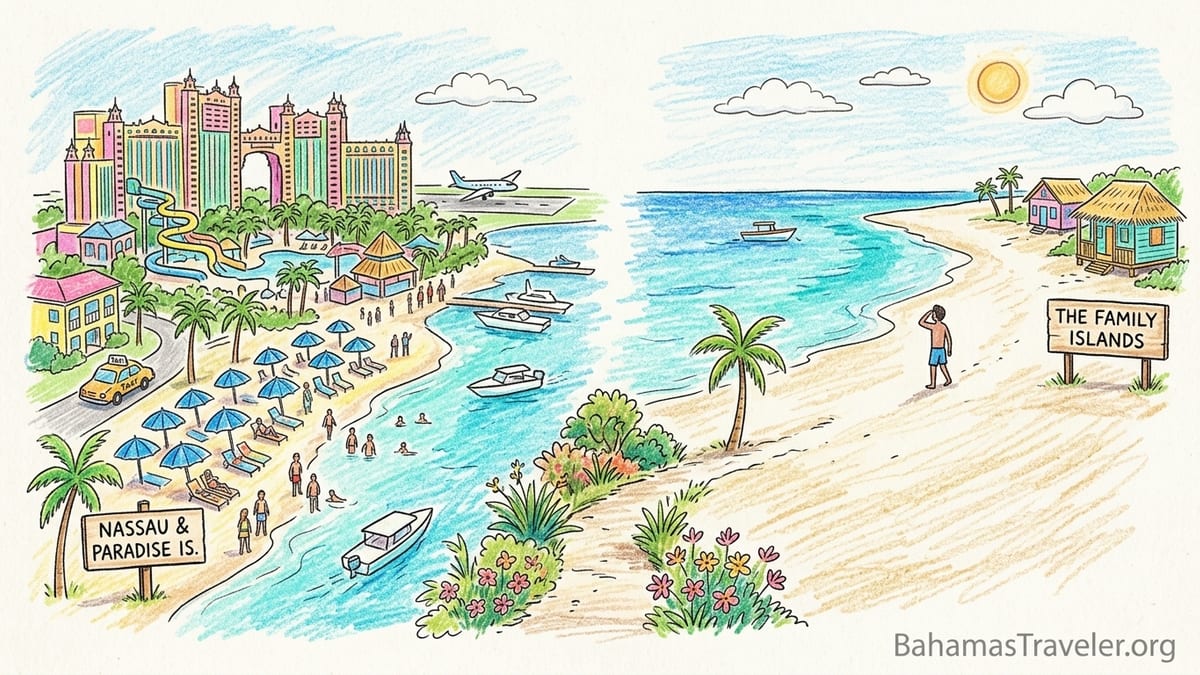
I’ve booked The Bahamas two very different ways: the classic first-timer approach of Nassau and Paradise Island, and the slower, stitched-together version that puts you on a Family Island where your “resort” might be a dozen rooms, a beach bar, and a grocery run that doubles as sightseeing. After doing both styles of trip, I don’t think the right question is “Which is better?” It’s “What kind of vacation are you actually trying to have?” Because the moment that sold me on each version of The Bahamas happened in totally different places: once on a nearly empty Family Island beach where my footprints were the only marks in the sand, and once on Paradise Island when I realized I could step out of my room and have restaurants, pools, and a waterpark within minutes without planning a thing.
Getting there: flights, airports, and the first hour on the ground
My Nassau and Paradise Island trips begin the way most Bahamas vacations still do: through Nassau’s Lynden Pindling International Airport. The big advantage is obvious the moment you start searching flights. Nassau has the broadest nonstop reach and the most schedule options, which is a big deal if you’re trying to turn a long weekend into a real reset. It’s also the simplest place to land if you’re traveling with kids, arriving late, or you just don’t want a complicated travel day to set the tone for your trip.
The first time I did a Family Island trip, I assumed it would feel like “Nassau but quieter.” It didn’t. It felt like a different country inside the same country. In practical terms, it started with the booking process: fewer nonstop flight options from the U.S. to individual Out Islands, more connections, and a higher chance that your ideal arrival time doesn’t match the limited schedule. The Bahamas tourism authority itself still frames it this way: some Out Islands do have international commercial flights, but many itineraries still route you through Nassau first.
The turning point for me was realizing how much the first hour matters. In Nassau, I can land, clear formalities, and be in a taxi lane with a plan. On a Family Island arrival day, I’ve had moments where the airport felt like a single-room welcome desk and a parking lot, which I genuinely love when I’m in the right mood. But if you’ve only got three nights and you lose half a day to connections, the “quiet” can start to feel like lost vacation time.
Hotel inventory and what “resort life” really means
Nassau and Paradise Island are built for scale. When I stay on Paradise Island, I’m choosing between large, facility-rich resorts where entertainment is part of the architecture. Atlantis Paradise Island alone operates multiple hotels under one resort umbrella with thousands of rooms and a massive list of on-site amenities, including a 141-acre waterpark, a major casino, and extensive shopping and dining. Baha Mar on Cable Beach is also a mega-resort complex with multiple branded hotels and a casino, which creates that self-contained “vacation city” feeling even if you never leave the property.
On the Family Islands, my lodging choices have been the opposite: smaller resorts, villas, and boutique hotels where the property is more of a base camp than a destination. The hotel is often where you sleep and maybe eat breakfast, and then the island becomes the itinerary. That can feel magical. It can also feel startling if you arrive expecting the same density of choices you’d have at a major Nassau resort. I’ve learned to read listings more literally: if a property says it has one restaurant and limited hours, believe it, and plan for that to be part of your day.
The exact moment my preference shifted during one Family Island stay was on night one. I checked in, dropped my bag, walked the beach until dusk, and then realized I couldn’t “just wander into” a lively restaurant row. The quiet was perfect until I was hungry. Compare that to Paradise Island, where I’ve had the opposite realization: after a long travel day, I could walk ten minutes and choose between a casual burger, a sit-down seafood dinner, or something sweet from a branded dessert shop without ever needing a rental car or a plan.
Beaches and water: empty perfection vs instant amenities
Family Island beaches changed my baseline for what “uncrowded” can mean. I’ve had afternoons where the ocean looked Photoshopped and there were no umbrellas in sight, no vendors, no background music, just wind and water. The first time I experienced that, it didn’t feel like a perk. It felt like the point. I remember walking long enough that I stopped counting steps, then turning around and seeing no one behind me, and thinking, “This is what I came here for.”
Nassau and Paradise Island beaches can be beautiful too, but they’re different in the way any beach attached to major resorts is different. You’re trading solitude for convenience. When I’m on Paradise Island, I can be on the sand with a towel in minutes, and I’m never far from a restroom, a bar, or a shaded chair. That’s not a small thing if you’re traveling with children, if you’re sensitive to heat, or if you simply prefer a beach day that doesn’t require logistics.
Waterparks are where the contrast becomes undeniable. Atlantis guests get daily access to Aquaventure through the resort fee package, and the property positions the waterpark’s adult “value” at around $190 per person and $95 per child. At Baha Mar, unlimited access to Baha Bay is included for resort guests, and the public day ticket rate is currently listed at $160 for adults and $65 for juniors. Those numbers aren’t just trivia, they’re the difference between a beach-only trip and a “do something big every day” trip.
The moment that made Nassau and Paradise Island click for me was watching a family finish breakfast, walk straight to the waterpark, then be back in time for a pool nap. On a Family Island, that kind of “one wristband unlocks the day” rhythm simply isn’t the default. You can build an amazing day, but it’s usually built from choices you actively make: a beach, a boat, a drive, a stop for conch salad, a sunset viewpoint.
Food, nightlife, and the reality of “options” after dark
In Nassau and Paradise Island, the density of restaurants is part of the vacation. Even within a single resort, you can move between cuisines and vibes without needing to coordinate transportation. Atlantis publishes weekly on-property dining and entertainment programming, and it shows in how easy it is to turn “What should we do tonight?” into “We’re going to dinner, then we’ll check out the casino, then we’ll grab dessert.” You don’t have to be a planner to have a full evening.
On the Family Islands, the best meals I’ve had were often the least formal: a plate that arrived in a plastic basket, a fish special written on a board, a place where the person taking my order also knew the fisherman’s first name. That’s not marketing. That’s scale. It’s also where you should calibrate expectations. If you’re the type of traveler who gets energy from choosing between ten restaurants, the Out Islands can feel limiting at night unless you’re staying somewhere with a strong on-site restaurant program or you’re happy repeating your favorites.
Nightlife is similar. Nassau and Paradise Island give you structured nightlife by default: bars, lounges, live music, and the kind of resort entertainment where you can show up spontaneously. The Family Islands give you quieter evenings, with the occasional standout night that feels authentic because it’s not designed for outsiders. I’ve had nights where my “plan” was to watch the sky turn ink-black and hear the ocean from a porch, and it was perfect. I’ve also had nights where I wanted one more drink and realized the island was basically going to bed.
The most important difference is not whether one has nightlife and the other doesn’t. It’s whether you want the vacation to deliver entertainment to you, or whether you want your surroundings to be the entertainment. I’ve enjoyed both. But I no longer book a Family Island expecting it to behave like a resort city.
Getting around: taxis, rental cars, ferries, and tours
Transportation is where the “entire vacation” difference becomes real, because it affects every hour. In Nassau and Paradise Island, taxis are a default tool, and fares are often discussed as zone pricing. Published references for Nassau airport taxi pricing commonly list a set price to Paradise Island, and there are also rate-card style resources that note Paradise Island fares with a bridge toll. In practice, I treat it like an airport transfer destination: I budget for it, I confirm the fare, and I move on with my day. I don’t need a rental car to have a full trip, especially if my stay is centered on a major resort.
On the Family Islands, I usually do the opposite: I assume I’ll want a rental car unless I’m staying somewhere truly walkable with a strong on-site program. That’s because the most memorable stuff is often spread out: beaches on different coasts, a local bakery, a harbor, a hiking spot, a beach bar that’s not next door. Rental costs vary by island and season, but even the act of booking one can become part of the planning puzzle because fleet sizes are smaller than you’ll find in Nassau.
Inter-island links are also part of the Family Island math. If you route through Nassau, you might be booking a domestic hop on Bahamasair or another local carrier, and schedules can be tight. There are also ferry options on some routes. Bahamas Ferries publishes service between Nassau and Spanish Wells and Harbour Island, and that’s a great example of how a Family Island trip can feel like a chain of mini-adventures rather than one straight line from airport to resort. It’s fun, but it’s not frictionless.
Tours are more “menu-driven” in Nassau and Paradise Island and more “conversation-driven” on many Family Islands. In Nassau, tour desks and hotel concierges can book you into half-day activities with predictable timing. On a Family Island, some of my best days started with asking someone at breakfast who they’d call for a boat ride, or where locals actually go for conch salad. That kind of travel can feel richer, but it requires time and a little comfort with uncertainty.
Shopping, groceries, and the hidden cost of convenience
Nassau and Paradise Island are where I go when I want shopping to be part of the vacation. Atlantis alone lists dozens of retail outlets across its property footprint, and the larger Nassau area is built around tourist shopping in a way that a smaller island just isn’t. If you enjoy picking up resort wear, skincare, gifts, or you simply like the energy of busy promenades, Nassau delivers that easily.
On the Family Islands, shopping is rarely the point, but groceries often are, especially if you’re staying in a villa or a small hotel where you’ll want snacks, breakfast supplies, and drinks. This is where costs can surprise first-timers. On one trip, I remember walking into a small grocery, filling a basket, and realizing I was paying not just for the items but for the fact that everything had to be shipped and stocked at small scale. The flip side is that grocery stops can be a window into local life, and I’ve had conversations in line that were more memorable than any souvenir purchase.
In Nassau, convenience can also be expensive, but it’s a different kind of expense. The prices are often tied to resort economics: you’re paying for the location, the service, the overhead, the on-site convenience. In the Out Islands, the cost is often tied to logistics and scarcity. Neither is “cheap,” but the why is different, and understanding that changed how I book.
If your idea of a vacation is never thinking about groceries, Nassau and Paradise Island are far easier. If you like the freedom of a rental car, a cooler, and the ability to build your own beach day, the Family Islands can feel like the better value even when individual items cost more, because you’re not required to buy every meal inside a resort ecosystem.
Community interaction and the moments that stuck with me
The Bahamas tourism story is shifting in a way that travelers can actually feel. While Nassau remains the main gateway, official tourism reporting has shown a meaningful share of stopover visitors going to the Out Islands, often framed as close to 30 percent in recent commentary. I noticed that change on the ground: more travelers asking about connecting flights, more conversations about splitting a trip between Nassau and a smaller island, and more properties leaning into “small hotel, big experience” positioning.
The most personal difference, though, is how often I interacted with local communities. In Nassau and Paradise Island, it’s absolutely possible to connect with Bahamian culture, but the resort bubble can be strong. If you stay on-property the whole time, your trip can feel international and polished, but not especially intimate. When I stayed on a Family Island, I had more “repeat faces” in a single week: the same cashier, the same boat captain, the same bartender who remembered my order. That creates a different kind of trip memory.
The exact moment that changed my own preference for certain trips happened on a Family Island afternoon when I pulled off the road near a beach access, walked through low brush, and stepped onto sand that looked untouched. No chair rentals. No music. Just sea. Ten minutes later, I was talking to someone about the best place to grab conch salad and how the weather had shifted. It felt like travel, not just vacation.
Then I went back to Paradise Island on a different trip and had my opposite “aha.” It was raining lightly, the kind of weather that ruins a DIY beach day. But I could pivot instantly: aquarium-style exhibits, a long indoor wander through resort spaces, a late lunch, then back out when the sky cleared. That flexibility is a form of luxury too, and it’s one Nassau and Paradise Island deliver consistently.
The Takeaway
If this is your first Bahamas trip, I’d personally start with Nassau or Paradise Island unless your dream is specifically a quiet, beach-first Out Island week and you’re comfortable with extra flight planning. Nassau is simply easier: more flight choices, more hotel inventory, and more “everything in one place” amenities. It lets you learn The Bahamas with training wheels, then you can decide how adventurous you want to get on a return visit.
If you’re booking a short break of three or four nights, I’d choose Nassau and Paradise Island again, because your time is the expensive ingredient. Less connecting, fewer moving parts, and a higher chance you can land and be in vacation mode fast. This is also where I’d send families who want waterparks and pools built into the day, since places like Atlantis and Baha Mar make entertainment effortless.
For a couples trip, I split it by personality. If you want nightlife, dining choices, and the option to dress up and wander, Nassau and Paradise Island win. If you want quiet mornings, long drives to hidden beaches, and evenings that feel like you’ve stepped out of the noise of everyday life, the Family Islands are where I’d book. For fishing and diving-focused travel, I lean Family Islands because the trip can revolve around the water rather than the resort, but I’d only do that if you’re comfortable renting a car and coordinating tours in advance.
For a beach-focused holiday where the beach itself is the headline, the Family Islands are my personal favorite, because the emptiness can feel like a luxury you can’t manufacture. For a repeat visit, my honest answer is that I’d split the trip: a couple nights in Nassau or Paradise Island for easy dining and a little buzz, then hop to an Out Island for the kind of beach days that reset your brain. I don’t think one version of The Bahamas is universally superior, but I do think choosing the right one for your specific trip style is the difference between a good vacation and a perfect one.
FAQ
Q1. Which is better for a first-time trip to The Bahamas: Nassau/Paradise Island or the Family Islands?
For most first-timers, I’d choose Nassau or Paradise Island for easier flights, bigger hotel selection, and more dining and activity options without a rental car.
Q2. Are the Family Islands hard to reach from the United States?
They can be, depending on the island. Some have international commercial flights, but many itineraries still connect through Nassau, which adds time and planning.
Q3. Do I need to rent a car on a Family Island?
In most cases, yes. Beaches, restaurants, and viewpoints are often spread out, and taxi availability can be limited compared with Nassau.
Q4. Is it easy to get around Nassau and Paradise Island without a car?
Yes. Taxis are widely used, and many travelers base their trip around one resort area, which reduces the need for a rental car.
Q5. Which has better beaches?
Both can be stunning, but the Family Islands are where I’ve consistently found the most empty, “wild” stretches of sand. Nassau and Paradise Island trade solitude for amenities and convenience.
Q6. Which destination is better for nightlife?
Nassau and Paradise Island. Resorts and the surrounding areas make it easy to find bars, lounges, and late-night options without planning far ahead.
Q7. Where are the best waterparks, Atlantis or Baha Mar?
Both are major draws. Atlantis is known for Aquaventure, and Baha Mar has Baha Bay. If waterparks are the centerpiece of your trip, staying at either resort simplifies access.
Q8. Are groceries and everyday items more expensive on the Family Islands?
They can be, because supply chains are smaller and more remote. If you’re staying in a villa, plan a realistic grocery budget and expect fewer brands.
Q9. Which is better for diving and fishing trips?
I generally prefer the Family Islands for dive and fishing-focused travel because the trip can revolve around the water and local operators, but it works best with extra planning time.
Q10. Should I split my vacation between Nassau and a Family Island?
If you have at least a week, yes. A split stay gives you Nassau’s convenience and amenities, then the slower, beach-first experience of an Out Island.