


I have stayed in all three of Nassau’s big visitor zones and they are not interchangeable, even when hotel listings slap “Nassau” on everything. Downtown Nassau felt like waking up inside the working capital, with cruise-ship surges and quick access to history and bars. Cable Beach felt like a modern resort corridor where the beach is the main event and taxis quietly add up if you leave often. Paradise Island felt like a self-contained vacation machine, easiest for an Atlantis-style trip and hardest for a spontaneous, walk-out-the-door cultural day. Below is the clearest, most practical way I can explain the differences, based on where I actually slept and where I only visited during the day, plus current 2026 logistics like airport taxi zone fares, ride apps, and what getting around really costs once you start repeating rides.
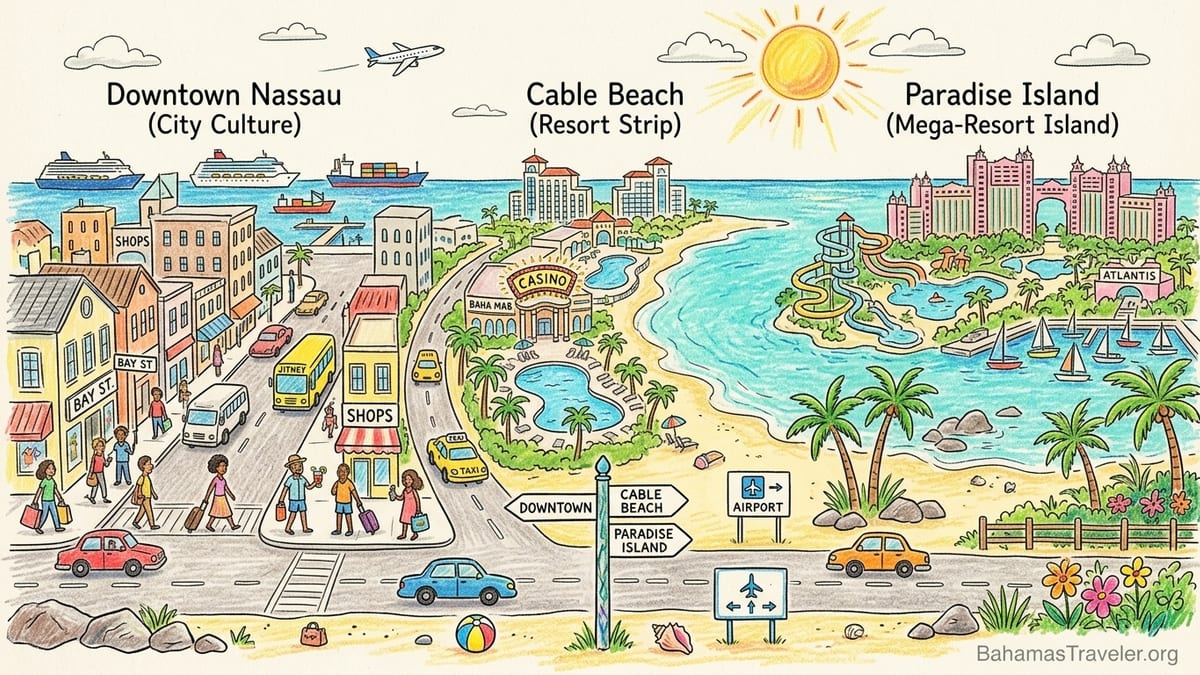
The three areas compared first: what changed the moment I checked in
I stayed in Downtown Nassau on Bay Street near the cruise port (Margaritaville Beach Resort, Nassau) and on Paradise Island near the Atlantis complex (Comfort Suites Paradise Island, using it as a base for the island). I did not stay overnight on Cable Beach, but I spent multiple full days there visiting Baha Mar and eating and walking the shoreline so I could judge the morning atmosphere, walkability, and how taxi-dependent it feels once you are outside the resort gates.
The most useful way to decide is to ask one question: do you want your “default setting” to be city, resort strip, or mega-resort island? Downtown’s default is movement: traffic, port activity, short walks to museums and rum cocktails, and a beach that exists but competes with noise. Cable Beach’s default is the beach: wide sand, big pools, casino energy, and most meals happening on-property unless you deliberately taxi out. Paradise Island’s default is the resort: lagoons, water parks, controlled access, and a sense that your vacation is curated for you, for better and worse.
In 2026, airport logistics make the first difference obvious before you even see the ocean. The official taxi zone fare structure out of Lynden Pindling International Airport is clear and fixed by zone: roughly $29 to Cable Beach, about $36 to Downtown Nassau, and around $45 to Paradise Island, with Paradise Island also commonly carrying a small bridge toll. That means you can feel the cost difference immediately if you are the kind of traveler who does a lot of quick, repeated rides.
My simplest summary: Downtown gave me the easiest “walk out for culture” days. Paradise Island gave me the easiest “everyone in the family is entertained without planning” days. Cable Beach looked like the easiest “resort holiday with a modern, high-end vibe” option, but also the one where you have to be intentional about leaving the property or you will blink and realize your whole trip happened between your pool chair, your dinner reservation, and your room.
Downtown Nassau (where I stayed): mornings on Bay Street, cruise-ship waves, and the real walkability
I stayed Downtown at Margaritaville Beach Resort, Nassau, which sits right on Bay Street close to the cruise port and the main downtown stretch. The best part was how “immediate” everything felt: coffee and breakfast were not a logistics exercise. In the morning, I could walk to casual options along Bay Street or around the central downtown blocks, and it was easy to add a quick stop at a museum or a historic site without turning it into a half-day excursion.
The morning atmosphere Downtown depended on the cruise schedule. On a quieter morning, the air felt like a city starting work: delivery trucks, commuters, and storefronts opening. On heavy cruise days, Downtown shifted fast from calm to congested. You feel it in the sidewalks, the traffic around the port area, and the general pace: more vendors, more tour groups, more lines, more noise. If you are sensitive to crowds, Downtown can feel overstimulating by late morning when multiple ships are in.
Beach access Downtown was real but not serene. You can get to sand quickly, but it is not the “I came for quiet turquoise bliss” version of Nassau. You are near the port, and you can hear the city. The upside is that you are not confined to a resort dining bubble. Dinner can be spontaneous: I could choose something casual and close, then follow it with a short walk for a drink rather than committing to a taxi round trip.
Taxi dependence Downtown was lower than I expected. I used taxis primarily for specific goals: Cable Beach visits (for Baha Mar time) and the occasional Paradise Island hop. The financial reality is still worth stating: even if the airport transfer is fixed by zone, repeated short rides add up quickly once you start doing them twice a day. Downtown is the one area where I felt I could minimize that by walking to the core attractions and saving taxis for “big moves” only.
Cable Beach (visited, not stayed): resort corridor convenience, Baha Mar gravity, and why it can feel contained
I did not sleep on Cable Beach, but I spent full days there at Baha Mar, which is the center of gravity for the area with its three main hotels (Grand Hyatt, SLS, and Rosewood). The immediate impression was that Cable Beach is built to keep you on-property: the beach, pools, casino, and a long list of restaurants are all right there, and the default day is designed to be frictionless.
The morning atmosphere at Cable Beach felt calmer than Downtown and more “vacation-forward.” The shoreline walk is the kind of thing you do before breakfast because it is pleasant, not because you are trying to dodge crowds. But the walk-to-breakfast reality depends on where you stay. If you are in a large resort complex, breakfast is usually a short internal walk, not a neighborhood stroll. You are walking within a property, not through a town.
In terms of beach access, Cable Beach is the clearest win of the three if what you want is a classic, wide, resort-adjacent beach day without needing a boat or a day pass puzzle. The trade-off is the feeling of being contained. The area is spread out and car-oriented once you step away from the major resort footprints. If your plan includes a lot of cultural stops Downtown and several Paradise Island days, Cable Beach can turn into a taxi-heavy itinerary.
Distance-wise, Cable Beach is closer to the airport than the other two zones, which is a small but meaningful quality-of-life factor, especially for short stays. But it is not “close” to Atlantis in the way people assume when they see both labeled as Nassau. Getting from Cable Beach to Paradise Island is a cross-town ride that can be slowed by downtown traffic and bridge approaches at peak times. If you do that repeatedly, it is not just the money. It is the time and the mental friction of always planning transportation.
Paradise Island (where I stayed): the Atlantis effect, beach access, and the easiest family logistics
I stayed on Paradise Island at Comfort Suites Paradise Island, a short walk from the Atlantis complex. The defining feature of staying here is that your day can be structured around Atlantis and the Paradise Island resort zone with minimal transportation planning. Mornings felt “resort quiet” compared with Downtown. The streets are calmer, and the crowd energy tends to concentrate around resort entrances and beach access points rather than spilling across the whole neighborhood.
Walking distance to breakfast and restaurants on Paradise Island depends heavily on your exact hotel. In my case, I could walk to casual meals and then decide whether I wanted a big resort dining night or a simpler, budget-conscious evening. The key detail: Paradise Island walkability is good within the Paradise Island bubble, but it is not a place where you naturally wander into a dense grid of local eateries the way you can Downtown. Many meals are either on-property, within resort-adjacent plazas, or they require a planned taxi ride to Nassau.
Beach access is strong and the water is the kind of turquoise people fly here for. The downside is that Paradise Island can make you feel like you are living inside an attraction. It is excellent when that is exactly what you want, especially for families or first-timers who want predictable, safe-feeling vacation days. It is less ideal if you want to pop into small museums, eat where locals eat, or build an itinerary around Nassau’s history.
Cost and confinement are the hidden story of Paradise Island. The airport taxi zone fare to Paradise Island is higher than to Downtown or Cable Beach, and once you are there, leaving for Downtown dinners, rum distillery visits, or Cable Beach days means repeating bridge-crossing taxi rides. If you do that twice a day for several days, the total starts to rival a memorable excursion. On my trip, Paradise Island was the area where I most noticed how quickly transportation spend can become a line item if you want variety beyond the resort zone.
Transport reality in 2026: taxis, ride apps, jitneys, and airport logistics you should plan around
Airport arrival at Lynden Pindling International Airport is straightforward, but your first decision is still important: fixed-zone taxi, prebooked transfer, or a ride app alternative. In 2026, official airport taxi information continues to publish zone-based fares and typical add-ons such as extra charges for oversized luggage. That clarity helps, but it does not solve the bigger issue: the cumulative cost of short rides once you start moving between Downtown Nassau, Cable Beach, and Paradise Island regularly.
For travelers used to Uber or Lyft, the practical reality is that those services are not the default here. In 2026, travelers commonly rely on licensed taxis, hotel-arranged cars, and a small ecosystem of local ride apps. That can be a relief if you like seeing a quoted fare in an app, but it is not always as seamless as big-city rideshare. I found that if I wanted to be spontaneous, Downtown was the easiest place to do it on foot, while the resort zones rewarded pre-planning.
The cheapest way to move between Downtown and Cable Beach is often the jitney bus system, which locals use daily. It is a real option for confident travelers who are comfortable with flexible schedules and a more local style of transit. The trade-off is convenience and predictability. If you are traveling with small kids, arriving late, or dressed for a formal dinner, the jitney can feel like an unnecessary stressor compared with a simple taxi.
Traffic deserves respect. Even if the distance is not huge, peak-hour congestion around downtown corridors can turn a quick ride into a slow one. That matters most if you are trying to stack experiences in a short window: a beach morning, a museum stop, a dinner reservation, and a nightcap across town. My advice is to treat cross-town movement as an “event” you plan once per day, not something you do impulsively three times, unless you are happy paying for that freedom.
Quieter western New Providence (only when it helps): when to leave the big three zones
If your trip goal is calm, space, and a more residential feel, western New Providence can be appealing, but it is not the best default for most first-time visitors who plan to do Downtown culture days and Atlantis-style activities. The western side can feel quieter and more local, but it also tends to increase taxi dependence. That is fine if you are renting a car and are comfortable driving on the left, but it can become frustrating if every breakfast, beach hour, and dinner requires arranging transport.
I treated the west as a day-trip territory rather than a base. The value was in contrast: fewer cruise-ship crowds, fewer tour buses, and more of that “living island” vibe. But I also noticed the practical issue immediately: if you are staying out west and want to do Paradise Island more than once, you are committing to long rides, and you will start planning your day around transit rather than around weather, mood, or spontaneity.
Where quieter western locations can genuinely shine is on a repeat visit when you already know the “must-do” hits. If your priority is a slower rhythm, patio mornings, and fewer resort crowds, then staying farther west can feel like an upgrade. For a first trip, I consider it an optional add-on, not the center of the hub.
Where I’d stay again by trip type (and why): family, couples, resort-only, short stay, or culture-first
If I were returning for a family trip where the priority is easy entertainment, minimal planning, and keeping everyone happy without constant transportation, I would choose Paradise Island again. The family logic is simple: you can build full days around the resort zone and beaches without negotiating across-town logistics. You pay for that convenience, but you also remove a lot of friction, especially if your group includes different ages and energy levels.
If I were returning for a pure resort holiday with a modern, high-end feel, I would base on Cable Beach and commit to the idea that the resort is the trip. This is the stay where you should budget for a few intentional “off-property” experiences, not daily cross-town shuttling. Do Downtown once or twice for history and local flavor, do Paradise Island once if Atlantis is a bucket-list item, then spend the rest of the time letting Cable Beach do what it does best: beach, pools, and resort dining without the sense of being in the middle of a port city.
If I were returning for a couples break where we want romance but also the freedom to walk out for a cocktail and a slice of Nassau’s personality, I would choose Downtown again but with a strategy: pick a hotel that is close enough to walk to dinner and drinks, and accept that some mornings will be louder if cruise ships are in. The trade-off is worth it if you value atmosphere and variety over controlled quiet.
If I were returning for a short stay of one or two nights, I would choose based on what I plan to do that specific trip. If it is one big Atlantis day, I would sleep Paradise Island to eliminate commuting. If it is a Baha Mar and Cable Beach-focused micro-vacation, I would sleep Cable Beach to keep airport transfers and beach time efficient. If it is a culture-focused visit with museums, historic sites, and short walks to food, I would sleep Downtown and use taxis only for one “beach resort day” as a treat.
The Takeaway
Downtown Nassau, Cable Beach, and Paradise Island are three different trips wearing the same destination name. Downtown is the best base if you want to walk to culture, handle more meals on foot, and treat resort zones as day trips. Cable Beach is the best base if you want a modern resort corridor where the beach and amenities are the point and you are comfortable leaving less often. Paradise Island is the best base if you want the easiest version of a resort-led vacation, especially for families, but you should expect to pay for freedom if you keep crossing into Nassau by taxi.
When I look back at my stays, the deciding factors were not room décor or pool size. It was morning atmosphere, how far I could walk before I needed a car, and how fast “just one more taxi ride” turned into a meaningful chunk of the trip budget. If you choose the area that matches your default day, Nassau becomes easy. If you pick an area that fights your itinerary, you will spend the week negotiating traffic, fares, and timing instead of enjoying the water.
FAQ
Q1. Which area is best if I want to avoid cruise-ship crowds?
Paradise Island and Cable Beach typically feel less exposed to port surges than Downtown, where cruise traffic can change the street atmosphere quickly.
Q2. Which area is most walkable for meals without relying on taxis?
Downtown Nassau is the easiest for walking to a variety of casual meals and bars, while Paradise Island and Cable Beach often keep dining inside resort zones.
Q3. Which area has the easiest “wake up and be on the beach” experience?
Cable Beach is built around beachfront resorts and direct sand access, while Paradise Island also offers strong beach access but in a more resort-curated environment.
Q4. How much should I expect to pay for an airport taxi in 2026?
Official zone fares are roughly $29 to Cable Beach, about $36 to Downtown Nassau, and around $45 to Paradise Island, with Paradise Island sometimes adding a small bridge toll.
Q5. Is there Uber or Lyft in Nassau?
Uber and Lyft are not the default in Nassau; most visitors use licensed taxis, hotel-arranged cars, and local ride apps where available.
Q6. Will I feel confined if I stay on Paradise Island?
You can, especially if you plan to explore Nassau daily. Paradise Island is excellent for a resort-led trip, but frequent off-island dinners and excursions can mean repeated taxi rides.
Q7. Can I base Downtown and still do Atlantis easily?
Yes, but expect to use taxis or planned transport for Paradise Island days. It is doable, just less seamless than staying on Paradise Island itself.
Q8. Is Cable Beach close to Atlantis?
Not especially. It is on the opposite side of Nassau from Paradise Island, and cross-town rides can be slowed by downtown traffic at peak times.
Q9. Are jitney buses a realistic option for tourists?
They can be, particularly between Downtown and the Cable Beach corridor, but they are less predictable than taxis and may not fit late nights or tight schedules.
Q10. What is the best area for a first-time visitor who wants both beaches and culture?
Downtown is the best culture base, with resort beaches and Paradise Island as planned day trips. If your priority is effortless beach time, Cable Beach or Paradise Island may fit better.