


Nassau looks like a postcard from the air, but the beaches are where the island’s personality really shows up: the resort-polished stretches, the working local parks, and the little pockets of sand where the ocean feels like it belongs to you. On my most recent trip, I chased swims instead of “best-of” bragging rights, which meant showing up early, staying late, and paying close attention to the small details that decide whether I’d happily do it all again: how the sand feels underfoot, how fast the water drops off, where the shade actually lands at noon, and whether snorkeling is real or just a hopeful sign on a brochure.
This guide is written in two lanes. First, I’m reporting what I genuinely experienced at the beaches I personally visited and swam: Cable Beach, Junkanoo Beach, and Saunders Beach. Second, I’m separating out researched options I did not personally swim on this trip but that deserve to be on your radar right now for Nassau and Paradise Island, including Cabbage Beach and Love Beach. Where I’m researching, I’ll say so plainly, and I’ll stick to what can be verified today: access realities, typical transport, and the kind of facilities you can reasonably expect.
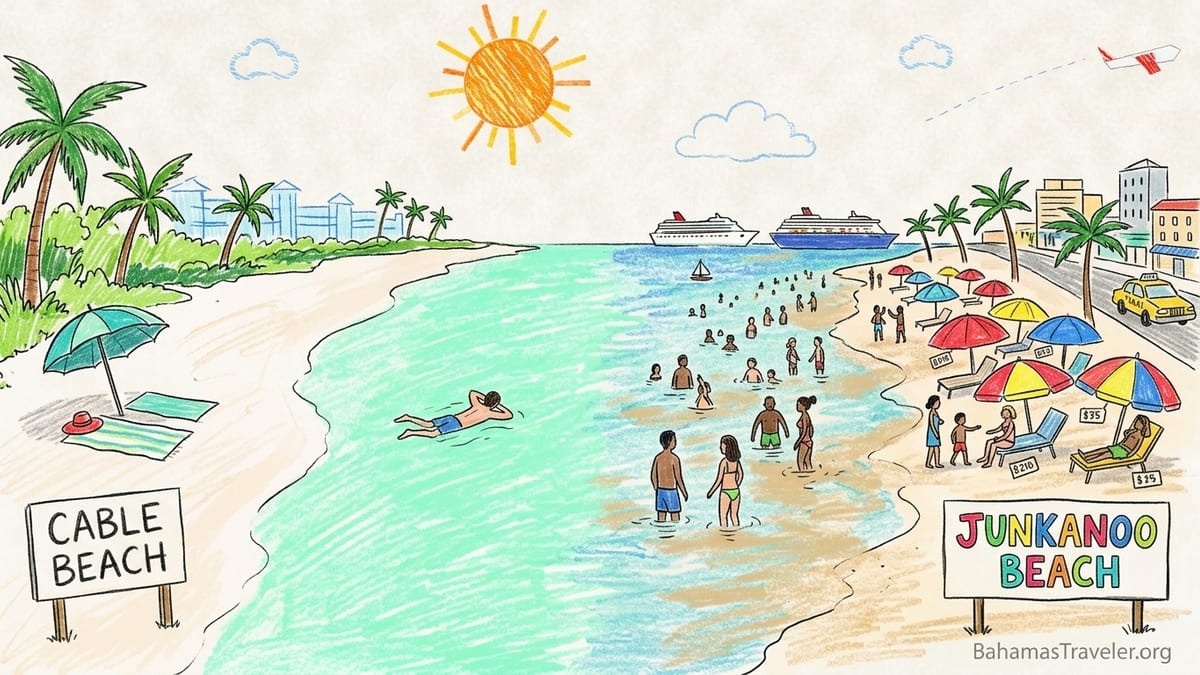
Cable Beach: The Swim I’d Repeat for Pure Ease
I started my trip at Cable Beach because it’s the most “drop in and be in the water fast” option on New Providence, especially if you’re staying anywhere along the resort strip. My first impression was tactile: pale sand that reads as soft from a distance but has that coral-sand crunch when it dries out near the back of the beach. Right at the waterline it turned silky and cool under my feet, the kind of sand that doesn’t punish you for pacing while you decide whether to commit to the first swim of the day.
The water, mid-morning, felt refreshingly warm rather than bath-hot. Entry was gradual for several steps, then dipped to waist depth with a gentle slope. Clarity was best early: I could see my feet clearly in knee-deep water, and the shallows had that bright, minty turquoise that makes you forgive a lot of travel logistics. Waves were small and rhythmic, more lift than slap, and the current that day felt mild alongshore, noticeable only because I kept ending up a few yards down from where I entered.
Shade is the first real “Cable Beach reality check.” Natural shade was limited where I set up, so I treated it like a beach you plan for: I brought sunscreen I actually trust and made peace with rotating between quick swims and towel time. Chair availability depends on where you post up. In the resort-adjacent zones, you’ll see set-ups that look private, and the vibe can feel like an invisible border even when the sand itself is a public shoreline. I walked until I found a section that felt less managed, then kept my footprint small. Vendors were light compared to downtown beaches. Bathrooms were not a guaranteed public facility where I entered, so I timed my visit around nearby options rather than assuming a beach restroom would be there.
Conditions changed noticeably as the day moved on. By early afternoon, the water looked a shade darker, with more surface texture from wind. The shoreline got busier, and the swim turned from “float and stare at the horizon” to “swim with awareness,” mostly because more people waded, splashed, and drifted in the same shallows. If you want Cable Beach at its best, my personal note-to-self is simple: arrive earlier than you think, do the long swim then, and treat noon as a shade and hydration checkpoint instead of trying to roast through it.
Junkanoo Beach: Famous, Convenient, and the One That Let Me Down
Junkanoo Beach is the beach you can practically stumble into from downtown, and that convenience is exactly why it’s so tempting, especially if you’re coming off a cruise ship or you’re staying near Bay Street. I walked in with high expectations for a quick “port day” swim and left feeling like I’d done the most obvious thing rather than the best thing. The sand was fine and light, but it didn’t feel as clean and cushiony underfoot as Cable Beach. It had more footprints, more mixed texture, and that slightly compacted feel that comes with heavy daily use.
In the water, entry was easy and shallow at first, which makes it friendly for non-swimmers. But clarity was the trade-off on my visit: the shallows looked stirred up, with suspended sand that dulled the view even in knee-to-waist depth. The water still had that Nassau warmth, but it didn’t have the same inviting transparency that makes you want to put your face in and explore. Waves were minimal, with a more sheltered feel than open Atlantic-facing beaches, but there was a constant background of activity: music, people moving around, and the sense that you’re sharing a small patch with a lot of agendas.
Junkanoo is also where the “beach economy” is most in your face. You’ll see chair and umbrella set-ups and people offering rentals, and prices can be inconsistent depending on the day and who you ask. I didn’t feel comfortable claiming a specific price from memory because what I heard varied, and I watched different groups negotiate different deals. What I can say honestly is that if you’re the type who wants a quiet swim with minimal transaction, Junkanoo is mentally noisy. Bathrooms and food options are more likely nearby than at a remote beach, but you’re paying for that in crowd levels and serenity.
How the day changed: by midday the crowd thickened, and the vibe shifted further from “beach morning” into “beach scene.” I still swam, but it was a short swim, not the kind that resets your nervous system. If you’re limited on time and you want the easiest saltwater dip from downtown, Junkanoo does the job. But it was the famous beach that was less enjoyable than I expected, and it’s the one I would not build a whole beach day around next time.
Saunders Beach: The Quieter Local Beach I’d Happily Revisit
Saunders Beach felt like Nassau exhaling. It’s not as glossy as the resort strip and not as hectic as the downtown scene, and that was exactly the point. The sand here felt softer and more natural underfoot, with small patches where the beach read as “family park meets shoreline.” I arrived earlier in the day and immediately noticed something Cable Beach didn’t give me for free: real shade. Trees and park edges created pockets where you could actually rest without turning your towel into a griddle.
The water entry was gentle and approachable. The shallows were calm enough that it felt kid-friendly, and the water temperature was comfortably warm. Clarity was decent close to shore, though not the glassy, open-water look you sometimes get on a perfect morning at Cable Beach. Waves were small, and I didn’t feel a strong current where I swam. It was the kind of place where you can wade out, float, and keep half an eye on the beach without feeling like the sea is trying to pull you into a workout.
Amenities were the big win here. Because Saunders Beach functions like a local park as much as a beach, it’s more plausible to find the basics nearby: places to sit, space for families, and a generally more “day out” infrastructure. I’m careful here because facilities can change, and I’m not going to promise you a specific amenity at a specific door. But in terms of the feel on the ground, this was the beach where I didn’t have to constantly plan my next move. Vendors were minimal on my visit, which I count as a plus. It also meant I brought my own water and snacks and felt good about that choice.
How the day changed: it got busier in the afternoon, but it stayed human. Instead of the intensity of Junkanoo, the crowd felt like locals arriving after work or families settling in. If you’re traveling with kids or you want a low-friction beach day without the resort sheen, Saunders is the quieter beach I would revisit, specifically because it let me swim, cool off, and relax without negotiating for every inch of comfort.
Cabbage Beach (Researched): The Iconic Paradise Island Stretch, With Real Access Questions
I’m separating this clearly: I did not personally swim at Cabbage Beach on this trip, but I researched it because it’s the beach everyone asks about on Paradise Island. Cabbage is famous for a reason. It’s long, photogenic, and faces the open Atlantic, which often means brighter water color and bigger wave energy than more sheltered spots. It’s also the beach that can make you feel like you’ve arrived in The Bahamas, even if you’re only there for a few hours.
Right now, access is the story you need to understand before you promise yourself a simple day there. Paradise Island is dominated by resorts, and recent local reporting and traveler guidance has highlighted that public access points can be limited, confusing, and sometimes treated as permission-based depending on the adjacent property. In other words: the sand may be public shoreline, but getting to it can be the tricky part. If you’re not staying at a resort on Paradise Island, do not assume you can stroll through any resort driveway and emerge on the beach without friction.
What to do with that reality: plan your route in advance and be ready to walk. Travel guides aimed at cruise visitors still describe a “free public beach access” approach that involves a longer walk from the bridge and ferry areas. Other options include buying a day pass through a beach club or resort-adjacent operator that explicitly includes chairs and an umbrella, which can remove the uncertainty if you’re traveling with a group or you don’t want to gamble on access points. The key is to treat Cabbage Beach like a destination with logistics, not just a pretty strip you can casually drop into.
Facilities and comfort are likely to vary along the length. Some sections will feel resort-managed with rentals and staff presence, while other sections will feel more open but also more bare-bones. If you go, bring your own water, and don’t count on public bathrooms right where you enter unless you’ve confirmed your access point has them. Consider the ocean conditions too: Atlantic-facing beaches can have stronger surf and rip currents on certain days, which changes what “a casual swim” looks like.
Love Beach (Researched): Quieter, Closer to the Airport, Better for Shore Snorkeling
I did not personally snorkel Love Beach on this trip, but it’s one of the strongest “if you care about snorkeling from shore” candidates in Nassau, and it keeps coming up in recent traveler conversations for a reason. Love Beach sits on the north shore not far from the airport approach, so plane noise can be part of the experience. Some people find it distracting; others treat it like background texture for a laid-back beach day.
What makes Love Beach different is the expectation of reef structure within an easy swim from the sand compared with many other Nassau beaches, where you may need a boat trip to reach more dramatic coral. Travel references describe nearshore coral that is present but not mind-blowing, plus offshore reef structure that’s more the domain of divers and guided snorkel trips. Translated into practical advice: if you’re a confident swimmer with your own mask and fins, Love Beach is the kind of place where you can try a quick, low-commitment snorkel without booking an excursion, as long as conditions are calm.
Access and amenities can be more limited than downtown beaches. Treat it like a bring-your-own-day: water, shade plan, and a dry bag. If you’re going specifically to snorkel, wear sturdy water shoes because coral-sand beaches can hide rocky patches near the edges, and entry points can vary by tide. Also, do not snorkel alone if you’re not used to ocean currents, and avoid going out if the water is rough or visibility is poor. Love Beach’s reputation is built on calm days and clear water, not on fighting chop.
If you want a quieter beach than Cable or Junkanoo and you’re willing to trade services for space, Love Beach is high on the researched list. It’s the kind of beach that rewards travelers who pack like they mean it and show up with realistic expectations about facilities.
Getting There, Costs, and What “Public Beach” Really Means in Nassau
Nassau is one of those places where the distance on a map doesn’t tell the whole story because your experience depends on whether you’re walking from downtown, staying on Cable Beach, or crossing to Paradise Island. For Cable Beach, the local jitney buses are a real budget tool: recent guidance for 2026 commonly cites a one-way jitney fare around $1.25 to $1.50 cash with exact change, and Route #10 is widely referenced as the tourist-friendly line connecting downtown and Cable Beach. I used taxis more than jitneys on this trip for time, but if I were doing a longer stay, the jitney is the obvious money saver.
For Paradise Island, taxis from the cruise port area to Atlantis and nearby drop-offs are commonly described as being priced per person for shared rides or as a higher private cab total, paid in cash. If you’re trying to reach Cabbage Beach without staying at a resort, build in extra time for walking from wherever you get dropped, and have a backup plan if an access point feels questionable. The single best way to reduce stress is to decide in advance whether you’re doing “free and flexible” or “paid and guaranteed,” then commit to that lane.
Now the most important nuance: in The Bahamas, beaches are generally public up to the high-water mark, but access across private land is where things get complicated, especially on resort-heavy Paradise Island. That’s why you can be legally standing on sand that’s considered public shoreline and still feel like you’re trespassing just because of how you had to enter. This is not theoretical. Current reporting and traveler guides have been openly discussing access confusion around Cabbage Beach, and it’s exactly why I’m telling you to treat access as a real part of trip planning.
Practical packing based on what I experienced: bring reef-safe sunscreen, a refillable water bottle, and cash in small bills for transport and rentals. If you’re sensitive to sun, bring your own shade solution or pick a beach where natural shade exists, like Saunders. And if you plan to snorkel, bring your own mask that seals well; a leaky rental mask can ruin what should be the best 20 minutes of your day.
The Takeaway
If I were choosing with my body, not my camera roll, Cable Beach is the swim I’d do again for that clean, easy, classic Nassau-water feeling, especially in the morning before the wind textures the surface. Saunders Beach is the quiet reset I’d happily revisit because it felt more local, more shaded, and less transactional. Junkanoo Beach, for all its fame and convenience, was the one that disappointed me, not because it’s bad, but because it’s busy in a way that makes the ocean feel like the background instead of the main event.
If you’re researching your own best beach day, treat Cabbage Beach as iconic but logistical, and Love Beach as quieter and more snorkel-curious, with fewer built-in comforts. Nassau rewards travelers who plan access and shade as carefully as they plan the swim.
FAQ
Q1. Which Nassau beach would you swim at again without hesitation?
Cable Beach, specifically in the morning when the water is clearest and the shoreline feels calmer.
Q2. Which famous Nassau-area beach was less enjoyable than expected?
Junkanoo Beach. It was convenient, but the crowding and stirred-up shallows made it feel less like a relaxing swim day.
Q3. Which quieter beach would you personally revisit?
Saunders Beach, because it felt calmer, more shaded, and more like a local beach day than a tourist scene.
Q4. Is Cable Beach good for strong swimmers or casual waders?
Both. The entry was gradual where I swam, with mild waves, but it’s best earlier in the day before wind roughens the surface.
Q5. Is Junkanoo Beach worth it if you only have a few hours in port?
Yes for a quick dip because it’s close to downtown, but I would not plan a full-day beach experience around it.
Q6. Do you need a day pass to use these beaches?
For the beaches I personally visited on New Providence, I did not use a day pass. For Paradise Island beaches like Cabbage, a day pass can be a practical way to reduce access uncertainty depending on where you enter.
Q7. What’s the most budget-friendly way to reach Cable Beach?
The local jitney is commonly described as the cheapest option, with 2026 guidance often citing about $1.25 to $1.50 one-way in cash, and Route #10 frequently noted as the downtown-to-Cable Beach line.
Q8. Is Love Beach good for snorkeling from shore?
It’s widely researched and discussed as one of Nassau’s better shore-snorkeling choices on calm days, though amenities can be limited and conditions matter.
Q9. Is Cabbage Beach actually public?
The shoreline is widely treated as public in The Bahamas, but current discussion emphasizes that access across resort-dominated Paradise Island can be confusing or restricted in practice, so planning your entry route matters.
Q10. What should I bring to make a Nassau beach day easier?
Cash in small bills, reef-safe sunscreen, water, and your own snorkel mask if you plan to snorkel; also plan shade intentionally, especially at beaches with limited trees.