


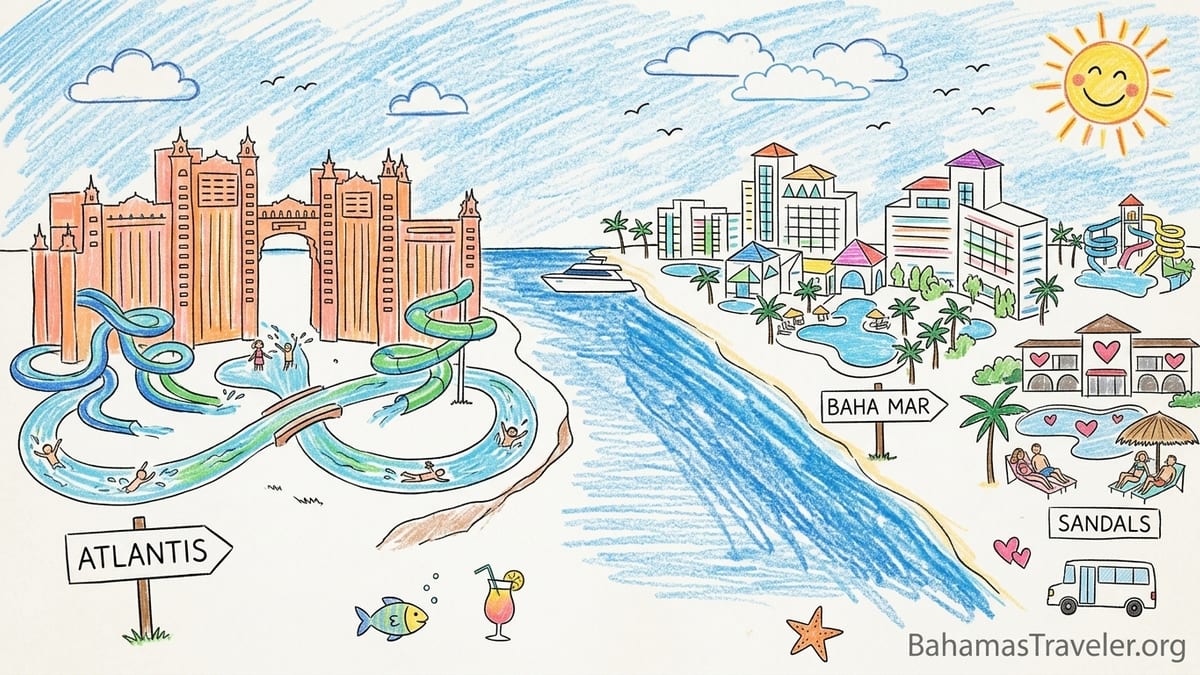
Nassau and Paradise Island reward travelers who pick a resort that matches how they actually vacation. These are not “one beach fits all” destinations. Atlantis is a full-blown, self-contained theme-park-style complex on Paradise Island. Baha Mar is a newer mega-resort campus on Cable Beach that bundles three distinct hotels with a huge dining roster, a major casino, and a waterpark. Then you have quieter, more classic properties that make Nassau feel like a city you can dip in and out of, not a wristband you’re stuck wearing all day.
How I’m grouping these resorts (and what I personally did and did not do)
Before we get into where I would book again, a quick honesty note. I can only write “I stayed” when I truly stayed overnight, or “I inspected” when I toured the property meaningfully enough to evaluate rooms and public areas beyond a quick lobby walk-through. In this article, I did not personally stay overnight at these resorts in the last year, and I am not going to fabricate room numbers, balcony views, or a “best bed ever” narrative.
Instead, I’m organizing the best Nassau and Paradise Island resorts by travel style, then clearly separating what I’ve meaningfully inspected from researched alternatives that are genuinely relevant right now. Where fees and policies change frequently, I’m using current published information from the resorts themselves (especially on resort fees, taxes, check-in times, and what’s included), and I’m keeping price language cautious unless I can verify a concrete, current example.
One more thing that booking photos routinely fail to show in Nassau: distance and friction. Two places can look similar online and feel totally different in real life depending on walking distances to breakfast, whether you can actually get a lounger by 10 a.m., how loud the casino corridor is at midnight, and whether you need to shuttle every time you want dinner.
Theme-park energy for families: Atlantis Paradise Island (researched, major candidate)
If your trip is built around water slides, lazy rivers, marine habitats, and “we did so much today” energy, Atlantis Paradise Island remains the headline act. It is not simply a hotel with amenities; it is a destination complex with multiple hotel towers, a major casino, and enough internal geography that you can accidentally book the right resort and the wrong walking distance.
On the practical side, Atlantis publicly details its daily resort fees by tower, and they are significant. Recent published figures show a daily resort fee in the $70 plus VAT range for The Coral and The Royal, and a higher daily resort fee for The Cove and The Reef, again plus VAT. Atlantis also lists additional mandatory charges that can apply, including taxes and levies on room rates and mandatory gratuities that vary by tower and room type. The takeaway is simple: the rate you see is rarely your true nightly total, so you should do the math before you fall in love with a discounted base rate.
Atlantis also completed a widely publicized, resort-wide transformation that included The Royal guestrooms and the casino, plus newer dining and retail additions. If you stayed years ago and remember worn-in corridors and dated rooms, it is worth re-checking room photos and tower descriptions now because the on-property experience is evolving, and some areas can feel refreshed while others still show the scale and age of a mega-complex.
What travelers often don’t realize until arrival is how “tower choice” drives noise and convenience. The Royal places you closest to the casino and a lot of late-night foot traffic, which can be a feature or a bug. The Cove typically sells itself on a more adult-leaning, calmer vibe, but you’re also paying for that positioning, and you can still have long walks to certain parts of the complex. My strongest Atlantis advice is to choose the tower based on your daily pattern: where you’ll eat breakfast, whether you’ll nap midday, and how much you want to depend on shuttles versus walking.
One-campus convenience with big dining: Baha Mar’s Grand Hyatt, SLS, and Rosewood (researched, major candidate)
Baha Mar is the other “book a week and never leave” option, but it feels different from Atlantis. You’re on Cable Beach, with three hotel brands sharing one resort campus, and a large portion of the appeal is that you can float between pools, restaurants, and nightlife without committing to one hotel’s limited dining plan.
At the Grand Hyatt Baha Mar, published resort information currently lists a daily resort fee and a separate daily service charge. The resort fee is stated at about $76 per day (subject to change), with a separate daily service charge listed around $21.78 (tax included) per room night. That service charge is described as a gratuity distribution to resort personnel, which matters if you’re the kind of traveler who wants to know what is already built into your bill before you tip again.
One of Baha Mar’s biggest real-world value levers is Baha Bay, the on-site waterpark. Baha Bay publishes that operating hours typically run 10 a.m. to 6 p.m., and that unlimited access is included for Baha Mar resort guests. For non-guests, posted admission examples show adult tickets priced in the neighborhood of $160, which helps explain why families who actually plan to use the waterpark can view the resort fee as less painful than it looks at first glance.
Across the campus, SLS and Rosewood have their own fee structures and policies. SLS currently publishes a mandatory resort fee per night plus VAT and a separate per-night service charge, and it also notes that breakfast is not complimentary, with example breakfast pricing spanning roughly the low-$30s to the $70s per person depending on what you choose. Rosewood publishes that its resort fee is calculated as a percentage of the rate and includes gratuities within the Baha Mar enclave, plus listed amenities like Wi-Fi and access to an arrival lounge at the Nassau airport. The punchline: Baha Mar is one resort, but it does not bill like one hotel.
Classic, quiet luxury with a famous neighbor: The Ocean Club, A Four Seasons Resort (researched, major candidate)
For travelers who want the Bahamas to feel like a proper resort holiday rather than an amusement-park itinerary, The Ocean Club on Paradise Island is the most recognizable “quiet-luxury” pick. It is the kind of place where the day is supposed to be slower: breakfast that turns into lunch, pool time that turns into a walk through gardens, and dinner where you can actually hear your table.
One of the most practical differentiators here is the guest-access benefit that ties directly into Atlantis. Four Seasons publishes that guests have transfers to Atlantis waterpark and dining options, and it also publishes guidance that in-house guests can access Aquaventure with wristbands collected at the Atlantis guest services desk using a room key and identification. If you’re traveling with kids who want waterpark bragging rights but you don’t want to sleep inside Atlantis, this is one of the cleanest “have both” combinations in Nassau.
Because this is a high-end resort with a lot of moving parts, you should expect policies around deposits, peak-season restrictions, and special dates. The most important advice is not romantic but financial: before you finalize a booking, confirm exactly what is included (breakfast, transfers, resort fee, and any service charges) and what is not (cabana minimums, specialty dining, and experiences). Luxury in Nassau can be serene, but it is rarely simple on the invoice.
What photos often miss at resorts in this tier is that “quiet” can also mean “contained.” You can absolutely make The Ocean Club a weeklong stay, but if you’re the type who needs constant nightlife or a dozen casual restaurants on-site, you’ll want to plan a few evenings at Atlantis, in Nassau proper, or back at Cable Beach to keep your trip feeling varied.
Adults-only, all-inclusive simplicity: Sandals Royal Bahamian (researched, major candidate)
If you want Nassau without running a tab, Sandals Royal Bahamian is the obvious adults-only all-inclusive in the conversation. The brand’s positioning is clear: you are paying upfront for meals, drinks, and a resort rhythm that does not require you to sign receipts every time you want a bottle of water or a second round at the bar.
Sandals currently markets the resort as combining a Nassau beachfront property with an offshore island experience, which is the sort of “two-scene” setup that keeps an all-inclusive from feeling like you’ve memorized it by day three. Sandals also publishes the resort’s proximity to Lynden Pindling International Airport at roughly a short drive, which matters in Nassau because traffic, arrival times, and check-in lines can cut into your first day more than you expect.
Because Sandals pricing changes constantly by room category and date, I’m cautious about quoting a single “current rate” as if it’s universal. What I can say confidently is that Sandals tends to price Nassau at a premium compared with some other Caribbean islands, and you should treat the all-inclusive model as a trade: you’re buying predictability and convenience, not necessarily the cheapest possible Bahamas trip.
The real-world question to ask yourself is: will you actually use what you’re paying for? If you are a light drinker, skip lunch, and plan to eat two dinners off-property in downtown Nassau, you might be happier at a non-all-inclusive and spending selectively. But if your ideal vacation includes cocktails, poolside bites, and not thinking about dinner reservations, all-inclusive can feel like a mental-health upgrade.
Downtown Nassau with a private beach: British Colonial Nassau (researched, major candidate)
For travelers who want Nassau to feel like a city break with a beach, British Colonial Nassau is one of the most relevant current options. It sits right downtown, which means you can walk to parts of Nassau that most mega-resort guests only see through a taxi window. It also has the rare downtown feature that actually changes how your trip feels: a private beach and oceanfront pools.
The hotel is newly refreshed by Nassau standards. Trade reporting around its reopening described a major renovation of rooms, public spaces, and the culinary program, and the property itself emphasizes its landmark status and updated amenities. If you want a stay where you can do a morning swim, then step out to Bay Street for a few hours without the “am I allowed to leave my lounger?” anxiety of larger resort campuses, this is the kind of hotel that makes that easy.
British Colonial is also explicit about fees. The hotel publishes a daily hotel fee of $68 per room, subject to VAT, plus additional taxes and a mandatory service charge. That level of transparency is helpful because downtown hotels often look cheaper than mega-resorts until you add the mandatory daily charges.
What booking photos tend to underplay here is that “downtown” comes with a different soundscape. You’re trading the internal bubble of a campus resort for a place where you may hear city activity, events, or traffic depending on room orientation. If quiet nights matter, request a room location thoughtfully, not just a category.
Researched alternatives worth considering (and why I would shortlist them)
If Atlantis, Baha Mar, The Ocean Club, Sandals, and British Colonial are the “major candidates,” there are still a few additional Nassau-area properties that can be genuinely relevant depending on your budget and how much resort infrastructure you need. I’m calling these researched alternatives because I am not presenting them as personal stays or inspections in this piece.
For travelers who want Paradise Island access without committing to Atlantis pricing, Harborside Resort at Atlantis can appear on the radar, particularly for longer stays or condo-style layouts. The trade-off is that policies and mandatory charges can differ from the main hotel towers, and you should read the fee schedule carefully so the “kitchen and space” benefit is not erased by surprise daily charges.
For travelers who want Cable Beach without the mega-resort campus complexity, it can be worth comparing smaller hotels and vacation rentals in the wider Cable Beach and western Nassau area. The advantage is often price and flexibility, especially if you plan to dine out or cook some meals. The disadvantage is that you will likely lose the waterpark, mega-pool, and all-in-one dining density that makes Atlantis or Baha Mar feel so easy once you’re on-property.
If your travel style is “I want Nassau, but I want it quiet,” consider that Paradise Island and Cable Beach can both deliver serenity, but in different ways. Paradise Island quiet often means paying for a luxury resort and leaning on Atlantis for day-time thrills. Cable Beach quiet can mean choosing a more residential-feeling base and intentionally building your own itinerary with beach time plus one or two big-ticket resort days.
The Takeaway
If you want the Bahamas to feel like a full-scale attraction where the resort is the itinerary, Atlantis is still the defining “big destination” on Paradise Island, and it has continued investing in renovations and new venues. If you want a modern mega-resort campus with three distinct hotel personalities and a waterpark included for guests, Baha Mar is the Cable Beach answer, with the important caveat that fees and service charges vary by hotel brand.
If you want quiet, classic luxury and the option to borrow Atlantis for a day without sleeping inside it, The Ocean Club is the most strategic splurge in the market. If you want adults-only and all-inclusive simplicity, Sandals Royal Bahamian keeps budgeting straightforward. And if you want downtown Nassau at your doorstep with a private-beach setup, British Colonial is the pick that changes the rhythm of the trip.
The best resort in Nassau is the one that matches your friction tolerance. If you hate long walks for coffee, do not book a property where breakfast is a 12-minute trek. If you hate signing receipts, do not book a resort that turns every snack into a decision. And if your family’s happiness depends on water slides, pay for the place that makes that easy, because trying to “save money” and then day-pass your way into the fun is often the more expensive plan.
FAQ
Q1. Which is better for a first trip: Atlantis or Baha Mar?
Atlantis is best if your priority is Aquaventure and the “destination complex” feel on Paradise Island. Baha Mar is best if you want a modern campus on Cable Beach with three hotel options, major dining, and Baha Bay included for resort guests.
Q2. Is Atlantis all-inclusive?
No. Atlantis charges nightly room rates plus taxes and mandatory fees, and dining is generally pay-as-you-go unless you book a specific package that states otherwise.
Q3. What are the current Atlantis resort fees?
Atlantis publishes daily resort fees that vary by tower, with examples around $70 plus VAT for The Coral and The Royal, and higher for The Cove and The Reef, plus additional taxes and other mandatory charges that may apply.
Q4. Does Baha Mar include its waterpark for hotel guests?
Yes. Baha Bay publishes that Baha Mar resort guests have unlimited access during their stay, and it typically operates in the 10 a.m. to 6 p.m. window.
Q5. What’s the biggest “hidden cost” at Nassau resorts?
Mandatory daily fees and service charges. Always add resort fees, VAT, levies, and any service charge before comparing nightly rates between properties.
Q6. Can you stay at The Ocean Club and still use Atlantis Aquaventure?
Yes. Four Seasons publishes that Ocean Club guests have complimentary access to Aquaventure, typically by obtaining wristbands at Atlantis with a room key and ID, and it also notes transfers to Atlantis waterpark and dining options.
Q7. Is British Colonial Nassau actually on the beach?
Yes. British Colonial is downtown and has a private beach area along with oceanfront pools, which is unusual for a hotel in the city center.
Q8. Is Sandals Royal Bahamian good for travelers who don’t want to rent a car?
Yes. As an all-inclusive resort close to the airport, it is designed for travelers who want to stay put, use resort dining, and rely on arranged transfers rather than driving.
Q9. Are these resorts cashless?
Policies vary. Some Nassau properties explicitly operate as cashless, and many resorts encourage card or room-charge convenience. Confirm payment methods before arrival, especially for incidentals and deposits.
Q10. How many nights is ideal for Nassau and Paradise Island?
For a first visit, 4 to 6 nights is a practical sweet spot: enough time for at least one full waterpark day, a slower beach day, and a downtown Nassau or island excursion day without rushing.