


I’ve landed at Lynden Pindling International Airport (NAS) enough times to know that Nassau doesn’t test your patience in the air. It tests it on the curb. On this trip, I arrived in the early afternoon, walked out of Arrivals with one checked suitcase and one carry-on, and did what most first-timers do: I followed the flow toward the official taxi queue. I took a licensed taxi to Paradise Island, paid the regulated zone fare plus the bridge toll, and timed the whole thing from terminal doors to my hotel lobby. Then, later in the same trip, I repeated the process to Cable Beach and Downtown Nassau so I could compare the feel, the traffic, and the real-world costs. Here’s exactly how it played out, what I paid, what slowed me down, and what I’d book again next time depending on where you’re staying.
My arrival at NAS: terminal, timing, and what the taxi queue was really like
I landed at Lynden Pindling International Airport on a weekday at roughly 1:40 p.m., arriving into the main international arrivals flow. By the time I was off the plane, through immigration, and standing at baggage claim, the terminal felt busy but manageable. My checked bag came out within about 20 minutes, which is the moment I start deciding whether I’m going to gamble on a taxi line or wish I’d pre-booked a transfer.
After Customs, I followed the signs for ground transportation and walked outside into the heat. The taxi area is straightforward: there’s a visible queue and staff directing people toward available cars. In my case, the line was not chaotic, but it wasn’t instant either. From the moment I stepped out of the terminal to the moment I was pulling away in a cab, I waited about 12 to 15 minutes.
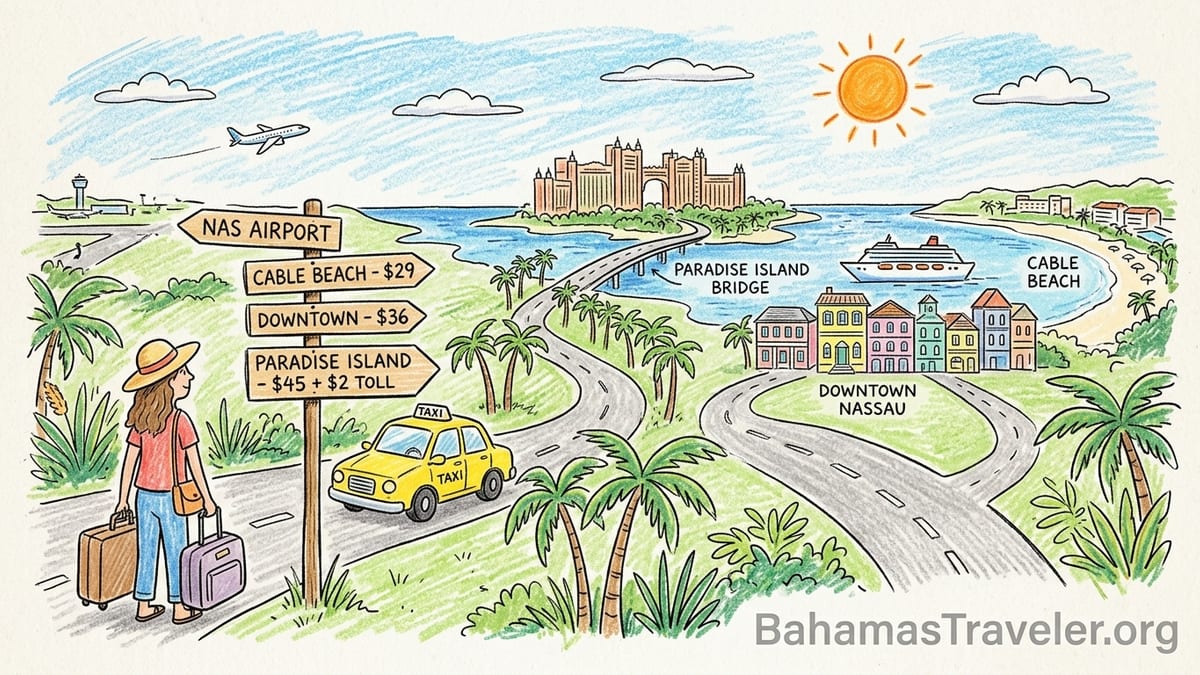
What helped: I already knew the airport’s published taxi zone fare for my destination, and I had the cash ready. Nassau is a place where having the number in your head matters. The official Nassau airport taxi fares are set as zone fares for up to two passengers, with add-on charges for extra passengers and certain luggage scenarios, plus a bridge toll when you go over to Paradise Island. The airport’s current posted fare table puts Cable Beach at $29, Downtown Nassau at $36, and Paradise Island at $45 for two passengers, with a separate $2 bridge toll for Paradise Island.
My main takeaway from the curb: the taxi queue is usually the biggest variable you can’t control. If three flights land close together, your “25-minute drive” can quietly become a 45-minute door-to-door experience even before traffic enters the story. If you’re arriving with kids, a tight dinner reservation, or you simply hate waiting, that’s when pre-booking starts to make emotional sense, even if it costs more.
Nassau Airport to Paradise Island: what I paid, the bridge toll, and door-to-door time
My first ride was from NAS to Paradise Island, with my destination being a Paradise Island hotel address (Atlantis area). At the taxi stand, I stated the destination clearly: Paradise Island. The driver confirmed the regulated zone fare and reminded me there’s also a bridge toll when you cross. That bridge toll is a real, separate line item that surprises people who only memorize the headline fare.
Here is what I genuinely paid for the ride itself: $45 for the Paradise Island zone fare plus $2 for the bridge toll, for a total of $47. I was traveling solo, but the zone fare is based on up to two passengers, so the base cost is the same whether you’re one person or two. I did not get hit with an extra passenger charge because there wasn’t an additional passenger. I also did not pay any luggage surcharge on this ride because I had one suitcase and one carry-on, which fits within the “two pieces per person” baseline that the airport taxi rules outline.
Timing-wise, my ride was not the fantasy 12-minute sprint some apps advertise. From the time we pulled away at about 2:20 p.m. to the time I was stepping out at the hotel drop-off, it took roughly 30 minutes. Add the queue and curb loading time, and my total door-to-door time from exiting Customs to arriving at the hotel entrance was about 45 minutes.
Traffic felt moderate, with the slowest stretch being closer to downtown and approaching the bridge to Paradise Island. If you’re arriving around mid-afternoon or early evening, you should assume the last third of the route can compress and slow, especially when the flow converges near the harbor crossings.
Understanding the official NAS taxi fare rules (and the add-ons that actually change your total)
The best way to avoid confusion at Nassau airport is to treat taxi pricing as a regulated menu: a fixed zone fare plus defined add-ons. The airport publishes taxi fares by destination zone, and the headline numbers most travelers care about are $29 to Cable Beach, $36 to Downtown Nassau, and $45 to Paradise Island for up to two passengers. Paradise Island rides also have an additional bridge toll charge. The airport’s current table lists that bridge toll as $2, while the Bridge Authority’s own published toll table also lists taxi cabs at $2.
Where people get tripped up is the add-ons. The airport’s current taxi rules say the set fare is based on two passengers and that each additional passenger costs $5. The luggage policy is also specific: the fare includes up to two pieces per person (one suitcase and one carry-on). Beyond that, each extra piece of luggage is charged at $2.20, and oversized items like golf bags and boxes can carry an additional $3.30 fee. If you’re a family of four, that “$45 to Paradise Island” headline can turn into $45 plus $10 in extra passenger fees plus the bridge toll, before anyone even talks about tips.
My practical method at the curb is simple and keeps the interaction calm. I say: “Paradise Island, one passenger, one suitcase and one carry-on. Confirm the total including the bridge.” If you’re going to Cable Beach, you can remove the bridge part of the script. If you’re going downtown, you swap in “Downtown Nassau” and ask them to confirm the zone fare before you load your bag.
One more nuance: the Bahamas uses both Bahamian dollars and U.S. dollars interchangeably in daily life, and travelers often pay taxis in U.S. cash. That convenience can tempt drivers and passengers into fuzzy math. If you want to keep everything clean, ask for the total before you move and have exact or close-to-exact cash ready so you’re not negotiating change on the curb.
Cable Beach from the airport: how it differs, what to expect, and what I’d do if I were staying at Baha Mar
Cable Beach is the easy win from NAS, both geographically and psychologically. It’s closer than Paradise Island, you avoid the bridge toll entirely, and the ride tends to feel like a clean west-to-north hop rather than a cross-island crawl. The airport’s posted taxi zone fare to Cable Beach is $29 for up to two passengers, with the same extra passenger and luggage rules applying.
On this trip, I also did the airport-to-Cable-Beach run to compare the experience. My destination was the Cable Beach resort strip area (think Baha Mar, Breezes, Sandals Royal Bahamian, and nearby hotels and rentals). The taxi line was shorter for this ride than it had been earlier in the week. I was curbside in under 10 minutes and on the road quickly. The driving time was about 15 minutes, with lighter traffic than the Paradise Island route, and the whole curb-to-hotel door experience felt smoother.
What would I use again for Cable Beach? If I’m traveling light, during daylight hours, and I don’t need a car seat, the regulated taxi is still my default because the price is strong for the convenience. But Cable Beach is also where it becomes easiest to justify a private transfer if you value predictability. A private car service can meet you inside, handle luggage, and remove the guesswork of the taxi queue. As one example of current, bookable pricing in Nassau, Chase Exclusive Transportation advertises one-way airport transfers starting around $80 for a sedan and $120 for an SUV, which is significantly more than the taxi fare but includes the “this is handled” feeling that some travelers pay for.
If you’re staying at a major resort such as Baha Mar, your reservation or package may include transfer options through certain channels, and other travelers report that some packages include shuttles while others do not. The key is to confirm what you actually have in writing before you land. If there is no included shuttle, the taxi fare to Cable Beach remains one of the more reasonable regulated airport transfers in the Caribbean.
Downtown Nassau from the airport: when the $36 fare is worth it and when I’d choose another option
Downtown Nassau is a different kind of ride because it isn’t just about beaches and resorts. Downtown travel often means the cruise port area, Bay Street shopping, the British Colonial corridor, government buildings, or hotels that put you in walking range of the historic core. The airport’s published taxi zone fare to Downtown Nassau is $36 for up to two passengers, again with the same extra passenger and luggage rules.
In real-world terms, Downtown can be faster than Paradise Island if the bridge approach is backing up, but it can also be slower if you hit congestion around the port area, especially on heavy cruise days. When I did the downtown run, the drive time landed in the mid-20-minute range, but the final few blocks near the busiest streets were noticeably slower than the earlier parts of the ride.
This is also where I think many travelers overpay with pre-booked “airport transfer” products that are essentially taxis in nicer clothing. If you’re going downtown with one or two people and standard luggage, the regulated taxi fare is competitive. I would only pre-book a private transfer downtown if one of these conditions is true: you’re arriving at night and want meet-and-greet; you’re traveling with a group and need a van; you need a car seat; or you have a timed commitment like a wedding check-in, an event, or a hard deadline.
Budget travelers sometimes ask about public transit. There is no bus that goes directly into the airport terminal, and jitneys do not run as an airport shuttle in the way travelers may expect. Some guides describe taking a jitney by walking out to the main road and catching a route toward downtown, but that’s a different experience entirely: it’s best suited to daytime arrivals with minimal luggage and a comfort level with local transit logistics. If you’re arriving with a checked suitcase, in the heat, after a flight, that walk-to-the-road plan can feel less like travel savvy and more like self-punishment.
Alternatives I’d actually consider now: private transfers, hotel shuttles, and legit ride apps
If you want to eliminate the two biggest pain points of a Nassau arrival, waiting and uncertainty, you’re really choosing between three categories: a pre-booked private transfer, an official hotel transfer, or a legitimate ride app with upfront pricing. Each has a different tradeoff.
Private transfers are the “I want it handled” option. They’re typically priced per vehicle, not per person, and often include flight monitoring and meet-and-greet style service. For example, Chase Exclusive Transportation advertises one-way pricing starting around $80 for a sedan and $120 for an SUV from the airport, which can make sense for couples who split the cost, families traveling with more luggage, or anyone who values walking out to a name sign instead of joining a queue.
Hotel or resort transfers can be attractive when they’re packaged with your booking or sold as an “official shuttle.” The reality is that not every resort includes airport transportation. Atlantis, for example, explicitly states it does not offer free complimentary airport shuttles, but it does sell transportation alternatives that guests can reserve in advance. Some third-party comparisons list the official Atlantis shared shuttle at a per-person price point, which can add up quickly for families and may cost more than a taxi for two people, even though it feels simpler to book.
Then there’s the ride app angle. Nassau does not have Uber the way many U.S. travelers expect, but there are local app-based options marketing fixed pricing and in-app payment. HOP, for example, positions itself as a Nassau ride app with fixed fares displayed before you confirm, and it publishes example destination pricing and trip-time estimates for common routes. The reason I’d consider it is not because it’s always cheaper than a taxi. It’s because it can be less ambiguous: you see the fare before pickup, and that reduces the chance of a surprise conversation curbside.
My honest recommendation is to match the tool to your mood and your luggage. If you’re arriving after a long travel day and you want the least friction, I’d pre-book a reputable private transfer for Paradise Island. If you’re traveling light and arriving at a normal hour, the regulated taxi system is still an efficient, legitimate solution, especially for Cable Beach and Downtown.
The Takeaway
If you want the simplest plan that also respects your budget, use the airport’s regulated taxi zone fares as your baseline and build your total from the real add-ons: extra passengers, extra or oversized luggage, and the Paradise Island bridge toll. On my most common route, NAS to Paradise Island, I paid $47 total ($45 fare plus the $2 bridge toll) with standard luggage and no passenger add-ons, and it took me about 45 minutes door-to-door once I included the taxi queue and a moderate traffic crawl near the bridge approach.
What I’d do again depends on where I’m staying. For Cable Beach, I’d happily use a taxi again because the $29 fare for two passengers is strong and the route is usually quick. For Downtown Nassau, I’d also lean taxi unless I had a late-night arrival or a tight schedule. For Paradise Island, I’d still use a taxi when I’m traveling light and the taxi queue looks reasonable, but if I’m arriving during a peak bank of flights, traveling with a family, or simply not in the mood to wait, I’d pay extra for a pre-booked private transfer or a fixed-price ride option so the first hour of my trip feels like vacation instead of logistics.
Before publication or before you travel, do one last quick check of the airport’s current taxi fare table for any updates. The numbers are posted and can change over time. But as of the latest published airport guidance, the regulated structure is clear, and when you use it confidently, Nassau arrivals become dramatically less stressful.
FAQ
Q1. What is the official taxi fare from Nassau Airport to Paradise Island?
As of the airport’s latest posted zone fare table, it is $45 for up to two passengers, plus a separate bridge toll charge to cross to Paradise Island.
Q2. Is there a bridge toll to Paradise Island, and who pays it?
Yes. A bridge toll applies when crossing to Paradise Island, and it is typically added on top of the taxi fare and paid by the passenger.
Q3. What is the official taxi fare from Nassau Airport to Cable Beach?
The airport’s posted zone fare to Cable Beach is $29 for up to two passengers, with extra charges only if you exceed passenger or luggage allowances.
Q4. What is the official taxi fare from Nassau Airport to Downtown Nassau?
The airport’s posted zone fare to Downtown Nassau is $36 for up to two passengers, plus add-ons only if applicable.
Q5. How much is the extra passenger charge in a Nassau airport taxi?
The airport’s current taxi rules state the set fares are based on two passengers, and each additional passenger is charged $5.
Q6. Do Nassau airport taxis charge extra for luggage?
Yes, but only beyond the included allowance. The airport’s current rules include up to two pieces per person (one suitcase and one carry-on). Extra pieces and oversized items can trigger additional fees.
Q7. Are taxis at Nassau airport metered or fixed price?
From the airport, pricing is set as published zone fares for common destinations, rather than a meter-based ride like in some U.S. cities.
Q8. Is it worth pre-booking a private transfer from Nassau Airport?
It can be worth it if you want meet-and-greet service, flight monitoring, guaranteed pickup without a taxi queue, or you’re traveling with a group or lots of luggage.
Q9. Does Atlantis provide a free airport shuttle?
No. Atlantis states it does not offer free complimentary airport shuttles, but it offers transportation alternatives that can be reserved in advance.
Q10. Is there public transit directly from Nassau Airport to Downtown?
There is no direct public bus that serves the airport terminal as an airport shuttle. Some travelers use jitneys by walking to the main road, but it’s best suited to daytime travel with minimal luggage.