


I thought getting from Nassau to the Family Islands by boat would be simple: show up, buy a ticket, ride the sea, step off into paradise. The Bahamas does have a scheduled passenger ferry that markets itself as connecting Nassau with the Family Islands, and it does. But after riding both a faster passenger ferry and slower mailboat style voyages, I learned the hard way that “ferry” can mean three very different things here: a scheduled passenger run (with check-in rules), a mailboat that prioritizes cargo and runs on dockside reality, and short local water taxis that stitch together nearby cays.
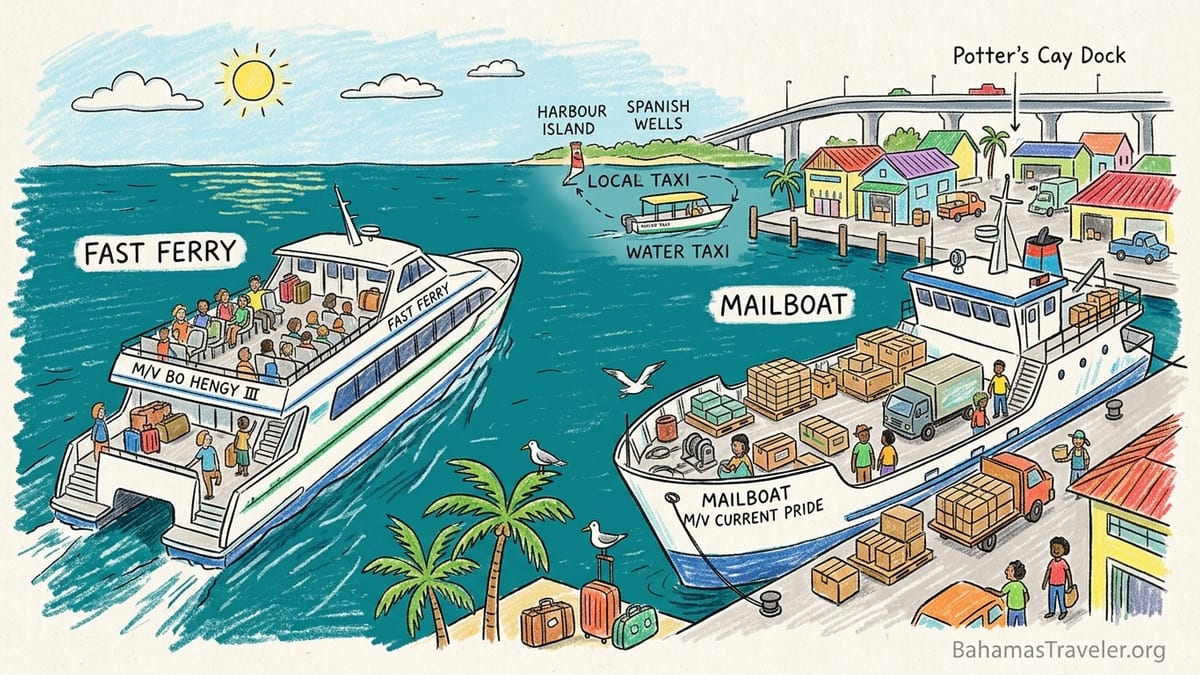
Choosing the Right Kind of Boat: Fast Ferry, Mailboat, or Local Cay Ferry
The first planning mistake I made was using the word “ferry” as if it were one product. In the Bahamas, it’s three categories that behave differently. Scheduled passenger service is the most traveler-friendly: a published timetable, defined check-in, and a boat built for seats. Bahamas Ferries is the name most visitors will encounter when they’re trying to go from Nassau to North Eleuthera destinations like Spanish Wells and Harbour Island on the passenger side, using a vessel such as the M/V Bo Hengy III, a 130-passenger craft listed in the operator’s fleet information.
Mailboats are a different world. They are inter-island workhorses carrying mail, pallets, building supplies, groceries, and a small number of passengers. They can be remarkably affordable, but the schedule can shift for weather, freight priorities, and mechanical reality. Several current travel guides still describe the practical system the same way: departures from Potter’s Cay, with information handled through the dockmaster and confirmed the day of travel, often by phone, with cash payment at the dock. If you’re looking for the most “local” travel process, this is it, but you have to build slack into every connection.
Then there are local cay ferries and water taxis: short hops that aren’t trying to replace flights or cross long open-water stretches. Around North Eleuthera, for example, travelers commonly combine ground transport and a short water taxi to reach Harbour Island or Spanish Wells once they’re already on the right side of Eleuthera. These smaller services are essential, but they’re not the same thing as a Nassau to Family Island crossing.
Departure Day at Potter’s Cay Dock: Where the Real Travel Starts
No matter which boat you choose, Nassau’s Potter’s Cay is a name you’ll hear early and often. It sits under the bridges that connect Nassau to Paradise Island, and it feels like a place where logistics happen before leisure. It’s not an airport terminal, and that’s part of the point. You’re in a working dock environment: trucks moving, people arriving with coolers, freight handlers calling out names, and travelers scanning for the right office or the right line.
On my first passenger-ferry morning, I arrived expecting a clean “ferry terminal” experience and lost time simply orienting myself. That cost me stress I didn’t need. For mailboats, the vibe is even more utilitarian, and a key detail many first-timers miss is that information can be posted locally and can change. Several current sources describe the mailboat schedule as something you confirm with the dockmaster the morning of departure and, crucially, as something that can be updated on-site rather than reliably “online.”
What I’d do differently is treat Potter’s Cay like a small port, not a tourist facility. I would arrive early enough to find the correct office, locate the boarding point, and ask simple questions in person: which boat is loading, what time it’s actually expected to move, and where passengers should stage their bags. That extra buffer matters more here than it does at a typical tourist pier.
Tickets, Check-In, and the One-Hour Rule That Can Make or Break Your Trip
For scheduled passenger service, the most important operational detail I’ve seen repeated across Bahamas Ferries materials is the check-in expectation: boarding time is one hour prior to departure, and check-in can close shortly before sailing. That is not a suggestion. It changes how you plan your morning, especially if you’re coming from a resort on Cable Beach or Paradise Island and you assume “Nassau is small, I’ll just taxi over.” On an 8:00 a.m. departure, “one hour before” effectively means you are commuting while it’s still early and the dock is already active.
My mistake was assuming I could purchase a ticket and board in one smooth motion the way I might at a commuter ferry in a major city. What actually happens feels closer to a small regional flight: you want time for the ticket process, any bag handling rules, and the human reality of a line forming all at once. Bahamas Ferries also publishes alerts and notices and explicitly reminds passengers that special events can override standard schedules and that sailings are weather permitting. I learned to check for notices the day before and again the morning of travel, because a “no changes” page today can become a “schedule update” tomorrow.
For mailboats, the process is often the opposite: less formal in appearance, but more demanding in planning discipline. You might pay cash at the dock, confirm by phone the same day, and accept that the vessel’s freight and the sea will dictate timing. The mailboat can be the cheapest way to move around the archipelago, but it punishes tight connections and rewards travelers who build in time, snacks, and patience.
Luggage, Seating, and Life On Board: What the Ride Really Feels Like
A scheduled passenger ferry like the M/V Bo Hengy III is designed around seats and a predictable ride time. On the Nassau to Spanish Wells route, third-party booking platforms commonly list a crossing time around two hours, give or take. The interior is typically air-conditioned, and there’s usually a mix of indoor seating and an outdoor area where you can step out, feel the wind, and watch the wake. That outdoor space is where you’ll immediately understand the tradeoff: it’s the best view, and also where you’ll feel the sea state the most.
Sea conditions in the Bahamas can change fast, and there’s a reason operators emphasize weather. Even on a “fine” day, the Atlantic side near Eleuthera is not the same as cruising in a protected harbor. If you get motion-sensitive, the worst mistake is to tough it out without a plan. I’ve been on crossings where people who felt fine on land started to fade once the boat began to slap over chop. What I’d do differently is treat seasickness prevention as a packing item, not an afterthought: bring what you know works for you, and use it before you feel sick.
Mailboats are a different sensory experience. They can be slower, louder, and more freight-forward. Seating may be basic, and the “travel soundtrack” includes loading equipment, crew instructions, and the thrum of an engine that’s working all night. That’s not a complaint; it’s a description of what you’re choosing. The upside is that you’re watching the Bahamas move supplies and people the way it has for decades, and you arrive feeling like you traveled, not like you were transported.
Food, Delays, and the Part Nobody Plans For: When the Sea Says No
One of the most common traveler errors in the Bahamas is planning ferry travel like rail travel. Boats are not trains. Operators can and do reschedule when conditions are unsafe. Bahamas Ferries’ own alerts language makes the point plainly: schedules are weather permitting, and in inclement weather passengers may be moved to the next available sailing. The practical consequence is that your itinerary needs “failure tolerance.” If your hotel check-out, your dinner reservation, and your flight all depend on a single weather-sensitive sailing, your plan is fragile.
I made that mistake once by stacking a flight too close after a crossing, assuming the boat would run exactly as timed because it’s “scheduled.” When the sea got sporty and the day’s rhythm shifted, I felt that sinking realization: I had planned for a perfect world. What saved me was that I had built just enough cushion to adapt, but not enough to be calm. Now I treat ferry days like weather days. I don’t schedule anything non-refundable immediately after arrival unless I have a fallback.
Food is part of that fallback. On a fast passenger run, you might have limited onboard options, and even if something is available, you should not treat it like a guaranteed meal. On a mailboat, the timeline can stretch into the range where you absolutely need your own snacks and water. What I’d do differently, every time, is carry a simple “dock-to-dock kit”: water, something salty, something bland, and something with sugar. It’s not glamorous, but it turns an uncertain delay into a manageable one.
Arrivals That Don’t Feel Like Airports: Spanish Wells, Harbour Island, and Beyond
Arriving by boat into the Family Islands is one of the best parts of traveling this way, because it’s immediate. You step off and you’re in it: golf carts buzzing in Spanish Wells, taxi drivers coordinating runs, locals greeting relatives, freight being staged nearby. It doesn’t feel like an arrivals hall. It feels like a place where the boat is part of daily life, not a special event. If you’re heading for Harbour Island, your next step may involve coordinating the short hop that gets you to “Briland,” and that handoff is where first-timers can lose time if they assume it’s all synchronized.
My biggest arrival-day lesson was that the journey does not end when the ferry docks. It ends when you reach your lodging. That sounds obvious, but it changes planning: if you arrive late due to weather, you may be organizing taxis and water taxis close to dusk, or negotiating last rides with tired staff. What I do now is pre-plan the “last mile” the same way I’d plan a transfer at an airport: know your options, know what you’ll do if you miss the last easy connection, and keep cash available for small-operator transport.
If you’re arriving by mailboat, arrival can be even more “port-forward.” Freight comes first, and passengers are often part of a broader unloading choreography. The upside is you’ll see a slice of real island logistics. The downside is that it can be slow. If you have the temperament for it, it’s a memorable way to arrive. If you don’t, it can feel like the boat is taking your time personally. That’s why, for many travelers, the smarter move is fast ferry for time-sensitive trips and mailboat for journeys where the travel itself is the point.
The Takeaway
If you want to travel by ferry in the Bahamas and actually enjoy it, the winning strategy is to match the boat type to your risk tolerance and your schedule. Bahamas Ferries’ passenger service is the closest thing to a conventional, bookable inter-island transfer, but it still expects airline-like discipline: arrive early, respect the one-hour check-in guidance, and treat the timetable as weather-dependent. Mailboats can be cheaper and more immersive, but they require a different mindset: confirm locally, carry your own basics, and never build a same-day connection that can’t survive a delay.
What I would do differently, in one sentence, is this: I would stop planning Bahamas boat travel like a promise and start planning it like a relationship with the sea. Leave margin, confirm before you go, and make the process part of the trip rather than an obstacle between you and the beach.
FAQ
Q1. What is the difference between Bahamas Ferries passenger service and a mailboat?
Bahamas Ferries passenger runs are scheduled and seat-focused, while mailboats are cargo-first vessels that take a limited number of passengers and can run on shifting dockside schedules.
Q2. Where do Nassau ferries and mailboats typically depart from?
Many inter-island boat services operate out of Potter’s Cay Dock in Nassau, under the bridges by Paradise Island, though you should confirm the exact departure point for your sailing.
Q3. Do I really need to arrive one hour before a Bahamas Ferries departure?
Yes. Bahamas Ferries materials emphasize boarding about one hour before departure, and late arrival can risk missing check-in and sailing.
Q4. Are Bahamas Ferries sailings guaranteed every day?
No. Passenger service to places like Spanish Wells and Harbour Island can operate on selected days, and all sailings can be adjusted based on operational needs and weather.
Q5. What does “weather permitting” actually mean for travelers?
It means the operator may delay, cancel, or reschedule a sailing if sea conditions are unsafe, and you should avoid tight connections to flights or major commitments.
Q6. How long is the Nassau to Spanish Wells ferry ride?
Travel times are commonly listed around two hours on fast passenger service, but actual duration can vary with routing and sea conditions.
Q7. Can I buy tickets at the dock on the day of travel?
Sometimes, but it’s risky. For scheduled passenger service, buying ahead is safer, and for mailboats you may pay at the dock but should confirm same-day details locally.
Q8. What should I pack specifically for a Bahamas ferry or mailboat day?
Bring water, snacks, motion-sickness prevention if you need it, a light layer for strong air-conditioning, and enough cash for last-mile taxis or water taxis.
Q9. What’s the biggest mistake first-time ferry travelers make in the Bahamas?
Assuming the service runs daily and on-the-minute, then scheduling a flight or check-in too close to a weather-dependent sailing.
Q10. What is the safest way to verify schedules right before publication or travel?
Check the operator’s current booking system and alerts, and if you’re using a mailboat, confirm with the dockmaster the morning of departure and be prepared for changes.