


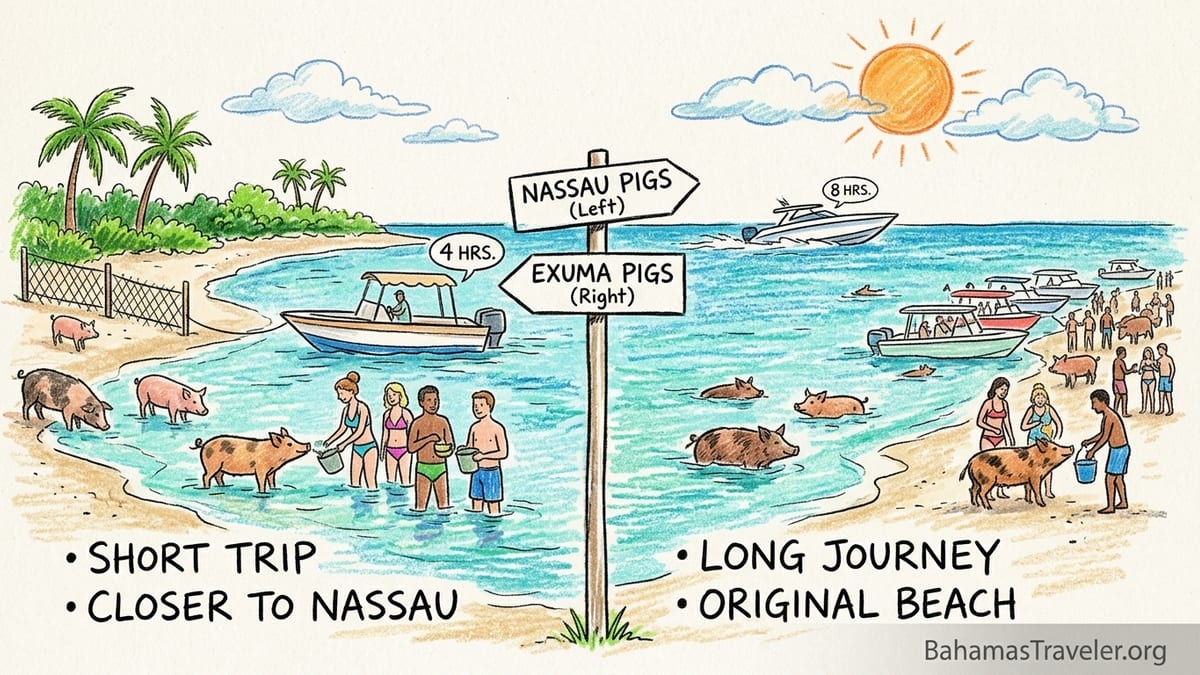
On my first trip to Nassau, I thought booking a “swimming pigs” tour would be straightforward. Instead, I fell into one of the Bahamas’ most confusing modern travel traps: glossy photos and vague tour names that blur the line between a quick half-day pig stop near Nassau and the long, expensive journey to the original Pig Beach on Big Major Cay in the Exumas. After doing both styles of excursion myself on separate visits, I would book them very differently next time.
How the Booking Search Creates Confusion
Open any major booking platform and type “swimming pigs Nassau” and you will instantly see the problem. Page after page of tours use nearly identical photographs of pink snouts bobbing in turquoise water, with titles that promise “Pig Beach,” “Exuma-style pigs,” or “original swimming pigs” while quietly departing from marinas just minutes from downtown Nassau or Paradise Island. The average visitor sees the water, the pigs and the word “Exuma” in the description and understandably assumes every tour is heading to the same iconic place.
The reality is very different. The original Pig Beach is on Big Major Cay in the Exuma chain, roughly 55 to 90 miles from Nassau depending on the route. It is reached on full-day powerboat or flight-and-boat combinations, and official Bahamas tourism information is clear that this is the recognized home of the famous Exuma pigs.
Meanwhile, a newer generation of tours markets “swimming pigs” on cays close to Nassau, including Rose Island, Athol Island and small private islets developed specifically for pig encounters. Operators openly describe these as “our pigs” or “resident pigs,” and some tours even name their near-Nassau sandbars “Pig Beach” in the description. For a first-time visitor skimming listings the distinction between an Exuma day trip and a Nassau-area cruise is anything but obvious.
When I booked, I saw thumbnail photos of the classic Big Major Cay scene and assumed everything on the page referred to the same place. Only when I checked the small print and distance details later did I realize that the tours I had shortlisted fell into two entirely different categories, with completely different time commitments, costs and overall experiences.
The Half-Day Nassau Pig Experience: Rose Island and Nearby Cays
My first outing was a classic Nassau pig excursion that combined snorkeling, beach time and a short pig interaction near Rose Island. I booked through a well-reviewed local operator who runs a four-hour, three-island tour by small powerboat. Prices for similar trips in 2026 generally sit around 130 to 150 US dollars per adult, often including soft drinks and a simple lunch, with some operators charging less for a shorter “express” three-hour version that focuses almost entirely on the pigs.
We met at a marina a short taxi ride from downtown Nassau and Paradise Island. My boat was a mid-sized open powerboat with twin outboards and bench seating, carrying around 16 passengers plus crew. After a safety briefing, we left the harbor and reached our first snorkeling stop at a nearby reef in about 20 to 25 minutes. The water was calm and clear, typical of the protected waters around New Providence on a good day, and sea turtles at nearby Green Cay were another advertised highlight on this circuit.
The pig interaction on my tour took place on a small beach area on or near Rose Island, where a fenced section of sand and scrub had been adapted to house a managed herd of pigs and piglets. The animals are clearly used to tourists; they trot toward arriving boats and toward the handler who brings buckets of feed. Guests line up along the shoreline in ankle- to waist-deep water as the pigs wade in, and the crew guides people through feeding and photos.
Door to door, my four-hour Nassau pig trip broke down roughly into 60 to 80 minutes of boating, 30 to 40 minutes of snorkeling, about 45 minutes of pig interaction and casual photos, and just under an hour of general beach time and lunch on Rose Island itself. My total cost for two adults, including a modest gratuity and taxi transfers, came to just under 350 US dollars. For that price point and timeframe, it felt very much like a fun island-hopping sampler with pigs as one photogenic stop rather than a once-in-a-lifetime wildlife pilgrimage.
The Long Journey to the Original Pig Beach in the Exumas
On a later trip, determined to see the “real” Pig Beach, I booked a full-day Exuma excursion from Nassau that specifically named Big Major Cay in the description and listed Staniel Cay among its stops. Official guides to the swimming pigs in Exuma emphasize that Big Major Cay is uninhabited and only accessible by boat, with most Nassau-based operators offering fast powerboat runs or fly-and-boat combinations.
Prices in 2026 reflect the distance and fuel involved. Day trips by boat from Nassau that reach Big Major Cay generally start in the high 300s per person and climb above 400 dollars for some operators. Packages that include a short flight from Nassau to a smaller Exuma hub and then a boat transfer to Pig Beach frequently start around 700 US dollars per adult, sometimes including hotel pickups, lunch and multiple cay visits.
My boat-based excursion checked in at the high 300s per person before taxes and fees. From Nassau’s marina we boarded a large, powerful speedboat with around 30 passengers. After distributing life jackets, the crew warned us about the possibility of rough seas over the open Exuma Sound. The first leg to the northern Exuma Cays took roughly 75 to 90 minutes in variable chop. On the outbound leg the ride felt like a bumpy thrill; on the return it was frankly tiring, and a few guests looked decidedly green.
The route included several classic Exuma stops: a sandbar for photos, a swimming stop with nurse sharks at a cay used by several operators, a brief visit to an iguana-inhabited island and finally, Big Major Cay itself. By the time we arrived at Pig Beach, we had already been out for several hours. Our actual time on Big Major Cay, counted from dropping anchor to re-boarding the boat, was just under 40 minutes. Crew were upfront about this: the pigs are one stop in a tightly timed day that must get back to Nassau before dark and before seas typically worsen in the afternoon.
How Much Time You Really Spend With the Pigs
Comparing the two tours side by side, the most striking difference is how little of either day is actually spent with pigs. On my half-day Nassau excursion, the pig component lasted around 45 minutes in a four-hour block. On my Exuma excursion, it was closer to 35 to 40 minutes on the actual Pig Beach within an eight-hour day that included long runs over open water and several non-pig stops, from iguana feeding to shark encounters.
If you measure purely in minutes near pigs, the Nassau-area experience can actually deliver a similar or even slightly longer interaction for a lower price and less logistical effort. The Exuma trip, by contrast, is primarily about the journey through the Exuma Cays, the drama of the open-sea crossing and the cachet of reaching the original herd rather than simply maximizing time beside the animals.
Transport and waiting account for far more of your day than most brochures imply. On my Exuma outing, I counted roughly three and a half to four hours of high-speed cruising, plus time idling as other boats loaded and unloaded at the shark and iguana stops. On the Nassau trip, transit time was shorter, but we still spent a good portion of the morning cruising between cays, queuing for snorkeling and pig-feeding, and listening to briefings.
For travelers imagining an entire dreamy day spent lazing on a beach with pigs, both styles of tour may be surprising. The animals are the focal point only for a carefully managed window, designed to control crowding, avoid overfeeding and fit into a broader island-hopping timetable.
Animal Welfare, Safety and Why Instructions Matter
Regardless of where you meet them, swimming-pig excursions are not petting zoos. Pigs are large, food-motivated animals, and local authorities and operators have had to address issues ranging from overfeeding and dehydration to aggressive behavior. Official guidance from Exuma-focused organizations notes that the pigs of Big Major Cay are feral domesticated animals, and various sources have documented concerns about tourists feeding them inappropriate food and alcohol in the past.
On both my Nassau and Exuma trips, guides repeatedly stressed a few rules: do not hold food above your head where pigs have to jump, keep snacks in the bucket rather than your pockets, avoid touching their faces while they eat and move slowly to one side if a pig approaches more assertively. On Pig Beach, handlers used wooden sticks not to hit the animals but to redirect them and keep them from crowding timid guests.
Several recent traveler accounts from around the Bahamas describe bites and minor injuries when visitors ignore instructions or try to treat the pigs like puppies. Part of the problem is the social-media image of people cuddling piglets in knee-deep water. In reality, most adult pigs are large, heavy and can jostle hard when food is involved. On my Exuma visit, one enthusiastic boar nudged guests sharply in the thigh whenever he sensed snacks behind them, and the handler quickly stepped in to redirect him.
From a welfare perspective, I felt more comfortable at the Nassau-area site where a smaller herd rotated into the interaction area and had shaded pens and freshwater troughs visible behind the beach. On Big Major Cay, the setting is wilder and more photogenic, but it is also clear that crowding can build when multiple boats arrive. In both cases, following the crew’s safety briefing and resisting the urge to sneak in “extra” treats is important for your own safety and for the pigs’ long-term health.
Crowds, Guides and the Social Media Factor
Both of my tours were clearly designed around photo opportunities, but in different ways. On the Nassau pig stop, the experience felt like a compact, well-oiled production line. The group was divided so that only part of the boat was in the shallows with the pigs at any one time while others waited on the sand. Guides moved down the line, positioning guests, handing over pig feed and offering to take photos on our phones. Professional photographer upsells were minimal, and most people left with a handful of usable images without feeling rushed.
At Big Major Cay, the scene was more chaotic but also more dramatic. Several boats anchored in a rough semicircle, and clusters of guests waded ashore while pigs milled around the waterline. Guides from each boat tried to create pockets of space for their own group, but pigs ignore imaginary boundaries and gravitate to wherever the food is. The backdrop is undeniably beautiful, and there is a sense that you are on a real, open beach rather than a managed pen, yet it was also obvious that the entire operation exists to feed the constant stream of smartphone cameras and influencer poses.
Guide quality varied between operators rather than between Nassau and Exuma per se. On both tours I encountered crew members who were patient, safety-conscious and genuinely proud of sharing their islands, alongside others whose main role was to keep the group on schedule. If having a more narrative, interpretive guide is important to you, it is worth reading recent detailed reviews of specific operators before you book instead of choosing solely on price.
From a crowding perspective, my Nassau experience felt more controlled simply because fewer boats can fit at the small pig beach at one time. The Exuma stop had more boats, more people and more unpredictable movement, which will either feel thrillingly lively or uncomfortably busy depending on your expectations and comfort with animals weaving between groups.
Weather, Rough Seas and Why Exuma Rarely Works for Tight Cruise Days
The sea conditions between Nassau and the closer cays like Rose Island are usually manageable on standard sightseeing boats. You are largely in the lee of New Providence and nearby islands, and although wind can kick up whitecaps, the crossing to the pig beaches on my Nassau trip took under half an hour in each direction. For families with younger children, nervous swimmers or anyone prone to motion sickness, this shorter, more sheltered ride is a major advantage.
The crossing to the Exumas is a different story. Even on a relatively calm forecast, our speedboat pounded through rolling swells for long stretches. Crew passed out seasickness tablets to those who wanted them and warned guests to secure hats and sunglasses. On the way back, as the afternoon breeze strengthened, we slowed for comfort, stretching the return leg toward two hours. Several passengers who had seemed cheerful on the way out stayed seated and quiet on the way home.
This is where cruise passengers in particular need to pay attention. While some cruise lines sell ship-organized “Exuma by air” or “swim with pigs by fast boat” tours that build in a safety margin for ship departure times, independent Exuma day trips from Nassau leave less room for delays caused by weather or mechanical issues. Many experienced travelers and locals caution that a full Exuma pig tour is not ideal for a limited port call, especially if your ship is in Nassau for only eight or nine hours.
By contrast, half-day pig excursions near Nassau slot neatly into a typical cruise schedule. You can disembark in the morning, join a four-hour pig and snorkeling tour, and still have time in the afternoon to explore the Straw Market or relax at a resort day pass. If your primary constraint is time rather than budget, the Nassau-area pigs are simply more practical.
What It Really Costs for Couples and Families
Putting real numbers side by side is where the difference between the two experiences becomes brutally clear. As of late 2026, many reputable half-day Nassau pig-and-snorkel tours price around 125 to 150 US dollars per adult. Children often receive reduced rates. For a couple, a realistic total including taxes, basic drinks, a simple lunch and a modest gratuity lands in the 280 to 350 dollar range. A family of four might expect to pay in the region of 500 to 650 dollars, depending on ages, extras and private versus shared boat choices.
Now look at Big Major Cay. Boat-based day trips from Nassau that explicitly include the original Pig Beach commonly start in the high 300s per adult before fees, with some edging over 400 dollars. A couple might easily spend 800 to 900 dollars in total once taxes, hotel transfers, lunch and gratuities are added. Air-based excursions that fly from Nassau down to an Exuma airport and then continue by boat to Pig Beach climb still higher. Published prices around 700 to 750 dollars per adult are not unusual, which pushes a couple toward 1,500 dollars and a family of four to 2,800 dollars or more.
When you divide those totals by the number of minutes actually spent beside the pigs, the cost per minute of pig time on an Exuma day from Nassau is startling. Of course, that calculation is slightly unfair, because you are also buying dramatic cays, sandbars, shark encounters and the satisfaction of reaching a remote corner of the archipelago. Still, from a strictly budget-conscious perspective, the Nassau pigs deliver a far lower cost for a not vastly shorter pig interaction window.
For travelers with deep pockets and a strong desire to tick off the original Pig Beach specifically, the numbers may still feel acceptable. For many families looking at the bottom line, however, the Exuma option is a significant financial leap for an experience that, in practice, may not feel proportionally more “special” once you are actually ankle deep in the water sharing space with dozens of other visitors and a cluster of pigs.
What Disappointed Me, What Surprised Me and What I Would Book Next Time
Both excursions left me with mixed feelings. At the Nassau-area pig beach, I had expected something more improvised and rustic. Instead I found a polished shore excursion environment clearly optimized for efficient selfies. The pigs were healthy-looking and the staff attentive, but the scene felt more like a staged attraction built around animals than a natural discovery. The upside was that it delivered exactly what most guests on the boat seemed to want: quick snorkel, sun, toes in clear water, pig photos, and back to the resort by mid afternoon.
The Exuma journey gave me the vistas I had been craving. Skimming past electric-blue shallows, spotting isolated cays and pulling up to the now-famous curve of Big Major Cay was undeniably impressive. Yet I was surprised by how compressed the Pig Beach portion felt after such a long, occasionally punishing ride. With multiple boats arriving, we shared the beach with scores of people, and the pigs’ enthusiasm for the tenth or twentieth bucket of the day was understandably muted.
If I could plan again with the benefit of hindsight, I would treat these as entirely different products. For a short Nassau stay or a cruise stop, I would book a half-day pig excursion that includes Rose Island or similar, being very clear with myself that I am choosing a convenient, photogenic tourist activity rather than making a pilgrimage to the pigs’ original home. For the Exumas, I would only visit Big Major Cay as part of a longer stay in the region, perhaps basing myself on Staniel Cay or Great Exuma and taking a shorter local boat trip, rather than pushing a full Nassau-based day into an already tight itinerary.
In terms of value, the Nassau pig excursions clearly win for most travelers. You spend less, sacrifice less time and still come home with the same core takeaway that animates social media posts worldwide: “I swam with pigs in the Bahamas.” The original Pig Beach, in my view, makes the most sense for dedicated photographers, repeat Bahamas visitors and true Exuma enthusiasts for whom the crossing, the cays and the cachet justify both the cost and the physical investment of a full day on the water.
FAQ
Q1. Are the swimming pigs near Nassau the same as the original Exuma pigs?
The pigs you meet on half-day Nassau tours are usually managed herds on cays like Rose Island or Athol Island, not the original feral pigs of Big Major Cay in the Exumas.
Q2. How long do you actually spend with the pigs on each type of tour?
On typical Nassau-area trips you may spend around 40 to 50 minutes with the pigs. On a full-day Exuma tour from Nassau expect roughly 30 to 40 minutes on Big Major Cay itself.
Q3. Is the Exuma Pig Beach day trip worth the higher cost?
It can be, if you care about seeing the original Pig Beach and the Exuma Cays and are comfortable with a long, sometimes bumpy day and a higher budget. For simple pig photos, Nassau trips are better value.
Q4. Which option is better for cruise passengers with limited time in Nassau?
For most cruise visitors, a half-day Nassau pig excursion fits better within port hours and carries less risk of delays than a long Exuma crossing.
Q5. Are swimming pig tours safe for children?
Many families take children, but pigs are large animals. Choose operators with clear safety briefings, stay close to younger kids and follow all instructions from local handlers.
Q6. What should I wear and bring on a swimming pigs excursion?
Wear a secure swimsuit, reef-safe sunscreen and water shoes or sturdy sandals. Bring a towel, a dry bag for valuables and any seasickness remedies you might need.
Q7. Can I feed the pigs whatever I like?
No. Only feed what the guides provide. Bringing your own snacks or drinks for the pigs can harm their health and may encourage aggressive behavior.
Q8. How rough are the seas on the Exuma trip from Nassau?
The open-water crossing can be choppy, especially in the afternoon. Expect a fast, bumpy ride and consider medication if you are prone to motion sickness.
Q9. Do I need to book swimming pig tours in advance?
For peak travel periods it is wise to reserve ahead, especially for Exuma Pig Beach trips, which have limited seats and strict departure times.
Q10. If I only have one day, which swimming pigs experience should I choose?
With just one day based in Nassau, a Nassau-area half-day pig and beach tour is the more practical choice. Save the original Exuma Pig Beach for a longer Bahamas itinerary.