


On Crooked Island in the far southeast of The Bahamas, Bird Rock Lighthouse looks close enough to touch from shore. The white tower rises from a low cay off Pittstown Point, just beyond the reef line, a vertical accent on an otherwise unbroken horizon of turquoise water. Yet getting there is neither quick nor straightforward. Bird Rock may be visible from beach chairs and lodge verandas, but it remains one of the country’s more remote historic lights, reachable only by boat and still shaped by the winds and currents of the Crooked Island Passage it was built to tame.
Planning a Boat Charter to Bird Rock Cay
Before arriving on Crooked Island, I knew I wanted to get out to Bird Rock Lighthouse rather than just admire it from Pittstown Point. The Bahamas tourism authority and local guides all stress that the cay is accessible only by boat, with no scheduled tours. On an island where visitor numbers are low and infrastructure modest, that means arranging a private charter or piggybacking on a fishing or sightseeing trip. I contacted Crooked Island Lodge & Marina at Pittstown Point several weeks ahead of travel and asked specifically about reaching Bird Rock. The lodge confirmed that skiffs and larger center-console boats can sometimes be arranged through their in-house guides or independent operators, but only when sea conditions on the northwest tip are safe enough to make the run.
By the time I checked in at Pittstown Point, the manager had already spoken with one of their regular captains who runs bonefishing and reef trips from the lodge dock. We sat down one evening after dinner with a chart of the local cays spread across the bar counter. Bird Rock Cay sits just off the northwestern point of Crooked Island, guarding the northern entrance to the Crooked Island Passage. The captain ran a finger across the charted reef line and explained that he preferred to do birding and lighthouse runs on mornings with steady easterly trade winds and relatively calm seas on the Atlantic side. If a cold front swings through or the ocean swells climb, he simply refuses the trip.
There is no public rate card for lighthouse charters, so we discussed a custom price for what would essentially be a half-day hire. For a 22-foot center-console with twin outboards, the captain quoted 550 US dollars total for the charter, covering up to four passengers, fuel, and his time. This was in line with what other travelers had reported paying for private bonefishing days in the Crooked Island and Acklins atoll region, where specialized guiding is the norm rather than mass-market excursions. Because I was traveling with two other guests from the lodge who were keen on photography, we split the cost three ways, making it more manageable on a per-person basis.
Even with the boat lined up, the captain refused to confirm a firm departure until he had checked the marine forecast and walked down to the point to look at the sea that same morning. Remote corners of The Bahamas do not have the safety net of harbors, fuel docks and rescue services found around Nassau or Grand Bahama. On Crooked Island the weather is the schedule, and any responsible operator treats Bird Rock as a privilege rather than an entitlement.
Departure from Pittstown Point and On-Water Conditions
We finally received the captain’s nod just after breakfast on a late-winter morning, with winds blowing about 10 to 12 knots from the east and a low, manageable swell on the Atlantic side. Our departure point was the small marina and dock below Crooked Island Lodge at Pittstown Point, a sheltered anchorage on the island’s northwestern tip that also serves private yachts and a handful of visiting sportfishing boats. From the lodge to the dock is a walk of only a few minutes, but the transition from land to sea feels immediate. The sound of the wind in the casuarina trees gives way to the slap of water on hulls and the clink of rigging against aluminum.
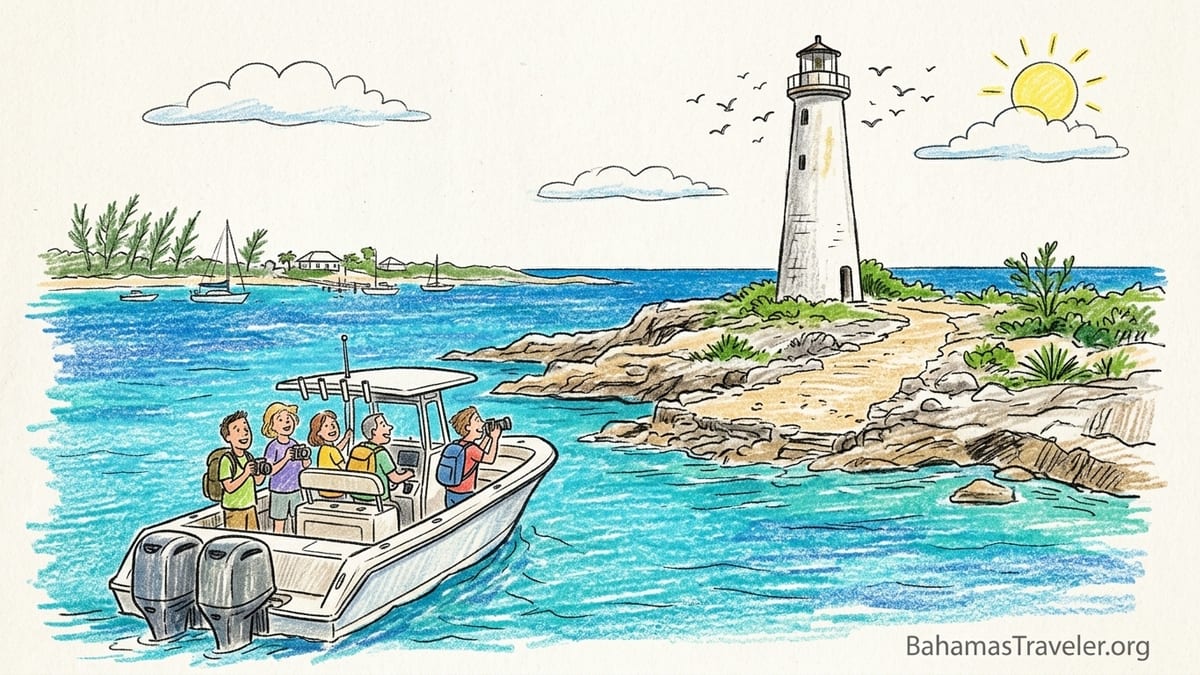
The vessel for our trip was a well-kept 22-foot fiberglass center-console, rigged with twin outboards to provide redundancy in a region where there are no tow services on call. Before we stepped aboard, the captain gave a short safety briefing. Life jackets were stowed under the leaning post and forward seating, with enough Type I flotation vests for six although there would be only three passengers. A small ditch bag held basic first aid supplies, a signaling mirror and whistle. On the electronics side, the helm carried a fixed VHF radio, and the captain wore a handheld backup clipped to his belt, alongside a waterproof cell phone sealed in a clear pouch. These measures felt proportionate to the distance we were about to cover rather than performative.
From Pittstown Point to Bird Rock Cay is not a long voyage in nautical terms, but conditions can change quickly around the entrance to the Crooked Island Passage. We idled out past a line of moored skiffs and turned northwest toward the gap between the main island and the cay, a route that threads through patches of sand and coral head. The run from dock to lighthouse took about 25 minutes at a moderate cruising speed, slowed occasionally where the captain throttled back to read the color changes over the reef. The seas that morning were what locals call a light chop, with wave heights around three feet once we were exposed to the open Atlantic, enough to send spray arching over the bow and drench the railings, but not enough to make the ride uncomfortable.
Communication with the captain was informal but constant. As we bounced over the low swell, he pointed out the line where shallower turquoise water darkened into deeper blue and explained how these gradients hide coral ledges that can be treacherous in poor visibility. He described other days when wind against current stacks up the chop at the mouth of the passage, turning a casual morning outing into a punishing slog. His message was clear: visitors who try to self-organize trips in smaller boats without local knowledge underestimate both the reefs and the remoteness.
First Sight of Bird Rock Lighthouse from the Sea
Bird Rock Lighthouse remains the undeniable focal point of this stretch of coastline. According to The Bahamas’ official tourism information, the structure stands about 112 feet above sea level on a low-lying cay just off Pittstown Point, separated from the mainland by a narrow waterway and marking the northern entrance to the Crooked Island Passage. From the lodge veranda, it appears as a slender white pencil on the horizon. From a boat at water level, the tower grows steadily with each passing minute, rising directly from a girdle of breakers and jagged rock.
As we approached from the southeast, the cay gradually resolved into detail. The tower is cylindrical and white, slightly weathered rather than freshly painted. At its base, shattered rock shelves and fossilized coral are bleached by sun and salt. The surrounding water breaks in concentric lines around the cay, revealing submerged ridges and patches of reef that have tested mariners for centuries. There is an unmistakable sense of isolation. No jetties, no handrails, no tourist infrastructure. Just one aging lighthouse at the edge of deep water.
The captain eased back the throttles as we reached the calmer lee side of the cay, where the swell smoothed out and the wind fell away. The air filled with the sound of water sucking back from the rocks and the occasional clatter of loose stones rolled by waves. At closer range, the lighthouse’s exterior showed its years more clearly. Rust stains bled from window casings and balcony fittings, and hairline cracks mapped the plastered surface in faint spiderwebs. The gallery deck circling the top appeared intact, but several sections of railing showed signs of corrosion. Offshore birds wheeled around the tower and settled on the rock ledges below.
Photography from the boat quickly became an exercise in timing. Each set of swells rocked the vessel just enough to tilt the horizon, and spray occasionally forced me to shield my camera. Yet this perspective is also part of the experience of Bird Rock. From the deck, the tower rises vertically from the sea in a way that no shore view can quite convey. The frame filled with light, water, and the stark geometry of 19th-century engineering planted in the middle of a reef.
Landing on the Cay and Current Access Limitations
Whether visitors can actually land on Bird Rock Cay varies with sea state and the skipper’s judgment. The Bahamas tourism authority notes that the lighthouse has no permanent keeper today and that very few people visit, aside from occasional boaters. Foghorn Publishing’s lighthouse database describes Bird Rock Lighthouse as deactivated and abandoned in recent decades, although the structure still stands. These facts translate into a cautious stance from local captains, who treat the island as an unsupervised historic site with no official facilities or staff.
On the morning of my visit, conditions were borderline for landing. The lee side of the cay was comparatively calm, but surge still ran strongly up the rock shelves, and the tidal range meant our time window would be narrow. The captain brought us in close and idled while we watched several sets of waves. In the end, he judged that putting guests ashore would require them to scramble over wet, uneven rock with packs and camera gear while timing their steps between surges. Because there are no fixed mooring points or ladders, he would also have needed to hold the boat off the rocks under power. After some discussion, we all agreed that remaining in the boat was the wiser choice.
Other travelers who have visited on flatter summer days have reported landing briefly on the cay, but always under similarly informal conditions. There is no dock, and there are no official pathways or barriers. In some seasons the rocks at the base of the tower are streaked with guano and slick with algae, another hazard for anyone attempting to walk closer. The interior of the lighthouse is also not maintained as a museum. Even when landing is possible, entry is at the discretion of local authorities and the individual guide, and no one should assume that climbing the tower is permitted or safe.
From our position offshore we could see what appeared to be a locked door at the base and shuttered openings on the lower floors, with no sign of recent painting or structural work. The tower’s survival in an active hurricane region speaks to the strength of its original construction, but it also emphasizes how alone the building is. The absence of any official landing infrastructure made it clear that this remains a working relic of the past rather than a packaged tourist site. For visitors, that means accepting that the best and safest view may be from the deck of a boat instead of the gallery of the lantern room.
The atmosphere in that moment combined elation and restraint. We were close enough to hear the sea hit the rock and to see individual bolts in the railing, yet separated from the structure by just enough white water to keep it at arm’s length. It felt fitting for a lighthouse whose purpose was to warn ships off danger rather than invite them in.
Bird Rock’s Role in the Crooked Island Passage
To appreciate Bird Rock Lighthouse, it helps to understand why the British colonial authorities were willing to fund a light on such an isolated cay in the 19th century. Historical accounts from Bahamian newspapers and maritime reports describe the Crooked Island Passage as a heavily trafficked corridor for ships moving between the Atlantic and the Straits of Florida. Vessels sailing between Europe or the eastern United States and ports in Cuba, Haiti, Colombia and beyond often threaded this gap between the shallow Bahama banks and deeper Caribbean waters. Before the lighthouse was built, captains relied on lead lines, dead reckoning and luck to avoid the reefs.
Archival research by Bahamian historians has highlighted specific cases of ships delayed or wrecked in the area. One article in a Nassau daily recounts how the schooner General Gazneau spent nearly a week becalmed in the Crooked Island Passage in 1869 due to light winds, while another vessel, the B.F. Waite, reportedly took ten days to fight through the same waters a few years later. Earlier still, in 1856, the French ship Elie ran onto Bird Rock itself and was totally lost. These incidents contributed to pressure on the British Board of Trade and the imperial Lighthouse authorities to improve navigational aids along The Bahamas’ southeastern approaches.
Verified records from The Bahamas tourism authority and international lighthouse registries agree that construction on Bird Rock Lighthouse began in 1866 and that the light was first exhibited in 1876. The tower was designed to mark the northern entrance to the Crooked Island Passage and to provide a prominent visual daylight mark in an area where low-lying land and reefs make distance hard to judge. The light’s elevation, 112 feet above sea level, gave mariners a valuable early warning of the rocks even before they could sound the depths accurately.
Local guides often enrich this factual history with stories told over generations. On our return run to Pittstown Point, the captain mentioned a frequently repeated tale that Christopher Columbus anchored off Crooked Island and may have seen the rocks where the lighthouse now stands, although this remains a matter of scholarly debate based on reconstructed routes rather than firm proof. He also shared oral histories of keepers and their families spending months at a time on Bird Rock with only infrequent supply ships, reinforcing the sense of isolation that still surrounds the cay. Where the official record confirms the dates, purpose and design of the light, these narratives fill in what daily life might have felt like on a station exposed to every front sweeping across the Atlantic.
What emerges from both the documented and anecdotal history is a consistent theme. Bird Rock Lighthouse was built at considerable expense on an uninhabited rock because the Crooked Island Passage mattered. It was a choke point on transatlantic routes and a place where commerce could be delayed for days by calms or destroyed in a single night by a navigation error. Today the volume of sailing ships has declined and navigation tools have advanced, but the reefs around Bird Rock are unchanged. Seeing the tower from close range underscored the continuity between that age of canvas and the present, when freighters still detour around these same hazards.
Dedicated Lighthouse Charter vs Broader Island Excursions
From a traveler’s perspective, the decision to book a dedicated charter to Bird Rock hinges on both interest and budget. The 550 dollars we paid for our half-day lighthouse trip from Pittstown Point represented a focused investment in one objective: seeing Bird Rock Lighthouse and its cay from as close as conditions allowed. By comparison, the same captain also offered full-day bonefishing charters across the flats of the Bight of Acklins for around 900 to 1,000 dollars for up to two anglers, and mixed reef-fishing and snorkeling trips that looped past nearby cays without necessarily circling Bird Rock itself.
On a pure sightseeing charter, the lighthouse can often be woven into a broader itinerary. Some guests at Crooked Island Lodge elect to spend a day exploring the outer reef, stopping to snorkel patch reefs teeming with small grouper and parrotfish, then cruising past Bird Rock for photographs on the way back. That kind of day on the water often runs seven to eight hours and spreads the cost of the boat across more varied experiences, appealing to mixed groups where not everyone is captivated by maritime history. In contrast, a lighthouse-focused charter may use the bulk of its time working around the cay, waiting for conditions to improve, and taking multiple photographic passes rather than dropping lines or masks over the side.
In terms of atmosphere, the difference is marked. Our dedicated Bird Rock outing felt almost meditative once we reached the cay, with cameras clicking, occasional radio chatter, and long stretches where the only sounds were waves and distant seabirds. A fishing charter carries its own rhythms, from the quiet concentration of stalking bonefish on ankle-deep flats to the shouts and motion that accompany a hooked barracuda or snapper. Travelers who crave narrative and activity may prefer to fold the lighthouse into a broader day, while those who enjoy slow observation will find a focused visit deeply satisfying.
The other contrast lies in how easy it is to organize. Fishing and general sightseeing excursions are a known quantity for lodges and local guides across Acklins and Crooked Island. They have standard gear, set day rates and well-practiced routines. Asking for a dedicated Bird Rock trip, on the other hand, requires more flexibility from both sides. Captains must weigh the additional fuel, the limited options for backup landing spots if seas build, and the narrower appeal of the destination. Travelers should expect to be patient, to accept that last-minute weather calls may cancel their plans, and to consider sharing the charter with other history-minded guests to amortize the cost.
Photography, Weather and What to Bring
From a photography standpoint, Bird Rock Lighthouse rewards those who can balance image quality with salt spray and motion. On the morning of my visit, we departed Pittstown Point around 9 a.m., which placed us near the cay while the sun was still climbing. Light came from the southeast, side-lighting the tower and etching the rough textures of the rock shelves into high relief. A circular polarizing filter helped cut glare on the water and deepen the blues and turquoises separating sand channels from reef heads. In calmer water, some captains may be able to position boats for late-afternoon shots with warmer tones, but they will always prioritize safety margins around the rocks over any photographic wish list.
Weather is not just a mood factor in this corner of The Bahamas; it is an absolute gatekeeper. Moderate trade winds and small swells, such as we encountered, produced enough motion to challenge longer lenses but still allowed the captain to maneuver comfortably. Under heavier seas, the cay would become encircled by chaotic white surf, making close approach and stable framing nearly impossible. During the Atlantic hurricane season, which runs from June through November, both sea state and weather systems can change rapidly. Guides on Crooked Island are accustomed to sitting out days when fronts push through and prefer not to promise Bird Rock excursions too far in advance.
Packing for the trip involves thinking like a small-boat passenger rather than a beachgoer. Even on a short charter, sun exposure is intense. I wore a long-sleeved UPF shirt, quick-drying pants, and a wide-brimmed hat with a chin strap, along with polarized sunglasses essential for reading the water. Each of us carried at least a liter of water in reusable bottles, stowed in a small cooler alongside simple snacks from the lodge kitchen. For camera gear, I brought a mid-range zoom lens and a telephoto, both kept in a dry bag between shooting bursts. A microfiber cloth proved invaluable for wiping salt spray from filters and viewfinders. Non-slip footwear was necessary for moving around the wet deck.
Those without a prior arrangement through a lodge will find logistics noticeably harder. Crooked Island has no chain resorts or mass-tourism operators. Independent visitors staying in guesthouses around Colonel Hill or other settlements may need to rely on word of mouth, contacting local fishing guides or small-boat owners who are comfortable running to Pittstown Point and beyond. Recent travel writing on the region notes that some private crewed catamarans and liveaboard yachts anchor off Pittstown Point and offer custom itineraries, but these options are far from guaranteed and require advance inquiry through specialist charter brokers. Travelers hoping to organize a one-off Bird Rock visit after arrival without any local network should be prepared for limited availability or no options at all.
The Takeaway
By the time we eased back into the sheltered water off Pittstown Point, the white line of surf around Bird Rock had already begun to blend into the horizon haze. The lighthouse shrank to a pencil once more, indistinguishable from the scattering of foam and swells that mark the entrance to the Crooked Island Passage. Over three and a half hours, including transit and time circling the cay, the charter unfolded at a pace entirely dictated by sea and wind rather than by an excursion timetable. In a travel world preoccupied with convenience, that felt like part of the reward.
For me, the expense of the dedicated 550 dollar charter was justified by the chance to encounter a remote piece of Bahamian maritime history on its own terms. I left with photographs, of course, but also with a more tangible sense of why 19th-century authorities were compelled to build a lighthouse on a low rock far from any town. Standing on the boat in the lee of the cay, listening to waves break across the reef, it was easy to imagine sailing ships groping through this same passage with only stars, lead lines and the sweep of Bird Rock’s lantern to guide them.
The trip also reframed Crooked Island itself. Seen from shore, this is an island of pale beaches, bonefish flats and quiet settlements, a place for anglers and solitude-seekers. Seen from the water off Bird Rock, it becomes the rim of a vast, shallow platform that once sat beneath the trade routes of an empire. The lighthouse acts as both a literal and figurative marker of that maritime past, linking local communities to global narratives of commerce, navigation and shipwreck.
Who, then, is likely to appreciate the excursion most? History enthusiasts, lighthouse aficionados, serious photographers and sailors with an interest in traditional navigation will find deep satisfaction in a focused visit, even if landing on the cay proves impossible. Travelers primarily seeking beaches, swimming and casual snorkeling may be better served by broader island excursions that include brief views of Bird Rock as part of a more varied day on the water. Either way, treating the lighthouse with respect, acknowledging its vulnerability to the elements, and accepting that access is never guaranteed are central to experiencing this remote sentinel in a way that honors both its past and its present silence.
FAQ
Q1. Where does a boat trip to Bird Rock Lighthouse usually depart from?
Most organized charters depart from the small marina at Pittstown Point on Crooked Island, often arranged through Crooked Island Lodge & Marina or local fishing guides based nearby.
Q2. How much does a private charter to Bird Rock Lighthouse cost?
On my visit, a half-day private charter on a 22-foot center-console boat cost 550 US dollars total for up to four passengers, a price comparable to specialized fishing trips in the area.
Q3. How long does it take to reach Bird Rock Cay by boat?
Under moderate sea conditions, the run from the dock at Pittstown Point to Bird Rock Cay took about 25 minutes each way at a steady cruising speed, plus additional time maneuvering safely around the cay.
Q4. Is it always possible to land on Bird Rock Cay and visit the lighthouse up close?
No. Landing depends entirely on sea state, tide and the captain’s judgment. There is no dock, and on my charter the captain decided conditions were not safe enough to put passengers ashore.
Q5. Can visitors climb inside Bird Rock Lighthouse?
Access to the interior is not guaranteed. The lighthouse is unmanned and in an abandoned state, and even when landing is possible, entry or climbing is at the discretion of local authorities and guides.
Q6. What kind of boat and safety equipment are typically used for this trip?
The charter I joined used a 22-foot fiberglass center-console with twin outboards, stocked with life jackets for all passengers, a first-aid kit, signaling devices, and both fixed and handheld VHF radios.
Q7. When are the best conditions for photographing Bird Rock Lighthouse?
Clear mornings with moderate easterly trade winds provide good light and manageable seas. On my trip, a late-morning approach offered strong side lighting and enough stability for handheld photography.
Q8. Do I need to stay at a lodge to arrange a Bird Rock excursion?
Using a lodge such as Crooked Island Lodge greatly simplifies arranging a charter, but independent travelers can sometimes organize trips through local fishing guides, albeit with more effort and less certainty.
Q9. What should I bring on a Bird Rock Lighthouse boat trip?
Sun-protective clothing, a wide-brimmed hat, polarized sunglasses, reef-safe sunscreen, plenty of water, light snacks, and a dry bag for cameras or phones are all important due to exposure and spray.
Q10. Is a dedicated Bird Rock charter worth it compared with a general sightseeing or fishing trip?
For travelers interested in maritime history, lighthouses or focused photography, a dedicated Bird Rock charter can be very rewarding. Those seeking varied activities may prefer broader excursions that pass the lighthouse as part of a longer day on the water.