

I went to Great Inagua expecting flamingos. What I did not expect was to spend a full day in Matthew Town, the island’s lone settlement, learning how brine, salt crystals and hard work have shaped a community at the far southern edge of the Bahamas. This is a town defined less by beach bars and boutiques than by its salt ponds, lighthouse and the quiet routines of the people who call it home.
Arriving in Matthew Town and First Impressions
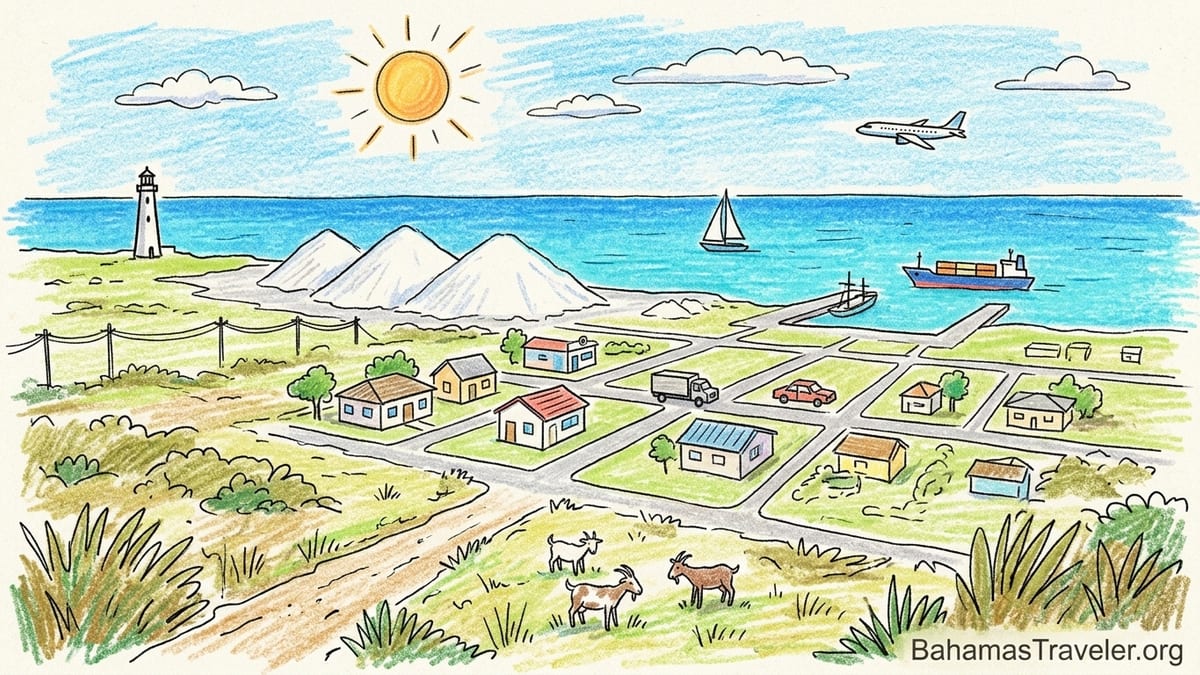
My introduction to Matthew Town began on the short Bahamasair flight that connects Nassau with Inagua’s tiny airport just outside town. The plane was packed with locals and a few birdwatchers with binoculars already around their necks. Stepping out onto the runway, the flatness of Great Inagua hit me first. The horizon was a straight line, broken only by scrub, power lines and the distant silhouettes of salt piles near the Morton Salt operation that dominates the island’s economy.
From the airport, there is no formal bus service. Local taxis and pre-arranged guesthouse transfers cover the few kilometers into Matthew Town, and prices at the time of my visit were typically discussed in advance with the driver rather than posted on a board. I paid the going rate quoted by my guesthouse host, a reminder that visitors should confirm current costs directly before arrival. The drive took less than ten minutes, past low houses, wide verges and the occasional goat grazing near the road.
Unlike more developed Bahamian islands, Matthew Town does not greet you with resort façades or a waterfront promenade. Instead, you enter a working settlement with a government complex, modest churches, a primary school, a small police station and a grid of streets where pickup trucks outnumber rental cars. It felt more like a southern Bahamian outpost than a tourist destination, which is exactly what it is: the only populated settlement on Great Inagua, and the administrative and commercial heart of the island.
That first drive also made something else clear. While Inagua is celebrated in national tourism brochures for its national park, flamingo colony and wild interior, the lived story of the island is concentrated here, in a town that exists because of salt and shipping as much as birds and beaches.
Where I Stayed and How Long I Spent in Town
I based myself in one of Matthew Town’s small guesthouses, the style of accommodation that predominates here instead of large hotels. Properties such as Enrica’s Inn, Walkine’s Guest House, The Main House and newer options like Red Knot Manor illustrate the range. Some are family-run B&Bs on residential streets, others are company-owned guesthouses tied historically to the salt industry. They usually offer air conditioning, private bathrooms and Wi-Fi, but amenities like on-site restaurants or 24-hour desks are limited.
On Great Inagua it is common for accommodations to bundle practical services with the room. My host arranged airport pickup, helped me coordinate a wildlife tour for another day, and advised on where to find groceries and cooked meals. Because room rates and availability change frequently in such a small market, travelers are wise to contact properties directly or through updated booking platforms, and to reconfirm everything a week or two before arrival.
I deliberately planned to spend a full day and night focused on Matthew Town itself, separate from my trip into Inagua National Park. That gave me roughly eight daylight hours in town, from late morning to sunset, plus an evening and the following early morning before heading out to the flamingo habitats. It proved just enough time to walk most of the streets, visit the waterfront, talk at length with several business owners, and make a slow journey out toward the lighthouse and the edge of the salt operation.
Staying overnight in a town with no bars in the usual tourist sense and limited restaurant options forced me into the local rhythm. Meals were timed around when someone was cooking, errands were grouped so I could walk them, and there was little temptation to stay up late. That slower pace, combined with the chance to talk in detail with residents about salt, storms and island life, became one of the trip’s unexpected pleasures.
Walking Matthew Town: Streets, Shops and the Waterfront
Matthew Town is compact enough that you can cover most of it on foot in a few hours, though the midday sun can make even short distances feel longer. From the guesthouse area near the center, I walked along the main street past the post office and several government buildings that form the town’s civic core. Many of these structures date back decades and carry the patina of salt air, hurricane repairs and repainting campaigns.
There are a handful of small grocery shops, one-room places with shelves of tinned goods, rice, cooking oil, soft drinks and sometimes a surprisingly good selection of fresh produce when the mailboat or plane has just come in. One shopkeeper pointed out that delivery days are when locals stock up, and visitors who arrive just before the next shipment may find only the basics. Prices reflect the realities of freight and scale. A loaf of bread and a few bottles of water cost noticeably more than on New Providence, and I learned to ask what had arrived that week rather than browse with fixed expectations.
Dining in Matthew Town is informal and often seasonal. Some guesthouses offer breakfast for an additional charge, typically eggs, toast and perhaps local dishes when available. For lunch, I found a simple takeaway operation housed in a converted home, where plates of stewed chicken with rice and peas were prepared when the owner felt there was demand. Opening hours were flexible and based more on the cook’s schedule than on a posted timetable, which is part of the charm but requires flexibility. Discussions with locals suggested that visitors should not rely on late-night dining and should be prepared with snacks from Nassau or the grocery.
From the center of town, it is only a short walk west to the waterfront. The sea along Matthew Town is a working coast rather than a manicured resort beach. A small harbor and wharf serve mailboats and supply vessels, and the coastline is dotted with piles of fishing gear, concrete ramps and the occasional rust-streaked building. Walking along the shore, I could look north toward stretches of sand just beyond town and south toward the distant silhouette of the Great Inagua Lighthouse. The water is as clear and turquoise as anywhere in the Bahamas, but the presence of industrial and maritime infrastructure makes the scene feel more like a frontier port than a postcard.
Salt, Brine Shrimp and Flamingos: How the Industry Shaped the Island
To understand Matthew Town, you have to understand salt. Great Inagua has long been recognized for its natural salt ponds, shallow inland basins that lend themselves to solar evaporation. Over time, these ponds were modified and expanded into a vast grid of crystallization pans and reservoirs operated today by Morton Salt, which runs one of the largest solar saline operations in the region. Production figures can vary, but local descriptions emphasize that salt is the island’s economic engine and employer.
The process begins with seawater being channeled into large reservoirs, where sun and wind concentrate the brine. As water evaporates, salinity rises and conditions become ideal for microscopic life, including brine shrimp. These tiny crustaceans turn the water a pinkish hue and are a critical link between the industrial landscape and the island’s celebrated wildlife. West Indian flamingos feed heavily on brine shrimp, filtering them through their specialized bills in the shallow ponds and wetlands that fringe the saltworks and extend into Inagua National Park.
Locals I spoke with were quick to point out that the relationship between salt production and flamingos is complex but symbiotic in many areas. Carefully managed salinity and water levels in some ponds support abundant brine shrimp, which in turn nourish the flamingos that have become both a national symbol and a modest but important driver of tourism. At the same time, the company and conservation authorities coordinate access, ensuring that industrial operations and sensitive habitats can coexist.
For visitors, this means that the salt ponds are not a playground. They are an active industrial site with heavy equipment, trucks hauling salt, and sections where the crust can be unstable. I was repeatedly advised not to walk into or across the ponds on my own, both for safety and environmental reasons. Flamingo viewing is instead arranged through the Bahamas National Trust and licensed guides, who use designated routes and viewing areas that do not interfere with production or disturb nesting birds.
Can You Visit the Morton Salt Facility?
Official tourism references have occasionally mentioned the possibility of tours at the Morton Salt facility on Great Inagua, and some older travel accounts describe visits arranged through company staff or local contacts. Given the obvious safety and security considerations at an industrial site, I treated these mentions as historical rather than guaranteed and set out to confirm what is currently possible.
During my stay, I asked both my guesthouse host and several long-time residents about public access to the plant. The consistent message was that there are no routine walk-up factory tours for casual visitors. Access, when it happens, is arranged on a case-by-case basis in advance, often for education groups, visiting officials or organized specialist trips rather than individual tourists. Company policies evolve, and any visit inside the operational area requires explicit permission and often the presence of company escorts.
Because I had not requested clearance before arriving, I did not attempt to enter the plant itself. Instead, I spent time near the margins of the operation, traveling on public roads that parallel some of the outer ponds. From vantage points outside the fences, I could see long windrows of white salt being shaped by machinery, trucks moving along levees, and the shimmering geometry of ponds stepping back from the sea. The scale is impressive, a man-made salt landscape laid over an already salt-rich island.
The takeaway for travelers is clear. If you are particularly interested in the industrial side of Great Inagua and hope for an inside look at the facility, you should contact your accommodation well ahead of time and ask whether any visit can be coordinated. Do not assume that turning up at the gate will result in a tour. Even without going inside, observing the operation from a respectful distance and talking with residents who work there gives a strong sense of how deeply the industry shapes local life, from wage employment to sponsorship of community events and infrastructure.
The Great Inagua Lighthouse and Accessible Views
Southwest of Matthew Town, at the island’s southwestern tip, stands the Great Inagua Lighthouse, sometimes called the Southwest Point Lighthouse. Built in the late nineteenth century and still active, it guards the approaches to Matthew Town and is listed among the significant historic lighthouses of the Bahamas. Seen from town, it is a slim white tower rising above low scrub and the glint of nearby buildings, a reminder of the era when ships and salt exports depended heavily on navigational aids rather than digital charts.
Several cruising-sailor accounts and older travel blogs describe hiking or driving out to the lighthouse and, in some cases, climbing the interior stairs to enjoy views over the salt ponds and sea. However, access policies for lighthouses can change as structures age, maintenance backlogs grow and safety standards tighten. Before making my own visit, I asked in town whether the lighthouse was open. The most up-to-date information from locals was cautious. People confirmed that visitors can travel along the rough road to the lighthouse area and view the tower and surrounding buildings from outside, but interior access and climbs were not something anyone would promise on a given day.
With that in mind, I arranged for a local driver to take me toward the point in the late afternoon, when the light softens and heat eases. The ride cost more than a short in-town transfer because of the distance and condition of the road, and we agreed a price before leaving. We stopped short of any locked gates or clearly posted boundaries and continued on foot to a position where the lighthouse stood clearly in view against the sky. From that vantage, I could photograph the tower, the keeper’s quarters and the curve of coastline without intruding on restricted areas.
I did not climb the lighthouse. None of the people I spoke with could confirm that it is currently maintained for regular public ascents or that the interior is safe for unsupervised visitors. Until the authorities responsible for the structure publish clear, current guidance on opening hours and conditions, it is safest to treat the lighthouse as an exterior landmark rather than an attraction with guaranteed interior access. Even so, the walk out and the view back toward Matthew Town, framed by salt ponds and flat bush, made it one of the most atmospheric spots on the island.
Everyday Life in a Small Industrial Town
Spending a full day in Matthew Town highlighted the difference between the island’s grand natural reputation and the quieter, harder-edged reality of living in a remote industrial community. Nearly every person I met had some connection to salt, either through direct employment at the plant, family members working shifts, or past experience in related jobs. Conversations drifted naturally to topics like production seasons, maintenance shutdowns and how global demand affects local overtime.
At the same time, there is a web of small businesses that keep the town functioning: corner shops, barbers, auto mechanics, a few informal eateries and guesthouses that double as social hubs. The pace is measured. In mid-afternoon, the streets can feel almost empty, with the loudest sounds coming from roosters and the distant buzz of generators or machinery at the salt ponds. As the sun lowers, people appear on porches, children ride bicycles in the streets, and pick-up trucks stop for conversations at intersections.
For visitors used to more developed islands, the limitations are evident. There is no strip of beach bars, no craft market, few formal excursions beyond wildlife tours, and only sporadic nightlife. If your idea of a Bahamian holiday revolves around restaurant hopping and shopping, Matthew Town will feel austere. Internet access exists but can be patchy, and power outages, while not constant, are part of life in a place this remote. Even simple errands involve planning around the mailboat schedule, air freight availability and the fact that nearly everything must be imported.
Yet there are compensations. Without a heavy tourism presence, interactions with residents are less transactional and more conversational. People have time to explain local history, point out old salt warehouses now serving as community buildings, or reminisce about earlier decades when stevedores from across the Bahamas came here for work. One older resident told me about the days when Matthew Town was considered a place to earn money and send it back to family in other islands, a narrative echoed in official historical summaries. That sense of a frontier town in the salt trade still lingers, even as some young people leave for Nassau or abroad.
Costs, Practicalities and How Accessible Things Really Are
In a place with so few formal tourism businesses, up-to-date practical information matters. During my visit, guesthouse rates were quoted individually and were not posted in any centralized way. Travelers should expect prices that reflect the island’s isolation, generally higher than budget stays in larger Bahamian centers but still below resort levels. Because many guesthouses have only a handful of rooms, single bookings can make a big difference, and owners are often willing to include airport transfers or breakfast in customized arrangements.
Local transportation costs are likewise negotiated. Short rides within Matthew Town, such as between the airport and central accommodations or between guesthouses and the harbor, are commonly arranged through your host or a known driver. Longer trips to the national park entrance or out toward the lighthouse cost more and can depend on fuel prices and vehicle availability. At the time of writing, there is no metered taxi system or scheduled local bus, so planning and clear agreements with drivers are essential.
Opening hours for shops and small eateries follow local needs rather than tourist expectations. Grocery stores tend to open in the morning and close early in the evening, with midday breaks possible. Some food options may operate only a few days a week or around work shifts at the plant. I learned quickly to purchase drinking water, snacks and breakfast items early in the day instead of assuming I could stock up late at night. Visitors who have dietary restrictions or who prefer familiar brands should consider bringing nonperishable items from Nassau.
Everyday conveniences, from ATM access to mobile coverage, are present but not as redundant as in bigger islands. Before traveling, it is wise to check with your bank about card compatibility and to bring a reasonable amount of cash in Bahamian or U.S. dollars. I found that most small businesses operated on cash, and while some accommodations can process electronic payments, connectivity issues can occasionally complicate this. Flexibility and patience go a long way, as does the habit of confirming details in person rather than assuming national norms apply.
Nature vs. Industry: The Character of Matthew Town
Perhaps the most striking aspect of spending time in Matthew Town is the contrast between its image in tourism materials and its daily reality. Inagua is often presented as a pristine natural paradise, home to vast saltwater wetlands, thousands of flamingos and a sense of untouched remoteness. All of that is true in the broader landscape, yet the town at the center of human life on the island is shaped unmistakably by industry, machinery and the routines of shift work.
From certain street corners in Matthew Town, you can look inland and see the white glint of salt piles or the straight lines of levees. Look seaward and you see freighters at anchor, small boats using the harbor, and the open Atlantic beyond. The air sometimes carries a tang of brine and machinery. Trucks move through town carrying workers to and from the plant. This is not an island trying to disguise its industrial side for tourists; rather, it is a community that exists because of it, while also benefiting from the conservation value and modest tourism revenue generated by its unique environment.
Talking with locals, I heard pride in both sides of this identity. People spoke of the flamingos with affection and protectiveness, aware that their presence makes Inagua special within the Bahamas. They also spoke with respect about the salt operation as a source of steady income and as a part of the island’s heritage. Historical accounts note that Matthew Town’s fortunes have risen and fallen with the salt trade, and older residents remember times when economic decline prompted out-migration and left parts of town quiet and worn.
For a visitor willing to look beyond postcard expectations, this duality is precisely what makes Matthew Town compelling. It is not a resort bubble set against a distant natural park. It is the working face of a wild island, where the same sun that draws tourists to the beach also powers the evaporation that keeps the town’s main employer operating. Spending time here reveals the negotiations, compromises and traditions that allow a small community to persist at the edge of the Bahamian archipelago.
The Takeaway
By the time I left Matthew Town after a full day and night, I realized how easy it would have been to treat it as simply a logistics hub: a place to land, sleep and catch a wildlife tour. Instead, walking its streets, speaking with residents and tracing the edges of the salt ponds and lighthouse road turned it into a destination in its own right. The town will never compete with Exuma or Eleuthera for beach holidays, and it does not try. Its appeal lies in its authenticity and in the way history, industry and ecology intersect in a single, quietly determined community.
From locals I learned that the story of Great Inagua is not just about flamingos, but about stevedores who once came here from across the Bahamas to load salt, about families who endured hurricanes and economic downturns, and about the quiet pride of workers who keep the salt flowing and the lights on. The most interesting historical stop for me was the waterfront area, where old salt-related buildings, the small harbor and views toward both the lighthouse and the ponds offer a compact, tangible sense of how trade, navigation and labor shaped Matthew Town over more than a century.
Does Matthew Town deserve a full day, rather than serving only as a place to sleep before birdwatching? In my experience, yes, provided you arrive with the right expectations. This is a place for travelers who are curious about the human side of remote islands, who can appreciate the texture of an industrial town set in an extraordinary natural environment, and who are comfortable with limited dining and entertainment options. Give it a day, walk slowly, ask questions, and the town will reveal stories far beyond the flamingo brochures.
In the end, what I discovered in Matthew Town was not a hidden resort, but something rarer: a community still defined on its own terms, at the edge of a salt pond and under the sweep of a working lighthouse, quietly carrying the weight of Great Inagua’s past and future.
FAQ
Q1. How do you get to Matthew Town on Great Inagua?
Bahamasair operates scheduled flights from Nassau to the small airport near Matthew Town. There is no public bus from the airport, so visitors generally arrange a taxi or guesthouse transfer in advance.
Q2. Are there hotels or only guesthouses in Matthew Town?
Accommodation is mostly in small guesthouses and inns, some family-run and others company-owned. Options include several properties in and around the center of town, offering basic comforts like air conditioning and private bathrooms rather than resort-style facilities.
Q3. Can visitors tour the Morton Salt facility?
There are no regular public walk-up tours of the Morton Salt operation. Access inside the plant, when it happens, is arranged in advance on a case-by-case basis, so travelers should not assume they can enter without prior permission.
Q4. Is it safe to walk around Matthew Town?
The town is compact and felt calm and friendly during my visit, and walking during daylight is a practical way to explore. As in any small community, basic precautions and respect for private property apply, and visitors should avoid entering industrial or restricted areas.
Q5. How close is the beach to the center of town?
There are stretches of shoreline within walking distance of central Matthew Town, including working waterfront areas and nearby beaches. Some sections are more industrial than resort-like, so travelers seeking long sandy beaches may need a short drive beyond town.
Q6. Can you climb the Great Inagua Lighthouse?
Locals advised that while visitors can usually reach the area near the lighthouse along a rough road, interior access and climbs are not guaranteed and may be restricted for safety. Anyone interested should seek current guidance in town and be prepared to enjoy the lighthouse mainly from outside.
Q7. What food options are available in Matthew Town?
Food comes mainly from small grocery shops, takeaway kitchens and meals provided by guesthouses. Opening hours are informal and can vary, so it is sensible to ask locally about what is available on a given day and to carry snacks for evenings.
Q8. How many days should you spend in Matthew Town?
If you want more than a transit stop, plan at least one full day and night to walk the town, visit the waterfront, see the lighthouse area and speak with residents, in addition to any separate wildlife or flamingo tours.
Q9. Is Matthew Town a good base for birdwatching trips?
Yes. Wildlife tours into Inagua National Park usually depart from the vicinity of Matthew Town, and guesthouses often help arrange guides and transport, making the town the practical base for flamingo and other birdwatching excursions.
Q10. What should travelers bring that might not be available locally?
It is wise to bring any essential medications, preferred snacks, sun protection and cash, since shops carry a limited range of goods and opening hours can be irregular. While basic supplies are available, specific brands or items cannot be guaranteed on such a remote island.