

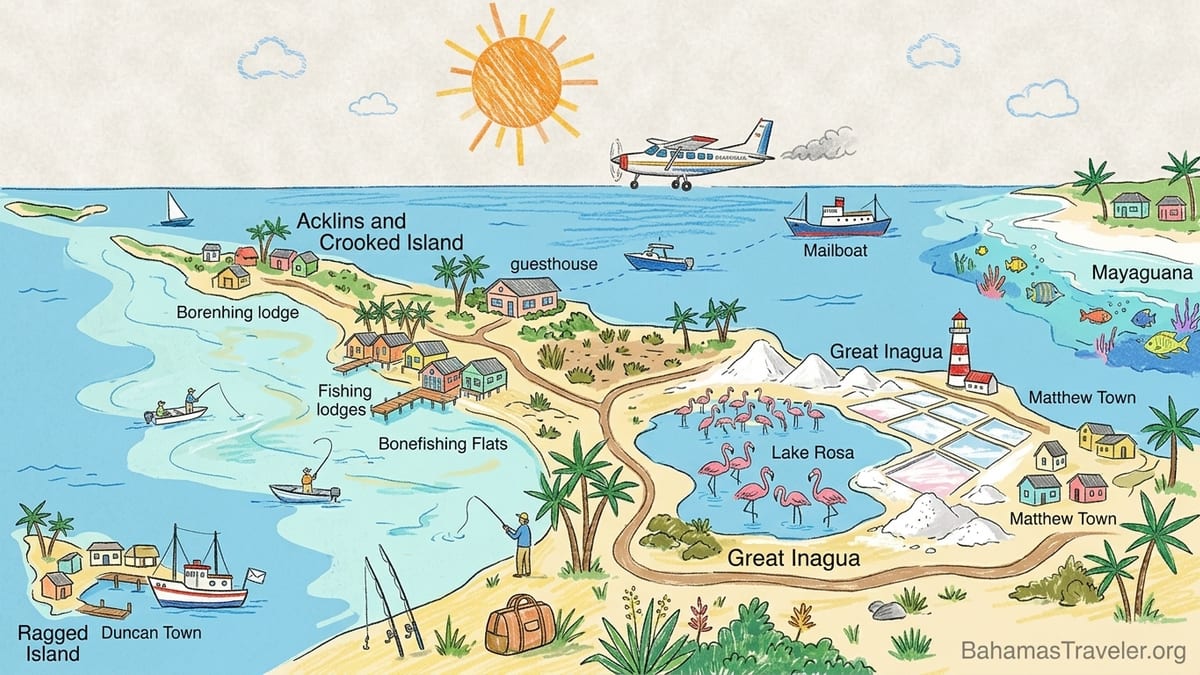
The Southern Bahamas remain some of the least-visited islands in the country, a scattered chain of quiet settlements, immense fishing flats and beaches where you may not see another footprint for days. They are also logistically more complex than better-known islands closer to Nassau. This guide focuses on the Southern Islands identified by the Bahamas Ministry of Tourism – Acklins and Crooked Island, Mayaguana, Inagua and Ragged Island, with Long Cay as a side trip from the Acklins–Crooked Island group – to help you decide which island actually fits your interests, budget and time frame.
How the Southern Bahamas Fit Together
When Bahamians talk about the Southern Islands, they usually mean the long crescent-shaped atoll of Acklins and Crooked Island, remote Mayaguana to the east, bird-rich Great Inagua even farther south, and tiny Ragged Island and Duncan Town on the far southwestern fringe. The distances between them are significant, which is one reason they feel so untouched compared with islands like Exuma or Eleuthera. It also means visitors have to think of these islands as stand-alone destinations rather than a simple island-hopping circuit.
There are no high-rise resorts, branded beach clubs or large marinas here. Instead you find a handful of fishing lodges on Acklins and Crooked Island, family-run guesthouses and small inns on Mayaguana and Inagua, and very limited rooms on Ragged Island. Daily life follows local rhythms set by fishing seasons, mailboats and small domestic aircraft that connect these islands to Nassau and, in some cases, to other Family Islands.
For trip planning it helps to know that Bahamasair is the main scheduled carrier into the Southern Bahamas, operating routes from Nassau to Mayaguana via Mayaguana Airport (MYG) and to Great Inagua via Inagua Airport, also known as Matthew Town Airport (IGA). Mayaguana’s airport and Matthew Town’s joint civil airport are confirmed on current aviation listings, with Bahamasair among the operators serving Mayaguana and scheduled service into Inagua. Other islands rely more on smaller domestic airlines, charters and the traditional mailboat, and services can change seasonally.
Because air schedules are infrequent and often operate only a few days a week, combining multiple Southern Islands in one short trip usually means long layovers in Nassau or overnight stops that eat into your beach time. For most travelers, the smarter approach is to pick one island that best matches your interests, commit to being there for several days, and treat the journey as part of the adventure rather than trying to see everything at once.
Acklins: Vast Flats, Lodges and Empty Beaches
Acklins is a long, thin island forming the eastern edge of the Acklins–Crooked Island atoll, and it has earned a strong reputation among serious fly fishers. Local operators and lodge owners describe Acklins as one of the most untouched bonefishing destinations in the Bahamas, with extensive shallow-water flats stretching for miles and very light fishing pressure. Dedicated bonefishing outfits such as Acklins Outback Fishing Lodge and Acklins Creekside Bonefish Lodge promote multi-day packages focused on stalking bonefish, permit and, in warmer months, tarpon across the island’s maze of creeks and sandbars, with some operations highlighting the possibility of double-digit bonefish during peak conditions.
Most visitors stay in small fishing-focused properties or family-run lodges. The Bahamas Ministry of Tourism’s hotel directory lists a cluster of fishing lodges and small inns on Acklins, and specialist properties like Salina Point Inn Bonefish Lodge market themselves to anglers who want a do-it-yourself style base with access to flats right outside their door. Rooms often include hearty meals geared toward long days on the water, and prices commonly fall in the range of roughly 250 to 450 US dollars per person per night when packaged with guiding and meals, although exact rates depend on the season, length of stay and the level of guiding included.
Eating on Acklins usually means your lodge’s dining room or small local restaurants in settlements such as Salina Point or Chesters. Menus lean heavily on whatever has come out of the sea that day, along with staples like peas and rice and baked macaroni. A simple local lunch might be 15 to 25 dollars, while a full lodge dinner with fish, sides and dessert is usually bundled into package rates. There are no banks on Acklins, a point some lodges emphasize directly in their guest information, so you should arrive with enough cash in small bills for tips and incidental purchases, even if the lodge itself can take cards.
Acklins is served by a small airport that receives domestic flights from Nassau, often with limited frequencies that may operate several times a week instead of daily. Flight patterns and operating carriers can change, so most lodges advise guests to check current schedules and coordinate closely before buying international tickets. Once on the island you should expect no rental car desks at the airport. Instead, lodge transfers are typically arranged in advance and you may rely on your hosts or a local driver if you want to visit a different settlement or beach on a non-fishing day.
Crooked Island and Long Cay: Fishing Lodges and Quiet Boating
Crooked Island forms the western side of the same atoll as Acklins and offers a similar mix of lonely beaches, shallow banks and a handful of specialist accommodations. The Crooked & Acklins Island Trophy Lodge, listed on the official Bahamas tourism site, positions itself as a quiet lodge on a white-sand beach that gives anglers access to both islands in a single trip, with a short vehicle transfer used to move between fishing zones on Acklins and Crooked. This ability to work both sides of the atoll makes Crooked Island an appealing base for travelers who want a bit more flexibility in where they fish.
While serious anglers dominate visitor numbers, Crooked Island also appeals to boaters, kayakers and travelers who simply want a very quiet beach environment with the occasional boat excursion. Local operators and lodge hosts sometimes organize day trips by skiff across the shallow banks, picnic outings to sandbars, or sightseeing runs to the historic lighthouse at Gun Point. With limited independent restaurants, most visitors rely on their lodge or guesthouse kitchen, and supplies are often brought in on the mailboat or from Nassau, so menus can feel homely and repetitive compared with more developed islands.
Long Cay sits just off Crooked Island and is typically visited as a boat excursion rather than a place to stay. It has a tiny settlement and rugged coastline but no conventional resort infrastructure. In practice, this means your host on Crooked or Acklins can sometimes organize a run over to Long Cay to walk the beaches, fish, or explore the shoreline for a few hours, then return to your main island by boat. Travelers should not expect restaurants, shops or medical facilities on Long Cay, and visiting without a local captain or guide is not recommended.
Access to Crooked Island is similar to Acklins, with a small airport and infrequent domestic flights from Nassau, sometimes shared patterns or alternating days with Acklins. In some seasons small carriers may adjust their schedules based on demand, and visitors should be prepared to adapt their travel dates to match available flights. As with Acklins, it makes sense to stay a minimum of five nights so that any weather-related or schedule-related delays do not cut your stay in half.
Great Inagua: Flamingos, Wildlife and an Industrial Edge
Great Inagua feels very different from Acklins and Crooked Island, even though it lies in the same broad region of the Bahamas. The island is dominated by the vast Inagua National Park and its famous West Indian flamingo population, which the Bahamas National Trust helps to protect. Large flocks of flamingos feed in the island’s interior saltwater lakes, especially Lake Rosa, and birdwatchers also come for rare and migratory species such as herons, egrets and various shorebirds. Wildlife tours often combine visits to the park with stops near the Morton Salt facility, one of the largest solar salt operations in the region, which creates a stark but photogenic landscape of salt pans and mounds.
Matthew Town, on the southwest coast, is the main settlement and home to Inagua Airport (IGA), a joint civil–military facility that connects Great Inagua to the rest of the Bahamas. Current aviation resources list Inagua Airport among the country’s domestic airports with scheduled services, and Bahamasair has historically operated flights from Nassau, although days and frequencies can vary. Many visitors arrange their trip around the flight schedule, sometimes staying in Nassau before and after their Inagua segment to avoid missed connections.
Accommodation on Great Inagua centers on small guesthouses and locally owned inns within or near Matthew Town. Room inventories are modest, and properties may have only a handful of rooms each, which means groups of birders or photographers can fill them quickly during peak wildlife-viewing periods. Nightly rates can fall roughly in the 120 to 200 dollar range for simple, clean rooms, with air conditioning and private bathrooms but limited resort-style facilities. Restaurants are simple as well, often doubling as bars or takeaway counters, serving fried fish, stewed chicken, conch and other staples for about 15 to 30 dollars a plate.
Travelers choose Great Inagua primarily for wildlife, photography and the feeling of being on the edge of the Caribbean close to the northern coast of Haiti. It is not a classic beach destination, although there are pleasant local beaches near Matthew Town. Roads to the interior are rough in places, and visitors often arrange 4x4 vehicles or guided tours with local operators who know the park’s track network and current conditions. Because of the island’s remoteness and the limited medical facilities, trip planners should take travel insurance seriously and consider how they would handle evacuation to Nassau in case of a serious emergency.
Mayaguana: Remote Beaches, Snorkeling and Village Life
Mayaguana sits far out in the southeastern Bahamas and is often described as one of the country’s least developed inhabited islands. The Bahamas Ministry of Tourism highlights it as a place for footprint-free beaches, offshore reefs, and a blend of solitude and local charm. Official tourism materials point to Horse Pond Beach, about ten miles east of Abraham’s Bay, as a favorite spot for land crab hunting among locals, and to offshore reefs in the 45 to 60 foot depth range that appeal to divers and snorkelers who do not mind minimal infrastructure. Smaller offshore cays such as Booby Cay add to the sense of isolation, with bird colonies and iguanas in natural surroundings.
Mayaguana Airport (MYG) lies near Abraham’s Bay and is the island’s only airport with regularly scheduled service to Nassau, which current descriptions from the Bahamas tourism website and reference sources confirm. Bahamasair has operated flights connecting Nassau and Mayaguana, often on limited days each week and sometimes using multi-stop routes that also serve other islands. When planning, you should check the latest Bahamasair timetable for the specific month of travel and be prepared for early-morning or midday departures that dictate your broader itinerary.
Accommodation consists mainly of modest guesthouses and small hotels around Abraham’s Bay, Betsy Bay and Pirate’s Well. The Bahamas government’s hotel directory identifies only a small number of properties, most with a handful of rooms. Rather than pools and spas, you are likely to find simple air-conditioned rooms, basic kitchens and porches overlooking the sea. Prices are often in the range of about 100 to 180 dollars per night for a standard double room, although some packages that include meals or fishing excursions can cost more. You may see Mayaguana’s name used by Bahamas-based resorts as a theme for guest rooms or villas elsewhere in the country, so ensure that any property you book is physically located on Mayaguana itself.
Food options are limited but rewarding if you like home-style cooking. Small restaurants and bar–grills in Abraham’s Bay serve dishes such as conch salad, cracked conch, fried snapper and stewed meats with sides for perhaps 12 to 25 dollars per plate. Groceries can be more expensive than on New Providence because most goods are imported. For snorkeling and diving, many visitors bring their own mask, fins and snorkel, and coordinate with local boat owners for half-day or full-day trips to reefs and walls. Because there is no large dive shop with full retail inventory, treating Mayaguana as a do-it-yourself snorkeling and beach exploration destination works best for experienced independent travelers.
Ragged Island: For Experienced Boaters and Extreme Seclusion
Ragged Island, with its small settlement of Duncan Town, is arguably the most remote of the Southern Islands described here. The island was badly damaged by Hurricane Irma in 2017, and rebuilding has been gradual, focusing first on essential infrastructure and homes. Today, Ragged Island is visited mainly by experienced sailors, private boaters and a small number of adventurous travelers who want maximum isolation and do not mind the lack of conventional tourist services. Recent sailing discussions still refer to using Ragged Island as a potential “ditch-out” point due to its airstrip and mailboat dock, underscoring its role as a frontier stop rather than a resort destination.
Duncan Town Airport (DCT), listed on current aviation references, provides basic air access, although scheduled services can be limited or seasonal. Some years see sporadic flights from Nassau or other islands via small carriers or charter operators; in others, the mailboat may be the more reliable link. Anyone considering a land-based stay on Ragged Island should confirm air and sea schedules directly with local authorities or property owners well before departure, and be prepared for last-minute changes due to mechanical issues or weather.
Accommodation is extremely limited, often amounting to a small guesthouse or rooms offered by local families. There are no large lodges, and restaurant choices are minimal. Visitors should be self-sufficient to a degree uncommon elsewhere in the Bahamas, bringing specialty food, medical supplies and any fishing or snorkeling gear they require. Independent boating visitors often provision in Nassau, Long Island or Great Exuma before coming down the Jumentos Cays and Ragged Island chain.
Because of its isolation, Ragged Island is best suited to those who value seclusion and have significant experience traveling in lightly serviced destinations. It is not ideal for first-time Bahamas visitors, families with young children or anyone with significant medical needs. For photographers and sailors willing to accept the logistical challenges, however, its small harbor, crumbling saltworks and almost-empty beaches offer compelling subject matter and an authentic sense of life in one of the country’s most distant communities.
Getting There, Getting Around and Daily Costs
All Southern Islands itineraries start with a flight into Nassau’s Lynden Pindling International Airport, then a domestic flight or connecting boat. As of late 2026, published aviation references and tourism materials confirm that Mayaguana (MYG) and Great Inagua (IGA) have scheduled flights from Nassau on Bahamasair, although frequencies and routes can change and may not operate daily. Acklins and Crooked Island also have small airports that receive domestic flights from Nassau on certain days of the week, typically via smaller carriers under domestic operating certificates. Ragged Island’s Duncan Town Airport is recognized but may have more sporadic traffic, making charters and mailboats more important there than elsewhere.
Because flight options are limited, practical planning means working backward from the domestic flight days. For example, if Bahamasair flies Nassau to Mayaguana on Mondays and Thursdays, then a five-night stay might realistically run Monday to Saturday, with a return through Nassau. Travelers who hope to connect same-day between their international arrival and a Southern Islands flight should leave generous buffers or consider staying at least one night in Nassau at the start and end of the trip to protect against delays.
On the ground, most of these islands do not have conventional rental car agencies with desks at the airport. Acklins and Crooked Island lodges often provide transfers and can sometimes arrange rental trucks or cars on an informal basis. Mayaguana and Inagua may have a few vehicles for rent through local contacts, but many visitors simply walk around the main settlement or pay for taxi-style rides when needed. For Ragged Island, visitors often rely entirely on their host or their own boat for movement. Fuel is expensive throughout the islands, which contributes to higher taxi and transfer costs compared with more developed destinations.
Daily spending varies significantly by island and travel style. A realistic minimum for a budget-conscious independent traveler on Mayaguana or Inagua might be around 150 to 250 dollars per person per day, including a simple room, local meals and occasional taxi rides. On fishing-focused islands like Acklins and Crooked Island, guided anglers staying in specialist lodges can easily spend 400 to 800 dollars per person per day when multi-day packages with full board and guiding are taken into account, similar to price levels at bonefishing lodges elsewhere in the Bahamas. Ragged Island trips by private sailboat can be less costly per day in cash outlay but require significant upfront expenses in equipment and provisioning.
How to Choose the Right Southern Island
Given the effort required to reach these islands, it is important to match your destination to your interests. Acklins is the clear standout for anglers who want vast wadeable flats and are happy to stay in a fishing lodge environment with very few distractions beyond the tide chart. Crooked Island offers similar fishing with the added benefit of easier boat access to different parts of the atoll and the ability to arrange day trips to Long Cay, making it appealing to couples where one partner fishes and the other prefers boating and beachcombing.
Great Inagua stands apart for birdwatching and wildlife. Travelers keen on photographing flamingos, salt pans and rugged coastal scenery will find more to work with here than on Acklins or Mayaguana, and the presence of a small town center in Matthew Town adds a bit more community life. However, beaches are not the primary attraction and visitors looking for classic turquoise shallows and long sandbars may be happier on Acklins, Crooked Island or Mayaguana.
Mayaguana strikes a middle ground between isolation and accessible beaches. Its footprint-free stretches of sand, accessible snorkeling just offshore from certain beaches and small, friendly settlements make it a strong choice for couples or solo travelers who want simple comforts and long walks more than structured excursions. First-time Out Islands visitors who are already confident independent travelers may find Mayaguana a gentler introduction to the Southern Bahamas than Ragged Island or even Acklins, because its scheduled flights and modest accommodation base offer a bit more predictability.
Ragged Island should be considered only by travelers who are comfortable with uncertainty and limited services. If you are a private boater, seasoned sailor or photographer willing to accept basic accommodations and minimal restaurant options in exchange for extreme seclusion, then Ragged Island has a distinct frontier appeal. For most visitors, however, it makes more sense to focus on Acklins, Crooked Island, Mayaguana or Great Inagua for a first Southern Bahamas trip.
Practical Comparison Table
Because each island serves a different niche, it can help to think in terms of “best in class” for specific interests. For fishing, Acklins and Crooked Island are the top choices, with multiple bonefishing lodges and guides operating on their extensive flats and creeks. Mayaguana also offers good fishing but with far less dedicated infrastructure. Great Inagua and Ragged Island can be rewarding for experienced independent anglers traveling by boat, but they are not set up around fishing lodges in the same way.
For wildlife and birdwatching, Great Inagua clearly leads thanks to Inagua National Park and its large flamingo population, along with the island’s salt ponds and coastal habitats that attract a range of species. Mayaguana’s Booby Cay and its iguanas and seabirds provide a smaller-scale alternative, while Acklins and Crooked Island support marine and bird life more in the context of general nature and fishing rather than formal wildlife tourism.
Photography and beaches are strong suits for several islands. Mayaguana, Acklins and Crooked Island all offer long, often completely empty beaches and shallow lagoons, ideal for landscape photography and couples seeking romantic walks. Ragged Island adds the interest of old saltworks and a windswept harbor, ideal for documentary-style photography. For couples who want some local interaction but do not need bars or nightlife, Mayaguana and Great Inagua can work well, offering small-town settings where you will quickly recognize familiar faces.
For independent exploration and first-time Out Islands visitors, Mayaguana and Great Inagua are generally more forgiving than Ragged Island, while Acklins and Crooked Island sit somewhere in between, rewarding experienced anglers and independent beach lovers who do not mind planning ahead for supplies and transport. Overall, a traveler whose main priorities are fishing and solitude might rank Acklins first, someone focused on wildlife photography would prioritize Great Inagua, and a beach-focused couple with a week to spare might choose Mayaguana or Crooked Island depending on flight schedules.
Seasonality, Hurricanes, Health and Connectivity
The Southern Bahamas share the same broad weather patterns as the rest of the country, with a drier, breezier period from roughly December to April and a more humid rainy season from late spring into autumn. Hurricane season in the Atlantic officially runs from June 1 to November 30. These islands sit in a region that has seen significant storm impacts in the past, including Ragged Island’s heavy damage from Hurricane Irma. Travelers planning trips in late summer or early autumn should pay particular attention to forecasts in the weeks before departure and consider flexible tickets and accommodation policies.
Travel insurance that includes trip interruption and evacuation benefits is strongly recommended for the Southern Bahamas. Because of their remoteness, medical facilities on these islands are generally limited to small clinics and nurses’ stations, with more advanced care available only in Nassau or, in life-threatening cases, by air evacuation to larger regional centers. If you have existing medical conditions, talk to your insurer about air ambulance coverage and confirm exactly how evacuation would work from islands like Inagua or Acklins, where runway lengths and aircraft types can constrain operations.
Mobile coverage is improving across the Bahamas but remains inconsistent in the far south. Cellular providers typically offer coverage around the main settlements such as Abraham’s Bay on Mayaguana, Matthew Town on Inagua and larger villages on Acklins and Crooked Island, but signals can drop out quickly once you move along remote coastlines. Data speeds may be slow, and roaming charges for visitors from North America and Europe can be high without local SIMs or roaming packages. Wi-fi is usually available in guesthouses and lodges, though speeds may vary and outages are not uncommon.
Given these factors, visitors should think in terms of resilience. Bring printed copies of your flight details, keep important phone numbers written down as well as stored digitally, and share your itinerary with someone at home. A basic first-aid kit, any prescription medications in original packaging, a backup power bank for phones and extra flashlight or headlamp can all make a big difference in the event of a local power cut or transport delay. None of these items take up much luggage space, and all are far harder to replace last-minute on small islands.
Sample 3-, 5- and 7-Night Itineraries
Because flight connections are sparse and the islands are far apart, it is rarely practical to try to “collect” all the Southern Islands in a single week. Instead, focus on a single base and, at most, one neighboring island or cay as a day trip. Below are realistic stay-length suggestions built around that philosophy, with the understanding that exact travel days must match current flight schedules at the time of booking.
For a three-night stay, consider Mayaguana or Great Inagua as your primary options. A long weekend on Mayaguana built around a Nassau–Mayaguana–Nassau flight pair gives you time for two full days of beach walking, snorkeling and exploring Abraham’s Bay and nearby areas, plus an evening or morning in Nassau at the start or end as needed. On Great Inagua, a three-night stay allows for at least one dedicated day inside Inagua National Park with a local guide focused on flamingos and other birds, plus time to walk or drive around Matthew Town and visit coastal viewpoints.
With five nights, islands like Acklins and Crooked Island come into their own. Many bonefishing lodges offer four- or five-day fishing packages that fit well into a five-night framework, giving you three to four full fishing days plus arrival and departure days that may also include short sessions on the flats. A five-night stay on Mayaguana or Inagua allows more flexibility to include both guided boat trips and quieter free days. Ragged Island, if pursued at all, makes more sense as a five-night or longer stop reached by private vessel or carefully timed flights, recognizing that any disruption in the schedule could extend your stay beyond what you plan.
For seven nights, you can settle into the rhythms of one island. On Acklins or Crooked Island a full week provides enough time to mix guided fishing days with unguided beach walks, while lodges can sometimes adjust your schedule around tides and weather. A week on Mayaguana is ideal for couples who want to divide their time between beaches, offshore snorkeling trips arranged with local boat owners, and unhurried afternoons in village bars or on guesthouse verandas. On Great Inagua, a seven-night stay lets wildlife photographers revisit the same sites in different light and weather, increasing the chances of memorable images of flamingos and other species. Attempting to split a week between two Southern Islands is occasionally possible, for example three nights on Mayaguana and four on Inagua, but only if flight schedules align almost perfectly; even then, you should accept a higher risk of lost time to transfers.
The Takeaway
Traveling to the Southern Bahamas is as much about mindset as logistics. These islands ask you to slow down, accept that flights do not always run daily and that menus are built around what can realistically be supplied to a small community. In return, they offer beaches with no footprints, bird-filled salt ponds, miles of unpressured fishing flats and evenings where the loudest sound may be the wind over the water.
Acklins and Crooked Island reward anglers and solitude seekers who do not need much beyond a skiff, a guide and a clean room with hearty meals. Great Inagua appeals to wildlife enthusiasts and photographers who find beauty in salt pans, flamingos and working harbors. Mayaguana gives couples and independent travelers a quieter, beach-focused setting with just enough infrastructure to feel comfortable but not crowded. Ragged Island demands even more self-reliance but offers a rare sense of frontier for those prepared to accept its challenges.
Rather than trying to see every island in one shot, choose the one that best matches your interests and build a realistic itinerary around its flight schedule, with buffer time in Nassau on either side. Approach the Southern Bahamas as destinations where time stretches out, routines slow down and the reward lies in immersing yourself in one place long enough for it to feel like a temporary home.
FAQ
Q1. Which Southern Bahamas island is best for bonefishing?
Acklins and Crooked Island are generally considered the best options for bonefishing, with several specialist lodges, experienced guides and vast shallow flats that receive minimal fishing pressure.
Q2. Can I fly directly from the United States to the Southern Islands?
No. You will need to fly into Nassau first, then connect on a domestic flight to islands such as Mayaguana, Acklins, Crooked Island or Great Inagua, or organize a charter or mailboat to more remote places like Ragged Island.
Q3. How many days should I spend on Acklins or Crooked Island?
A minimum of five nights is recommended on Acklins or Crooked Island to make the most of limited flight schedules and to allow several full days for fishing or beach exploration.
Q4. Is Mayaguana suitable for first-time Out Islands visitors?
Yes, provided you are comfortable with simple guesthouses and limited restaurant choices. Mayaguana’s scheduled flights, friendly settlements and great beaches make it one of the more accessible Southern Islands for independent travelers.
Q5. What is the main reason to visit Great Inagua?
Most travelers come to Great Inagua for birdwatching and wildlife photography, especially to see West Indian flamingos and other species in Inagua National Park and the island’s salt ponds.
Q6. How expensive are fishing lodges in the Southern Bahamas?
Fishing lodges on Acklins and Crooked Island commonly charge several hundred dollars per person per day for packages that include lodging, meals and guided fishing, with total daily costs often in the 400 to 800 US dollar range depending on season and inclusions.
Q7. Is it realistic to visit more than one Southern Island in a week?
It is challenging. Because domestic flights are infrequent and routes limited, trying to visit multiple Southern Islands in seven days often leads to lost time in transit. Most travelers focus on one island per trip.
Q8. What should I know about hurricane season in the Southern Bahamas?
Hurricane season runs from June through November. If traveling during this period, monitor forecasts closely, choose flexible bookings and purchase travel insurance that covers trip interruption and delays.
Q9. Will I have mobile phone service on these islands?
Mobile coverage typically exists around main settlements such as Matthew Town on Inagua and Abraham’s Bay on Mayaguana, but service can be patchy or absent on remote beaches and along less populated coasts.
Q10. Are medical facilities adequate on the Southern Islands?
Medical facilities are basic, usually limited to small clinics or nurses’ stations. Serious issues generally require evacuation to Nassau, so travelers should carry sufficient medications and consider insurance with medical evacuation coverage.