


I landed in Nassau expecting an easy, resorty Caribbean week where everything would feel walkable, predictable, and priced like “vacation.” What I got instead was a trip with real texture: humidity that changed my pace, taxi zone fares that rewarded planning, a jitney ride that taught me patience, and three distinct “Nassaus” that didn’t behave the way brochures suggest. Downtown felt like a working capital with cruise-day surges and sudden quiet. Cable Beach felt like a wide, modern resort strip where you can disappear into a pool day. Paradise Island felt like its own engineered universe, polished and self-contained, with prices that can shock you if you arrive unprepared.
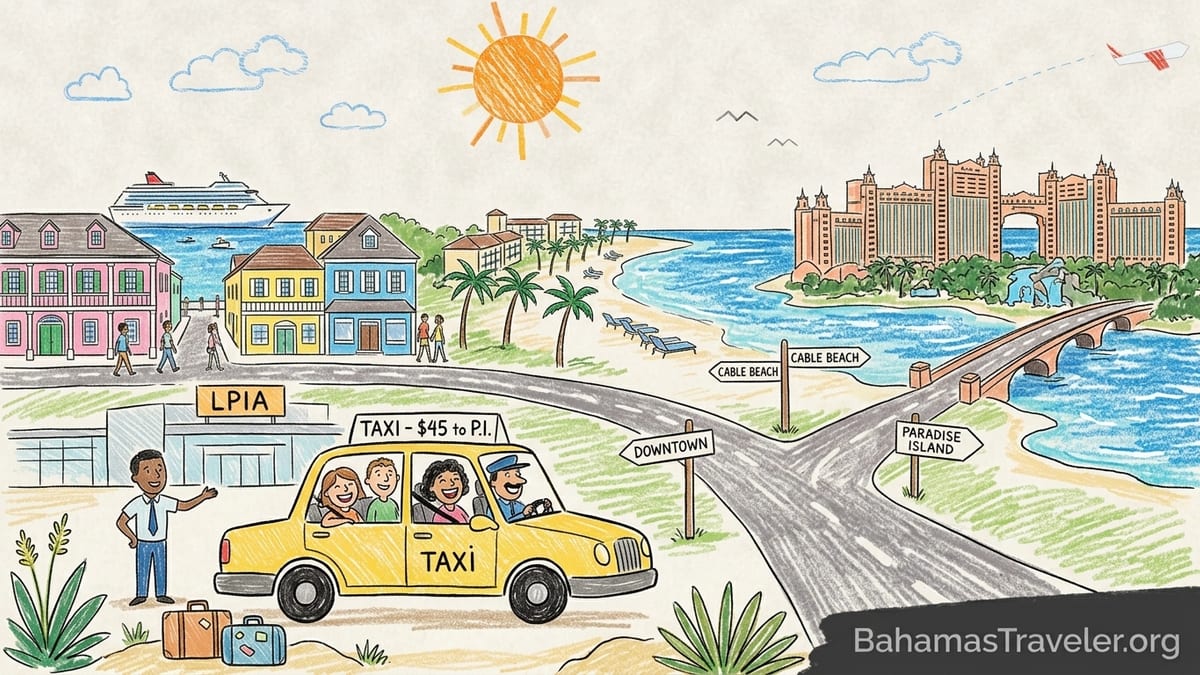
Arriving At Lynden Pindling International Airport And My First Cost Surprise
Walking into Lynden Pindling International Airport (LPIA) felt immediately familiar in the best way: that compact, sunny, slightly bustling Caribbean airport rhythm where everyone is moving, but nobody is sprinting. As soon as I stepped outside, the heat wrapped around me like a wet towel, and I realized I’d underestimated how quickly the sun drains you here, even before you start “vacation activities.” I slowed down, re-checked my phone for my hotel notes, and followed the signs toward the taxi line.
Here’s where my first practical lesson hit. Nassau runs on taxi zone fares in a way that’s straightforward once you know it, but it’s not the kind of place where you just hop in and assume a meter is running. I asked the dispatcher before I got into the car, and I’m glad I did because it set the tone for the whole trip: confirm the fare, confirm if tolls apply, then get in. The posted LPIA taxi fare to Paradise Island is B$45 for two passengers, plus the bridge toll, which is listed separately on published rate cards as B$2. That means the ride starts feeling “fixed,” but the extras can creep in if you’re not thinking about baggage or additional passengers.
I chose a regular taxi rather than trying to improvise a shared shuttle on arrival because I was tired, sweaty, and carrying more than I wanted to wrangle on a first day. The drive itself was short enough that I could stay alert and orient myself. What I remember most is how quickly the scenery changes: airport roads, then neighborhoods, then suddenly water glimpses and resort signage. My driver talked in that relaxed Nassau cadence, and when traffic thickened near the main corridors, it wasn’t gridlock, just the kind of slow-down that reminded me this is a real city with rush hours and school runs, not a theme park.
Where I Stayed And How Nassau’s Neighborhoods Actually Felt
I split my time to understand the island in practice, not just in theory: a few nights near Downtown Nassau for walkability and local texture, then time over by Cable Beach for a resort-style reset. That choice ended up shaping everything I did, because Nassau is a place where “nearby” can still mean a sweaty walk you won’t want to do at noon.
Downtown, I felt the cruise ship pulse immediately. In the morning, the streets had an almost staged energy, with vendors setting up, tour groups clustering, and that distinct mix of vacation voices and local workday routines. Then, later in the afternoon, it could quiet down fast in certain pockets, and the contrast made me more deliberate about where I wandered. I learned to treat Downtown as a place for daytime exploring and early evening dinners, not aimless late-night strolling.
Cable Beach, by comparison, felt like Nassau’s “wide-screen” version of the Bahamas. Sidewalks and resort entrances, long frontage, and a different kind of traffic: fewer tour buses, more taxis dropping off couples in linen sets. The vibe was calmer, more insulated, and the evenings felt designed. You could spend an entire day without needing to decide anything, and I understood why some travelers never leave their resort strip.
Paradise Island was the third world entirely. Crossing the bridge felt like passing through a seam in the map. It wasn’t just “another neighborhood” to me, it was a curated environment that runs on wristbands, reservations, and resort logic. Even when I wasn’t staying there, I could feel the difference: more controlled access points, more signage, more people in purposeful motion toward specific attractions.
Getting Around: My Taxi Rides, My Jitney Attempt, And The Pace Of Island Movement
I used three transport modes repeatedly: taxis, one jitney ride, and walking. Taxis were my default because they were easy to find in tourist zones and they matched the way Nassau days unfold: beach, then lunch, then an attraction, then back for a shower before dinner. The key was asking the fare before I got in, especially when crossing to Paradise Island where tolls apply. On one Downtown-to-Paradise hop, the ride was quick, but it reminded me that “quick” can still be expensive when you’re doing it multiple times across a trip.
I also tried the local jitney once specifically to ground myself in how locals move through Nassau. The fare I’d researched was US$1.50 per person for common routes, including the run out toward Cable Beach. That number is so low compared with taxi pricing that it almost dares you to try it. My experience was that it works, but you have to relax your schedule. The bus wasn’t “late,” it arrived when it arrived, and it stopped as needed. Inside, it felt like a real commute, not a tour. I kept my bag close, stayed aware, and treated it like public transit anywhere: fine when you’re sensible, not ideal when you’re carrying a day’s worth of beach gear and impatience.
Walking was my sneaky budget drain, not because walking costs money, but because the heat changed my decision-making. I’d set out thinking I’d do a long walk, then I’d spot a shaded café and pay for a cold drink I hadn’t planned on. Or I’d decide I “needed” a taxi for what I could have walked if it were 15 degrees cooler. My practical tip after living it is simple: plan midday as “shade time.” Do museums, long lunches, distilleries, or anything that keeps you out of direct sun from late morning through mid-afternoon.
Another small thing that became big: I started carrying small bills because it made every short taxi ride and snack purchase smoother. I also learned not to treat every transfer as casual. If I was heading to something timed, I left earlier than I thought I needed to. Nassau traffic isn’t constant, but it can bunch up enough to make you sweat twice: once from the weather, once from watching the minutes tick.
Downtown Nassau Days: What I Loved, What Felt Tourist-Trappy, And What I’d Do Again
My best Downtown day started early, before the streets filled. I walked Bay Street with a coffee, not because it was serene, but because I wanted to see the city wake up. What surprised me is how much Downtown felt like a place people actually work. It’s not a quaint old town preserved for visitors. It’s commerce, banks, government buildings, quick lunches, and then a layer of tourism laid over it.
I visited John Watling’s Distillery at the Buena Vista Estate, and it became one of the most satisfying “low-pressure” stops of my trip. According to their posted visitor information, they offer complimentary guided tours and they’re open daily from 10 a.m. to 6 p.m., excluding Bahamian national holidays. The visit felt like a heat break that still delivered something distinctively Bahamian. I lingered longer than I expected, partly because it was genuinely pleasant and partly because I didn’t want to step back into the sun yet.
I also did the classic Queen’s Staircase area, and I’m glad I went, but I’m equally glad I didn’t build my whole day around it. In real life, it’s one of those quick-impact attractions: you arrive, you take it in, you take the photos, and then you decide what’s next. It’s worth it if you pair it with nearby stops and you’re honest about the fact that it’s not an all-day experience.
One thing I would skip next time is any “hard-sell” shopping pitch that tries to turn a quick browse into an itinerary. I don’t mind paying tourist prices for something I truly want, but I do mind losing time and energy in the midday heat being guided store-to-store. Downtown Nassau rewards travelers who arrive with a short list: one or two cultural stops, one sit-down meal, and then a retreat to water or shade before you get fried.
Cable Beach: My Resort-Strip Reality Check (And Why It Felt Like A Different Island)
Cable Beach was where I went when I wanted to stop thinking. The sand felt wide and the horizon felt uncluttered in a way Downtown never does. Even the soundscape changed: fewer horns, more wind, more pool music drifting from big properties. It wasn’t “better,” but it was easier. If you’re traveling with family, or you want a classic lounge-chair vacation, this is the zone that makes Nassau feel effortless.
I built one of my days around Baha Bay at Baha Mar, partly because I wanted a modern waterpark day that didn’t require me to stay inside a single resort bubble all week. Their official FAQ lists operating hours as 10 a.m. to 6 p.m., which mattered because I learned quickly that arriving late makes a day pass feel like bad math. The afternoon sun can be brutal, and the last thing you want is to pay for a full day and then realize you only have a few hours of energy.
My mistake here was underestimating the “extras” that tag along with a day built in a resort complex: a snack becomes a meal, a drink becomes two, a towel feels included until you realize you’re tempted by a better chair setup, and suddenly you’re spending more than you would wandering Downtown. I’m not sharing that as a warning against it, but as a reminder that Cable Beach days are where budgets quietly go to sleep.
If I were organizing this trip again, I’d pick Cable Beach for the part of the week when I knew I’d be tired. I’d schedule my “do stuff” days earlier in the trip, then let Cable Beach absorb the slack. It’s the best part of Nassau for strategic laziness, and I mean that as a compliment.
Paradise Island: Day Pass Logistics, Beach Time, And The Atlantis Price Reality
I crossed to Paradise Island multiple times, and each time felt like stepping into a different set of rules. The big magnet here is Atlantis, and I planned for it like an event because that’s how it functions. I researched day passes in advance and learned that official Atlantis Day Pass wristbands can only be issued by an Atlantis representative onsite. That detail matters because you can’t assume you’ll stroll up and improvise your way into everything.
Once I was there, I understood the appeal immediately. The atmosphere is high-energy, and it’s not shy about being a spectacle. But it also confirmed a hard truth: this is not the place to arrive “hoping it’s all included.” Atlantis itself emphasizes that it is not an all-inclusive resort, and that mindset shift saved me money and frustration. I treated every meal and every add-on like a deliberate choice rather than a surprise bill waiting to happen.
On the beach side, what stayed with me were the small sensory details: water that looked impossibly clear from a distance, then turned lively with swimmers once I stepped in; sand that felt hotter than I expected under direct midday sun; and crowds that swelled and thinned depending on cruise ship rhythms and school-holiday timing. It wasn’t empty paradise, but it also didn’t feel miserable. It felt like what it is: one of the Caribbean’s most famous resort zones doing what famous resort zones do.
If you’re budgeting, the published LPIA airport taxi fare to Paradise Island is B$45 for up to two passengers, plus the bridge toll listed separately as B$2. That single number sounds manageable until you realize you’ll likely do multiple crossings during a trip, and each one chips away at the “I’ll just pop over” fantasy. Next time, I’d cluster my Paradise Island plans into one full day rather than treating it like a repeated side quest.
The Takeaway
Nassau rewarded me most when I stopped trying to force one unified “island vibe” onto it. Downtown Nassau is for texture: history, daily life, quick cultural wins, and lunches that feel like you’re in a capital city, not a resort. Cable Beach is for decompression: long shoreline, large resorts, and days that run on shade and pool time. Paradise Island is for spectacle: engineered fun, day-pass logic, and the kind of polished atmosphere that can be thrilling if you know what you’re buying into.
The moments that changed my expectations were never the big-ticket attractions. They were the practical flashes: realizing a five-minute walk at noon can feel like a hike, learning that confirming a taxi zone fare is a kindness to your own mood, noticing how quickly cruise-day crowds can shift the entire energy of Downtown, and accepting that resort areas are built to make spending feel frictionless. Once I understood those rhythms, I started enjoying Nassau more, not less.
If I could redo my trip with what I know now, I’d plan fewer transitions per day, start earlier each morning, reserve one full day for Paradise Island, and leave one full day intentionally unplanned for whatever weather and energy allowed. I’d still eat conch, still chase the bluest water, still do at least one paid day pass experience, but I’d do it with clearer expectations about the real costs and the real pace of this place.
FAQ
Q1. What is the current taxi fare from Nassau airport to Paradise Island?
The published LPIA taxi zone fare to Paradise Island is B$45 for up to two passengers, plus a separately listed B$2 bridge toll.
Q2. What is the taxi fare from Nassau airport to Downtown Nassau?
Published airport taxi zone fares list Downtown Nassau at B$36 for up to two passengers.
Q3. How much does the jitney bus cost in Nassau, and is it realistic for tourists?
Commonly published guidance lists the jitney fare at about US$1.50 per person for standard routes, and it can work for tourists if you stay flexible and travel light.
Q4. What are Baha Bay’s operating hours right now?
Baha Bay’s official FAQ lists operating hours as 10 a.m. to 6 p.m.
Q5. Can I get an Atlantis day pass without staying at Atlantis?
Yes, Atlantis offers day passes, and official information notes that day-pass wristbands must be issued onsite by an Atlantis representative.
Q6. Is Atlantis Bahamas an all-inclusive resort?
No. Atlantis states that it is not an all-inclusive resort, so you should expect extra costs for most food, beverages, and many add-ons.
Q7. When is Atlantic hurricane season, and how should that affect planning?
The Atlantic hurricane season officially runs from June 1 to November 30. I plan trips in that window with flexible reservations and a weather backup plan.
Q8. What are John Watling’s Distillery hours, and does it cost anything to tour?
John Watling’s Distillery posts that it is open daily from 10 a.m. to 6 p.m. and offers complimentary guided tours, excluding national holidays.
Q9. What is the VAT rate in The Bahamas, and will I see it on trip expenses?
The Bahamas applies a standard VAT rate of 10%. In practice, that can show up across many goods and services you buy during a Nassau trip.
Q10. If I only have time for one area, which should I prioritize: Downtown, Cable Beach, or Paradise Island?
For culture and city texture I prioritize Downtown. For relaxed beach-resort days I prioritize Cable Beach. For attractions and a high-energy resort universe I prioritize Paradise Island.