


I used to think I “knew” The Bahamas because I’d done Nassau and a quick day on Grand Bahama. Then I started hearing locals use a phrase I couldn’t stop thinking about: the Family Islands. In Bahamian everyday language, “Family Islands” means the islands outside the two big gateway hubs, Nassau on New Providence and Freeport on Grand Bahama. The official tourism framing lines up with that local usage, too: it’s essentially every Bahamian island group beyond Nassau and Freeport, from the Exumas and Eleuthera to Andros, Abaco, Cat Island, Long Island, and more. Once I began hopping those smaller islands, I realized the biggest difference isn’t just fewer cruise passengers. It’s the way distance shapes everything: flight times, store shelves, dinner options, road conditions, cell signal, and what the nights feel like after the day visitors vanish.
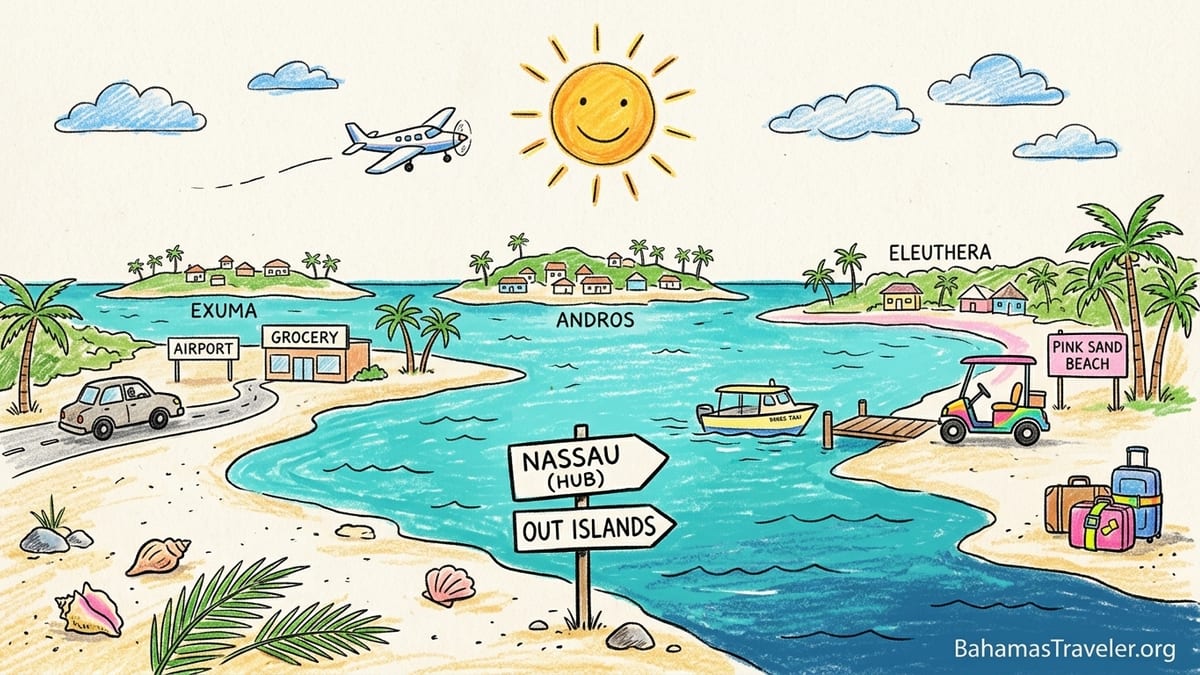
What “Family Islands” Really Means, and Why It Matters for Planning
On paper, it’s a simple definition: the Family Islands (also called the Out Islands) are the Bahamian islands outside Nassau and Freeport. In practice, that definition changes the way you plan your trip because it changes your baseline expectations. Nassau is built for volume. Many Family Islands are built for the people who live there first, and visitors second.
That difference shows up immediately in the logistics. In Nassau, if you miss a dinner reservation, you can walk into another restaurant. On a smaller island, a place might close early, run out of a menu item, or stop serving entirely if the generator acts up or the boat delivery was delayed. I had to stop thinking like I was planning a resort vacation and start thinking like I was visiting a small community that happens to be surrounded by some of the most photogenic water on Earth.
It also matters because “Family Island travel” usually means at least one extra connection. Even when an island has direct international flights seasonally, the most common setup is still a hop through Nassau. I learned to treat Nassau like a true transit hub: buffer time, early check-in, and a willingness to roll with schedule changes, especially in summer and early fall when weather can be part of the story.
How I Actually Got Around: The Small Aircraft, The Lines, The Baggage Reality
I did my Family Islands trip as a string of short flights out of Nassau, and those flights felt like a completely different category of travel than my international arrival. The domestic side of Nassau’s airport operates in the same overall complex, but the rhythm is its own: more locals traveling with coolers and taped boxes, more “we’re all on the same flight so we’re all in this together,” and less of the polished conveyor-belt feel you get in bigger terminals.
The first lesson I learned was a hard one: domestic check-in timing is not optional. Bahamasair’s published cutoff for domestic check-in is 60 minutes before departure, and the recommended arrival time is about two hours before a domestic flight. That sounds conservative until you’re standing in a line that suddenly grows because two flights are boarding close together and several passengers need baggage help at the counter.
The second lesson was baggage. On these hops, checked bags are normal, but the handling feels more human than automated. On more than one arrival, my suitcase didn’t pop out on a polished carousel. It came through quickly and plainly, the kind of “here it is” handoff that makes you glad you packed a bright luggage strap. I stopped bringing anything fragile in checked baggage and started putting essentials in my personal item as if I might be separated from my suitcase for a night.
My third lesson was mental. These flights are short, but they are real flights with real constraints. I learned to book earlier departures when I could and avoid tight connections on separate tickets. If your international flight lands late, you can lose the whole day. If you’re building an island-hopping itinerary, I now treat travel days as travel days and plan nothing “important” for the afternoon besides groceries and a beach close to where I’m staying.
Exuma (Great Exuma): The First Island That Reset My Expectations
Exuma was the island that made me understand why people insist you can’t judge The Bahamas by Nassau alone. I flew from Nassau into Exuma International Airport (GGT), and within minutes I felt the scale shift. The airport is functional and straightforward, and the transition from plane to outdoors is fast. There’s no long runway-adjacent maze of shops. It’s more like arriving somewhere that expects you to get on with your day.
I rented a car and immediately understood why people describe driving as part of the Exuma experience. The roads were good enough to be comfortable, but they demanded attention in a different way than Nassau: fewer streetlights, darker stretches at night, and the constant temptation to stop for yet another view of water that looks edited. I underestimated how quickly I’d rely on my own wheels for everything, including basic errands.
Groceries were my first practical stop, and it’s where I felt the “imported-island” reality. I remember paying what felt like city prices, sometimes more, for simple items. I started shopping like I was on a sailboat: buy what you know you’ll use, be flexible with brands, and don’t assume the exact snack you want will be there. I also learned to ask what day shipments usually come in, because the best selection can depend on timing.
Evenings in Exuma were my favorite kind of quiet. After sunset, it wasn’t a nightclub energy. It was porch lights, a soft soundtrack of insects and distant music, and a sense that the island was returning to itself. I’d underestimated how much I would like that, and also how much it requires you to plan ahead. If you want dinner at a specific spot, you don’t drift until 9 p.m. and hope. You go when it’s open, and you respect that “island time” includes early kitchen cutoffs.
Eleuthera and Harbour Island: Pink Sand, Golf Carts, and the “Two-Trip” Problem
Eleuthera and Harbour Island were where I learned the “two-trip” problem: you can arrive somewhere gorgeous and still spend the first day just figuring out the geometry of how life works. I flew into North Eleuthera Airport (ELH), and the airport experience was quick and no-fuss. The bigger adjustment came right after: this is a region where your transport plan often involves layers, like a short taxi, a water taxi, and then a golf cart, depending on where you’re staying.
On Harbour Island, the golf cart is not a novelty. It’s the rental car. I rented one and immediately appreciated two things: first, how small the island feels when you’re moving at golf-cart speed; and second, how important it is to confirm battery range and charging expectations with the rental company if you’re staying far from where you pick up the cart. The roads, in my memory, felt tight and busy in pockets, and then suddenly calm as you move away from the busiest lanes.
Pink Sand Beach lived up to the hype, but what I didn’t expect was how the vibe changes through the day. Midday can feel like a glossy magazine shoot with people drifting in and out. Later, it becomes softer and more local, like the island has exhaled. That’s when I found myself lingering: the light going warm, the conversations quieter, the sense that you’ve finally arrived.
Wi-Fi and mobile signal were good enough for messages and basic planning, but I stopped trying to “work like normal.” I could do essentials. I couldn’t always do video calls with the confidence I’d have in Nassau. It wasn’t a dealbreaker. It was a reminder: if you’re coming to the Family Islands, consider that the point might be to loosen your grip on constant connectivity.
Andros: The Island Where Remoteness Felt Real, Not Romantic
Andros was where I realized I’d been romanticizing remoteness. In Nassau, you can fix a mistake quickly. On Andros, you fix it slowly or you live with it until tomorrow. I got there on a short hop, and the arrival felt like stepping into a quieter, less tourist-shaped Bahamas. It felt more lived-in than curated, and I mean that as a compliment.
Driving on Andros made me pay attention. Road conditions can vary, and distances can feel longer because there’s less visual clutter to trick you into thinking you’re “making progress.” I learned to keep more fuel than I thought I needed and to treat daylight as a planning tool. If you’re not comfortable driving at night on darker roads, you build your day around that reality.
Food and supplies were another lesson in planning. I could get what I needed, but I stopped expecting abundance. If you’re the kind of traveler who likes to cook, Andros rewards you if you arrive with a plan and a few key items in your suitcase. If you’re the kind who wants to eat out every night with lots of choices, you need to be realistic about what the island offers and how early things can close.
The payoff was the feeling of space. The beaches felt wide and uncrowded, and the island felt like it had more room for silence than anywhere I’d visited in The Bahamas. I also felt, more than on other islands, that you should travel respectfully here. You’re not just passing through a tourism machine. You’re visiting someone’s home island.
Abaco: What I Learned About Recovery, Availability, and Checking What’s Open
Abaco was the part of my trip that taught me to verify the “factual layer” before I commit money. Flights to Marsh Harbour (MHH) exist and are bookable, but availability and what’s operating can shift by season, and conditions on the ground can change. I learned not to assume that every hotel, restaurant, and marina listing I see online reflects what’s actually open that month.
When I arrived, the airport experience was straightforward in the way small airports often are: quick, practical, and focused on getting you out the door. What felt different from Nassau was the way you immediately notice the local pace. People were friendly, but not “tourism-script friendly.” It felt like a place where visitors are welcome, but you’re expected to adapt.
Transportation in Abaco pushed me to think in neighborhoods rather than “the island.” Where you stay changes the trip. If you’re trying to do boat days, you plan around weather and marina logistics. If you’re staying inland, you plan around driving and where you’ll buy groceries. The practical reality is that Abaco rewards travelers who confirm details directly with accommodations and local operators before arrival, especially in shoulder seasons.
At night, Abaco felt calmer than Nassau, with fewer big-production entertainment options and more of a small-town vibe. I remember dinners that felt early, sunsets that felt like the main event, and evenings where the soundtrack was the wind and whatever music drifted from a nearby porch. That’s exactly what I came for, but I had to admit it isn’t for everyone.
Taxes, Seasons, and the Details I Now Build Into Every Family Islands Itinerary
If you only take one practical planning lesson from me, let it be this: the Bahamas looks close on a map, but the details add up fast. Taxes and fees can meaningfully change your final lodging and dining totals, and they don’t always feel consistent across properties. On major-resort islands like Nassau and Paradise Island, some hotels publish detailed breakdowns that show how VAT and local levies stack up. On smaller islands, you may see simpler invoices, but you still need to ask what taxes and service charges are included.
Departure taxes are another detail I now keep in mind when budgeting. Official guidance has stated a government departure tax for people leaving The Bahamas, and the amount can be presented in different contexts depending on whether you’re flying commercial or private and how it is bundled into your ticket. I no longer guess. I assume taxes exist, and I confirm what is included in the fare before I celebrate a “deal.”
Hurricane season is the other planning cornerstone. The Bahamas’ hurricane season broadly overlaps the Atlantic hurricane season, and local materials often describe the risk window as June through November. That doesn’t mean “don’t go.” It means go with better habits: buy travel insurance you understand, keep your itinerary flexible, avoid stacking nonrefundable bookings across multiple islands, and leave yourself a buffer day if you’re flying home right after an outer-island hop.
Finally, inter-island transportation has its own rhythm. Flights are the fastest, but schedules can change. Ferries and mailboats exist on some routes, but they are not always a daily, tourist-friendly system you can rely on like a commuter train. If you’re determined to use a boat transfer, I learned to verify the operator’s current sailing days and check-in rules in the same way you would verify a flight.
The Takeaway
What made the Family Islands feel different from Nassau wasn’t just the lack of high-rises. It was the way each day had edges. Stores close earlier. Dinner can be earlier. Roads get darker. Shipping schedules quietly determine what’s on the shelf. You start paying attention, and you start traveling more intentionally.
The thing I underestimated most was how remoteness affects the “little stuff” that makes a trip comfortable: finding ice, keeping your phone charged in a rental car, getting the one grocery item that turns dinner into dinner, and having a plan when the weather shifts. I also underestimated how much I’d enjoy the emotional side of it: evenings that feel like the island belongs to itself again once the day visitors are gone.
If I could redo my route, I would stay longer on Exuma. It was the island that balanced ease and beauty best for my style of travel: enough infrastructure to feel comfortable, enough quiet to feel like I’d escaped, and enough water-front moments that didn’t require a “big excursion” to feel special.
I still like Nassau for what it is: a convenient gateway with energy, dining, and big-resort ease. But the Family Islands taught me what I actually want from The Bahamas: not a checklist of attractions, but a slower, more grounded experience where the best part of the day can be the walk back from the beach when the light turns soft and the island gets quiet.
FAQ
Q1. What are the “Family Islands” in The Bahamas?
Locals commonly use “Family Islands” to mean the Bahamian islands outside the main gateways of Nassau (New Providence) and Freeport (Grand Bahama), essentially the Out Islands.
Q2. Do I have to connect through Nassau to reach the Family Islands?
Often, yes. Some islands have nonstop international flights in certain seasons, but many itineraries still connect through Nassau for inter-island hops.
Q3. How early should I arrive for a domestic Bahamas flight?
I plan to arrive about two hours early. Domestic check-in for many carriers has firm cutoff times, and missing them can derail the whole day.
Q4. Are inter-island flights reliable enough for tight connections?
I don’t plan tight connections, especially on separate tickets. Short delays can cascade, so I build buffer time and treat travel days as flexible days.
Q5. Is it better to rent a car or rely on taxis on the Family Islands?
On islands like Exuma and parts of Eleuthera, I preferred having my own wheels. On Harbour Island, a golf cart is often the most practical option.
Q6. What should I expect for groceries and prices?
Expect imported-island pricing and occasional gaps in selection. I shop early in the stay, stay flexible on brands, and don’t count on one specific product.
Q7. How is Wi-Fi and mobile service on the Family Islands?
Good enough for basics in many places, but not always consistent for heavy remote work. I plan for downtime and avoid scheduling critical calls.
Q8. When is hurricane season in The Bahamas?
The riskier window is generally June through November. That doesn’t mean you can’t travel, but it’s when I prioritize flexible bookings and insurance.
Q9. Are ferries a dependable alternative to flying?
Sometimes, but routes and sailing days can be limited. I only plan a ferry day after confirming the current schedule and check-in requirements.
Q10. Which island would I stay longer on next time?
Exuma. It delivered the best mix of easy logistics, memorable beaches, and calm evenings without feeling like I needed a packed itinerary.