


I keep returning to the Bahamas for a very specific kind of dive trip: warm water, short boat rides, and the rhythm of wake up, gear up, splash, repeat. The Family Islands are where that rhythm becomes easiest to live, because the best stays are built around diving, not merely adjacent to it. The Bahamas’ official 2025 hotel directory even treats dedicated dive lodges as their own Family Island accommodation category, which matches what I felt on the ground: when the dock, compressors, rinse tanks, and crew are part of the property’s daily pulse, you spend less time coordinating and more time underwater.
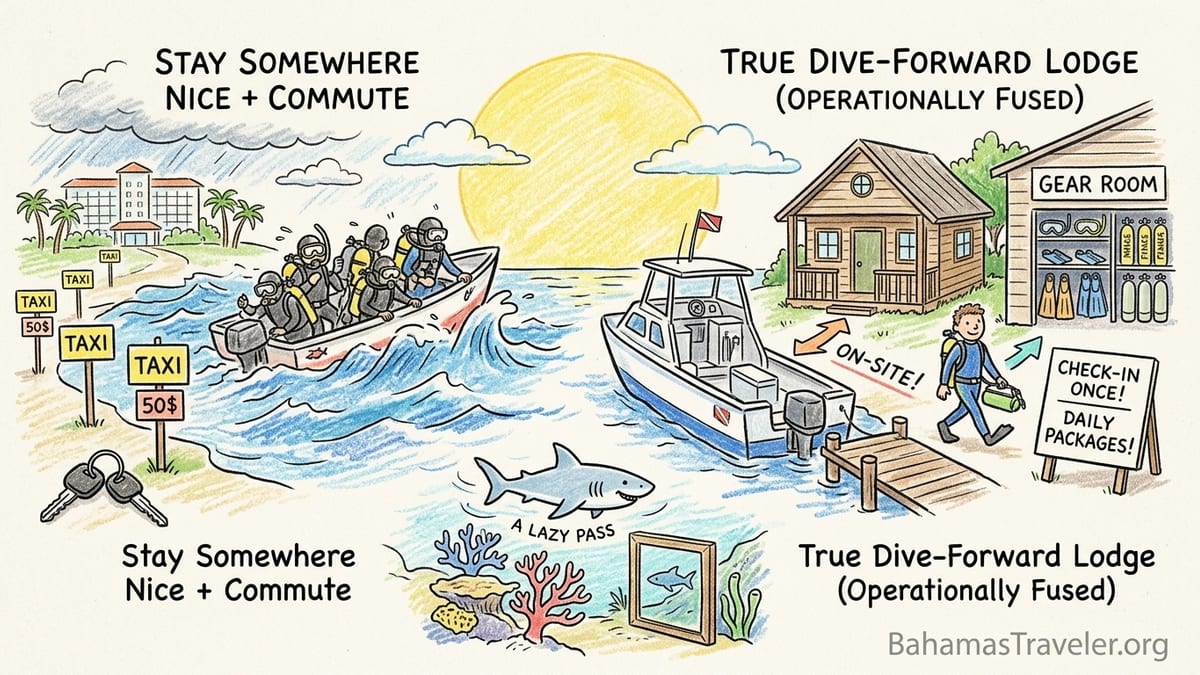
How I Judge A Family Island Dive Stay (And Why Dive Lodges Win)
I’ve done Bahamas trips both ways: staying “somewhere nice” and commuting to an independent operator, and staying at a true dive-forward property where the dive center is either on-site or operationally fused to the resort. In the Family Islands, the second approach is usually what makes a week feel frictionless. Boats tend to run on tighter schedules, taxi options can be limited or expensive, and weather windows are too precious to waste on logistics.
My ideal setup is simple: I can walk from my room to a gear area, hand over a certification card once at check-in, and let the staff handle the rest while I focus on buoyancy, camera settings, and bottom time. I also look for small boats or small groups. In the Bahamas, I’m not chasing mega-schools of fish the way I might in the Pacific. I’m looking for clear water, healthy spur-and-groove structure, dramatic ledges, and the moments that make the Caribbean feel alive: a turtle cruising the drop-off, a reef shark doing a lazy pass, or a perfectly framed swim-through that makes you stop and just hover.
When I’m researching a return trip, I also check operator availability and the reality of “packages.” Some islands have one primary dive operation that effectively sets the cadence for visiting divers. Others are best done via a lodge that anchors the whole week. That’s the lens for everything below: what it felt like to actually dive these places, and whether the accommodation made multi-day diving easier or harder.
Andros: Small Hope Bay Lodge, Where The Week Turns Into A Routine
Andros is the island I recommend when someone tells me they want a real dive lodge experience in the Bahamas, not just a hotel with a dive desk. Small Hope Bay Lodge is built around that classic routine: you wake early, wander to breakfast, and by the time your coffee hits, the day’s diving feels pre-planned in the best way. When I arrived, dive-center check-in was straightforward: certification verification, waivers, and a quick gear conversation so the staff could match what I brought with what I needed on-site. From that point forward, the feeling was less “booking excursions” and more “joining the lodge’s dive week.”
On my boat days, what stood out was how little time I spent worrying. Gear lived in a predictable place and moved like clockwork: set, loaded, dived, rinsed, dried, repeated. The dive briefings were the kind I like: not theatrical, but practical. Site orientation, maximum depth, typical current behavior, and the exact plan for descent, route, and ascent. Andros diving also has that particular emotional note: the sense of space as the reef structure gives way toward deeper water. On my dives, visibility was the kind of clear that makes distance hard to judge, and the water felt consistently comfortable for long bottom times, especially once I settled into a wetsuit choice that matched the season. Marine life was classic Bahamas: reef fish schools in the shallows, the occasional larger silhouette on the edge, and those long glides along structure that make you forget you’re watching your pressure gauge.
Staying at a dedicated lodge mattered here. Andros is not the island where I’d want to rely on daily commuting from a random rental to a far-off dock, especially if I’m doing multiple days in a row. The lodge rhythm made multi-day diving easier because it reduced the number of decisions I had to make each morning. Non-diving time also felt designed for divers: meals were timed around the boats, there was a casual end-of-day energy, and the property itself made it easy to rest between dives without feeling like I had to “go find” entertainment. If I were returning to Andros for pure dive immersion, this is still where I’d start.
Andros (South): Andros Beach Club + On-Site Diving For Small-Group Wall Days
South Andros is a different flavor: more remote, more private, and in my experience better for travelers who want a quieter resort feel while still treating diving as the main event. At Andros Beach Club, the key detail is that the dive operation is on-site and positioned as part of the resort experience. The check-in process felt like what you’d expect at a property that knows divers: certification confirmation, sizing and equipment needs, and then a simple explanation of how the week runs. I didn’t feel “processed.” I felt looked after, which is a subtle but real difference when you’re about to spend days in the water.
What I remember most from the boat days was the small-group vibe. The operation emphasizes limited numbers, and in practice that meant less crowding on deck and less waiting in the water. Briefings were clear, with a focus on safety and enjoyment: how to approach the wall, what to do if the current picked up, and how they wanted us to regroup. Conditions in Andros can vary by wind and season, but on my dives I had strong visibility and that bright Bahamian light that makes reef edges look etched. Depth profiles were the classic Bahamas pattern: spend time shallower first, then let the terrain invite you deeper, then return to the sunlight for a slower ascent and safety stop.
This is also where the “dive lodge vs. commute” argument becomes real. If your resort is not integrated with your diving, you end up managing boat departure times, transportation, and the small stuff that steals energy: wet gear in a rental, rinse logistics, and the constant micro-planning that can turn a dive holiday into a checklist. Here, I had the opposite experience: diving felt like the default setting. Between dives, I could actually enjoy the resort, not just crash in my room. That’s the reason I’d stay again: not because every single dive was dramatically different, but because the whole week stayed easy.
Bimini: Big Game Club With Neal Watson’s Bimini Scuba Center, A Short-Flight Shark Fix
Bimini is my go-to when I want maximum underwater payoff with minimal travel time from the U.S. It’s the Bahamas trip you can do like a long weekend, yet still come home with stories that sound like you went much farther. I’ve paired Bimini Big Game Club with Neal Watson’s Bimini Scuba Center because the diving and lodging coordination is already built into the island’s established pattern. Their current dive-and-hotel packages are set up as real bundled trips, with multi-day diving baked in rather than treated as an add-on.
Dive-center check-in in Bimini felt more like a busy, capable operation than a tiny lodge, which makes sense for an island that often serves both dedicated divers and people squeezing in a day on a cruise stop. The key functional moment was the paperwork and verification process: they collect certification details and confirm what gear you’re bringing versus renting, which is exactly what you want before the boat schedule starts. Once that’s done, the days move fast. Boats are set up for efficiency, and the crew runs a tight system so everyone gets in and out cleanly.
Underwater, Bimini delivered what I came for: clear water, purposeful sites, and the kind of animal encounters that can dominate a trip memory. On my dives, visibility was strong and the water temperature stayed in that comfortable Bahamas range where you can decide your exposure protection based on personal tolerance rather than necessity. Briefings were direct, especially for shark-forward dives and wreck-oriented plans: where to position, how to maintain spacing, how to manage buoyancy and finning to keep the scene calm. I also liked that staying at the resort made early departures and post-dive downtime easy. I could rinse off, grab a meal, and actually enjoy Bimini’s laid-back marina vibe without feeling like I was shuttling between two separate vacations.
San Salvador: Riding Rock Resort, The Rare Place I’d Book For The Diving First
Some islands are great all-rounders. San Salvador is a diver’s island first, and Riding Rock Resort is the kind of dedicated setup that makes that possible without stress. The package structure is built around dive days, and the resort has a long-running dive identity. When I arrived, it felt like stepping into a routine that has been repeated for decades: divers checking in, crew sorting gear, and the property’s social life organized around who is diving what site tomorrow.
Dive operations here felt like classic dive-resort diving: set times, clear briefings, and a sense that the crew knows the local conditions well. On my dives, the best moments came from dramatic structure and the way marine life uses it: patrol paths along reef edges, fish aggregations around features, and that occasional pass-by that makes everyone’s heads turn at once. Conditions were what you hope for in the Bahamas: warm enough to keep you in the water for multiple dives a day, and visibility that made navigation feel intuitive. Currents were manageable on my days, but briefings accounted for the possibility of flow and explained how they wanted the group to respond if the water moved more than expected.
Staying on-site mattered more here than almost anywhere else I’ve dived in the Bahamas. San Salvador is not a place I’d want to “piece together” with separate lodging and an operator across the island unless I had a very specific reason. The resort made multi-day diving easy because it removed transit uncertainty and kept everything on diver time. Non-diving time felt exactly right for a dive-heavy itinerary: meals, casual drinks, recovery, and early nights when you want them. If I were going back purely to dive walls and reefs with minimal distraction, this is a repeat booking for me.
Cat Island: Greenwood Beach Resort, Quiet Shoreline, Small-Scale Diving
Cat Island is where I go when I want the opposite of a busy dive scene. Greenwood Beach Resort felt like the kind of place that doesn’t try to entertain you into exhaustion. It gives you beach, space, and the sense that you’re living on an island rather than visiting a product. The dive operation is boutique in feel, and that tone starts at check-in: a calmer pace, a smaller group expectation, and an emphasis on keeping things simple.
On my dive days, the briefings were personal and scaled to the group. The number of divers per guide was small enough that I never felt like I was fighting for attention or being rushed through a site. Conditions on my dives matched what I associate with the Family Islands: clear water, warm temperatures, and reefs that reward slow observation more than aggressive mileage. Visibility was good enough that I could maintain awareness of the group without needing to stack closely, and the currents I experienced were mild. Reef condition is always a sensitive topic in the Caribbean, and I’m careful not to generalize from a handful of dives, but I came away feeling that Cat Island’s underwater scenery was worth the trip for divers who value quiet, uncrowded water time over high-adrenaline encounters.
As an accommodation choice, Greenwood worked best when I treated it as a true stay-put vacation. If you want nightlife or lots of dining variety, you might find it too calm. But if your plan is to dive, read, walk the beach, and sleep well, it’s close to perfect. For multi-day diving, staying where the dive center is integrated with the property made the week feel cohesive. I didn’t have to keep shifting into “planning mode.” I could stay in “island mode,” which is exactly why I’d return.
Exuma, Abaco, Long Island: How I’d Plan Them Now (And What I’d Repeat)
Not every Family Island dive trip needs to be a classic dive lodge week, and in a few places the smartest move is to plan around the operator availability that is actually current, then choose lodging that makes the daily schedule easy. In Great Exuma, for example, Dive Exuma is listed as a PADI dive center based in George Town, which is useful because it anchors your planning to a real, named operator presence rather than wishful forum advice. If I were returning to Exuma specifically to dive again, I’d plan it as an operator-based trip with lodging chosen for proximity to where the boat actually departs, and I’d confirm schedules and rental availability well before arrival. Exuma can also be excellent as a liveaboard-style solution in the wider region, where the boat is the accommodation and the itinerary is the point.
In Abaco, I’ve treated the diving as an add-on to an island vacation rather than the entire reason to go, and that can work beautifully when you choose an operator with long-running local presence. Dive Abaco is a recognizable name serving Marsh Harbour and the surrounding cays, which matters because Abaco logistics can be spread out. For me, the best Abaco trips are the ones where your non-diving time feels genuinely full: harbor sunsets, small restaurants, and an easy cadence that makes a two-tank day feel like part of a broader itinerary, not the only activity on the calendar.
Long Island is the one I frame differently: it’s a beach-first island that can support diving as a highlight, especially if you want to see famous natural features like Dean’s Blue Hole as part of the trip. Resorts such as Cape Santa Maria can arrange dive outings, which is helpful if you’re traveling with a mixed group and want the property to handle coordination. The key planning point is that Long Island diving often feels more like “organized excursions” than “dive lodge routine,” so I’d choose it when I want variety: a dive day, a beach day, then another dive day, rather than five straight days of diving on autopilot.
The Takeaway
If I’m booking the Bahamas for diving again, I’m choosing a property that makes multi-day diving easy, even when the island itself is remote. Andros and San Salvador are where the dedicated dive lodge model shines: you wake up and the diving is already the day’s spine. Bimini is my short, sharp option, the place I go when I want clear water and big encounters without a long travel chain. Cat Island is my quiet reset, where the diving is personal and the shoreline does half the relaxing for you.
For islands like Exuma, Abaco, and Long Island, I plan around what is operationally real right now: the current dive center presence, where boats leave from, and whether the property actually reduces friction or simply offers to “arrange” things. The Family Islands reward divers who prioritize ease. When your accommodation is aligned with your diving, you get more bottom time, better rest, and fewer of those small travel headaches that shouldn’t exist on a dive vacation.
FAQ
Q1. What makes a “dive lodge” different from a regular resort in the Bahamas?
A dive lodge is organized around scheduled diving and usually has on-site dive operations or tightly integrated logistics, making multi-day diving smoother than commuting daily.
Q2. Which Family Island is best for a dedicated dive-week routine?
Andros is one of the strongest choices for a true dive-lodge rhythm, where your days naturally revolve around boat schedules, meals, and easy gear handling.
Q3. Is Bimini a good option if I only have a long weekend?
Yes. Bimini is one of the easiest Bahamas dive escapes from the U.S., and established operators offer structured multi-day dive-and-hotel packages.
Q4. Do I need to show my certification card at check-in?
Yes. Expect the dive center to verify your certification level and number, and to have you complete liability paperwork before your first boat day.
Q5. What medical paperwork should I expect for recreational diving?
Most operators require you to complete a scuba medical questionnaire. If you answer “yes” to certain conditions, you may need physician clearance before diving.
Q6. Can kids dive on the Family Islands?
Yes, but age and depth limits apply. Many training systems offer junior certifications, and operators may have additional rules based on conditions and supervision.
Q7. Is staying on-site at a dive resort worth it?
For multi-day diving on less-developed islands, it often is. On-site operations reduce transport stress and make gear storage, rinsing, and early departures much easier.
Q8. What about equipment rental, tanks, and weights?
Many Bahamas dive packages include tanks and weights, while full gear rental is usually extra. Confirm what’s included before you arrive, especially for multi-day packages.
Q9. How do I plan Exuma diving if I’m not staying at a dive lodge?
Plan around the current operator base and departure point, choose lodging nearby, and confirm schedules in advance so you’re not scrambling on the island.
Q10. If I can only pick one “dive-first” Family Island resort, what’s your repeat choice?
For a pure dive resort feel where the property exists to support diving day after day, San Salvador’s established dive-resort model is a strong repeat pick.