


On a humid Nassau morning I walked up Chippingham Road toward Ardastra Gardens, intent on answering a question I hear often from visitors to New Providence: is the flamingo march really worth carving out a chunk of island time, and is there enough beyond the famous pink parade to make this one of Nassau’s top family stops? To find out, I spent half a day at the Ardastra Gardens & Wildlife Conservation Centre, arriving in time for the late-morning flamingo presentation, exploring every pathway and enclosure, and looking at the experience through the eyes of small children, teenagers and adults who care about wildlife and photography.
Planning the Visit: Timing, Tickets and First Impressions
I visited Ardastra Gardens on a recent weekday in September 2026, timing my arrival to coincide with the first flamingo presentation of the day. Current information from the park and recent guides indicates that Ardastra opens around 9:30 a.m., with last entry mid-afternoon and closing at 4 p.m., and that flamingo shows are scheduled for 11:00 a.m., 1:30 p.m. and 3:00 p.m., subject to operational changes. I aimed to be at the gate shortly after opening so I could settle in before the 11:00 a.m. show and avoid the hotter mid-afternoon period.
At the ticket window I paid 35 US dollars for a non-resident adult admission, which matches the most recent pricing cross-checked in late August and September 2026. Children aged 4 to 12 were listed at 25 dollars, with Bahamian residents paying significantly less, and children three and under entering free. There were no surprise surcharges attached to the ticket itself, which covers entry to the grounds, access to the flamingo shows and the rest of the animal exhibits. Optional add-ons such as tortoise encounters are paid separately inside the park.
I walked through the gate at roughly 9:45 a.m. and left around 1:00 p.m., for a total stay of just over three hours. During that time I attended the 11:00 a.m. flamingo march, joined a late-morning tortoise interaction at an additional fee, and did a slow loop of the gardens with a camera in hand. Visitor numbers built steadily over the morning. Before 10:30 a.m. the park felt very quiet, with perhaps a few dozen people scattered across the grounds; by the time the flamingo show began there were around 70 to 100 visitors in the arena, including several tour groups from cruise ships and a mix of local families and independent travelers.
First impressions were of a compact, leafy refuge rather than a grand zoological park. The entrance area is modest, with a small gift shop and simple ticket counter, and within a few steps the noise of downtown Nassau falls away. The grounds cover roughly four to five acres, which is worth noting for anyone expecting a sprawling zoo. Ardastra feels more like an intimate tropical garden threaded with animal enclosures than a major metropolitan zoological park, and that scale influences how you should plan your time here.
Inside the Flamingo Arena: What the March Really Looks Like
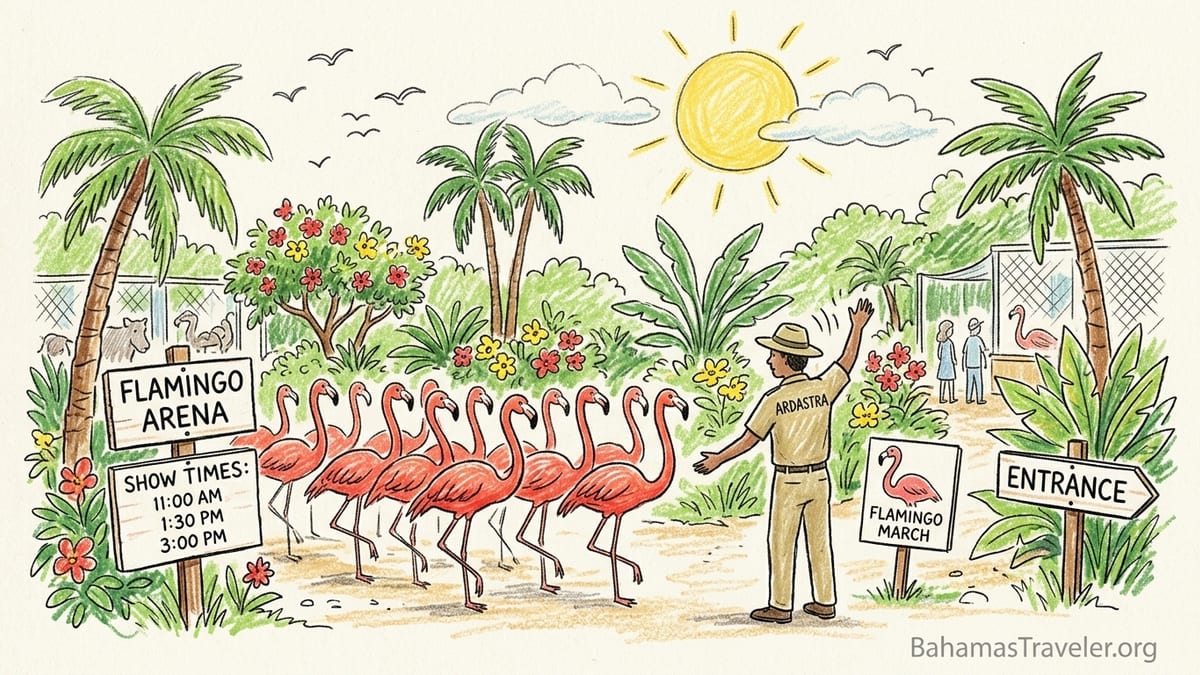
The flamingo presentation is clearly the centrepiece of an Ardastra visit, and I made a point of taking a seat at least 15 minutes before the scheduled 11:00 a.m. show. The arena is an open, sandy ring bordered by low wooden fences and simple bleacher-style seating in partial shade. Hand-painted signs and a pink flamingo cut-out give the space an old-fashioned charm that sets it apart from the slick stadiums of large commercial attractions.
When the show begins, there is no attempt to stage elaborate tricks or anthropomorphise the birds beyond what years of conditioning have made possible. A keeper walks into the arena in khaki uniform, calls to the flock in a clear, rhythmic voice and uses short commands that the birds have learned to associate with moving together. The flamingos, a brilliant coral-pink that reflects their Caribbean diet, stride into the ring from a holding area, then circle the arena in loose formation. They pause on cue, regroup, and change direction, but they never stop being unmistakably birds: some preen, a few look around in apparent confusion, one or two lag behind before catching up. The overall effect is of a gently choreographed herd rather than a regimented parade.
At several moments the keeper pauses to explain what visitors are seeing. The staff member during my visit emphasised that these are Caribbean flamingos, also known as American flamingos, and that their natural stronghold in The Bahamas is on Great Inagua, several hundred kilometres to the south. The "march" developed over time here at Ardastra, after flamingos were brought from Inagua in the 1950s, first as part of a government-backed conservation experiment and later as a breeding colony that became one of Nassau’s most recognisable tourist sights.
About halfway through the show, the keeper invited a small number of volunteers into the arena to stand in a marked circle while the flamingos walked around them. Participation is truly optional; guests who prefer to observe from the seats can do so without missing the main elements of the presentation. Photographers will appreciate that there are several natural pauses when the birds cluster or preen, offering opportunities to capture close-up shots of plumage and eye detail without needing to zoom in excessively. The entire demonstration lasted around 20 minutes, with a few extra minutes at the end for guests to take photos as the flock exited.
From Inagua to Nassau: Conservation Roots and Education
To understand Ardastra, it helps to know that it began as a garden long before it became a zoo. In the 1930s a Jamaican horticulturist, Hedley Vivian Edwards, established the original Ardastra Gardens on what was then the outskirts of Nassau. In the 1950s, as Caribbean flamingos in The Bahamas were being hunted to near extinction and wild numbers were believed to have dropped to only a few thousand birds, the Bahamian government and conservation partners looked for ways to safeguard the national bird. Part of that effort involved relocating a small group of flamingos from the vast colony on Great Inagua to Ardastra, with the aim of breeding them in a protected environment.
Historical accounts and Ardastra’s own conservation material explain that Edwards gradually realised that the birds responded to his voice and to consistent routines. Over time, what began as practical herding techniques evolved into the "march" that visitors still see today. The show is not presented as a circus act but as a legacy of that early conservation work, and staff use the presentation to explain why flamingos had become rare, how hunting and habitat loss threatened them, and how legal protection and managed breeding both in the wild and under human care helped populations recover.
During my visit the keeper wove several educational points into the dialogue. They highlighted that the flamingos in the arena are part of a managed flock and that Ardastra monitors breeding behaviour, nest building and chick survival as part of its ongoing "Flamingo Project." Staff spoke in general terms about the collaboration between Ardastra, the Bahamas National Trust and regional partners, noting that their aim is to maintain a healthy, genetically diverse flock and give visitors a reason to care about the wetlands that support wild flamingos. It felt more like a concise interpretive talk than a lecture, pitched at families who may not have a science background but are curious about the story behind the spectacle.
Elsewhere in the park, educational signs and quick conversations with keepers added context on other species. When I asked about native versus nonnative animals, staff were clear that many of Ardastra’s residents, such as the Caribbean flamingos, Bahamian hutias and some iguanas, are native or regional species, while others like capybaras, certain parrots, and small primates are not native to The Bahamas but serve as ambassadors to spark broader conservation conversations. The messaging leans on respect and curiosity rather than on flashy slogans, which suits the scale of the centre.
Walking the Grounds: Enclosures, Shade and Practical Comforts
After the flamingo show I spent nearly two hours wandering Ardastra’s network of pathways, circling back to some areas twice to watch feeding and keeper interactions. The gardens themselves are lush, with mature trees, palms, and flowering shrubs that create welcome shade. The paths are mostly compacted earth or concrete, with some gentle slopes but no steep climbs. In several spots the trail narrows and winds between foliage, which adds to the sense of discovery but can make passing strollers a little tight at busy moments.
The animal enclosures at Ardastra are functional rather than flashy. Many consist of mesh-fronted habitats bordered by tropical planting, with signs that identify each species and outline basic information such as range and diet. I noted small primate exhibits, parrots and other birds, a capybara enclosure, reptiles, and local species such as rock iguanas and hutias. There is an open area where free-roaming peafowl and other birds move through the grounds, which younger children seemed to enjoy. Compared with large city zoos, the collection feels modest, but the closeness of the viewing areas means you rarely need binoculars to see details.
From a comfort perspective, Ardastra offers several shaded resting areas, including simple benches tucked under trees, a small covered seating area near the flamingo arena, and some picnic-style tables closer to the entrance. I counted multiple toilet facilities, including one near the front and another deeper into the grounds. They were basic but reasonably clean at the time of my visit, with running water and soap. Drinking water options inside the park were more limited. I saw bottled water for sale at the entrance kiosk and a small snack counter, but did not find obvious free water fountains, so bringing a refillable bottle and purchasing or filling before arrival is sensible in the Bahamian heat.
Accessibility is adequate but not perfect. The main loops are navigable with a stroller, and I saw parents pushing prams without major difficulty. For visitors with mobility limitations or using wheelchairs, the combination of compacted paths, occasional tree roots, and slightly uneven surfaces could present challenges in some sections. There are no long flights of stairs, but there are a few short steps and narrow turns where a wheelchair user might need assistance. The flamingo arena seating includes a lower, flatter area where someone with limited mobility can remain on level ground and still enjoy the show, but accessible seating is not heavily signposted, so it is worth asking staff at the entrance for guidance.
Optional Encounters: Tortoises and Other Close-Ups
I chose to participate in the interactive tortoise experience that runs around late morning, timing it immediately after the 11:00 a.m. flamingo presentation. Recent park information lists this as a daily add-on with a 7 US dollar fee per person, on top of general admission. I paid that amount at a small kiosk and joined a group of about ten participants in a roped-off lawn area where several medium and large tortoises were already exploring shallow trays of vegetables.
A keeper explained basic rules at the start: approach slowly, touch only the shell and front legs, do not tap or knock, and allow the animals to move away if they choose. Each participant was given leafy greens to hand-feed the tortoises, which responded with deliberate, unhurried bites. During the session the keeper gave an informal talk about the different species present, the habitats they come from and why tortoises in general are vulnerable to habitat loss and the pet trade. Questions were encouraged, and several children asked about lifespan and whether the tortoises recognise individual keepers.
The encounter felt calm and low-pressure, without any sense of animals being forced into tricks. Photography was allowed, and because the animals move slowly it was easy to capture detailed shots without flash. For families, the 7 dollar fee struck me as reasonable, given that the experience lasted around 15 to 20 minutes and added a tactile element that the rest of the park does not provide. However, it is entirely optional. Visitors on tight budgets or short visits can skip it and still enjoy the core Ardastra experience built around the flamingos and general exhibits.
Other scheduled activities, such as lory parrot feeding listed in some guides, were not running as a major focus during my visit, or at least were not promoted prominently. This reinforces the idea that the flamingo presentations and the tortoise encounter are the main time-specific experiences to build a visit around at present, and anyone planning a trip should check the latest schedule on arrival in case offerings change seasonally.
Who Enjoys Ardastra Most: Kids, Teens or Wildlife-Focused Adults?
Watching families and couples move through Ardastra made it clear that different age groups engage with the park in different ways. Young children, roughly in the preschool to early primary-school range, seemed captivated by the flamingo march and by any opportunity to see animals up close. Several little ones in the audience gasped audibly when the flamingos first entered the arena, and they were quick to respond when the keeper asked for volunteers to stand inside the ring. Free-roaming birds, the tortoise feeding and the chance to spot colorful parrots in the foliage also drew excited reactions.
Teenagers were more selective, with some appearing mildly sceptical on arrival, perhaps expecting something more like a big-budget theme park. However, I noticed that many older kids became engaged once they picked up cameras or phones. The compact size of enclosures makes it easier to get striking photos of flamingos, parrots and other photogenic species without needing long lenses, and I saw several teens experimenting with portrait modes and slow-motion video during the march. Those with a genuine interest in biology or conservation lingered at the signs and asked staff more detailed questions.
For adults, especially those who enjoy travel photography or quieter attractions, Ardastra offers a pleasant half-day. The gardens provide appealing backdrops of dappled light and lush greenery, and the flamingos in particular are a rewarding subject for both close-ups and wider shots that show them in a more naturalistic group. Adults with a strong animal welfare focus will likely appreciate the conservation history and the educational tone of the keeper talks, while also noticing that some enclosures are older and relatively small by the standards of newer, purpose-built zoos. During my visit I did not observe any overtly distressed animal behaviour, but ethically minded visitors will still want to weigh the benefits of public engagement and breeding programs against the limitations of a compact urban site.
Overall, the demographic that seemed to get the most out of Ardastra consisted of families with children under about 12 and adults who genuinely enjoy animals and gardens. Teenagers with limited interest in wildlife may find the park small and the pacing slower than they would like, particularly if they are comparing it to water parks or high-adrenaline excursions. Managing expectations within a group before visiting will help everyone appreciate Ardastra for what it is: a small, leafy conservation-focused zoo rather than a headline thrill attraction.
Size, Expectations and Cruise-Time Calculations
In total I walked the full loop of Ardastra’s grounds twice, stopped for the flamingo show and tortoise encounter, and paused often for photos and shade. Even at that leisurely pace, three hours felt sufficient, and I could see how some visitors, especially those skipping optional add-ons, might be content with two hours. This has important implications for planning, particularly if you are visiting Nassau as a cruise passenger with only a day in port.
Families expecting a large zoological park similar to major city zoos in North America or Europe may initially find Ardastra smaller than anticipated. The roughly four to five acres of gardens hold a respectable range of animals but far fewer species than a full-scale zoo. That said, the compactness has advantages. Short walking distances are kinder to young children and older relatives, and there is little risk of decision fatigue. It is entirely realistic to see all of the enclosures, attend one flamingo show and take a short rest within a two to three hour window.
For cruise passengers, I would place Ardastra in the category of a worthwhile but not all-day stop. Independently, you can reach the gardens by taxi from the cruise pier in about 10 to 15 minutes in normal traffic. A practical plan might be to leave the ship around 9:15 a.m., arrive at Ardastra before 9:45 a.m., explore briefly, attend the 11:00 a.m. flamingo presentation, and depart around 12:15 p.m. That leaves plenty of time for an afternoon at the beach, a walking tour of downtown, or a visit to Fort Charlotte and nearby Arawak Cay, both of which sit reasonably close to the gardens.
When weighing independent visits against organised excursions, cost and convenience trade-offs emerge. Some cruise lines and local operators bundle Ardastra into half-day sightseeing tours that also stop at landmarks such as the Queen’s Staircase, Fort Fincastle or Cable Beach viewpoints. These packages usually include transportation and a limited amount of time at the gardens, often just enough to walk the main loop and see one flamingo show. If you value a guided narrative and dislike negotiating taxis, those excursions can make sense. However, my experience suggested that independent visitors who arrive early have a more relaxed time, with less crowding at the flamingo arena and more leeway to linger with favourite animals or wait for better photographic light.
The Takeaway: Was the Flamingo Experience Worth It?
By the time I walked back out onto Chippingham Road shortly after 1:00 p.m., my initial question felt answered. The flamingo march itself was both understated and memorable, not because the birds performed circus tricks, but because watching a flock of Caribbean flamingos respond as a group to calm voice commands while remaining entirely themselves is quietly compelling. The experience matched my expectations in the sense that the march is, indeed, the highlight of a visit. It also exceeded them in terms of educational content and the chance to stand so close to these birds without obvious stress behaviour.
What surprised me most, beyond the main presentation, was how much the setting contributed to the overall experience. The gardens’ mature trees, the shaded benches, the calls of parrots echoing through the foliage and the occasional glimpse of a free-roaming peafowl all created the feeling of a small sanctuary wedged into urban Nassau. It is not pristine or manicured in the style of a new-build attraction; some paths are a little uneven and a few enclosures show their age. Yet that slightly worn charm fits the story of a place that grew organically from a 1930s garden into The Bahamas’ first zoo and a long-running conservation partner for the national bird.
On the question of value, the 35 dollar adult admission felt fair for a three-hour visit that included the flamingo show, time with a wide variety of animals, and access to pleasant green space. Families with multiple children will need to factor in the cumulative cost, especially if they add paid encounters, but compared with many Caribbean attractions that charge similar or higher prices for shorter, more commercial experiences, Ardastra sits in the reasonable middle. Travellers on very tight budgets might rightfully prioritise Nassau’s free or low-cost beaches and public sights, but anyone with a real interest in wildlife or travelling with animal-loving children is likely to consider the ticket money well spent.
As for timing, I would advise most families to allow at least two and a half hours on site, plus travel time. That window comfortably accommodates one flamingo presentation, an unhurried circuit of the gardens and a short rest in the shade. Keen photographers or visitors who plan to join an animal encounter should plan on three to three and a half hours door to door. With the right expectations, Ardastra Gardens delivers exactly what it promises: an up-close encounter with the Bahamas’ national bird, framed by a modest but engaging wildlife centre that still carries the imprint of its conservationist roots.
FAQ
Q1. How much does it cost to visit Ardastra Gardens?
The most recent information I verified in late 2026 listed non-resident adult tickets at about 35 US dollars and non-resident children at about 25 dollars, with discounted rates for Bahamian residents and free entry for children three and under. Prices can change, so it is wise to confirm the latest rates shortly before your visit or at the ticket window.
Q2. How long should I plan to spend at Ardastra Gardens?
During my visit I spent just over three hours on site, which allowed a relaxed walk around the grounds, one flamingo presentation and an optional tortoise encounter. Most families will be comfortable with two to three hours inside the park, plus travel time, unless they plan to linger for multiple shows or extensive photography.
Q3. Are the flamingo shows really at 11:00 a.m., 1:30 p.m. and 3:00 p.m.?
Current visitor information and a recent 2026 guide both listed flamingo presentations at 11:00 a.m., 1:30 p.m. and 3:00 p.m., but these times are always subject to operational changes. Older brochures and tourism websites still show slightly different schedules, which can be confusing, so check the board at the entrance or ask staff on arrival to confirm the day’s exact showtimes.
Q4. Is Ardastra Gardens suitable for strollers and wheelchairs?
The main paths are mostly flat and stroller-friendly, and I saw several families pushing prams without difficulty. Wheelchair users and visitors with limited mobility can navigate much of the park, including the flamingo arena, but some paths are narrow or uneven, with occasional roots or small steps. It is not fully barrier-free, so those with mobility challenges may want to bring assistance and ask staff to point out the easiest routes.
Q5. What animals will I see besides flamingos?
Beyond the Caribbean flamingos, Ardastra houses a mix of regional and nonnative species, including parrots, small primates, capybaras, reptiles, Bahamian hutias, iguanas and free-roaming birds such as peafowl. The collection is modest compared with a large city zoo, but the enclosures are close enough to allow good views and photographs without long zoom lenses.
Q6. Is Ardastra worth visiting if I am in Nassau only for a day on a cruise?
If you enjoy wildlife or are travelling with children, Ardastra can be a satisfying half-day addition to a cruise stop. A practical plan is to visit in the morning for the 11:00 a.m. flamingo show, spend two to three hours at the gardens, and then use the afternoon for beach time or a walking tour. Those who prefer shopping or water-based excursions might choose to skip it, but animal lovers generally find the stop worthwhile.
Q7. Can I visit Ardastra independently, or should I book a tour?
Both options work. Visiting independently by taxi gives you more flexibility to arrive early, avoid the largest crowds and linger where you like. Organised tours bundle transportation and often include brief stops at other Nassau landmarks, but usually allow less time inside the gardens. If you value control over your schedule, going on your own is the better choice; if you prefer everything arranged for you, a guided excursion may be more comfortable.
Q8. Are there food and drinks available inside the park?
During my visit I saw bottled drinks and light snacks available near the entrance and a small refreshment area, but there was no full restaurant on-site. Because free drinking-water fountains were not obvious, I recommend bringing a refillable bottle and planning to buy or fill water before or shortly after you arrive, especially in the hotter months.
Q9. Is Ardastra Gardens a good spot for wildlife photography?
Yes, particularly for close-up shots of flamingos and other birds. The compact size of the park and the proximity of enclosures mean that a standard zoom lens is usually sufficient, and the flamingo arena offers clear sightlines for both wide shots and portraits. Early in the day provides softer light and fewer crowds, which helps if you are trying to avoid people in your frames.
Q10. Will teenagers enjoy Ardastra, or is it mainly for young kids?
Teenagers who are interested in animals, conservation or photography can find Ardastra engaging, especially during the flamingo march and interactive encounters. Those who are more focused on high-energy activities may perceive the park as small and slow-paced. Setting expectations and combining Ardastra with more active outings, like beach time or water sports, can help ensure everyone in a mixed-age group has a satisfying day.