


Paradise Island in the Bahamas offers two adults-only all-inclusive resorts that often appear in the same search results but deliver very different vacations. To move beyond brochure language, I booked back-to-back stays at both: three nights at Warwick Paradise Island Bahamas – All-Inclusive, followed immediately by four nights at Hotel Riu Palace Paradise Island. What follows is a ground-level comparison based on real room types, actual prices, and what it was genuinely like to swim, dine, sleep and relax at each property in October and November 2026.
Trip Snapshot: When, Where and What I Paid
I stayed at Warwick Paradise Island from October 26 to October 29, 2026, followed by RIU Palace Paradise Island from October 29 to November 2, 2026. Both resorts are on Paradise Island near Nassau, but Warwick fronts Nassau Harbour while RIU sits directly on the Atlantic beach. For consistency, I booked standard or near-entry categories, then priced out upgrades to see how costs could rise for couples aiming at a honeymoon or special celebration.
At Warwick Paradise Island, I booked a Water View room for two adults on an all-inclusive basis. For comparable autumn dates in November 2026, publicly bookable sample rates for Water View rooms are around 690 to 700 US dollars per night including taxes and fees, with promotions sometimes dropping the effective nightly cost into the mid-500s depending on advance-purchase deals and cancellation rules. That means a three-night stay for two with a mid-range cancellation policy comes in roughly between 1,600 and 2,100 dollars, including the mandatory all-inclusive program.
At RIU Palace Paradise Island, I chose a Junior Suite with partial ocean view rather than the absolute cheapest room because most couples looking at this resort want at least some sea view. For late October and November 2026, sample package and hotel-only rates for these rooms often land in the 550 to 750 dollars per night range for two adults, including the 24-hour all-inclusive plan and taxes. For a four-night stay this works out to roughly 2,200 to 3,000 dollars depending on the offer and whether you book directly or through a tour operator.
Across seven nights total, my combined bill for both stays, including resort fees where applicable and airport transfers but excluding flights, landed just under 4,800 dollars for two adults. A couple booking all seven nights entirely at one property could reasonably expect, based on current sample rates, to pay roughly 2,800 to 3,500 dollars for a week in a standard or water-view category at Warwick, and 3,200 to 4,200 dollars for a comparable week at RIU Palace in a standard or entry-level ocean-oriented suite. Upgrading to the better view categories and paying for popular off-site excursions can nudge those totals another 600 to 1,200 dollars higher over seven nights.
Oceanfront vs Harbour: How the Setting Shapes Your Stay
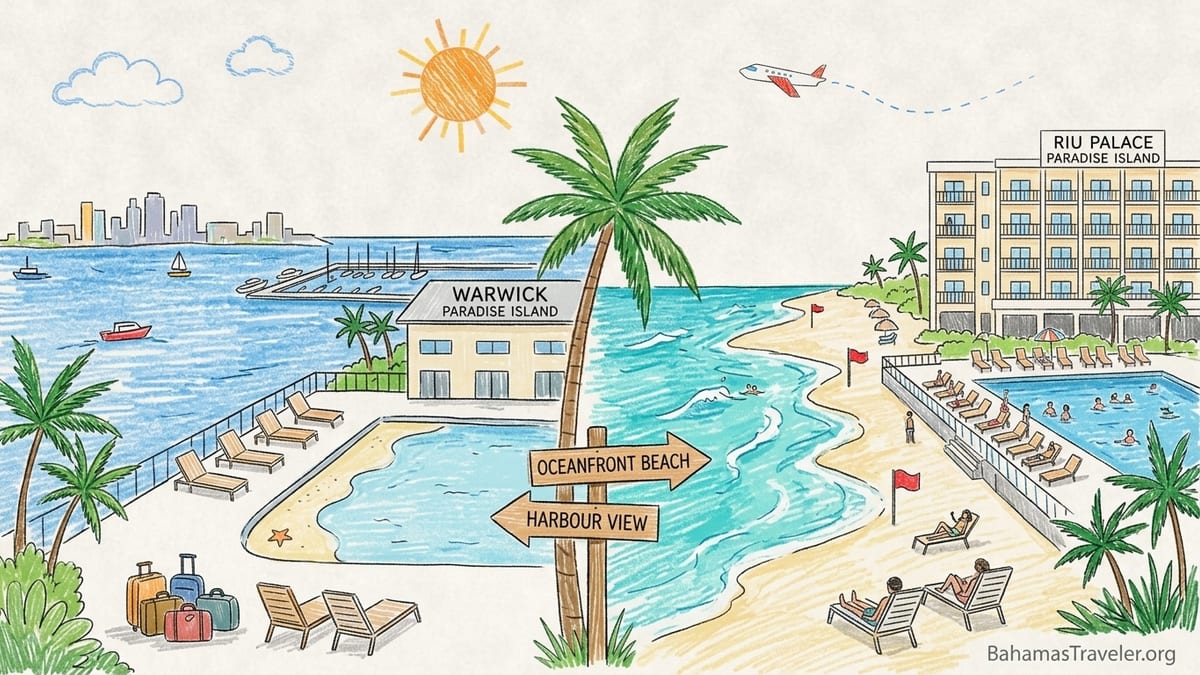
The most fundamental difference between these two adults-only resorts is the water in front of them. RIU Palace Paradise Island stands directly on the beach along the north side of Paradise Island, facing the Atlantic with soft white sand and the classic turquoise water many travelers picture when they think of the Bahamas. You step off the pool deck onto a sandy strip that continues west toward other hotels and east toward quieter sections of shore. Waves here range from gentle to moderately strong, depending on the wind, and there were days during my stay when red flags signaled rougher surf. Most mornings, though, meant safe conditions for swimming, bobbing in waist-deep water and long walks in either direction.
Warwick Paradise Island is different from the moment you arrive. The property fronts Nassau Harbour rather than the open Atlantic, so what you see from the pool deck and harbor-side rooms is a calm expanse of water with boat traffic, marinas and the skyline of Nassau across the channel. The resort has a small man-made beach area beside the pool, but the shoreline is bulkheaded and more lagoon-like than oceanic, and swimming is in a protected cove-like area rather than in open sea. I did wade in a few times, but the real appeal here is sitting on a lounger watching the harbor, not body-surfing or taking long shoreline walks.
Warwick acknowledges this trade-off by emphasizing its included shuttle to Cabbage Beach on select days, which gives guests access to a genuine Atlantic beach away from the harbor. That shuttle service was running during my October 2026 stay, though seats were limited and departures were at set times. On one morning it filled and a few late-arriving guests were told they would need to wait for the next run or make their own way by taxi. RIU does not need to offer a beach shuttle because its pool deck opens directly onto the sand, which is a major benefit if beach time is your top priority.
From a relaxation perspective, I found Warwick’s harbor-front setting quieter and somewhat more sheltered from wind. Sitting with a drink and watching the harbor traffic felt almost like a small-city waterfront hotel, just with palm trees and an all-inclusive bar. The trade-off is that you will not get that endless horizon of blue water from most loungers, and you cannot simply wander down the shore for twenty minutes in either direction. At RIU, the roar of the surf is ever-present and the views from the pool, many balconies and the beach itself have that big, cinematic quality you expect from a high-rise oceanfront resort.
Beach Time, Pools and Sun Loungers
For swimming, RIU clearly wins on variety and atmosphere. During my stay the main oceanfront pool at RIU was the daytime hub, with rows of loungers on both the deck and the beach, a pool bar and staff circulating with basic table service. There are no extensive water slides or lazy rivers like at Atlantis, but the combination of pool and ocean made it easy to mix sunbathing with dips in both fresh and salt water. Signs posted near the lifeguard stand outlined flags for surf conditions, and on windy afternoons staff gently reminded guests to stay within the safer swimming zone.
Warwick offers a single main pool overlooking the harbor, with loungers arranged along the deck and on the small artificial beach. The pool itself is large enough for casual swimming and water aerobics but is not designed as a lap pool. Because there is no natural surf or broad sandy shoreline, most people treated the pool as their primary water feature, occasionally venturing into the sheltered cove area for a short swim. The harbor backdrop gives it a different energy from typical Caribbean resorts; it felt more urban and enclosed, but in a pleasant way when I wanted to read or work without worrying about blowing sand or sun glare off the waves.
Securing a sun lounger told another story about how each property manages crowds. At Warwick, I was consistently able to find a lounger by the pool between 9:00 and 10:00 in the morning without resorting to the towel game. Shade was somewhat more limited, so if I wanted an umbrella, arriving before 9:30 helped. At RIU, loungers by the main pool in prime positions started filling by around 8:30, and by 10:00 only scattered options remained unless you were content to sit farther back or directly on the open beach with no shade. The actual policy at both properties discourages reserving loungers with towels for long stretches, but in practice RIU was more competitive due to its stronger beach appeal.
Noise levels around the pools also differed. RIU leaned into a social, energetic adults-only vibe, with daytime playlists, occasional poolside games and a slightly higher baseline volume from the ocean and the crowd. Warwick’s pool atmosphere was calmer, with music present but lower, and no constant roster of participation games. That made sunbathing more peaceful, though those seeking a lively atmosphere might find the harbor-side scene subdued compared with RIU.
Food, Drinks and Real-World Waits
Both resorts operate all-inclusive dining with a blend of buffet and specialty options, but the details matter if you care about breakfast variety or how hard it is to get a steakhouse reservation. During my stay, breakfast at Warwick was served in the main Verandah restaurant in a buffet format. The spread included eggs cooked to order, bacon, sausages, pancakes or French toast, fruit, yogurt, pastries and Bahamian touches such as boiled fish and grits on some mornings. Coffee was poured at the table, and servers were quick to offer refills, though peak times around 9:00 did lead to short waits at the omelet station of around five to ten minutes.
At RIU, breakfast took place in the main Atlantic buffet, with a larger selection overall. In addition to omelets and standard American items, I counted multiple hot stations with grilled vegetables, local fish, plantains and a more extensive pastry section. Self-serve juice machines and coffee stations reduced the wait for basic drinks, though that also meant more people moving around the room at once. On busy mornings, finding a particular item fresh occasionally meant waiting for a tray to be replenished, but staff were swift at swapping out lukewarm dishes.
Specialty dining showed the strongest difference in how “included” felt in practice. Warwick lists several restaurants in its all-inclusive plan, including an Italian venue and a steakhouse-style option. During my three-night stay, not all specialty restaurants were open every evening. The hotel rotates venues based on occupancy, which meant that on one night only the buffet and a single a la carte option were available. Reservations were required for the specialty restaurant; on my first night, the next available slot was 8:30 p.m., about two hours after I inquired. Once seated, service was friendly but on the slower side, with the meal lasting close to two hours from appetizer to dessert.
RIU’s specialty restaurants during my visit included a steakhouse by the beach, a Japanese venue and an Indian restaurant, alongside a more formal fusion venue. Reservations were necessary for certain restaurants during peak periods, and lines formed at the reservation desk shortly after it opened in the morning. I typically waited ten to fifteen minutes to secure a dinner time, especially if I wanted a prime 7:00 to 8:00 seating. Unlike Warwick, RIU had more consistent nightly availability across multiple a la carte venues due to its larger scale and multiple kitchens, though last-minute walk-ins often ended up at the buffet instead of the most popular specialty options.
Neither resort charged me extra for standard dining, and everything advertised as all-inclusive at the restaurant level was indeed available. The main upsell opportunities appeared in the wine lists and premium liquor shelves. House pours at both properties were included and serviceable, with RIU offering a slightly broader range of recognizable international brands at the standard bar level. At Warwick, request-based upgrades to premium spirits and bottled wines incurred surcharges, especially for top-shelf labels. Bartenders at both resorts were willing to customize cocktails beyond the printed menus, though during crowded pre-dinner hours at RIU I sometimes waited ten minutes at the bar for a drink, compared with closer to five at Warwick.
Rooms, Comfort and Maintenance
Room comfort can quietly make or break an all-inclusive stay. At Warwick, my Water View room measured about 300 square feet and faced the harbor at an angle, offering a partial water view. Furnishings were contemporary but simple, with tile floors, a king bed, small table and chairs, and a compact but functional bathroom with shower-tub combination. The air conditioning kept the room cool even in the warm, humid evenings, though it cycled on and off audibly at night. Blackout drapes did an effective job of blocking harbor lights, which helped sleep quality. Wi-Fi worked smoothly for work tasks and streaming.
Cleanliness at Warwick was solid overall. Housekeeping visited daily in the late morning during my stay, replenishing towels and toiletries without my needing to call. I did notice some minor wear on furniture corners and along hallway walls, the type of cosmetic scuffing that appears in busy mid-range resorts. In-room maintenance was otherwise sound; lighting, plumbing and the safe all functioned without issue.
At RIU Palace, my partial-ocean-view Junior Suite felt slightly larger, with a more open floor plan, separate sitting area and balcony facing both ocean and neighboring properties. The décor leaned brighter and more polished, befitting the resort’s upper-mid to upscale positioning. The balcony made a significant difference; sitting outside with a view of the sea and breeze made the room feel like an extension of the beach experience. Air conditioning here was quieter and more even, and the bed felt marginally more supportive.
RIU’s housekeeping was efficient and almost hotel-like in its predictability. My room was cleaned before noon on each day of the stay, and turndown service on two nights added an extra touch of polish. I saw fewer signs of wear in corridors and common areas compared with Warwick, though the higher foot traffic around elevators during peak check-in and check-out times made the lobby feel hectic. Overall, in-room comfort and maintenance tilted in RIU’s favor, especially for travelers who place a high value on balconies and uninterrupted ocean views.
Activities, Excursions and Getting Around Paradise Island
Both Warwick and RIU advertise a range of on-site activities that are part of the all-inclusive program, but many of the most coveted Bahamas experiences, such as swimming with pigs or island-hopping boat tours, remain off-property excursions at extra cost. During my week on Paradise Island, I booked a half-day boat trip to visit nearby cays and snorkel, arranged through an independent operator at the Paradise Island marina. Prices for these kinds of outings typically start around 140 to 180 dollars per person, including basic drinks and snorkel gear, and neither Warwick nor RIU includes them in the room rate.
On property, Warwick’s activity schedule leaned to fitness classes, trivia, light live music in the evenings and occasional themed nights. Participation was voluntary and, in my experience, unobtrusive if you preferred simply to read by the pool. Pool games happened in a defined window and wrapped up in the late afternoon. RIU’s programming was more robust, with daily entertainment staff organizing pool volleyball, light competitions and evening shows that could range from live bands to themed dance performances. Late-night bar energy was also higher at RIU, with more guests lingering after 10:00 p.m.
Walkability is a key part of choosing between these two. Warwick sits slightly east and inland from the main Atlantis campus, along the harbor side. Walking from Warwick to Marina Village near Atlantis took me around 12 to 15 minutes at a moderate pace, involving sidewalks, a short bridge segment and a few road crossings. From there, the Atlantis casino, water park entrances and additional dining were another five to ten minutes’ walk, depending on which tower you aim for. Returning at night felt reasonably safe thanks to resort-area lighting, though sidewalks were quieter than during the day.
RIU occupies a compact but prime plot directly on the beach, west of parts of Atlantis. Walking from RIU to the Atlantis casino or Marina Village took closer to 8 to 10 minutes via paved walkways and resort roads. Access to public transportation or taxis into Nassau proper is broadly similar from both properties, with the main difference being how quickly you can reach the central Atlantis complex on foot. If you intend to dine, gamble or spend significant time at Atlantis, RIU has a slight edge in convenience, though the gap is not enormous.
Does Adults-Only Actually Mean Peaceful?
Many couples and groups choose adults-only resorts expecting quiet by default. The reality at both Warwick and RIU during my stays was more nuanced. Warwick, with its harbor-front setting and smaller footprint, felt genuinely calm for most of the day. Background music played at the pool, but at a volume low enough that conversations at neighboring loungers did not require raised voices. I spent entire afternoons reading without once feeling that organized games or a booming playlist intruded on the atmosphere. After about 11:00 p.m., public spaces grew notably quiet, with most socializing confined to the lobby bar and a few outdoor tables.
RIU, in contrast, delivered a distinctly social adults-only experience. The pool area featured louder playlists, periodic announcements from entertainment staff and generally higher noise from conversations and laughter. It never approached club-level volume during my visit, but anyone specifically seeking hushed tranquility around the main pool might be disappointed. RIU does have areas of relative calm, especially along the far edges of the beach and at certain corners of the property, yet the overall personality of the resort is lively rather than meditative.
In the evenings, RIU’s shows and bar scene extended the energy into the night. Performances usually wrapped by around 11:00 p.m., after which the crowd thinned but did not disappear. If your room faces the pool and entertainment area, some noise may filter up; higher floors and ocean-facing rooms away from the central stage area are better choices for light sleepers. Warwick’s evening entertainment tended to be acoustic sets, small bands or DJ playlists at lower volume, and by midnight I consistently found the resort very quiet.
In both cases, adults-only did indeed mean no children, but it did not universally guarantee spa-like serenity. Couples seeking a social, adults-only vibe with plenty of conversation, bar time and music will likely appreciate RIU’s energy. Travelers craving a more restful, grown-up escape with limited ambient noise and fewer large-group celebrations may feel more at home at Warwick, accepting the harbor setting as the trade-off for additional peace.
Real-World Pricing: Three and Seven Nights Compared
Pricing on Paradise Island moves with demand, but my October and November 2026 bookings provide a useful reference point for how costs stack up. For a three-night adults-only stay at Warwick in a Water View room, sample autumn 2026 rates including taxes and the all-inclusive plan fall around 1,600 to 2,100 dollars for two adults. An upgrade to a Harbour Deluxe Balcony room with better outdoor space and more frontal harbor views can add roughly 100 to 200 dollars per night, so a three-night balcony stay could land closer to 1,900 to 2,700 dollars in total. Optional paid extras might include a couple of premium cocktails or wine upgrades and any off-property tours, which can add another 200 to 400 dollars for two if you book a single half-day excursion.
For RIU Palace Paradise Island, a three-night stay in an entry-level or partial-ocean-view junior suite typically prices in slightly higher, around 1,800 to 2,400 dollars in late 2026 based on current sample rates. Opting for a full oceanfront suite or higher floor with better views can raise that total by a few hundred dollars over three nights. Again, off-property activities, spa treatments and casino spending at nearby Atlantis will be the primary variables that swell your final bill beyond what you prepay for the all-inclusive package.
Over seven nights, Warwick remains the more affordable choice more often than not. A week in a standard water-view room with all-inclusive inclusions commonly lands somewhere between 2,800 and 3,500 dollars for two adults in shoulder season, with balcony or higher-category harbor rooms potentially reaching toward the upper end of that range or slightly above. RIU’s seven-night totals in junior suites and entry-level ocean-oriented rooms frequently span from about 3,200 to 4,200 dollars, rising to the mid-4,000s or higher when you step up to premier oceanfront suites.
What matters most for many travelers is not just room pricing but how much additional spending feels necessary once on site. At Warwick, I found it easier to stay within the prepaid all-inclusive envelope, with fewer temptations for add-on spending beyond excursions. At RIU, the proximity to Atlantis, the more extensive selection of off-site bars and restaurants, and the general social ambiance made it more tempting to wander, gamble or dine outside the resort, all of which can balloon the total cost of a week on Paradise Island.
The Takeaway: Which Resort I Would Choose for Different Trips
After a week split between Warwick Paradise Island and RIU Palace Paradise Island, I would not call either property an automatic winner for every traveler. Each has clear strengths and distinct drawbacks that matter more or less depending on the style of trip you are planning.
For a honeymoon, I would lean toward RIU Palace Paradise Island, but only if the couple genuinely values the oceanfront setting and plans to spend a lot of time on the beach. Waking up to direct sea views, walking hand in hand along the sand at sunset and hearing the surf from your balcony all carry real romantic weight. The trade-off is that the pool and bar atmosphere can be lively, so honeymooners craving absolute seclusion might be better served in a higher-category oceanfront suite positioned away from the main entertainment areas.
For a romantic beach holiday that mixes relaxation with affordability, Warwick becomes a serious contender. Although the resort does not sit on a natural beach, the harbor views at sunset, the quieter pool atmosphere and the generally lower price point combine into an appealing package for couples who are content to use the Cabbage Beach shuttle periodically instead of expecting an oceanfront lounger every day. The main drawbacks are the more limited on-site restaurant rotation on some nights and the lack of that endless-horizon ocean view from the majority of loungers.
For an affordable couples’ vacation where budget control matters, I would personally book Warwick again. It consistently came in a bit cheaper than RIU for comparable dates, and the harbor-front setting reduced my temptation to overspend on off-site nightlife. The rooms are comfortable enough, cleanliness was good and, while some areas show light wear, the property did not feel tired. Couples who want to experience the Bahamas, venture into Nassau and perhaps splurge on a single marquee excursion can treat Warwick as a solid, adult-focused base.
For a social adults-only trip with friends, RIU is the clear choice. The atmosphere around the pool, the broader restaurant selection, the constant low-level buzz of activity and the oceanfront location all support a more extroverted, group-oriented vacation. The drawback is noise and competition for the best loungers, as well as potentially higher overall costs once off-property opportunities are factored in.
For quiet relaxation, Warwick is the better fit, provided you accept that “Bahamas” in this context means harbor views, calm water and occasional shuttle rides to the ocean. The more modest scale of the resort, the subdued entertainment program and the sheltered location all contribute to longer stretches of genuine quiet. If this is your priority, I would recommend paying for a harbor-facing balcony room to maximize both natural light and private downtime.
Looking ahead, if I had to choose just one to return to, I would split my decision by purpose. For a first-time couple wanting that classic beach postcard and willing to pay more for it, I would rebook RIU Palace Paradise Island. For a repeat visit focused on unplugging, reading by the pool and enjoying an adults-only environment that feels calm without being stuffy, I would happily return to Warwick Paradise Island, fully aware that I am trading surf for harbor and glamour for value.
FAQ
Q1. Is the ocean swimmable at RIU Palace Paradise Island?
The ocean in front of RIU Palace Paradise Island was swimmable on most days during my stay, with lifeguards using flag systems to indicate conditions. Some windy days brought stronger waves, so guests needed to follow posted guidance and remain within the designated safe swimming zone.
Q2. Can you actually swim at Warwick Paradise Island’s waterfront?
Warwick fronts Nassau Harbour, not the open Atlantic, so swimming is in a sheltered cove-like area beside the man-made beach and pool rather than along a natural shoreline. The water was calm but felt more like a small lagoon, and most guests treated the pool as their primary place to swim.
Q3. Do both resorts really include all food and drinks?
Both properties included buffet meals, standard a la carte restaurants and a selection of alcoholic and non-alcoholic drinks in the all-inclusive plan during my stay. Premium wines and top-shelf spirits at Warwick sometimes carried surcharges, and specialty coffees or branded bottles could incur extra charges at either resort, so it helps to confirm inclusions at each bar.
Q4. How difficult is it to get dinner reservations?
At Warwick, limited nightly openings for specialty restaurants meant reservations could push to later times, especially when only one a la carte venue was operating. At RIU, more specialty options were open each night, but lines formed early at the reservation desk, and popular times between 7:00 and 8:00 p.m. filled quickly, leading latecomers to dine at the buffet instead.
Q5. Which resort is better for nightlife?
RIU Palace Paradise Island offered the more energetic nightlife during my visit, with scheduled shows, a livelier bar scene and more guests out and about after 10:00 p.m. Warwick’s evenings felt quieter, centered on live music in the lobby bar and a more relaxed crowd, with most public spaces winding down by midnight.
Q6. How far is each resort from Atlantis and Marina Village?
From Warwick, walking to Marina Village by Atlantis took me about 12 to 15 minutes at a moderate pace, plus a few more minutes to reach the main casino and tower areas. From RIU, the same walk was shorter, roughly 8 to 10 minutes, because the resort sits closer to the heart of the Atlantis complex.
Q7. Are the rooms quieter at Warwick or at RIU?
My room at Warwick was generally quieter, influenced by the harbor setting and lower late-night activity. At RIU, my partial-ocean-view suite was comfortable but picked up more ambient sound from the pool and entertainment areas during show times, though higher floors and rooms positioned away from the stage are likely to be quieter.
Q8. Do I need to budget extra for excursions at these resorts?
Yes. While both resorts include on-site activities, most off-property excursions such as snorkeling trips, visits to nearby cays or swimming with pigs require separate payment. During my week on Paradise Island, a half-day boat and snorkel excursion cost in the region of 140 to 180 dollars per person, which was not covered by the all-inclusive plan.
Q9. Which resort is better for travelers who want peace and quiet?
For sustained peace and quiet, Warwick Paradise Island felt more suitable, thanks to its smaller size, harbor-front setting and relatively low-key entertainment schedule. RIU can offer quiet corners, especially along parts of the beach, but the overall personality of the resort is more social and energetic.
Q10. If I am on a tight budget, which resort should I book?
On a tighter budget, Warwick is usually the more economical choice based on current sample room rates and the tendency for guests to spend less on off-property activities. It may lack RIU’s oceanfront beach, but it offers solid value, adults-only policies, a calm pool environment and easy enough access to Cabbage Beach or Atlantis when you want to venture out.