


On Paradise Island, most visitors are pulled toward Atlantis, water slides and casinos. Yet above the shoreline, behind the manicured lawns of Four Seasons’ The Ocean Club, lies a very different world: terraced gardens, weathered cloister columns from medieval France and long views toward Nassau Harbour. This story is based on what I was able to confirm directly with the resort and on-site staff in October 2026, including current access rules and realistic options for non-guests who want to experience this quieter side of the island.
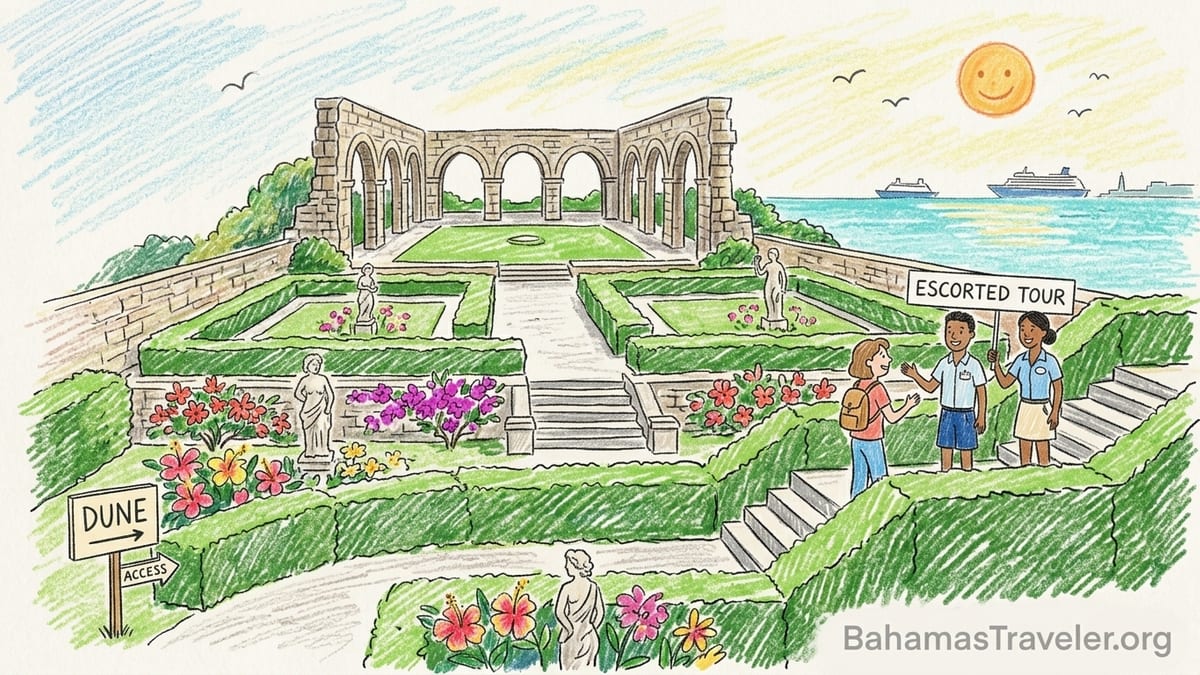
Verifying Access: What I Confirmed With Four Seasons
Before planning any visit, I contacted Four Seasons The Ocean Club in early October 2026 using the resort’s published concierge contact details and then spoke in person with front-desk staff once on Paradise Island. The Versailles Gardens and French Cloisters sit inside The Ocean Club’s private grounds and are treated as part of the resort, not as a separate public park. Staff were clear that the gardens are primarily for registered hotel guests, wedding parties and participants in approved events or photo sessions. They specifically asked that travel writers not describe the space as an open, free public attraction, because conflicting online sources have led to uninvited visitors walking through areas the resort considers private.
During my stay on Paradise Island I requested permission to visit the gardens without being an overnight guest. After checking with security and management, the concierge confirmed that I could access the gardens by booking a same-day restaurant reservation at DUNE by Jean-Georges and then requesting an escorted walk to the cloisters after my meal. I was told this is not a guaranteed privilege for every diner, and that approval is handled case by case depending on occupancy, events and staffing on a given day. In other words, non-guests should never assume that a restaurant booking automatically includes access to the gardens.
For my visit, I booked a late-afternoon table at DUNE and mentioned my interest in the Versailles Gardens and French Cloisters when I made the reservation and again when I checked in at the host stand. After lunch, a staff member met me near the bar and walked me through the resort grounds, past the oceanfront lawn and up toward the terraces. There was no separate fee for this short escorted visit, but I was reminded that photography had to remain non-commercial and that some areas might be closed if a wedding or private event was in progress.
The resort emphasized that policies can change and that photography for engagements, elopements or styled shoots must be arranged in advance through their events team, usually with a location or setup fee. Walk-up photo sessions with lighting equipment, drones or models in formal attire are not allowed. As of October 2026, the safest approach for non-guests is to either stay at The Ocean Club as an overnight guest or to contact the resort directly before your trip to ask whether a restaurant or bar reservation might include a brief escorted walk through the gardens.
Walking In: Arrival, Timing and Route Through the Terraces
On the day I visited, I arrived at The Ocean Club’s main security gate by taxi from the Atlantis area. The ride took less than ten minutes in light weekday traffic and cost roughly the same as a short city hop within Nassau, with the driver dropping me at the porte cochère outside the reception building. Security confirmed my name and DUNE reservation before allowing the taxi to proceed. Without a confirmed booking or room reservation, visitors risk being turned away at this first checkpoint, so it is worth having a printed or digital confirmation handy.
After lunch at DUNE, I met my escort near the restaurant terrace at about 4:30 p.m. The resort had suggested late afternoon as a good compromise between softer light and fewer guests in swimwear around the pools. From DUNE, we followed a paved path along the lawn, then turned inland and began to climb a gentle series of stone steps. The route first passes the resort’s main infinity pool area and then continues upward toward the Versailles Pool, which is flanked on one side by the formal gardens. Guests in loungers were shielded by hedges and planters, so the transition from busy pool deck to formal terraces was surprisingly smooth.
The Versailles Gardens themselves unfold as a sequence of long, narrow terraces that step up from the main resort toward the hilltop cloisters. My escort walked with me along the central axis, which is aligned with the pool and a narrow reflecting basin. From there, low stone walls frame lawns, clipped hedges and scattered statuary. Because I was not an overnight guest, I was asked to stay close to the primary walkway and to avoid veering into side paths or lawns that lead back toward guest rooms.
The light in late afternoon fell across the terraces from the west, casting long shadows from the statues and palm trees. This is also when the view opens most clearly back toward the water. From the mid-terrace level, I could turn around and see bands of green lawn, the blue strip of the resort pool and, beyond, the pale turquoise of the sea off Paradise Island. My escort allowed occasional stops for photographs, but reminded me not to photograph identifiable guests near the pools or staff in close-up without permission.
Versailles-Inspired Terraces, Fountains and Sculptures
The Versailles Gardens at The Ocean Club are inspired by French formal design rather than being a replica of any specific part of the Château de Versailles. The basic vocabulary is familiar to anyone who has visited a European baroque garden: a strong central axis, terraces that step up the slope and a sequence of focal points that pull your eye from one level to the next. Here those focal points are low fountains, marble and bronze statues and urns set at the edges of lawns.
On the lowest terrace, closest to the Versailles Pool, the garden is framed by low stone balustrades and clipped hedges. A small rectangular water feature occupies the center, edged with stone coping that shows some weathering from wind and salt air. Around it, statues of classical figures in pale stone stand on plinths at the corners of the lawn. During my visit, the water in the basins was still and reflective rather than animated by jets, which added to the quiet atmosphere.
As we climbed, each successive terrace repeated the pattern at a slightly different scale. There were sculptural urns with floral motifs, small benches built into the stone walls and occasional niches containing busts or allegorical figures. The marble surfaces bore subtle staining and lichen that spoke to decades of exposure in the Bahamian climate. Unlike the dense, immaculately trimmed parterres at the real Versailles near Paris, these gardens felt slightly softened by tropical conditions. Shrubs were neatly maintained, but palms and flowering trees introduced an informal note that kept the space from feeling like a rigid historical set.
The overall impression was of a European formal garden adapted for a coastal resort: symmetrical enough to frame weddings and portraits, yet open to sea breezes and the rustle of palms. It was easy to understand why couples choose the terraces for ceremonies, especially on days when the sun sets in a clear wash of color over the water beyond Paradise Island’s north shore.
The French Cloisters: How a Medieval Monastery Reached the Bahamas
At the top of the final terrace, the path arrives at the French Cloisters perched on a small rise above the gardens. What you see here is a reconstructed cloister assembled from genuine medieval stonework brought from France, but rebuilt in a new configuration for a twentieth-century resort. Several historical accounts trace the stones to a 14th century Augustinian monastery in or near Montréjeau in southwestern France, which were dismantled and purchased by newspaper magnate William Randolph Hearst in the 1920s. The crates then spent years in storage in the United States before a later owner acquired them for a project in the Bahamas.
Four Seasons’ own description of the cloister, provided by the resort’s marketing team and echoed in their printed materials, emphasizes that the structure is composed of authentic medieval elements but that it is not a precise reassembly of the original French monastery. When the stones finally reached Paradise Island in the mid twentieth century, many were unlabeled or mixed from different parts of the original complex. The current arcade of pointed arches and carved capitals atop the Versailles Gardens is therefore best understood as an evocative reconstruction rather than a museum-accurate transplant.
The cloister itself forms a rectangular frame around a small lawn, edged with low hedges and flowering beds. Each side consists of repeating stone arches supported by slender columns with carved capitals. Some capitals show foliage patterns familiar from Gothic architecture, while others feature more abstract motifs. The texture of the stone is roughened in places, with chipped corners and softened carvings that reveal both medieval age and the wear of dismantling, transport and reassembly.
Standing under the arches, I could see the gardens falling away in a series of terraces toward the pool and sea. Looking inward, the central lawn offered a secluded space where chairs are sometimes arranged for ceremonies. When I visited, the cloister was empty except for a small maintenance cart parked discreetly in a corner. My escort explained that when weddings are scheduled, access for casual visitors is cut off entirely, and staff begin setting up several hours in advance, so anyone hoping to see the cloister should be prepared for the possibility of partial or complete closure.
Atmosphere, Gardens and Views Toward Nassau Harbour
The most striking difference between the Versailles Gardens and the rest of Paradise Island is the level of quiet. On the same morning, I had walked through the public areas around Atlantis, where music from pool decks mixed with shouts from water slides and the constant movement of cruise passengers on day passes. By contrast, the terraces at The Ocean Club felt muted and almost contemplative. The main soundtrack here was wind moving through palm fronds, the faint splash from the Versailles Pool and the occasional murmur of conversation from guests strolling the paths.
The planting scheme blends formal structure with tropical species. Along the edges of the terraces, trimmed hedges define lawns and pathways. Within those boundaries, gardeners have introduced flowering shrubs, likely including hibiscus and bougainvillea, whose colors punctuate the greens and stone tones. On the day of my visit, gardeners were at work with hand tools and small carts, clipping growth back from the stone steps and cleaning leaf litter from the fountains. Their presence was quiet but constant, a reminder that maintaining formal lines in a humid, salt-laden climate requires daily attention.
From several points in the gardens, particularly near the upper terraces and the cloister, you can look outward toward Nassau Harbour. The view is partly filtered by palm trees and resort buildings, so it is not a sweeping panorama, but there are moments where the harbor appears in a gap between trunks. You catch sight of the channel, the low profile of Nassau’s waterfront and, occasionally, the silhouettes of cruise ships at anchor. For photographers, these glimpses work best when framed intentionally, using the cloister arches or terrace balustrades to focus the eye on a distant slice of water and city.
What impressed me most about the atmosphere was its contrast with Atlantis, which sits only a short drive away. Where the resort complex bills itself as an aquatic theme park with constant activity, the Versailles Gardens feel deliberately slow. There are no loudspeakers playing pop music, no water slides, no casino lights. Instead you notice details: the play of shadow under a carved capital, the way sunlight picks out veins in marble statues, the straight line of a hedge receding toward a fountain. For travelers who crave a mental reset from the sensory overload of resort entertainment, this enclave can feel like a different island altogether.
Photography, Restrictions and Practical Tips for Visual Storytellers
Because the Versailles Gardens and French Cloisters sit on private resort property, photography rules are more restrictive than in a public park. During my escorted visit in October 2026, staff confirmed that casual personal photography was allowed for non-commercial use as long as I respected guest privacy, avoided photographing children without parental consent and did not obstruct pathways, steps or staff at work. Tripods and lighting stands were discouraged, and my escort asked that I keep my gear to a handheld camera and a single small shoulder bag.
For serious photographers and couples considering engagement or wedding portraits, the resort’s events team handles all formal shoots. Staff indicated that these sessions must be arranged in advance and may involve a location fee, especially during peak wedding seasons. The exact amounts are negotiated case by case, and the resort prefers to communicate them directly with clients rather than through third-party articles. Drones are not permitted over the gardens, both for privacy and safety reasons, and commercial photography for magazines, advertising or social media campaigns requires written approval.
In practical terms, the best time for photography during my visit was late afternoon, between roughly 4:00 p.m. and 5:30 p.m., when the sun was lower and the terraces were bathed in softer light. A moderate zoom lens allowed me to frame both wide garden views and tighter details of capitals and statues without stepping off the main path. The stone and foliage handle contrast well, but bright midday light can make shadows under the arches very deep, so photographers may want to increase exposure slightly or use cameras with good dynamic range.
For couples or solo travelers interested in capturing the atmosphere without staging elaborate portraits, a realistic approach is to plan a meal at DUNE, ask politely at the time of reservation about the chance of a short escorted walk afterward and then travel light: one camera, no stands, neutral clothing that blends into a resort setting. If staff decline access on the day due to events or occupancy, it is important to accept that decision gracefully and to avoid attempts to enter via side paths or from the public beach, which are guarded by security and are clearly signed as private.
Comparing Experiences: Gardens vs the Rest of Paradise Island
Spending time in the Versailles Gardens after a morning at Atlantis highlighted just how sharply experiences can diverge on a compact island. At Atlantis, I queued with families for water rides, walked through the marine habitat tunnels and watched crowds flow in and out of the casino. The visual language there is exuberant and theatrical, with large-scale sculptures, bright colors and constant movement. It is a place built for spectacle, where the goal is to keep guests in motion from dawn to midnight.
The Versailles Gardens, in contrast, invite stillness. There are no attractions in the conventional sense, no timed shows or interactive features beyond the pleasure of walking the terraces. Instead, interest comes from pattern and perspective. The terraces narrow and widen, the stairs compress your view upward toward the cloister, and the statues mark pauses where you can stop and look out to sea or back across the lawns. Even during my relatively brief escorted visit, the change of pace had an almost physical effect; the noise of Atlantis receded, replaced by a sense of layered history, however reconstructed.
For travelers who already plan to stay at The Ocean Club, the gardens are an integral part of the property’s charm. Guests can wander the paths early in the morning or at golden hour without escorts, photograph from more angles and sit on benches to read or simply watch the light change. For those based elsewhere on Paradise Island, especially families focused on water parks and kid-friendly diversions, arranging access may feel like an extra layer of logistics with uncertain payoff. The key question is not whether the gardens rival Atlantis in entertainment value, but whether you are the type of traveler who finds satisfaction in slow, contemplative spaces.
In that sense, the Versailles Gardens are best suited to photographers, history enthusiasts, couples and solo travelers who prefer a quiet hour among stone and greenery over another circuit of the lazy river. If your ideal afternoon involves reading the story behind the cloister stones and searching for the best angle through a pointed arch, then the effort to secure legitimate access is more likely to feel worthwhile.
Can Dining at DUNE or Other Venues Provide Access?
One of the most common questions about the Versailles Gardens is whether booking a meal or drink at an Ocean Club venue opens the gates. During my October 2026 visit, staff at both the main reception and DUNE were explicit: a restaurant or bar reservation does not automatically grant garden access, but it can create an opportunity to request it. On quieter days without weddings or large corporate events, the concierge or restaurant manager may arrange for a brief escorted walk for diners who ask politely and who are prepared to remain within designated areas.
In my case, lunch at DUNE was followed by a twenty- to thirty-minute escorted visit, which felt sufficient to walk the central terrace axis, climb to the cloister and take a modest number of photographs. However, staff made clear that this was an accommodation, not a formal package. They declined to promise that the same access would be available every day or for every guest, even within the same week. For example, if another couple has reserved the cloister lawn for a private proposal, staff may block all non-essential traffic to preserve their privacy.
Other venues within The Ocean Club, such as the Martini Bar or the poolside restaurants, may work similarly. Being on property with a legitimate spending relationship improves the chances of a favorable response, but it does not override security considerations. Visitors who arrive at the resort without reservations, hoping simply to walk the gardens because they read online that the space is free and open, are now more likely to be turned away due to past incidents of overcrowding and privacy concerns.
For travelers planning a special trip around the gardens, the most reliable routes to access remain twofold. One is to book a stay at The Ocean Club, which allows you to move through the property like any other guest. The second is to contact the resort well before your trip and ask about arranging a private event, vow renewal or photo session that includes the terraces and cloister. Both options require a significantly higher budget than a casual walk from the public beach, but they align with how the property itself now manages the site.
The Takeaway
What stayed with me after leaving the Versailles Gardens and French Cloisters was not just the improbable journey of medieval stone to a Bahamian island, but the feeling of stepping into a different tempo of travel. In a destination dominated by water slides, casino floors and mega-resorts, the terraces and cloister offer a rare pocket of calm where history, however reconstructed, shapes the experience more than spectacle. The combination of layered stone, formal axes, blooming shrubs and glimpses of Nassau Harbour creates a visual rhythm that rewards careful looking and quiet patience.
Do the historic gardens justify arranging a special visit if you are not staying at The Ocean Club? For travelers who care deeply about architecture, landscape design and photography, the answer can be yes, provided expectations are set correctly. Access is limited, never guaranteed for non-guests and subject to last-minute closure for weddings and events. The experience you can realistically expect as a diner with an escort is a relatively short but memorable walk along the central terraces and a brief time under the cloister arches, with enough opportunity to take thoughtful images and absorb the atmosphere.
If you are primarily interested in entertainment, shopping and pool complexes, the logistical effort and potential for refusal may outweigh the benefits. Non-guests should understand that they may be restricted to the main axis, that side paths and lawns can be off-limits and that photography is constrained by privacy rules. Yet for couples seeking a quiet interlude away from Atlantis, for photographers chasing soft light on stone and for history-minded travelers curious about how fragments of a French monastery came to crown a Bahamian hill, the Versailles Gardens and French Cloisters represent one of Paradise Island’s most distinctive experiences.
In the end, what I found most memorable was the contrast: looking down from a medieval-style arcade assembled from centuries-old stone across manicured terraces to the turquoise water that draws millions of visitors for entirely different reasons. It is a reminder that even on a resort-driven island, there are places where history and design matter as much as entertainment, and where a carefully arranged visit can reveal a quieter, more reflective Paradise Island than most visitors ever see.
FAQ
Q1. Are the Versailles Gardens and French Cloisters open to the general public without restrictions?
The gardens and cloisters sit inside Four Seasons The Ocean Club’s private grounds and are not treated as an unrestricted public park. Access is primarily for registered hotel guests, event participants and visitors who have arranged permission in advance through the resort.
Q2. Can I see the gardens if I book a meal at DUNE or another Ocean Club restaurant?
A restaurant reservation does not automatically include garden access, but during my October 2026 visit, staff sometimes arranged short escorted walks for diners who asked politely. This is handled case by case and depends on events, occupancy and staffing, so it should never be assumed or promised in advance.
Q3. Is there an entrance fee to visit the Versailles Gardens if I am not a hotel guest?
During my visit, there was no separate admission fee for a brief escorted walk arranged after a restaurant meal, but that access itself was not guaranteed. Formal photo sessions, weddings or private events generally involve fees negotiated directly with the resort’s events team.
Q4. How did a medieval French cloister end up on Paradise Island?
Historical accounts and the resort’s own description agree that the stone elements came from a 14th century French monastery, dismantled and purchased in the early twentieth century, then later shipped to the Bahamas. They were reassembled on Paradise Island in a new configuration, so the current cloister is a reconstruction using authentic medieval pieces rather than a precise replica of the original building.
Q5. What parts of the gardens can non-guests realistically expect to see?
Non-guests who receive escorted access can typically walk the main central axis of the terraces from near the Versailles Pool up to the cloister, pausing at key viewpoints. Side paths, lawns adjacent to guest rooms and any area in use for weddings or private events may be off-limits.
Q6. Are there specific photography restrictions in the Versailles Gardens?
Yes. Casual personal photography is generally allowed for non-commercial use, but visitors are expected to avoid photographing other guests without consent, especially children, and to stay off lawns and restricted paths. Tripods, lighting setups and drones are not permitted without prior written approval, and commercial shoots must be arranged through the resort.
Q7. When is the best time of day to photograph the gardens and cloisters?
During my October 2026 visit, late afternoon provided the most pleasing light, with softer shadows on the terraces and warm tones on the stone. Early mornings can also be attractive for hotel guests who have full access, but any non-guest escorted visit will depend on when the resort can spare staff and when no events are scheduled.
Q8. How does the atmosphere compare with the rest of Paradise Island, especially Atlantis?
The Versailles Gardens are notably quieter and more contemplative than the busy, entertainment-focused spaces at Atlantis. Instead of water slides and loud music, visitors encounter terraces, statues, cloister arches and views toward the sea and Nassau Harbour, which appeal more to travelers interested in history, design and photography than to those seeking high-energy activities.
Q9. Is the visit suitable for couples and travelers who are not staying in luxury resorts?
Couples and independent travelers can find the gardens rewarding if they appreciate architecture and peaceful spaces, but they should be prepared for limited and uncertain access if they are not hotel guests. Booking a special meal or contacting the resort in advance improves the chances of a short escorted visit, yet there is always a possibility that events or security considerations will restrict entry on the day.
Q10. Do the Versailles Gardens and French Cloisters justify planning a special trip?
For visitors who prioritize culture, photography and landscape design, arranging legitimate access can be a highlight of a Paradise Island stay, especially when contrasted with the island’s more commercial attractions. However, those whose interests center on water parks, nightlife and shopping may find that the time and effort required for a brief, potentially restricted visit does not match their priorities.