


Northern Bahamas fishing is all about proximity. In Bimini you can clear customs, sip coffee, and be trolling a true ocean edge in under an hour. In Abaco you can step off a skiff into ankle-deep marl and hunt bonefish that feel like they live in another planet’s light. In the Berry Islands, especially around Chub Cay, the bank drops away fast and turns a marina departure into a big-game gamble within minutes. And Grand Bahama can do both flats and offshore with the easiest non-fishing logistics of the bunch. This guide is built for travelers who want the most fish per vacation day, without getting surprised by permit rules, what “includes tackle” really means, or what a “bare boat” rate actually leaves out.
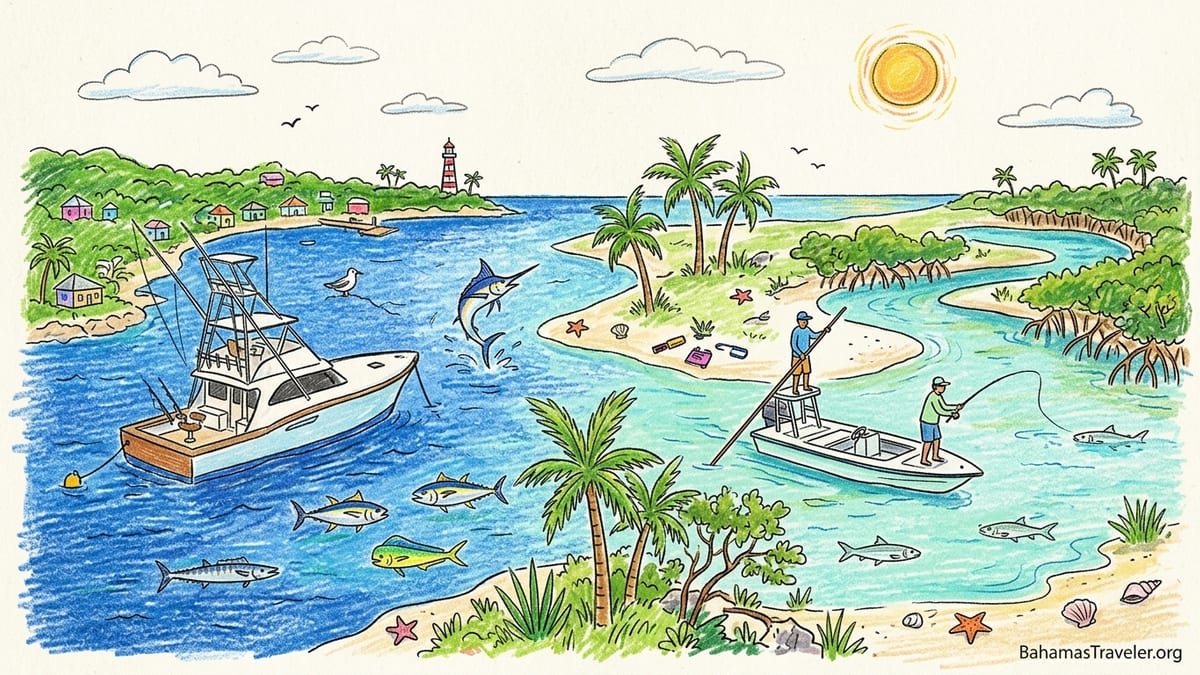
Before You Book: 2026 Permit Rules, Catch Limits, and What Captains Expect
If you are fishing on a Bahamian-owned charter boat with a licensed captain, the operator typically handles the practicalities, but the rules still matter because they shape what you can keep, what must be released, and what tackle styles are allowed. The Bahamas’ sportfishing regulations and official fishing FAQs repeatedly emphasize hook-and-line angling and clear catch limits for what may be on board at any time on a licensed sportfishing vessel.
The catch limits most travelers actually run into are the combined pelagic limit and the “always-release” billfish rule. The official guidance lists a maximum of 18 pelagic fish total on board (any combination of dolphin or mahi-mahi, wahoo, kingfish, or tuna). Billfish are a different category: outside of an approved tournament, marlin, sailfish, and swordfish must be returned to the sea unharmed. That matters because “we want a marlin for dinner” is not the plan in most Bahamian day charters. A good crew will set expectations early and shift your “meat” target list to tuna, wahoo, mahi-mahi, or deep-drop species depending on season and sea state.
Flats fishing has its own layer. The Bahamas has formal flats guide licensing rules, and on-the-water etiquette is tight in high-demand areas. If you are booking bonefish, permit, or tarpon, choose a guide who is clearly operating as a professional flats guide. For travelers, the practical point is simple: book your guide first, then build the rest of the trip around the tide window and wind forecast, not the other way around.
Rates and inclusions vary wildly, and the fine print can be the difference between a stress-free trip and a surprise bill. “Bare boat” can mean you pay extra for fuel, ice, bait, and even lunch. Meanwhile, higher-end operations often bundle tackle, water, and a mate who is there to keep lines clean and beginners comfortable. When you compare quotes, ask for what is included in writing: fuel or fuel surcharge, bait, ice, fishing gear, licenses, lunch, and how many anglers are included before per-person add-ons.
Bimini: Marlin Edges, Tuna Runs, Wahoo Sprints, and Legit Bonefish Water
Bimini is the closest Bahamas island to the U.S., and the fishing style reflects that speed and access. The island has a big-game identity, and official destination material leans hard into record history, with more than 50 record-setting catches associated with Bimini. Whether you chase that legacy or just want a high-odds day for pelagics, the core advantage is simple: deep water is close, runs are short, and weather windows can be used efficiently.
For a resort-based, easy-to-book offshore day, Bimini Big Game Club and Resort has an on-site charter partner operating a 50-foot sportfisher named Jezebel. The boat is described as carrying heavy Penn tackle for marlin and lighter gear for tuna, sailfish, wahoo, king mackerel, and mahi-mahi, plus electric reels for deep-drop fishing. The resort lists trips in 4-, 6-, and 8-hour formats, with prices starting from $1,200 for bare boat. Translation for travelers: that starting number is the floor, not the real all-in, and you should ask exactly what “bare boat” includes that day, especially bait, fuel, and lunch.
If you want a more curated, “vacation plus fishing” setup that is priced like a private experience, some Bimini operators sell multi-day VIP style packages. FishingBooker listings in fall 2026 show multi-day trips priced in the mid-$4,000s per day range for an entire boat (for example, 2-day and 3-day VIP trips advertised around $4,150 to $4,450 per day for up to four people, with per-person add-ons after that). That is a different product than a standard day charter: you are paying to remove friction, build in flexibility, and keep chasing the weather window.
For travelers who care as much about the boat as the bite, there are also high-end, overnight-capable options like Bimini4Fish, which advertises extended trips aboard “No. 7” starting at $6,795 per day, including captain, gear, tackle, and onboard amenities. This is the kind of booking I recommend when you have a short calendar and a big species wish list. The practical value is not that it guarantees fish, it is that you can change the plan midstream, run farther if conditions allow, or pivot to deep-drop when the surface bite is slow.
Bonefish in Bimini is real, and it is not just a “bonus day.” Local destination information highlights Bimini natives who guide specifically for bonefish and build days around stalking fish on flats and in mangrove creeks. If you are traveling with mixed experience levels, Bimini is one of the few places in the northern Bahamas where you can realistically split the party: one group does a morning offshore charter and the other does a flats session with a skiff or wade plan, then you meet back for dinner without turning it into a logistical expedition.
Abaco: The Lodge I’d Rebook for Flats Fishing, Plus How to Add Offshore Days
If you want a dedicated flats program with polished logistics, Abaco Lodge is one of the most straightforward “book it and you are fishing” answers in the region. The lodge sits on Great Abaco with direct access to the Marls of Abaco, a huge expanse of shallow-water habitat that is exactly what serious bonefish travelers come for. What makes this kind of lodge worth it is not just fish, it is the rhythm: breakfast, skiff departure, a guide who reads wind and light for a living, then a repeatable plan that does not depend on you renting a car or finding ice.
For 2026 pricing, Abaco Lodge publishes peak-season package rates (January to July 2026) at $8,350 per person for 7 nights and 6 days of fishing on a shared room and shared boat basis, plus 10% government tax. The lodge also lists shorter packages down to 3 nights and 2 fishing days, and it spells out inclusions clearly: accommodations, transportation between the lodge and Marsh Harbour, meals and beverages with an open bar, fishing license, professional guide services, and loaner rods, reels, and lines. That “loaner equipment” line matters if you are bringing a spouse or friend who wants to try fly fishing without investing in a full travel rod lineup.
Logistically, Abaco Lodge reads like it was designed by someone who has watched anglers lose half-days to airport transfers and check-in times. The lodge publishes check-in after 4 p.m. and check-out before 10 a.m., and it offers optional half-day or full-day fishing on arrival and departure days at per-boat rates (the lodge lists $850 per boat for a half day and $950 per boat for a full day, plus tax). This is one of the easiest ways to squeeze “one more tide” out of a trip without forcing a full extra night.
Species-wise, treat Abaco Lodge as a bonefish-first trip with realistic shots at permit and tarpon depending on conditions. The lodge’s program is skiff-based and optimized for anglers who want a guide calling shots in the wind. Abaco also gives you a clean “add-on” offshore option: multiple travel partners and lodge descriptions note the lodge can coordinate offshore days with local captains for marlin, sailfish, dorado, wahoo, or tuna depending on season, at an additional charge. The key is to book those offshore days early, because the best boats do fill up, especially around holiday weeks and tournament seasons.
Berry Islands and Chub Cay: Billfish Water Close to the Dock
If your mental picture of Bahamas fishing is a marina exit followed by instant blue water, the Berry Islands deliver that feeling better than almost anywhere else in the country. Chub Cay brands itself as the “Billfish Capital of the Bahamas” and anchors that claim in geography: it sits near “The Pocket,” with deep water close enough that the resort talks about billfish, wahoo, mahi, and tuna being effectively next-door. This is the kind of place where a “short run” is not a compromise, it is the point.
Chub Cay is also unusually clear about offering both big-game and flats options, which matters for groups. On the flats side, the resort advertises bonefishing half-day and full-day charters at $550 and $750, respectively. Those numbers are valuable as real-world benchmarks even if you do not stay at the resort: in the northern Bahamas, a guided flats day often lands in the same neighborhood once you add up boat, guide, and logistics.
Tournament culture is part of the Chub Cay identity, and it can be a feature or a bug depending on your travel style. The resort publishes a 2027 tournament schedule with entry fees per boat (for example, events listed with $3,500 to $5,000 plus VAT). You do not need to fish tournaments to enjoy the area, but you should be aware that tournament weeks can change marina energy, restaurant availability, and the “quiet island” vibe. If your dream is a calm couples trip with one day of fishing, pick non-tournament dates. If your dream is to be around serious anglers swapping stories at the dock, a tournament week is exactly when you go.
One more practical note: regulations drive how a “billfish trip” looks here. Outside approved tournaments, all billfish must be returned to the sea unharmed. That is not a footnote, it shapes the whole day. When I evaluate a Chub Cay style booking, I prioritize crews who are excellent at the release process and who can pivot to “meat fishing” with wahoo, tuna, mahi, or deep-drop species when your group wants fillets for dinner.
Grand Bahama: The Easy-Logistics Pick for Flats or a Split Offshore Plan
Grand Bahama is often the most comfortable answer when your group is half anglers and half vacationers. The island’s Port Lucaya and Freeport areas have the broadest non-fishing infrastructure in the northern Bahamas, and that lets you build a trip where the fishing is serious but not the only pillar holding the itinerary up. It is also a strong “first Bahamas flats” choice because you can pair a guided day with a comfortable room, reliable dining, and simple transfers.
For a lodge-style, fishing-forward plan on Grand Bahama, East End Lodge publishes 2026 to 2027 package pricing (October 2026 through June 2027) with a 3-night, 2-days fishing package at $3,375 per person for shared room and shared boat, scaling up to 7-nights, 6-days fishing at $7,855 per person in the same shared setup. This is the sort of pricing that makes sense for anglers who want multiple guided days and a dedicated fishing property, rather than piecing together guides while staying at a general resort.
For a hotel-based program with maximum spouse and family convenience, H2O Bonefishing is widely sold as a Port Lucaya-area package. Orvis lists 2026 season pricing in a menu of short stays (for example, 3 nights and 2 days fishing priced at $1,973 per person for two anglers sharing a room and guide, with upgrades for private room and private guide). That is a meaningful “real-world” option if you want guided flats fishing but your group also wants to walk to restaurants, beaches, and shops after you rinse the salt off.
If you also want an offshore day, Grand Bahama can do it, but you should treat it as a weather-dependent add-on rather than the main event, especially if the group is beginner-heavy. The island sits near extensive flats and also has access to deeper water, but the deciding factor is often wind and sea state. When the wind is up, flats fishing can be sheltered and productive while offshore becomes an endurance test. When conditions are calm, a split plan can be ideal: one day stalking bonefish, one day trolling or deep-dropping for dinner.
Seasonal Patterns and How to Match Islands to Species (Without Overpromising)
In the northern Bahamas, the best trips are the ones built around what the island does naturally well in that season. Bimini is the most consistent “offshore first” choice because deep water and strong current edges are close. If you are prioritizing tuna, wahoo, and the possibility of marlin or sailfish action, Bimini is a smart base because run times are typically short and crews can spend more time fishing and less time commuting.
Abaco is the opposite: it is a flats-first island where the quality of the experience comes from the size of the habitat and the guide program, not from sprinting to an offshore edge. Bonefish is the backbone, and Abaco Lodge is set up to make that repeatable day after day. Offshore days can be added, but if your primary goal is multiple days of bluewater trolling, Abaco is rarely the most efficient anchor point compared with Bimini or the Berry Islands.
The Berry Islands and Chub Cay are the “close-to-deep-water” answer when you want to feel like a big-game angler without committing to long runs. This is also where you can satisfy a mixed group: a serious offshore team can chase pelagics while another pair books a flats half-day. Just remember the billfish rules and plan on releasing marlin and sailfish outside tournaments.
Grand Bahama shines when the trip must work even if you fish only one or two days. It is the island where you can say, “We are going to do a full flats day, eat well, shop, snorkel, and still feel like we had a vacation,” without forcing everyone into lodge dining times or remote transfers.
The Takeaway
If I had to book again for a short, high-impact trip focused on offshore variety, I would start in Bimini and choose the charter style that matches my priorities: a straightforward 4- to 8-hour sportfisher day via a resort partner if I want convenience, or a higher-end multi-day operator if my goal is to keep moving until we find clean water and the right current edge. If the trip’s purpose is flats fishing with real structure, Abaco Lodge is the simplest rebook because the packages publish clear inclusions, the guiding is the point, and the marls are a destination in themselves.
When billfish is the dream and you want that “minutes from the dock” offshore feeling, I would build around the Berry Islands and Chub Cay, and I would go in with a release-first mindset plus a backup plan for wahoo, tuna, mahi, or deep-drop species for dinner. For families or mixed groups that need amenities and non-fishing options to be excellent, Grand Bahama is the practical win, with pricing and packages that make sense for a one-to-three day flats add-on rather than a full-on remote lodge week.
Across all four areas, the booking strategy is the same: confirm what is included, build at least one flex day for weather, and treat any billfish plan as a catch-and-release experience unless you are in an approved tournament. Northern Bahamas fishing can feel effortless, but the best trips are the ones where you choose the island for the species and the experience, not just the Instagram color of the water.
FAQ
Q1. Do I need a fishing permit as a tourist in the Bahamas?
It depends on how you fish. On a Bahamian-owned licensed charter, the operator typically handles requirements. If you are using a foreign-owned vessel, you generally need a sportfishing permit before fishing.
Q2. Can I keep a marlin in the Bahamas if I catch one?
Outside of an approved tournament, billfish such as marlin, sailfish, and swordfish must be returned to the sea unharmed.
Q3. What is the pelagic catch limit I should know for a boat trip?
The official guidance commonly cited for sportfishing vessels is a maximum of 18 pelagic fish total on board at any time, in any combination of mahi-mahi, wahoo, kingfish, or tuna.
Q4. Is Bimini good for both offshore and bonefishing in the same trip?
Yes. Bimini is set up well for a split itinerary because deep water is close for offshore trips and there are established flats and guides for bonefish-focused days.
Q5. What does “bare boat” mean on Bimini charter pricing?
It usually means the listed price is for the boat and captain, with common extras potentially including fuel, bait, ice, lunch, and gratuity. Always ask for a full included list before you pay a deposit.
Q6. What is a realistic all-in flats package option on Abaco?
Abaco Lodge publishes 2026 packages that include lodging, meals, open bar, transportation to Marsh Harbour, guide service, fishing license, and loaner rods and reels, with government tax added.
Q7. Why do anglers talk about Chub Cay as a billfish hub?
Because the Berry Islands bank drops into deep water near Chub Cay, putting offshore structure close to the marina and making it possible to be fishing quickly after departure.
Q8. Can beginners do a flats day on Grand Bahama without staying at a remote lodge?
Yes. Grand Bahama has hotel-based fishing programs sold as packages, which can be easier for beginners who want comfort, simple transfers, and nearby restaurants after fishing.
Q9. Are half-day flats charters available at Chub Cay?
Yes. Chub Cay advertises both half-day and full-day bonefishing options, with published pricing for each.
Q10. How should I plan for weather on a Northern Bahamas fishing trip?
Build at least one flex day. If wind makes offshore uncomfortable, pivot to sheltered flats or shorter runs, and let the captain choose the safest plan for the conditions.