


I need to level with you up front: I cannot honestly claim firsthand swims, crowds, or wildlife sightings on specific Out Island beaches. What I can do, and what I did here, is build a swim-first beach guide the way I would plan my own return trip: by cross-checking current national-park rules, locally published access notes, and the most consistent, repeatable details about sand, entry, waves, and facilities. I’ll tell you where the water usually feels “made for swimming” (easy entry, predictable depth, fewer surprise currents), where it’s more of a photo-and-wade situation, and where you need to treat the ocean like it’s in charge (because it is). If you want the kind of Bahamas beach day where your shoulders unclench the second you step in, these are the Out Islands beaches I’d put at the top of the list.
Eleuthera and Harbour Island: Pink sand, real surf, and calmer bays
Harbour Island’s Pink Sands Beach is famous because it delivers on the basic, non-negotiable swim requirements: comfortable sand underfoot, a long shoreline so you can spread out, and water that often stays inviting even when the Atlantic side of other islands looks moody. The sand’s pink tone tends to read stronger when it’s dry and in angled light, but what matters for swimmers is texture: it’s typically fine and forgiving, the kind that doesn’t feel like it’s “scrubbing” your feet on the walk back to your towel. The entry is usually gradual, so you can ease from ankle-deep to waist-deep without that sudden shelf that can knock you off balance when a set rolls in.
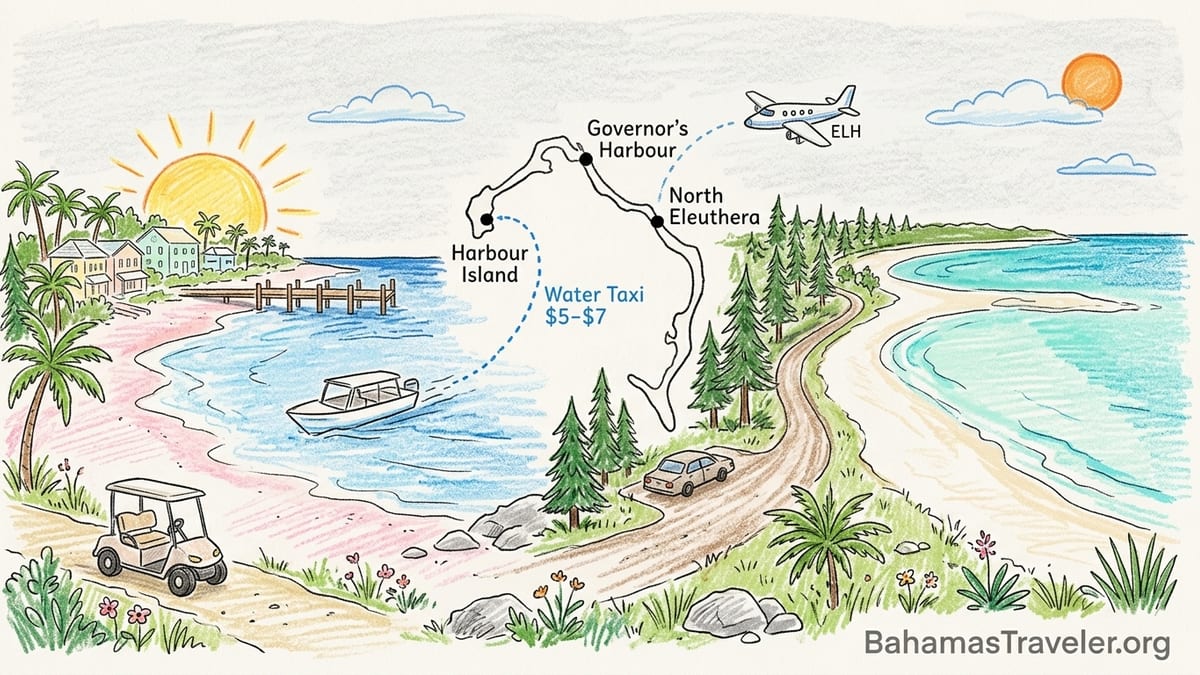
Getting there is part of the Harbour Island rhythm. The most commonly published, practical route is flying into North Eleuthera (ELH), taking a short taxi ride to the dock (often described around $5 per person), then hopping the quick water taxi over to Harbour Island (commonly described around $5 to $7 per person, with boats generally running roughly 6:00 a.m. to 9:00 p.m.). Once you’re on the island, day-to-day transport is often by golf cart rather than car, which matters because it shapes where you’ll actually enter the beach and how much you’ll want to carry in one trip.
On mainland Eleuthera, I’d plan two very different swim styles: an Atlantic-side “big beach” and a protected bay. French Leave Beach near Governor’s Harbour is widely described as a long, open, pale sand beach (often with a subtle pink cast) with clear water that can shift quickly with wind and swell. When it’s calm, it’s the kind of place where swimming feels expansive, like you can pick a line parallel to shore and just keep going. When it’s windy, the same openness can translate into more chop and a rougher surface, which is still beautiful but less relaxing if your goal is a steady, easy float.
For a calmer, shallow-water swim day on Eleuthera, Ten Bay Beach is regularly described as a reliable “quiet water” option, with access typically involving a turn off the main road onto a dirt track to a small parking area. The appeal here is how the water often behaves: it tends to stay shallow farther out, so swimming can feel like drifting over a bright, sandy bottom rather than bobbing in deep water. If you travel with kids or anyone who wants to stand up often between dips, this is the kind of beach where the ocean gives you more second chances.
Exuma: Where the swim is gentle, and the rules are not optional
Exuma is where I plan beach time by “which side of the island” first, and “which beach” second. On many days, the bank side offers calmer, clearer shallows, while Exuma Sound can look like a different ocean, darker, deeper, and more energetic. That’s why Tropic of Cancer Beach on Little Exuma keeps showing up in serious beach conversations: it’s the archetype of pale, flour-fine sand meeting luminous water. As a swimming beach, it often feels best when conditions are mild and the entry is smooth. If the shore break is active, it can turn into a quick in-and-out dip rather than a long, lazy swim.
For an easygoing, shallow-water experience that’s more about wading, lounging, and cooling off than clocking laps, Coco Plum Beach (on Great Exuma) is frequently described as a low-tide favorite. The swim logic is simple: when the water is low, you can end up with wide, warm shallows that feel like a natural splash pad. When the tide fills in, you get more room to actually swim, but it’s still usually the kind of place where you’ll want to check tide timing if your personal definition of a beach day includes “fully submerged for more than 30 seconds.”
Exuma is also where you need to know the difference between a pretty shoreline and a protected marine space with strict enforcement. The Exuma Cays Land and Sea Park is explicitly a no-take zone: no fishing, no conching, no shelling, no lobstering, and nothing living or dead should be removed from within park boundaries. The park’s guidance also makes it clear there’s no trash disposal in the park, and anchoring is not permitted in mooring fields, on coral reefs, and in other designated areas. For boaters and jet ski users, the rules extend to speed and distance behavior, including idle speed in mooring fields and specific standoff distances for jet skis. Even if you’re “just here to swim,” the practical takeaway is that your best Exuma snorkeling and swimming often overlaps with protected habitat, and the privilege of that clarity comes with rules you cannot freestyle.
Closer to George Town, the Bahamas National Trust has also published specific rules effective February 13, 2024 for Moriah Harbour Cay National Park, including no extractive fishing of any kind (spearfishing, netting, trapping, hook and line), no-wake zones in shallow flats and mangrove creeks (with vessels advised not to exceed 3 knots), and holding tank use being mandatory within park boundaries. If your perfect beach day includes a sandbar stop, a dinghy ride, or paddling into mangroves, these details matter because they change what “normal” boating behavior looks like for the area.
Abaco: Sandbar drama, reef edges, and getting there by golf cart
The Abacos reward travelers who accept that “access” is part of the experience. On Elbow Cay, Tahiti Beach is routinely described as a palm-lined sandbar at the southern tip, and the most common practical approach is by golf cart down the island past White Sound, parking where the road ends, then walking a sandy path for roughly ten minutes. This matters for swimming because Tahiti Beach is as tide-shaped as it is beautiful. At the right tide, you get glassy shallows that feel like warm satin around your calves. At the wrong tide, it can become more of a spectacular wade than a satisfying swim, with the best moments happening at the sandbar’s edge where the color shifts from pale aqua to deeper turquoise.
If you’re eyeing Abaco for snorkeling, you’ll keep hearing about the barrier reef and nearshore reef pockets that can be reachable from beaches on cays like Great Guana Cay. A practical caution, though: reef-adjacent swimming is not the same as “easy beach swimming.” Coral and rock mean you may want water shoes, and channels and cuts can concentrate current. The swim can feel exhilarating, but it’s not a place to assume you can casually drift wherever you like and simply wander back in when you’re done. This is also where the Bahamas National Trust’s broader anchoring guidance matters: their bylaws include restrictions against dropping anchors where damage to coral, seagrass, or other seabed organisms is likely.
When Abaco beaches work as swimming beaches, they tend to work in a very specific way: shallow, bright water over sand, with a comfortable entry that doesn’t demand you time your steps between sets. Treasure Cay Beach on Great Abaco is widely cited as one of the long, white-sand stretches built for that kind of uncomplicated swim. The best practical plan is to treat Abaco swims like a “two-stop day,” with one beach chosen for pure, easy water time and another chosen for reef texture, even if the second is more of a snorkel session than a classic swim.
Cat Island: The quiet-beach advantage (and why it changes the swim)
Cat Island is the kind of place where your swimming experience is often defined by what is not there: fewer vendors, fewer boats idling offshore, fewer last-minute crowds that compress everyone into the same patch of shade. That quiet changes how a swim feels. Instead of the subtle tension of staying aware of other swimmers and watercraft, you can settle into a slower rhythm, letting your breathing match the small pulse of shore water. On many Cat Island beaches, shade can be limited once you leave the immediate area of resorts or settlements, so the practical swim comfort move is bringing your own sun protection and not assuming there will be a convenient tree line exactly where you want to set up.
Cat Island sand can vary from powdery to slightly coarse depending on the stretch, sometimes with more visible shell fragments than you’ll see on the most manicured, postcard-famous beaches. For swimmers, that can be a plus: slightly firmer sand often means easier walking at the waterline and less “sink” underfoot when you’re carrying gear. The water, when calm, tends to deliver that Out Islands clarity people come for, but the island’s exposed sides can still pick up wind and swell, so choosing your beach on the day, not just on reputation, is the difference between a long swim and a quick dip.
Because Cat Island is less about checking off famous names and more about finding your own stretch, it’s also where I’d be most cautious about promising amenities. Many of the best-looking shorelines are exactly that: shorelines. If you need guaranteed bathrooms, food within a five-minute walk, or lifeguard-style oversight, you’ll want to base your beach time near a property that explicitly offers those services rather than betting on a remote beach access having infrastructure.
Long Island: The “walk-in and swim” beaches that feel like a reset
Long Island earns its beach reputation with stretches that look designed for long, easy entries: the kind where the first fifty steps are still ankle-to-knee deep, and the water’s color stays readable all the way out. Cape Santa Maria is often discussed in the context of the resort, but the underlying reason swimmers love that area is straightforward: soft, pale sand and typically calm water that makes it easy to get comfortable in the sea without fighting it. If your ideal swim includes floating for a long time, the experience you’re chasing is less “adrenaline” and more “buoyancy,” and calmer Long Island beaches can deliver that sensation better than more wave-exposed Atlantic strands.
On the more dramatic side of Long Island’s water geography, Dean’s Blue Hole is famous for depth, and that changes the feel of a beach day even if you never go near the deepest point. The nearby shallows can be inviting, but the psychological shift happens the moment the bottom drops away. Swimming stops feeling like strolling into a pool and starts feeling like entering a landscape. If you’re traveling with mixed comfort levels, this is a good place to split the day: let confident swimmers do their deeper-water sightseeing while others stay in the gentler shallows.
Long Island is also a good reminder that “best beach” sometimes means “best logistics.” When you can park, walk a short path, and be in swimmable water without a boat ride, a perfect tide window, or a long trudge carrying everything you own, you end up swimming more. And if the goal of this article is beaches I’d prioritize for swimming on a return trip, that convenience counts as a feature, not a compromise.
Bimini: The easy swim day, the cruise-day reality, and a beach that’s actually monitored
Bimini is close enough to Florida that it attracts quick-turn travelers, and that shows up most clearly at Radio Beach. Several local operators describe it as the busiest beach on Bimini and, importantly for swimmers, the one most associated with public-facing facilities like toilets, vendors, and snack bars. That infrastructure changes who uses it: families, day-trippers, and anyone who wants a lower-friction beach day. The water here is often described as calm and protected, which is exactly what you want when your beach day is less “expedition” and more “I want to swim for an hour and then eat something without planning a route.”
Radio Beach also stands out for something most Out Island beaches cannot offer: consistent public water-quality monitoring. Waterkeepers Bahamas, via the Swim Guide program, lists Radio Beach as being sampled on a bi-weekly schedule year-round. That does not replace common sense about weather and local conditions, but it’s a concrete, practical layer of reassurance if you like your swim plans backed by more than vibes.
The main Bimini caution is crowd energy. On high-traffic days, a beach can still be swimmable, but it may not feel restful. If you know you’re sensitive to loud music, dense chair setups, or the general “day party” atmosphere that can come with cruise calls, the smart move is choosing your timing and walking farther down the shoreline to create space. In other words: Bimini can be a genuinely good swimming island, but you may need to actively engineer the quiet.
The Takeaway
If I had to reduce the Out Islands to a swim strategy, it’s this: choose beaches that match the day’s conditions, not the daydream. Atlantic-facing shores can be unforgettable, but they can also turn a “long swim” into a “look, photograph, and retreat” experience when wind and swell arrive. The most reliably relaxing swims often come from protected bays, bank-side shallows, and beaches where the entry is gradual enough that you never feel rushed by the water.
The beach that tends to photograph better than it functions as a pure swimming beach is Tahiti Beach on Elbow Cay. It’s visually perfect, especially when the sandbar draws that curved line into bright water, but it can behave like a tide clock: sometimes it’s an all-time wading and floating spot, and sometimes you’ll wish you had planned your true swim somewhere with more consistent depth. The less-famous beach I would deliberately prioritize on a return trip, specifically for swimming time rather than bragging rights, is Ten Bay Beach on Eleuthera, because the protected, shallow-water style is the kind of comfort that keeps you in the water longer.
Finally, treat marine-park rules as part of your beach kit. In Exuma, that means respecting explicit no-take protections and operating rules in places like the Exuma Cays Land and Sea Park and Moriah Harbour Cay National Park. In Abaco and elsewhere, it means thinking about coral and seagrass under the surface before you drop an anchor, stand on a reef, or assume a cut is safe to drift through. The best Out Islands swims feel effortless. Keeping them that way takes a little homework and a lot of respect.
FAQ
Q1. When is the calmest time of year for swimming in the Out Islands?
Late spring and early summer often bring warm water and many calm days, while winter can add trade winds and more swell on Atlantic-facing beaches. Day-to-day conditions still matter more than the month.
Q2. Are beaches in the Bahamas public, even in front of resorts?
Many beaches are treated as public up to the high-water line in practice, but access paths and parking can be controlled. If a resort frontage feels gated, look for clearly marked public access points and be respectful.
Q3. What does “no-take” mean in Exuma’s protected waters?
In the Exuma Cays Land and Sea Park, no-take means no fishing and no removing anything living or dead, including conch and shells. Plan your beachcombing as “look, don’t take.”
Q4. Do I need to worry about boating speed in marine parks if I’m just swimming?
Yes, because no-wake zones protect swimmers, wildlife, and seagrass flats. In places like Moriah Harbour Cay National Park, slow-speed rules are part of the safety and conservation framework.
Q5. What’s the typical water taxi cost and timing for Harbour Island?
Commonly published guidance puts the water taxi around $5 to $7 per person each way, generally running roughly from early morning to around 9:00 p.m. Confirm on arrival because hours can shift.
Q6. Is Radio Beach in Bimini a good choice if I want bathrooms nearby?
It is often described by local operators as the best bet for public-facing facilities like toilets and vendors. It’s also the beach most associated with higher crowds, especially on busy days.
Q7. Which beaches are more “wade-friendly” than “swim-long” beaches?
Tahiti Beach (Elbow Cay) and Coco Plum (Exuma) are often at their best as tide-shaped shallows where you wade, float, and cool off, especially around lower tides.
Q8. Do I need water shoes in the Out Islands?
On pure sand beaches like Pink Sands or many Long Island strands, you often won’t. Near reefs, rock, or ironshore, water shoes can prevent cuts and make entries less stressful.
Q9. How can I avoid dangerous currents around cuts and reef passes?
Don’t treat cuts like casual swimming lanes. If a spot is known for flow between cays, swim parallel to shore in protected water instead, and ask locals about the day’s current before entering.
Q10. What should I pack for remote beaches with no services?
Bring more water than you think you need, sun protection that creates shade, a small first-aid kit, reef-safe sunscreen, and a plan for trash. In protected parks, assume there is no on-site disposal.