


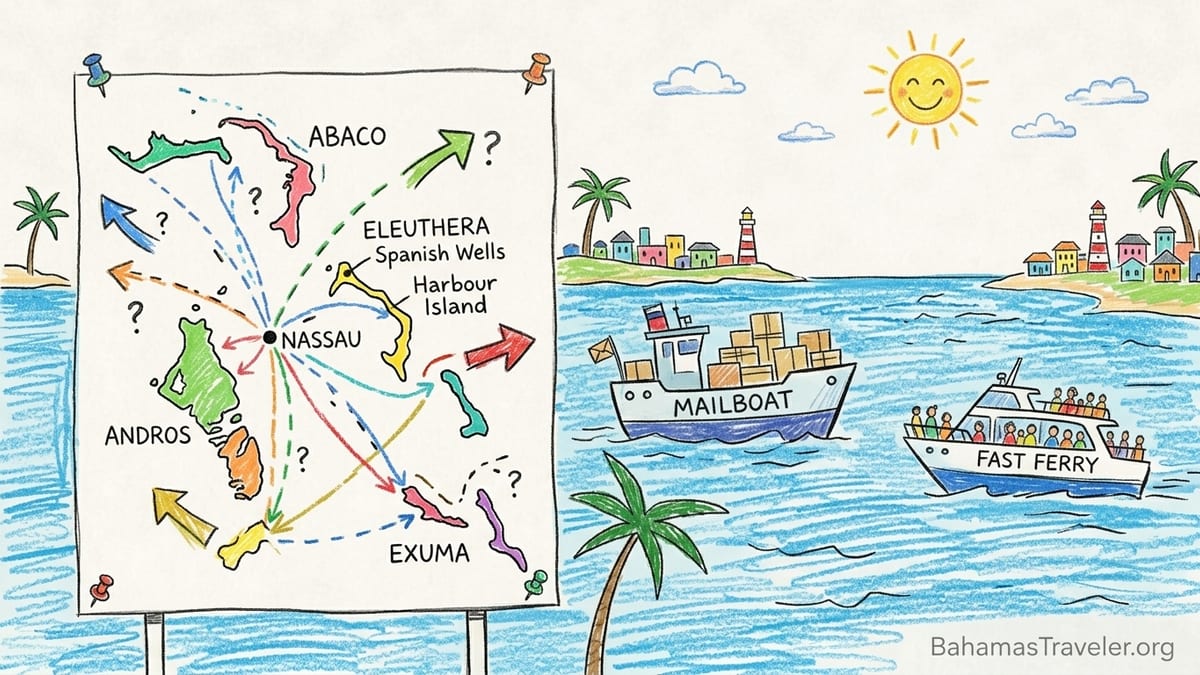
The Bahamas looks like an easy connect-the-dots vacation until you try to hop islands the way locals move freight, groceries, and family around the Out Islands. On a map, Harbour Island seems close to Exuma, Andros looks like it should be a quick boat ride from Nassau, and Abaco appears made for day trips between cays. In reality, island hopping by ferry, mailboat, and local cay runs is a chain of early mornings, limited sailing days, weather calls, dock confusion, and hours lost to transfers. This is a practical, dock-level look at what it takes to travel between islands by water, and why official guidance still steers many multi-island itineraries back through Nassau.
Why Out Island ferry hopping feels harder than the map suggests
The first mistake most travelers make is assuming the Bahamas works like a single ferry network, the way some island nations do. It does not. What exists is a patchwork: one well-known high-speed passenger route from Nassau to North Eleuthera’s Spanish Wells and Harbour Island, a handful of local cay ferries that behave more like commuter boats, and mailboats that are primarily freight lifelines with a few passenger spaces depending on the vessel and the day.
The second mistake is expecting frequency. A route that looks “major” can run only a few days a week. Bahamas Ferries’ high-speed passenger vessel M/V Bo Hengy III, for example, publishes service only on Wednesday, Friday, and Saturday, with a check-in window early in the morning and a same-day return that dictates your entire day. That is not a gentle island day trip schedule; it is an all-day travel block.
The third mistake is expecting direct connections between neighboring-looking islands. In practice, many multi-island journeys still require connecting through Nassau because the national hub structure is real. Air schedules, boat departures, and even where mailboats stage and load are heavily oriented around New Providence. If you are trying to string together Abaco, Eleuthera, and Exuma by water, your “simple triangle” can become a set of spokes that keeps pulling you back toward Nassau or toward the nearest functioning air link.
Nassau’s Potter’s Cay Dock: the real starting line (and time sink)
In Nassau, water-based island hopping typically begins around Potter’s Cay Dock, the working dock tucked under the bridges that connect Nassau to Paradise Island. It is not a resort marina. It is where mailboats, freight, and local commerce overlap with passengers who are hoping for an inexpensive, romantic “sea route” to the Out Islands.
Even when your sailing time looks reasonable, the dock timing is where the day starts to disappear. Bahamas Ferries publishes a check-in window of 6:45 a.m. to 7:45 a.m. for its Spanish Wells and Harbour Island service, with an 8:00 a.m. departure. That means your morning is decided before the sun is fully up. If you are staying on Paradise Island or Cable Beach, you are building in a taxi ride and buffer time on top of that, because missing a sailing that runs only a few days per week is not like missing a subway.
Ticketing and check-in also vary by boat type. High-speed passenger services are structured like a transportation business: fares, add-ons, seating upgrades, change fees, and set windows. Mailboats are different. Schedules can be weekly, the trip can be long, and the passenger experience may be secondary to cargo. On some mailboat days, you may find yourself doing more “asking at the dock” than you expected, including confirming which boat is actually running and whether passengers are being taken that trip.
The practical reality is this: even before you set foot on a boat, you can lose a large piece of your day to showing up early, waiting, and absorbing the uncertainty that comes with weather-permitting travel. Bahamas Ferries itself highlights that schedules are weather-permitting, and its alerts and notices emphasize checking for route modifications or cancellations before you travel.
The most defined Out Island ferry route: Nassau to Spanish Wells and Harbour Island
If you want a published, passenger-first ferry experience from Nassau into the Out Islands, Bahamas Ferries’ M/V Bo Hengy III is the clearest current option on the books. The company publishes an 8:00 a.m. departure from Nassau, arriving Spanish Wells at 10:10 a.m., departing Spanish Wells at 10:25 a.m., and arriving Harbour Island at 11:10 a.m. The return departs Harbour Island at 3:40 p.m., reaches Spanish Wells at 4:10 p.m., and returns to Nassau at 6:30 p.m.
Those times are a perfect illustration of why island hopping is “a whole day” even when the boat ride is not extreme. With the required early check-in window, you are essentially committing the full daylight block to transit. You arrive late morning, you turn around mid-afternoon, and you are back in Nassau after dinner time. That can be ideal for a structured day trip, but it is also a trap if you expected to arrive and still have a wide-open day for beach time, errands, or a leisurely rental car pickup.
Pricing also changes how you think about “ferry as the budget option.” Bahamas Ferries publishes an adult one-way fare of $139 and an adult round trip of $257 between Nassau and Spanish Wells or Harbour Island, with child fares listed separately. It also publishes add-ons and fees that matter in real life, including a voyager cabin upgrade, preferred table seating, ticket change fees, and specific charges for extra luggage per piece, plus charges for bringing small or large dogs and for bicycles. The fine print of island hopping is often a luggage conversation, not a geography one.
Onboard comfort is one reason travelers choose this route, but it also comes with sea reality. This is open-water travel, and “weather permitting” is not a slogan. In trade winds or winter fronts, sea conditions can turn a fast morning into a bouncy one. If you are prone to seasickness, your seating preference stops being about the view and becomes about stability and hydration, and you should plan your day in Spanish Wells or Harbour Island with that in mind.
Harbour Island and Spanish Wells: the short hops that still eat your day
Harbour Island and Spanish Wells are close enough that they tempt travelers into over-planning: “I’ll do both, plus Eleuthera, plus a beach stop.” The ferry schedule argues otherwise. Bahamas Ferries even publishes a separate inter-island fare for Spanish Wells to Harbour Island only, listing $47 adult one way and $77 adult round trip. That is useful, but it also signals something important: once you arrive, you are often shifting into a different, more local transport rhythm, and each shift costs time.
In real-world terms, arriving at Harbour Island around 11:10 a.m. still leaves you needing to get from the dock into Dunmore Town and on to wherever you are actually going, often via taxi or a rented golf cart. Harbour Island is famous for Pink Sands Beach, but the island’s everyday transport culture is small-vehicle and short-distance, which is charming and also surprisingly time-consuming when you are trying to beat a 3:40 p.m. departure back out.
Spanish Wells has a similar feel. It is compact, navigable by golf cart, and oriented toward a working community and marina life. That makes it a rewarding stop, but it also means your “arrival” is not the same thing as being “settled.” If you want to rent a cart, coordinate a pickup, buy supplies, or simply find lunch, your usable time compresses quickly between docking and whatever return or onward boat you are aiming for.
This is also where many travelers learn another quiet truth: a lot of “neighbor islands” are not connected the way you assume. From Harbour Island, getting to other island groups by sea is not typically a direct ferry proposition. For many itineraries beyond Eleuthera’s immediate neighborhood, the practical move is still to go back through Nassau by scheduled service, or to switch modes to flights or charter boats once you have reached an Out Island hub.
Mailboats: Andros and Cat Island by sea is possible, but not casual
Mailboats are the Bahamas’ original logistics system, and they still matter. They are also where travelers get into trouble when they assume “mailboat” means “daily ferry.” Some routes operate weekly, and schedules can change with weather, demand, maintenance, or the realities of freight. Institutions on the Family Islands openly describe mailboats as vital, operating weekly or bi-weekly out of Potter’s Cay Dock, and emphasize that they are core to commerce, education, and healthcare.
For Andros, one example of how freight-focused these services can be is the way schedules are discussed publicly. A North Andros institution notes weekly departures from Nassau (Potter’s Cay Dock) to Morgan’s Bluff on named vessels, including President Taylor taking freight on Wednesday with early morning arrival and returning Thursday, and Central Andros Shipping’s M/V Capt. Prince taking freight on Friday with an early morning arrival and returning Sunday. That kind of timing is excellent for a freight pipeline, but it is a warning label for tourists trying to do a quick hop.
Cat Island is another classic “looks easy, actually hard” route if you insist on traveling by sea. A Cat Island resort notes that mailboat service from Nassau’s Potter’s Cay Dock to Smith’s Bay Dock exists, but is generally once a week, often on Thursdays, and advises checking with the dock master because schedules can change. A local Cat Island visitor guide also notes that mailboats operate between Nassau and the island, naming boats and docking points, and emphasizes that it takes a long time and depends on weather.
The main lesson with mailboats is not that they are impossible. The lesson is that they are not designed around a tourist’s clock. If you have a fixed-length vacation, a hotel check-in time, or a plan that assumes you will “pop over” for a night, mailboat travel can quietly force you into multi-day buffers. It is one of the biggest reasons multi-island itineraries still funnel through Nassau by air for reliability, even when the sea route looks like it should be the authentic option.
Abaco and Exuma: local cay ferries, cancellations, and the myth of “next island over”
Once you are inside an island group, the local ferry ecosystem becomes your best friend and your biggest variable. Abaco is a good example because the cays demand small-boat connections. One well-known operator’s published schedule shows just how commuter-like these runs can be, with Marsh Harbour to Hope Town departures spread through the day, plus separate runs from Red Bay Marina to Great Guana Cay and to Baker’s Bay. The same operator publishes simple, local-style fares like $15 adult one way and $25 adult round trip on certain routes, with open-return language that feels refreshingly non-airline.
But Abaco is also a reminder that you must confirm who is actually running what. Local sources and community information can conflict with operator pages, and service patterns can change after storms, ownership changes, or shifting demand. Another Abaco source has noted that a different provider may be the relevant schedule for certain cay routes, and a local ferry service’s public updates show real weather-driven decisions, including canceling runs to specific cays when high winds are forecast. That is island hopping in the real world: the sea makes the final call, and sometimes the “neighbor island” is a tomorrow problem.
Exuma adds a different dimension: connections that feel like ferries but operate more like a scheduled small craft. The Sheep Runner Ferry, for instance, publishes a regular 1.5-hour journey linking George Town, Exuma and Long Island’s Salt Pond area, with service on Mondays, Wednesdays, and Fridays. Its published schedule includes a 7:30 a.m. departure from Long Island Harbour Club arriving George Town Government Dock around 9:00 a.m., and a 3:00 p.m. return from George Town arriving Long Island around 4:30 p.m. It also notes that in inclement weather the captain may dock at Harry Cay rather than cancel, shifting your arrival point and adding a road transfer.
Details like luggage allowances and booking rules are where the day disappears. Sheep Runner notes booking and payment in advance, a requirement to arrive at the dock before departure, and an included luggage allowance with additional parameters. It even warns that this is open-water travel with natural boat motion and that passengers must remain seated while underway. This is not meant to scare you off. It is meant to remind you that “a short crossing” still needs planning, and that every extra transfer, taxi ride, and dock change can erase the afternoon you thought you had.
The Takeaway
Island hopping in the Bahamas is absolutely worth doing by water when it lines up with how the country actually moves: hub-and-spoke from Nassau, tight local networks inside an island group, and mailboats that exist first to move freight. The frustration starts when you plan by proximity alone. Two islands that look close can be separated by a missing schedule, a weather cancellation, or a route that only runs on certain days.
If you want the most straightforward passenger ferry experience from Nassau, build around the published Bahamas Ferries Bo Hengy III schedule to Spanish Wells and Harbour Island, and treat it like an all-day commitment with early check-in and a fixed return. If you want to lean into the local side, use cay ferries in places like Abaco, but confirm the current operator and expect cancellations when wind rises. And if you want to try mailboats to places like Andros or Cat Island, plan generous buffers and confirm sailing details at Potter’s Cay Dock before you commit hotel nights and onward connections.
Most importantly, decide what you are optimizing for. If it is maximum islands in minimum days, you will likely end up back in Nassau for connections and you may prefer flights for reliability. If it is the feeling of the Bahamas as an archipelago that still runs on docks, schedules taped to windows, and boats that wait for weather, then slow down, pick fewer islands, and let the sea route be part of the story, not a hurdle you are trying to outrun.
FAQ
Q1. Do ferries run every day between Nassau and the Out Islands?
Not necessarily. A key example is Bahamas Ferries’ M/V Bo Hengy III, which publishes Nassau to Spanish Wells and Harbour Island service only on certain days of the week, with an early morning check-in window. Other water options, especially mailboats, may run weekly rather than daily and can change with weather.
Q2. Where do most Nassau ferries and mailboats depart from?
Many sea departures in Nassau are associated with Potter’s Cay Dock, the working dock area under the bridges to Paradise Island. It is also a common staging point for mailboats serving Family Islands. Because services can shift, confirm the exact slip and check-in location with your operator before travel day.
Q3. Is the Nassau to Harbour Island ferry a quick day trip?
It can be a day trip, but it is rarely a short one. The published schedule includes early morning check-in, late-morning arrival to Harbour Island, and a mid-afternoon return that gets you back to Nassau in the evening. In practice, that timing means much of your day is structured around transit rather than free exploration.
Q4. How much are tickets on the Nassau to Spanish Wells and Harbour Island fast ferry?
Bahamas Ferries publishes adult fares of $139 one way and $257 round trip between Nassau and Spanish Wells or Harbour Island, with separate child fares. It also publishes add-on fees such as preferred seating, cabin upgrades, change fees, and extra luggage charges. Always re-check current pricing before booking.
Q5. Can I travel between Spanish Wells and Harbour Island by ferry without going back to Nassau?
Yes, at least on days when the Nassau service is operating. Bahamas Ferries publishes inter-island fares specifically for Spanish Wells to Harbour Island only, including an adult one-way fare of $47 and an adult round trip of $77. This is useful if you are staying within North Eleuthera’s neighborhood rather than treating Nassau as the hub.
Q6. Are mailboats a realistic option for tourists going to Cat Island or Andros?
They can be, but only if you plan for uncertainty and time. Public travel guidance for Cat Island notes that mailboat service is generally once per week and recommends checking with the dock master because schedules can change. For Andros, publicly shared information emphasizes weekly freight runs that do not operate like daily passenger ferries.
Q7. Is there a ferry from Nassau to Exuma?
As of the most clearly published passenger ferry information available to travelers, the best-defined high-speed passenger route out of Nassau is focused on Spanish Wells and Harbour Island. Exuma is commonly accessed by scheduled flights, and sea options may be charter-style, freight-oriented, or route-specific within the islands rather than a simple daily Nassau passenger ferry.
Q8. What local ferry examples exist once I am already on an Out Island?
Abaco is a classic case: local schedules show frequent short runs linking Marsh Harbour with cays like Hope Town and Great Guana Cay, with simple local fares and multiple departures on some days. Exuma has its own sea links too, including a published scheduled service connecting George Town and Long Island on specific weekdays.
Q9. How often do weather delays or cancellations actually happen?
They happen often enough that operators build them into their public messaging. Bahamas Ferries states that schedules are weather-permitting and that passengers may be rescheduled for the next available sailing if conditions prevent travel. Local ferry services also publicly cancel specific cay runs when high winds make crossings unsafe.
Q10. What is the single biggest planning mistake for Bahamas island hopping by sea?
Planning by distance instead of by schedules. A short-looking crossing may only be available on certain days, may require an early check-in, or may be vulnerable to wind-driven cancellations. Build your itinerary around published departure days and times first, then choose hotels, rentals, and activities that fit the transportation reality.